


 Locations


On September 30th, 2024, the format of Commander changed forever. The group that oversaw Commander as a format turned control over to Wizards of the Coast. With this changing of the guard came a brand-new way to evaluate the power level of a particular deck in what is now called the Bracket System.
In this article, we will go over what the power level system originally was, what it is now, and we will dive into what types of experiences these Brackets are producing in real games.
By understanding the Brackets, it becomes much easier to find a fair fight in Commander games when playing with people you don't already know, especially in more open environments like local game stores, conventions, or larger community meetups.
Before the Brackets
Originally, we had what were called Power Levels. This was a way of evaluating how strong a Commander deck was on a scale from one to ten. Ten represented the top-competing cEDH decks, while one would be a pile of random cards with very little synergy holding it together.
Each number came with an explanation of what a deck at that level was realistically trying to accomplish. This was how players aligned expectations as best as possible before sitting down to play a game.
The issue with this system was that it required a strong understanding of the game and what Commander decks are capable of doing at different levels of play. It wasn't easy for a newcomer to comprehend at all.
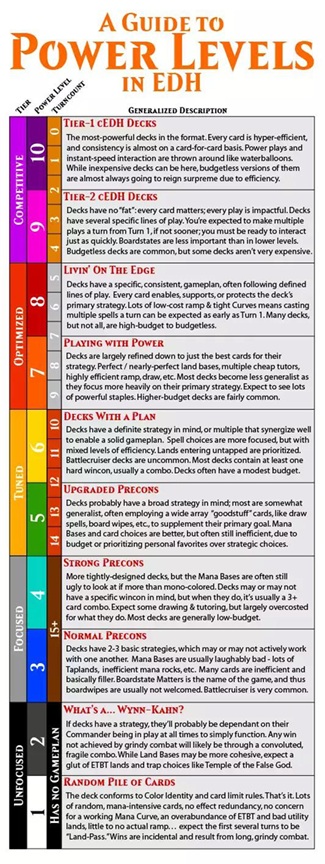
We would consistently see players from smaller, more casual playgroups use an updated precon and believe it to be stronger than it actually was based on their local experience.
Inversely, players from more competitive playgroups would often see their decks as much weaker than they were because their baseline for comparison was so much higher. This back and forth created the long running joke of "everything is a seven."
This meant that nearly every deck, when being evaluated, would be placed at level seven regardless of its actual strength. Players didn't think their deck was cEDH, but they also didn't want to undersell themselves as a five or six and risk being outmatched at the table.
These levels also had very few concrete examples of what a deck at a particular level would look like outside of personal experience, which made it even harder for newer players to participate in these conversations in a meaningful way.
That lack of clarity and consistency became the main jumping off point for the Bracket System as a whole.
The Bracket System Explained
Instead of using a scale from one through ten, the numbers were consolidated into Brackets one through five. Bracket 1 contains the weakest decks, while Bracket 5 is reserved for cEDH tournament-level decks.
We also now have specific examples of deck elements to watch for at each level, like chaining extra turns together, stax effects, and the newly created Game Changers. These are specific cards that tend to warp a game around them in some capacity and can dramatically increase a deck's overall impact on a table.
While reviews have been mixed, the consensus is that the Bracket System has been helpful in pregame conversations, especially for players who are meeting for the first time or playing outside of their usual groups.
The latest updates to the Bracket System were in October 2025, so things have been steady for a while apart from the regular bans.
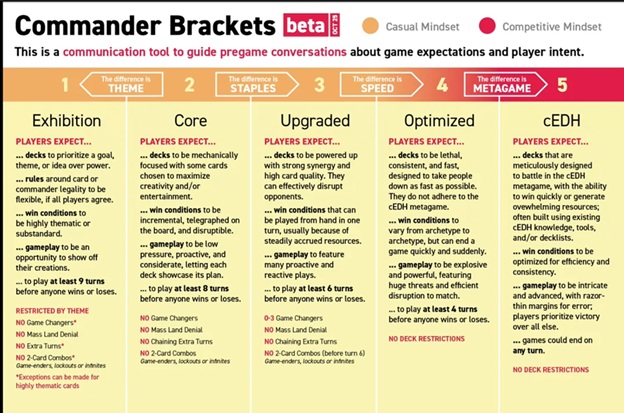
But what are these Brackets like in practice?
Let's go through each Bracket to get a better understanding of what they really represent and how they feel in an actual game setting.
Bracket 1
If Bracket 5 is hyper competitive, Bracket 1 is hyper casual. This Bracket is about themes and memes, building decks for flavor rather than victory, or in some cases, even functionality. The best comparison for this Bracket is the concept of art.
One person's masterpiece may not connect with someone else in the same way, and that is perfectly fine in this space. These decks push the limits of theme, factoring in things that other Brackets tend to ignore, like artwork, flavor text, and character lore in deck construction.
The most up-to-date definition makes that very clear:
Players expect:
- Decks to prioritize a goal, theme, or idea over power
- Rules around card legality or viable commanders to have some flexibility depending on the pod
- Win conditions to be highly thematic or substandard
- Gameplay to be an opportunity to show off your creations
Games in this Bracket are expected to last, often reaching at least nine turns before a winner is decided. That extra time is intentional. The focus here is not on rushing to the finish, but on giving players the space to fully showcase what their decks are built to do and let their themes come through.
How This Looks in Play
In practice, this is a pod of Commander players who are there to enjoy what everyone else has put together just as much as their own deck. Removal or aggressive play is typically frowned upon, as the game is meant to last long enough for everyone to do their thing and show off their ideas.
It is a very laid-back environment that is more about appreciating card design, creativity, and conversation than it is about trying to win the game as efficiently as possible.
Highlights
The main benefit of this Bracket is pure expression. Since it is not trying to be competitive, there is far less pressure to include every staple just to keep up with the rest of the table.
Players can make decisions purely based on enjoyment, flavor, or even nostalgia tied to certain cards. There are even Bracket 1 decks that are assembled more for collection purposes than actual gameplay, which says a lot about what this space is trying to accomplish.
In this environment, from a casual perspective, the sky is truly the limit.
Common Issues
The biggest concern with this Bracket right now is its popularity, or lack of it. Bracket 1 is by far the least commonly played Bracket in Commander at the moment.
Even at large events like MagicCon, it can be difficult to find a full pod of Bracket 1 decks without waiting for a long period of time. This leaves players with two options: not playing at all or bringing a Bracket 1 deck into a Bracket 2 pod and hoping for the best.
Mixed Bracket games can lead to frustrating experiences, as players at the table may have very different expectations and goals. This is something that will likely improve as more players explore the Bracket and become more comfortable engaging with it.
Bracket 2
Bracket 2 is where decks start to have a clear game plan to win, while still leaving room for theme and personal expression. This Bracket is built for slower, more laid-back games where players develop their plans over several turns rather than trying to end the game quickly.
Here is what Wizards has to say:
- Decks to be unoptimized and straightforward, with some cards chosen to maximize creativity and/or entertainment
- Win conditions to be incremental, telegraphed on the board, and disruptable
- Gameplay to be low pressure with an emphasis on social interaction
- Gameplay to be proactive and considerate, letting each deck showcase its plan
Players expect:
One thing they failed to mention is that this is the last Bracket before Game Changers are introduced. Most games in this bracket tend to go long enough for at least eight turns to pass before a winner is decided, which gives every deck time to unfold its plan and be seen.
How This Looks in Play
Originally, this is where preconstructed decks were expected to land. However, as precons have become more streamlined and synergistic, Wizards of the Coast has moved away from that.
Now, this Bracket feels more like the classic "beer and pretzels" Commander experience.
The game is casual, but players are still trying to win and execute a plan. Mistakes are not punished nearly as hard as they would be in higher Brackets because threats take longer to develop and games give players more time to recover.
Highlights
One of the best aspects of this Bracket is how relaxed deck-building can be while still feeling functional. Players are still aiming to win, but the available card pool feels much deeper since decks are not fully optimized.
Because the games are slower and less cutthroat, this is also a great training ground for newer players who are still learning the fundamentals of Commander. Most players who build a deck from scratch without referencing a list will naturally land in Bracket 2.
Between the pacing, the flexibility, and the room for pet cards, this is a very comfortable and inviting place to play.
Common Issues
The main concern here revolves around precons. Many players use Bracket 2 as the default space for precon battles, which makes sense on paper. Since precons are no longer exclusive to this Bracket, things can get a bit unclear.
On the surface, most precons appear to fit since they rarely include Game Changers. However, some perform significantly better than others, and deciding whether a precon belongs in Bracket 2 or even Bracket 3 becomes subjective rather than clearly defined.
Even within Bracket 2, decks can occasionally produce explosive turns, which can lead to situations where a player appears to be pub stomping despite having no intention of doing so.
Bracket 3
From the original joke that "everything is a seven," we now have "everything is Bracket 3."
With the introduction of limited Game Changers, this is where a large number of Commander decks end up, especially among veteran players who are looking for stronger but still interactive games.
Here is the most recent info on the Bracket:
Players expect:
- Decks to be powered up with strong synergy and high card quality; they can effectively disrupt opponents
- Game Changers that are likely to be value engines and game ending spells
- Win conditions that can be deployed in one big turn from hand, usually after building resources over time
- Gameplay to feature both proactive and reactive plays
Bracket 3 is where decks start to feel polished and purposeful, with stronger synergies, better card quality, and the ability to both push their own plan and meaningfully interact with others.
Games build over several turns but often hinge on timing. Wizards description says that they usually reach a decisive swing by around turn six. Players may not agree.
How This Looks in Play
This Bracket sparks the most debate among players. With the increase in power, nearly every archetype is viable, apart from heavier combo, stax, and mass land destruction strategies that tend to push into higher Brackets.
Games can swing dramatically depending on how resources are built and spent, but it is still uncommon to see one end before turn six in most cases.
That said, it is possible for a player to be eliminated early through something like voltron damage or a particularly strong opening. Game Changers are usually present, though limited to a maximum of three. Some decks run fewer, and others rely on synergy alone without using any at all.
Highlights
In this Bracket, almost anything can work within the confines of the rules, which makes it an appealing place for a wide variety of players. It is also the easiest place to find games, since most players are building decks in this range by default.
Game Changers allow access to powerful effects without forcing decks to be overloaded with top tier staples, which helps maintain some level of individuality. This creates a space where players can enjoy strong gameplay without constant concern over early combo finishes abruptly ending the game.
Most gameplay content creators tend to showcase decks around this level because they can feel unique while playing explosive cards to keep the audience entertained, so there will never be a shortage of content to watch.
Common Issues
The main issue here is the gap between the low and high ends of the Bracket. An upgraded precon and a slower combo deck might both fall into Bracket 3, but they are unlikely to produce a balanced or enjoyable game when paired together.
Because of this, Bracket 3 sees more accusations of pub stomping than any other Bracket, whether those accusations are warranted or not.
Combo strategies also exist here, but opinions on them vary widely across different playgroups, which can lead to tension at the table if expectations are not clearly discussed beforehand.
Bracket 4
Next on the list is one of the more complex Brackets, Bracket 4. This is an anything goes environment filled with very competitive, fast, and often spiky decks.
That is not meant as a negative description, as many players genuinely enjoy pushing their decks to the absolute limit in terms of performance and efficiency.
Here is the most recent word on it:
Players expect:
- Decks not to adhere strictly to the cEDH metagame reserved for Bracket 5
- Decks to be lethal, consistent, and fast, designed to end games quickly
- Game Changers that include fast mana, resource engines, free interaction, and tutors
- Win conditions that are efficient and often immediate
- Gameplay to be explosive and powerful, with strong threats and equally strong answers
Games in Bracket 4 are fast and explosive, with decks built to execute powerful strategies quickly. Most matches are decided within about four turns, giving little room for slow buildup but plenty of opportunity for high-impact plays.
How This Looks in Play
At this point, the focus shifts heavily toward winning the game above all else. This can take many different forms depending on the deck.
Some decks aim to race to a fast victory, others control the board until they can assemble a winning combination, and some attempt to slow the game down with stax strategies until opponents are locked out.
Everything is on the table here. Many powerful commanders live in this Bracket permanently, as they are too strong for Bracket 3 but not quite aligned with the cEDH metagame.
Highlights
The biggest advantage of this Bracket is the freedom to play powerful Magic without needing to constantly chase the evolving cEDH environment.
Players can focus on their own strategy and make targeted adjustments rather than rebuilding entire decks from the ground up.
Games can end very quickly or stretch into longer battles depending on how they unfold, but in either case, individual card choices have a major impact on the outcome and can swing games in meaningful ways.
Common Issues
This is a challenging Bracket to build for and to play in consistently. Decisions carry much more weight, and mistakes are punished far more often than in lower Brackets. The Bracket is also divided between decks that are just below cEDH level and those that are simply stronger versions of Bracket 3, which do not always match well.
Budget is another major factor, as high card quality becomes increasingly important for keeping up. Flavor and personal expression also start to take a back seat, since not every Commander can realistically compete at this level.
Bracket 5
Finally, we arrive at the F1 of the Commander Bracket system, Bracket 5, better known as cEDH. This is the tournament level of Commander, where winning is the primary goal and everything else is secondary.
Players often study results, decklists, and trends to prepare for games.
Here is the most recent definition from Wizards of the Coast.
Players expect:
- Decks that are meticulously designed to compete within the cEDH metagame, with the ability to win quickly or generate overwhelming resources; often built using established knowledge and decklists
- Win conditions to be optimized for efficiency and consistency
- Gameplay to be intricate and highly technical, with very little room for error; players prioritize victory above all else
These games could end on any turn. These decks are no joke. These players are hardcore.
How This Looks in Play
The key difference between Bracket 5 and proper cEDH is that cEDH decks are built specifically to compete against each other in a structured, tournament setting. What opponents are playing matters just as much as your own deck.
The metagame plays a central role, unlike Bracket 4, which focuses more on raw power. These games are fast, complex, and extremely precise, with very little margin for error.
Even small decisions or pieces of shared information can influence the outcome in meaningful ways.
Highlights
The biggest benefit is unrestricted access to power. These decks represent Commander at its absolute peak in terms of efficiency and execution.
Games are fast, intense, and rewarding for players who enjoy high level competition and tight decision making. It also gives Commander players a way to engage in tournament play within the singleton format.
Perhaps most importantly, everyone at the table shares the same expectations, which makes pregame conversations very straightforward and eliminates most ambiguity.
Issues
The main concerns here are creativity, accessibility, and cost.
Since winning is the only goal, there is very little room for pet cards, themes, or personal expression. This can feel limiting for players who enjoy a more casual or creative approach to deck-building.
The complexity is also very high, making it difficult for newer players to jump in without a strong understanding of the game.
Finally, these decks are expensive. Even lower cost cEDH decks can range from one to two thousand dollars. While proxies can help mitigate this issue, they are not always allowed, which creates a significant barrier to entry.
Wrapping Up
The creation of the Bracket System has helped shift pregame conversations away from vague power level numbers and toward clearer discussions about intent, expectations, and gameplay experience.
No system will ever be perfect for a casual format, since ideas of fun can vary widely from group to group and even from game to game. Still, the Brackets serve their purpose as a strong starting point for players who do not know each other well and are looking to get on the same page quickly. They help create more balanced games and more enjoyable overall experiences.
No matter what kind of Commander experience you are looking for, there is a Bracket that fits.