


 Locations


It was the weekend of Grand Prix Las Vegas 2001.
I had just won the first PTQ ever with The Rock and His Millions. My play group had run out of Donate deck pieces so I was relegated to (possibly?) "our" second-best deck, Sol Malka's baby. Well, I won the Grand Prix Trial for Vegas, beating Pro Tour Champion Dr. Michael Pustilnik in the Finals. In Vegas I scrubbed out of Day One despite my three byes, but [again] took down the first PTQ ever with The Rock on Sunday. Meanwhile MikeyP was winning the main event with the deck that had so impressed him in defeat a month earlier.
Late Sunday night, my friend Patrick Chapin asked me if I wanted to test against the new combo deck he had brought. I was high on life, the universe, and everything. Surely my deck (did I mention I had just won a nine round PTQ?) that was also dominating the main event couldn't lose to anything, right? Patrick showed me, for the first time ever, Aluren.

I had Pernicious Deed. This was years before the card Naturalize had been printed, but I at least had access to Emerald Charm.
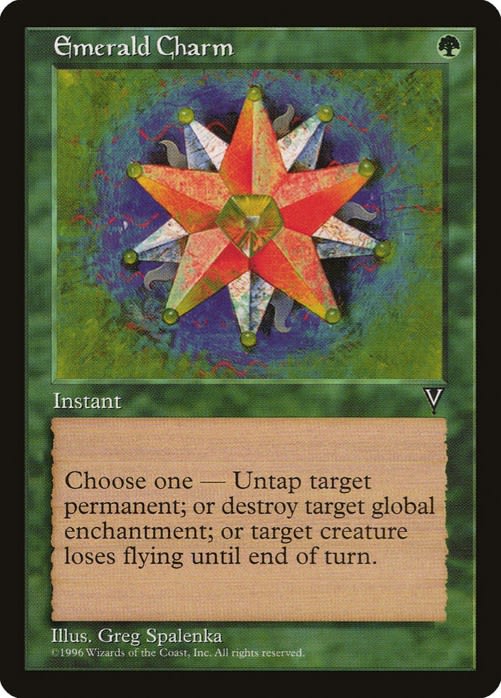
Patrick, a future Hall of Famer and Pro Tour Champion himself, was far too patient to lose to a seven-mana answer to his four-mana combo engine, and certainly not to point removal. I might have interaction, but he kept killing me in response, deploying annoying creature after annoying creature at instant speed while my Charm or Deed activation was still on the stack.
Years later, Aluren would finally become a proper Staple in Extended Magic. Some people think about Premodern as kind of a port from "old Extended" and Aluren was certainly a key combo deck in the early aughts. It has never been a super popular deck in Premodern (for reasons that we'll get to in a moment) but I really started to care about it when I stumbled on this deck a few years ago:
Aluren | Premodern | Javier Dominguez, 1st Place LCOS Premodern, October 2022
- Creatures (18)
- 1 Cloud of Faeries
- 3 Cavern Harpy
- 3 Raven Familiar
- 3 Wirewood Savage
- 4 Birds of Paradise
- 4 Wall of Roots
- Instants (8)
- 4 Accumulated Knowledge
- 4 Intuition
- Sorceries (7)
- 3 Cabal Therapy
- 4 Living Wish
- Enchantments (5)
- 1 Pernicious Deed
- 4 Aluren
- Lands (22)
- 4 Forest
- 3 Island
- 1 Swamp
- 2 City of Brass
- 2 Polluted Delta
- 3 Havenwood Battleground
- 3 Llanowar Wastes
- 4 Yavimaya Coast
Was that the Javier Dominguez? It was. At the time I was one of The Rock's most vocal critics in Premodern, but still friends with Sol. What even made The Rock? I got him to define it as something like "a deck with Llanowar Wastes and Pernicious Deed, that helps to control the opponent with Cabal Therapy" ... Would Javier's deck count?
Sol said no, so I moved on.
ModernCurrent / Contemporary Aluren in Premodern
Years have passed once again. In early 2026 the incomparable Sam Black has put Aluren back on the map with a shockingly innovative new take on the archetype:
Aluren | Premodern | Sam Black, First Place $1k SCGCon Milwaukee
- Creatures (19)
- 1 Rishadan Cutpurse
- 3 Cloud of Faeries
- 3 Soul Warden
- 4 Cavern Harpy
- 4 Man-o'-War
- 4 Raven Familiar
- Instants (13)
- 3 Chain of Vapor
- 3 Flash of Insight
- 3 Intuition
- 4 Impulse
- Enchantments (4)
- 4 Aluren
- Lands (24)
- 10 Island
- 2 City of Traitors
- 4 Havenwood Battleground
- 4 Hickory Woodlot
- 4 Yavimaya Coast
- Sideboard (15)
- 4 Xantid Swarm
- 3 Compost
- 3 Masticore
- 3 Show and Tell
- 1 Chain of Vapor
- 1 Soul Warden
Sam's deck ultimately tries to do the same thing(s) as previous Aluren decks from Extended or even Premodern previous, but takes a different path to get there.
His innovations are largely in the mana base. This allows Sam to compact the Aluren "combo" into fewer steps and cards.
The most difficult thing about any Aluren deck is just getting Aluren in play. It's a green deck mostly because Aluren costs  . This has caused Aluren players over the years to do all different kinds of goofy things, from adding a Survival of the Fittest Plan B to (at the very least) running Wall of Blossoms in one of the deck's many creature slots. After all, Wall of Blossoms is a card that at least kind of works with Aluren, buys time, and potentially digs to Aluren if you don't have it yet.
Sam decided to solve the fundamental problem of Aluren by playing eight cards that tap for . He doesn't run any half measures. He relies on no de facto mini-combos like Birds of Paradise or Wall of Roots just to help get Aluren in play. If he can tap for , he is very likely to be able to tap for . Great, right?
The Three Pillars of Aluren
This is a deck of no half measures. It's an Aluren deck. At least in Game 1, if it doesn't have Aluren going, it's unlikely to have anything going. Therefore, the deck functions via three distinct and necessary components:
First is the path to having Aluren. This is both relatively simple and very fundamentally ingrained into how Sam has built the deck. For example, you can start with Hickory Woodlot, then follow up with Island.
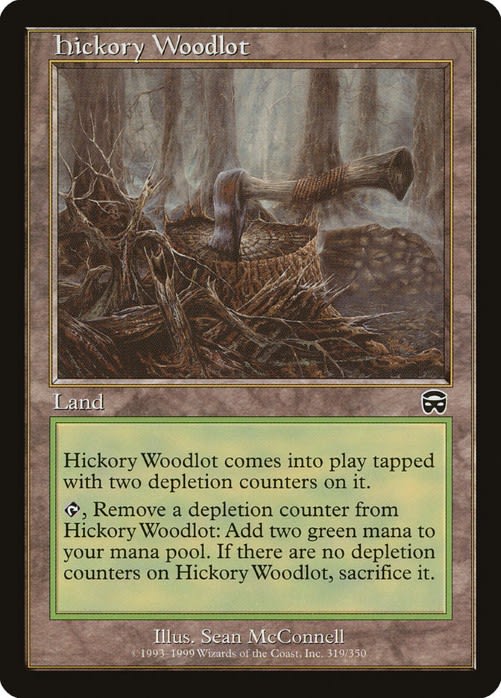 |  |
On turn two you can tap for three mana and Intuition for three copies of Aluren, play your third land on turn three, and just cast Aluren the old fashioned way, on turn three. This satisfies both of the first two components of the deck

In sideboarded games you can often cast Show and Tell (maybe using City of Traitors, maybe never playing any source of Green mana) as early as turn two. Show and Tell is a "must-Counter" card for any Blue deck because it almost guarantees that Aluren is going to enter the battlefield. It also gets around a lot of the deck's potential problems.
The opponent might play Meddling Mage naming Aluren, but Show and Tell gets around what should be a game-winning threat. Or consider that most of Aluren's Green-producing lands enter the battlefield tapped, and an opponent with Wasteland or Rishadan Port can make your life difficult if they're focused on that pivotal Green source.

Sam has been iterating on this deck for a few months. One of his innovations was eventually removing all of the Wall of Blossoms (a darling to kill if ever there were one) and adding more and more copies of Cloud of Faeries. With the exception of the Green sources / double sources (which, to be fair are super essential to getting Aluren into play) the mana base of this deck is quite durable. Twelve basic Islands? It can run a weird Draw-Go game of Impulse, Flash of Insight, or even value-Intuitions while the opponent is frightened to blink.
But none of that gets around the fact that Hickory Woodlot and Havenwood Battleground enter the battlefield tapped. Enter Cloud of Faeries.
The turn you want to "go off" you can just play one of the double lands, cast Cloud of Faeries, untap it, and cast Aluren. Got two creatures? Pray for the opponent.
You've Got Aluren in Play... So Now What?
In the previous segment we talked about having "two creatures" as a condition for winning with this deck ... It's not just any two creatures, mind you (like two copies of Cloud of Faeries might not get you very far) but part of the thing that makes Aluren so alluring is that many different combinations of two creatures - once you have Aluren in play - can potentially win the game, and from so many different angles.
The simplest combination is just these:
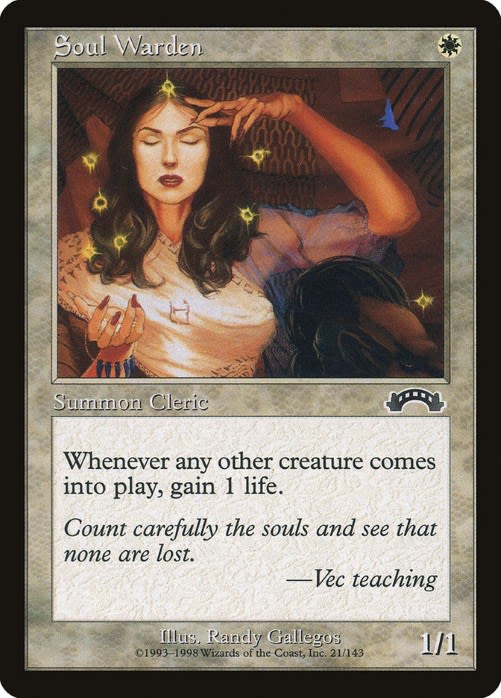 | 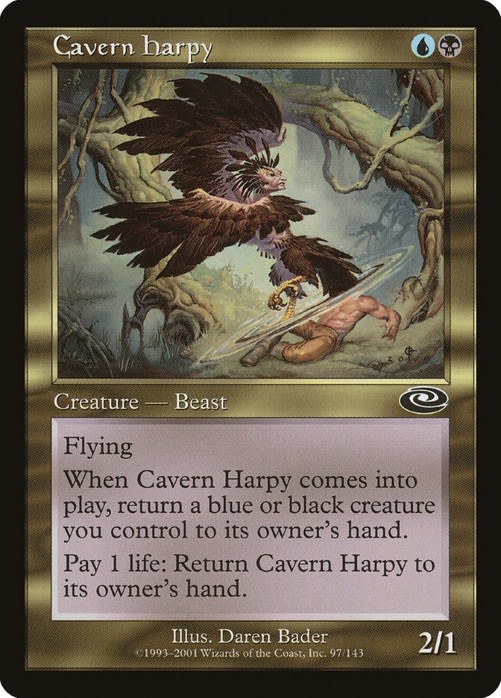 |
If you have Soul Warden in play, you can play Cavern Harpy and then just Gate the Cavern Harpy to itself over and over, which will allow you to gain essentially infinite life. Even if you don't have a direct way to win the game, most decks can't beat infinite life, so will concede for time.
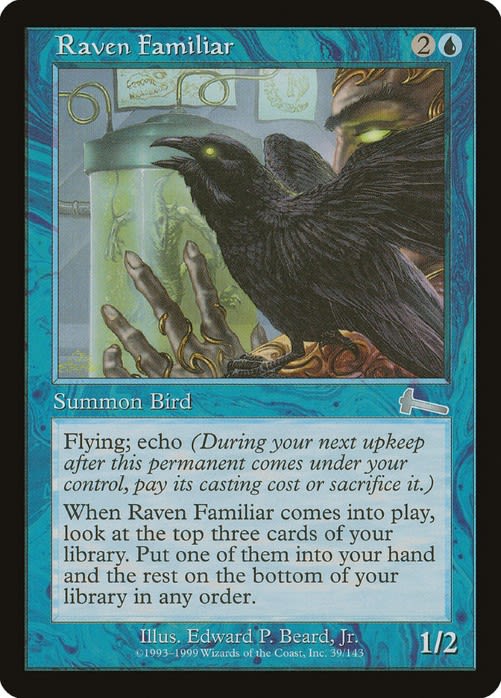 | |
The other iconic combo for this deck is to pair Raven Familiar with Cavern Harpy. This combination will allow you to look at lots of cards. You can't "draw your deck" without a Soul Warden in the mix (because you can only activate the Cavern Harpy so many times), but with a high enough life total you can usually find something interesting to do, like bouncing all the opponent's creatures or destroying all their permanents.
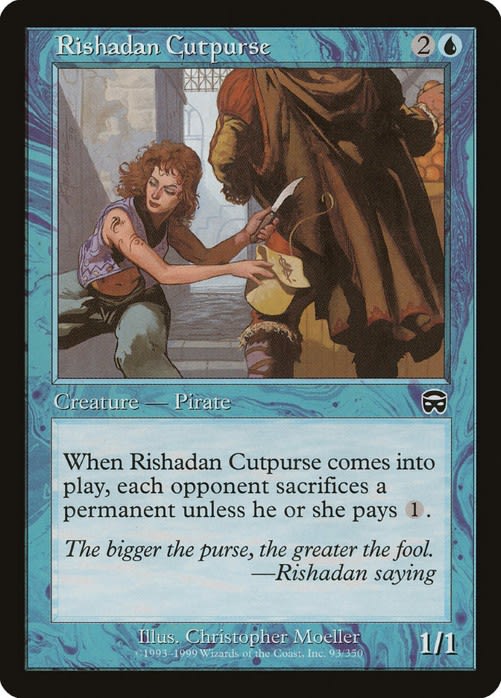
Even with nothing else, a Rishadan Cutpurse might be a free play that immediately blows up the opponent's worst permanent. If you have some way to bounce and re-play the Cutpurse (most conveniently will be Cavern Harpy) you can probably reduce the opponent to no permanents at all. Even if your position somehow doesn't improve over much over the next couple of turns, with any reasonable amount of life, you can probably demolish the opponent's board position and keep them at zero permanents while you attack them for one 20 times.
You'll note that a lot of the mischief this deck wreaks after getting the card Aluren into play revolves around having Cavern Harpy in play. This is a reason you might not see this deck as a top contender if you're mostly been paying attention to Magic Online results. Playing infinite combos around Cavern Harpy are easy to do in paper, but obnoxious to execute online. This is a key difference between Aluren and a more conventional A + B combo deck like Dreadnought.
Dreadnought has a lot of flexibility and can sometimes win in novel ways, like decking the opponent with Brain Freeze. But one of its key weaknesses is the fact that it has to attack you twice, even after executing its two-card combination.
Provided it has two interesting creatures, Aluren will ruin the opponent's day once it has Aluren in play, whether that's drawing its deck, gaining infinite life, or "just" undoing the opponent's whole strategy. The card Man-o'-War lines up great against specifically the card Phyrexian Dreadnought, and Man-o'-War + Raven Familiar will get you surprisingly far. Cloud of Faeries in various combinations can get you infinite mana... Or just enough mana to cast your Flash of Insight or Intuition [which will almost by definition be "enough" because your next card(s) will be free].
Aluren is far less directly disruptable by cards like Red Elemental Blast or Overload, and has a gigantic ceiling. Once it starts to roll, Aluren will build more and more card advantage, and can find increasingly terrible things to do to the opponent, up to and including destroying all their permanents (and every permanent they add to the battlefield thereafter).
Weaknesses
Sam has decided that there are three fundamental problems an Aluren player has to solve:
- Mana disruption
- Discard
- Counterspells
The card Sphere of Resistance, for instance, is super annoying for Aluren. Everything goes from zero mana to one mana, even once you have Aluren in play; this is an infinite gulf over time. That's why you have cards like Chain of Vapor in the deck. You just need them to operate.
If your metagame has more mana denial you'll want more cards like Tsabo's Web, which can draw you into more lands while making life difficult for Rishadan Port and everything that tends to come with that. From the Counterspells front though? Xantid Swarm is great, and again, Show and Tell is a must-Counter.
Sam has characterized Mono-Black as potentially the worst matchup, because discard can cut off your path to Aluren; and even if you somehow get Aluren in play, hand destruction might mean you don't have the two requisite creatures to satisfy the deck's third pillar.
A few weeks ago I won the weekly Premodern League with a  Gamekeeper Rock deck. That week I took the opportunity to test a lot against Aluren after the event ended. Gamekeeper Rock has lots of Wastelands and Dust Bowls, and a full arsenal of Duresses and Cabal Therapies. I lost almost every game from the side. It was almost like the second coming of Patrick in Vegas 2001.
Nevertheless, Sam bas been very attentive to what he sees as one of his deck's potential weaknesses. Can a black deck beat Sam Black if he transforms into a Compost / Masticore engine? Not so far, at least.
LOVE
MIKE