


 Locations


We all know that Limited is the best way to play Magic. What are the best of the best, though? Which Limited formats stand out as the cream of an excellent crop? We're going to have a look at some of the best Draft environments of all time. Maybe, along the way, we can find out what they have in common.
Honorable Mentions
I wanted to shout out a few older sets before we get into the complete list. There are plenty of excellent formats that are largely lost to the past. It feels rough to include them on the proper list, though, when most of Magic's ever-growing player base haven't and likely will never play them.
On top of that, some of them haven't aged all that well, but were among the greats once upon a time.
Modern Masters was my favorite draft set of all time for a whole host of personal reasons but it was also a great set in its own right. It was very complex, had a lot going on, and housed a lot of fun individual cards.
Innistrad is another classic that shaped the way Draft formats are designed today. It doesn't play as well as you remember, though. Everybody knows about Spider Spawning and Burning Vengeance.
Rise of the Eldrazi was one of the first sets to have really well-defined archetypes and build-around cards. The pace was glacially slow by modern sensibilities, but you could do a lot of different things and have success with most of them.
5. Hour of Devastation
 |  |  |
This was perhaps the biggest glow-up in Magic history. Triple Amonkhet was a much-maligned Draft format. It was heavy on aggro, light on interaction, and blocking was a headache. That was before Hour of Devastation (HOU) came along like a breath of fresh air. Suddenly, you could live past turn five. Suddenly, you could play fun decks like multicolour deserts or Blue-Black cycling. Suddenly, you had decent removal. Blocking was still difficult, but you sometimes had efficient removal to blow out your opponent's combat tricks.
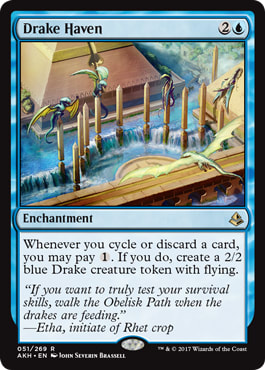
Everything came together so sweetly in HOU. It added its own flourishes while highlighting the few good parts of Amonkhet. Look at Drake Haven, for example. It was already good, but cycling decks were often too slow against Boros (
 ) or Izzet (
 ) aggro decks in triple Amonkhet. With HOU slowing the games down significantly, cards like this got to shine.
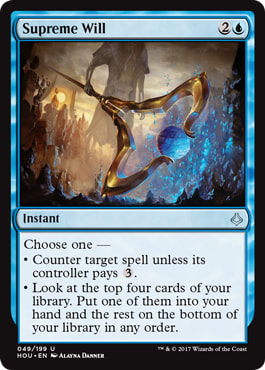
HOU brought a lot of bombs - especially the gods - but it also brought much better answers. There was exile removal for those gods and counter-spells like Countervailing Winds and Supreme Will were excellent. In a pinch, there was even good old Unsummon to at least buy some time.
Perhaps the best thing about HOU, though, was the fact that five-color Green was not just playable but actively good. Fixing was abundant, games were much slower, and multicolor bombs were everywhere you looked. Unlike some lesser sets, HOU didn't make five-color decks always the best thing to do, but they were a viable option on occasion.
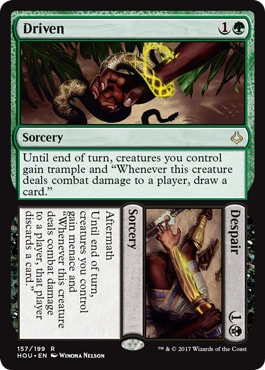
I've barely mentioned specific mechanics so far, but this is the perfect place to bring up Aftermath. This amalgamation of split cards and flashback was one of the main reasons to play more than two colors. Most of them were decent enough if you could only cast one half. Eventually you might draw your Black splash for Driven // Despair but the Green half was fine on its own.
In the end, the fact that HOU is not really playable in its original form is the only thing holding it back. Amonkhet Remastered comes up from time-to-time on MTG Arena, but it's not quite the same.
4. Kamigawa: Neon Dynasty
 |  |  |
Moving forward a little, we have Kamigawa: Neon Dynasty (NEO). NEO came out at a time when Drafters were having a pretty poor time. It followed on the heels of the so-so Crimson Vow and Midnight Hunt and it preceded the mediocre Streets of New Capenna. Luckily, it blew all of them out of the water.
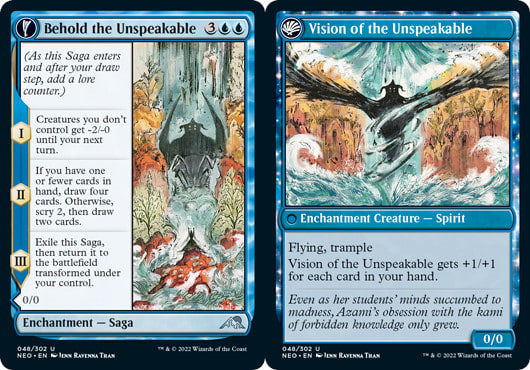
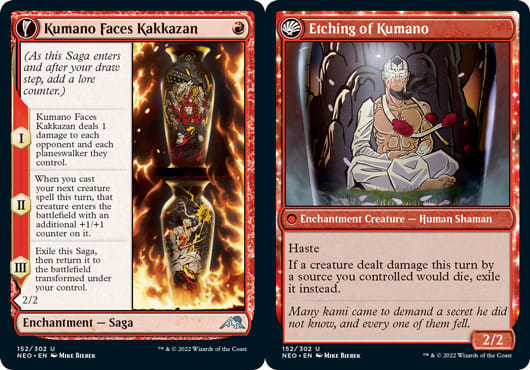
I want to start with mechanics this time because NEO had some of the best. Sagas are an absolute all-timer, and NEO was the perfect place for them both thematically and mechanically. Sagas are great ways to accrue value over time. When they're good, it often means the format necessarily has to be a little slower than average. And yet, NEO had some great aggressive sagas, too. For every Behold the Unspeakable, there was a Kumano Faces Kakkazan. This was emblematic of a format where multiple approaches could work.
Having ways to re-buy sagas is always fun, and NEO's Ninjas were great at this. Okiba Reckoner Raid is maybe the best example. It came down early, doing a bit of damage, then attacked as a hard-to-block Menace creature. Literally any creature with Ninjutsu combines beautifully with it. The menace makes it easier to pay the Ninjutsu cost in the first place, then you get to drain for another two over the next couple of turns.
NEO was full of these synergies that gained advantages over time. Even the aggressive decks got paid off for doing something more interesting that just attacking. Modified and Reconfigure felt so natural that it made you wonder how we hadn't had them before.
More than any other set on this list, NEO was about how its mechanics worked together. Synergy was everywhere, even if you weren't really trying. It was much subtler than typal sets like Lorwyn Eclipsed, too. Even the set's best rares were largely burying you in card advantage rather than slapping you in the face for comical amounts of damage. Three of the top five win-rate cards were sagas. If the best rares in the set take three turns to go off, that gives you a lot of time to find an answer.
3. Final Fantasy
 |  |  |
All right, let's get this out of the way immediately: I'm not a fan of Universes Beyond. I say this because I want you to know that Final Fantasy (FIN) is so good that it overcomes my bias against it. Honestly, if these exact cards had been released as a normal Magic set, this might have been even higher up the list.
FIN had a lot in common with NEO. It had great mechanics - some very similar ones, in fact. More importantly again, though, was the way they synergized. Sound familiar? Sagas were creatures now. Reconfigure was gone, but snap-on equipment was back and played a very similar role. There was even an "artifacts matter" theme, which I never got around to mentioning in NEO.
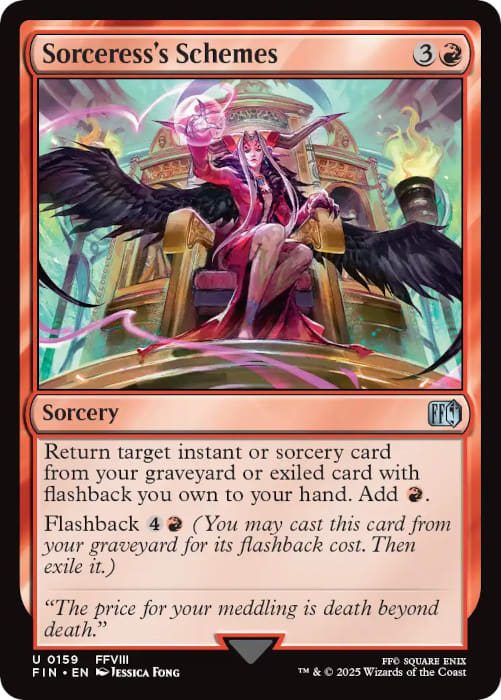
Perhaps the biggest success in terms of overarching mechanics was Izzet. "Mana value four matters" doesn't exactly roll off the tongue, but it played like a dream. Cards like Shantotto, Tactician Magician were both powerful and fun. Izzet was so well-developed in the format that there were two very distinct version of the typical spell slinger archetype we're used to. Tempo/aggro was the most common one, but you could also draft a combo/control deck with Sorceress's Schemes and tons of removal.
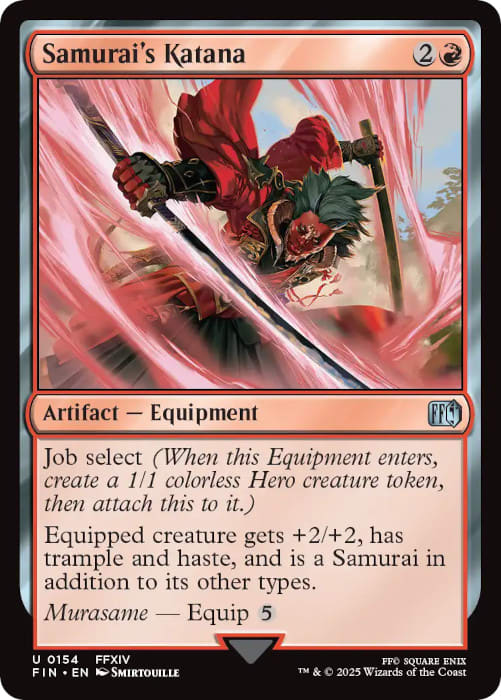
Izzet was the best deck, but not by a lot. Boros was right behind it, with its Job Select-fuelled aggression. It played out very much like a combination of Modified and Reconfigure from NEO. Samurai's Katana was the best of the bunch, attacking for three on-curve and boosting another creature later on if needed. It aimed to get its opponents dead before they could get their synergies online, and often succeeded.
The fascinating thing about FIN is how it rewarded good players. Almost every colour pair has an above average win-rate according to 17 lands. Only Gruul ( ) did poorly, and it was the pair with by the far the least amount of synergy. That means that players invested enough to track their games on 17lands were doing better than average players with almost every single deck.
Final Fantasy took many of the best thing about other great formats and put its own spin on them. Saga creatures felt like a natural evolution. Tiered spells felt like a flavorful take on Multikicker. Like every set on this list, these mechanics all worked together to make something greater than the sum of their parts.
2. Duskmourn
 |  |
What can I say about Duskmourn that I haven't already said about other sets above? See, Duskmourn (DSK) is another set where the interplay of its mechanics is what makes it so beloved. All of its mechanics are decent on their own, but work so much better when thoughtfully put together.
Rooms were the headlining mechanic - another enchantment subtype. While Izzet was the main "thing matters" pair, every color got rooms, and several got to synergize with them in engrossing ways. Esper ( ), for example, had Eerie, which paid you off doubly. You got a trigger for a room (or any enchantment) entering the battlefield, and when you fully unlocked a room.
Manifest Dread was the best take on Morph to date. Every colour got some amount of it, but Green got more than most, including the exceptional Valgavoth's Onslaught. Morph in general is a great mechanic, but Manifest Dread offered even more flexibility than the mechanic it built on. Again, though, its main strength was how it worked with other mechanics.
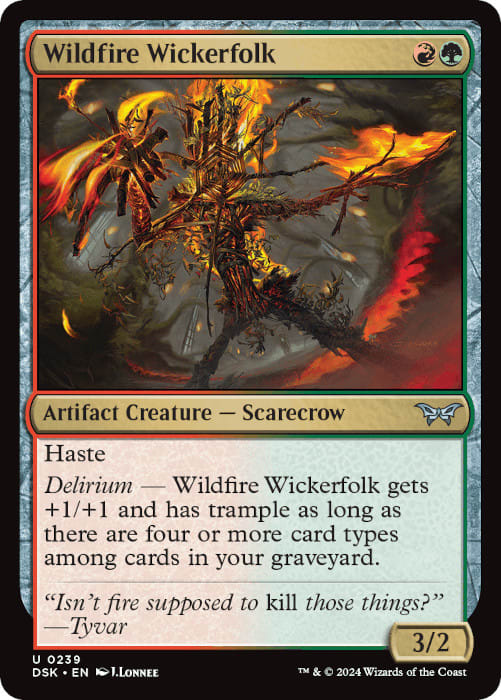
For example, it always puts a card into your graveyard to help with Delirium. Delirium was solely in the Jund colours () and only on 20 cards, but it played a crucial role in the format. It really tied the room together, if you'll excuse the pun. You rarely had a Delirium Deck, but cards like Wildfire Wickerfolk paid you off for filling up your graveyard. Delirium was a small part of the set, but every deck in those colours benefited from having some pay-off. You just naturally ended up with cards in your graveyard in DSK without having to seek them out deliberately.
The only mechanic that didn't really work out too well in DSK was Survivor. Having your creature get into combat and survive just didn't turn out to be a reliable strategy. To make matters worse, DSK didn't have many alternative ways to tap your own creatures for profit. Selesnya () suffered, and ended up being the weakest color pair because of this.
Duskmourn is testament to the fact that color balance is less important than people think, then. Several color pairs were decidedly underpowered compared to the rest, but DSK is still a well-remembered Draft format. Color balance is nice, but great mechanics working well together is much more important.
1. March of the Machines
 |  |  |
There are a few themes I've noticed as I go through these sets, but one macro factor ties them all together, even the honorable mentions. They're all deep. They all have a lot going on. March of the Machines (MOM) might have the most going on of any Standard set ever.
MOM feels more like a Masters or Horizons set than it does a regular Draft format. The Mechanics article mostly sticks to new stuff, because there's too much other stuff to reasonably discuss in one place.
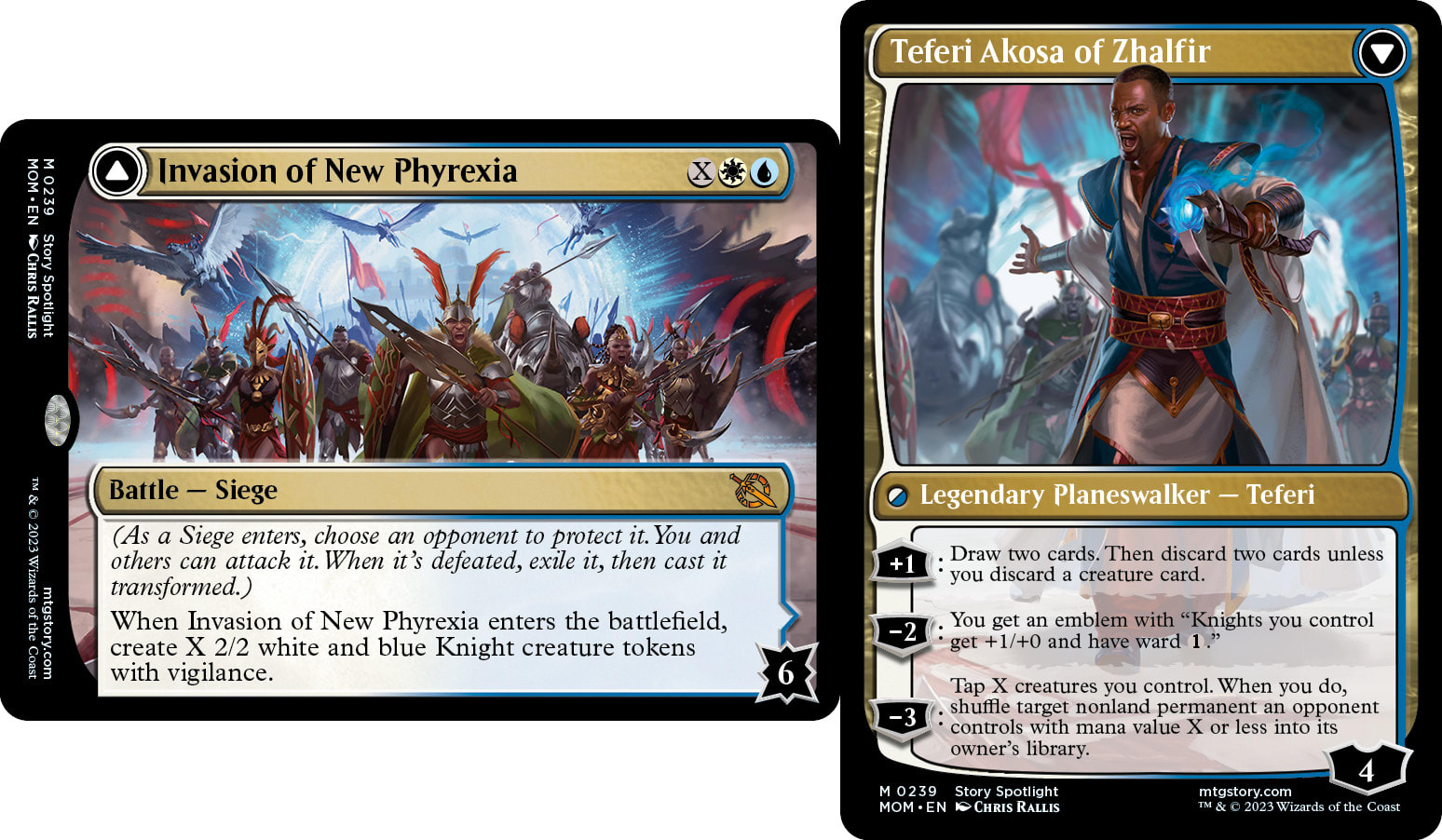
Battles were where most of the design complexity went, but in-play they were pretty straightforward. They did something when they came into play, then you might want to attack them to get a creature out of them later on. Invasion of New Phyrexia was the best of the bunch, and definitely one you wanted to try and flip if you could.
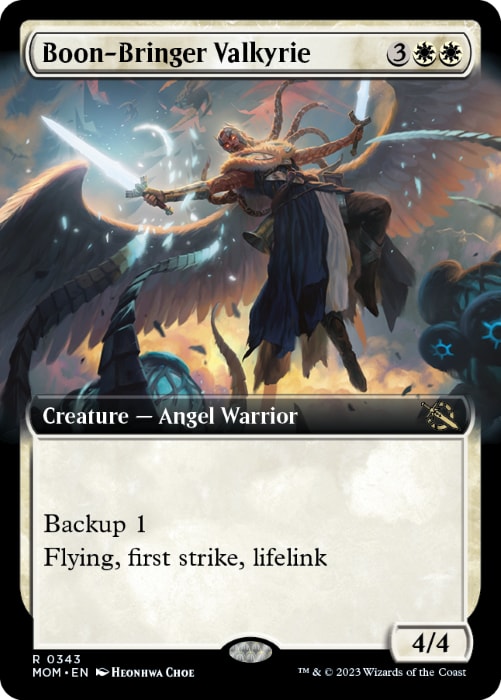
Backup was even more intuitive. You gave your creature a bonus for a turn and made them a bit bigger. This often ended up being very powerful, with Boon-Bringer Valkyrie being among the best cards in the set despite its simplicity.
Incubate was another of those mechanics that felt like it could have been around since the beginning. You stored counters on an artifact that you eventually turned into a creature.
Sagas were back again, too. Kind of. Each of the five Phyrexian Praetors had a creature in the set which could flip into a saga. After three chapters, they flipped back and started all over again. Most of them were pretty good, but Sheoldred // The True Scriptures and Vorinclex // The Grand Evolution were among the best cards in the set.
None of this was particularly taxing on its own. When you added it all together and added in the bonus sheet, things quickly got out of hand. See, the theme of MOM's bonus sheet was pretty much just "legendary creatures." This led to weird situations like Elesh Norn, Grand Cenobite being the best card in the set despite not technically being in the set.
 |  |  |
But what really made the MOM bonus sheet so crazy was the amount of mechanics it added to the Draft. Infect is on there, Devotion is on there, Companion is on there. Oh, yeah, Companion. It might be absolutely busted in Constructed, but in Limited it's actually a bunch of fun deck-building challenges. Still, it's another level of complexity thrown into the mix.
The point is, MOM is complicated. Like the other formats on this list, it has a lot of synergy, but much of it feels accidental. Wizards wanted to put all these exciting cards into the format, and it just so happens that some of them play well with the cards in the main set. Oh, look, my Atraxa, Praetors' Voice pumps my Incubate tokens, That's cool. What's that? It also makes your Battle harder to flip? Nice!
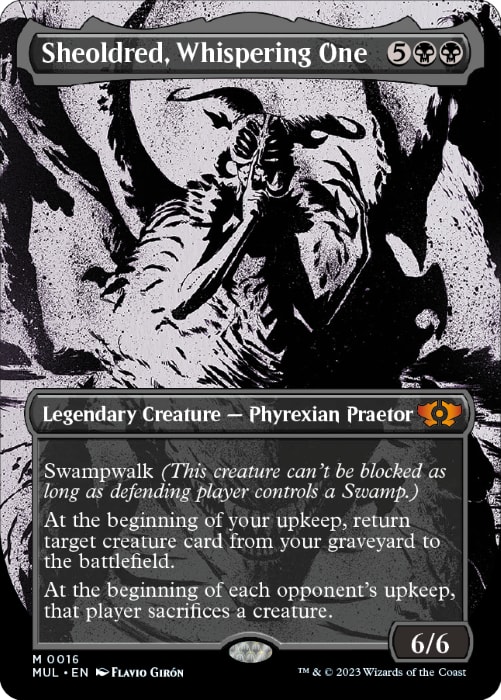
MOM has the most emergent game play of any set ever but it comes at a cost. This is not a set for beginners to dive into. It rewards knowledge and practice. I've played for years and know what Sheoldred, Whispering One does without having to think. If you see it for the first time in a Draft, though, that's going to take a lot of mental energy to parse. Maybe you pass it in a draft because you simply can't be bothered to read it.
MOM's greatest strength is also its greatest weakness: its complexity. It is a real Drafter's Draft set, one for the degenerates who have 20+ drafts of every format they play. This is true because the set is complicated and rewards good draft skills. More importantly, though, it rewards invested players who know what old mechanics do without having to read them every time.
Putting it All Together
What I realized when writing this article is that synergy and the interplay of mechanics is what makes a great Limited format. There are other factors, of course, but this is the one thing that keeps coming up. Even in the honorable mentions, there is a level of complexity for experienced drafters to sink their teeth into.
For me, at least, most of the other things that usually get brought up in these discussions are nice rather than necessary. Color balance is a means to an end, I think. If one or more colors are borderline unplayable, that is limiting the amount of variety.
Why this actually matters at all is it means there are fewer viable options. If you can just ignore 20 percent of the cards, you're drastically reducing variety and replay-ability. When you reduce the number of viable archetypes, you reduce both. You only need to look at Spiderman to see this in action.
It's also important that the bombs don't get too out of control. That can mean a couple of things. Firstly, you could have a set like FIN where bombs abound, but removal keeps them in check. Alternatively, the bombs are just slow burns, such as the sagas in NEO. Draft formats need ways to end the game, but the best environments don't usually allow one card to end the game whenever it's cast.
Finally, it's important to state that all of this is personal preference. I love complicated draft formats with a lot going on. Maybe you prefer to chill out and coast a bit more when drafting. That's totally fine and valid, too. Foundations didn't make this list but it managed to be a great core set experience without needing 18 different mechanics. One of the things that makes draft so good is that there is a format for everyone.