 Locations



It's a random Tuesday evening. You want to jam some Magic but don't have the time or energy to drive to a friend's house or your local game shop. Instead, you hop onto the ever-so-convenient MTG Arena to scratch that competitive itch.
Once the application boots up and finishes its updates, you are ready to hop into a match. Now comes the big decision point: which Magic format are you going to play? It turns out Arena offers numerous ways of playing this beloved game. The format you select will have a profound impact on your gameplay experience.
Ranked Constructed Play
When you select "Find Match" on Arena, a number of options appear. Ranked play reveals all options to play a ranked, Constructed game of Magic. Let's review each option and decipher the differences between each.
Standard
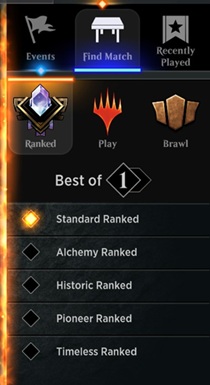 This is Wizards of the Coast's bread-and-butter format. It's the format that has been on MTG Arena the longest, and continues to be the most popular option on the platform. This is the analogue to your FNM Standard events at your local LGS. It has the same legal sets as the paper version of Standard, ranging from Wilds of Eldraine up through Teenage Mutant Ninja Turtles.
Technically, there is one small nuance that differs between Arena's Standard and paper's version: Best-of-One. When playing on Arena, you have the option of playing a Best-of-One match, whereas most tabletop events are Best-of-Three. This leads to corner cases where Wizards may have to ban something uniquely in Arena Best-of-One play, such as Leyline of Resonance. This is done rarely, however, and for all intents and purposes, the two formats are identical.
Alchemy
Alchemy is Wizards of the Coast's rotating digital format. It follows the same set rotation schedule as Standard, but includes Arena's cadre of digital-only cards.
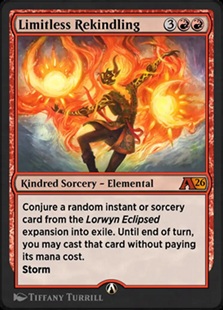
The Alchemy format can look like its Standard counterpart, though it doesn't always have to be this way. Because the cards are strictly digital, Wizards tends to push the power level of Alchemy cards. Heist, for example, is a digital-only mechanic that players disliked for its power level. Since there is no physical counterpart, it's relatively straightforward for Wizards to update cards and tweak their power level accordingly - something that can't happen in a paper environment.
Historic
If you enjoy the digital cards of Alchemy, but also want to experience a format that doesn't rotate like Standard and Alchemy do, then Historic is the format for you. According to Wizards of the Coast, Historic is extremely diverse, with the widest array of balanced decks possible. "Historic is the most diverse format on MTG Arena, and it is currently the most diverse it's ever been," according to Magic's website.
Historic encompasses all the sets that have been released on MTG Arena, both paper and Alchemy sets. This includes the likes of Modern Horizons 3, which wouldn't exist in an Alchemy or Standard format. The diversity sounds fantastic, but you need to be prepared to see digital-only cards, which aren't for everybody. As long as you're OK with those cards, Historic is sure to give you a diverse, dynamic play experience.
Pioneer (formerly Explorer)
Four years ago, Wizards of the Coast announced Explorer, a new MTG Arena format meant to approximate Pioneer. The problem at the time was that not all Pioneer-legal cards were yet available on Arena, meaning the formats were not analogous to each other.
That has changed. If you log into MTG Arena right now, you'll find Pioneer as an option for Constructed play instead of Explorer! Thanks to the release of Pioneer Masters on Arena, the digital version of the format now contains nearly all the cards players could possibly want to use to play all the competitive Pioneer decks.

That means that, at this point, the Arena version of Pioneer just about mirrors the tabletop version of the format. I wonder if we'll get Modern next...
Timeless
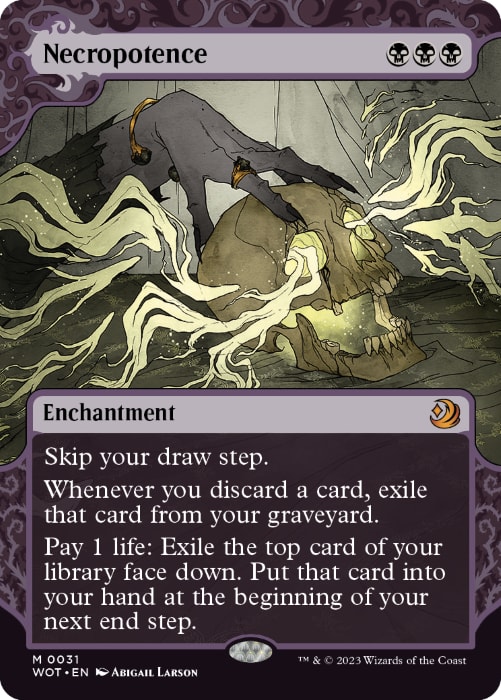
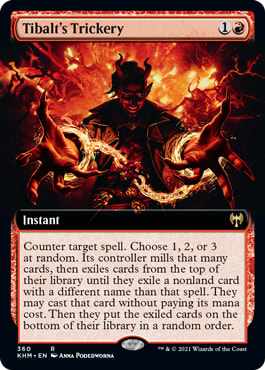
Timeless is another digital-only Magic format. This MTG Arena format is designed to prioritize enabling the widest possible array of cards you can find on the platform. Every card on MTG Arena is legal in Timeless, with just four currently restricted (meaning you can only have one in your deck): Channel, Demonic Tutor, Necropotence, and Tibalt's Trickery.
 |  |
Everything else is fair game. You want to jam a combo deck with four Dark Rituals? You got it. Sneaking Omniscience into play with Show and Tell more your jam? Go for it. If it's available on Arena, it's yours to build with. I view Timeless as Arena's online parallel to Vintage. In fact, now that Vintage Cube is on Arena, I wonder if we'll see something akin to real Vintage before long?
Limited: Traditional, Premier, Quick, Pick Two, Sealed
If you enjoy drafting, then these are the events you'll want to pay closest attention to. Each option provides a slightly different flavor to the draft experience.
Traditional most closely mirrors the Draft event you'll run into at your LGS. You have eight players each take one card at a time from a pack, pass to the next player, until you've drafted through three packs. Then you construct your 40-card deck and jam matches Best-of-Three style. This event is unranked, but taps into your sideboarding skills for a most skill-testing gameplay experience.
Premier Draft is the same as Traditional, except the matches are all Best-of-One and the games are ranked. Therefore, you'll be paired against players with similar rankings to you most of the time.
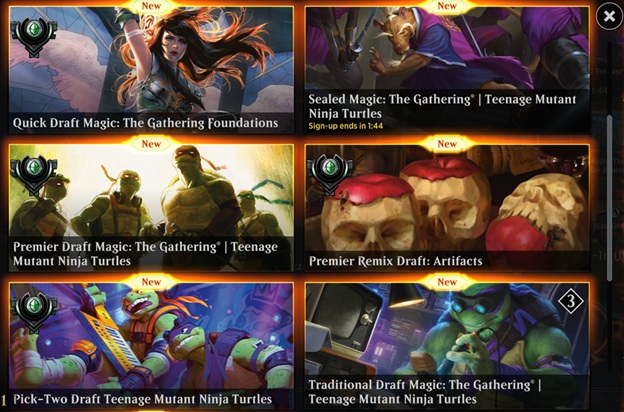
Quick Draft is also Best-of-One and ranked, but the drafting experience is a little different. You still select cards one at a time, but the other seven "drafters" at your table are bots. WOTC's algorithms are what dictate the cards that you see on the wheel, for example.
Pick Two Draft is relatively new with the release of smaller sets like Spiderman and Teenage Mutant Ninja Turtles. Instead of eight players you have four at a table, and you pick two cards at a time rather than one.
Lastly, sometimes you have an option to play a Sealed event. This is reminiscent of the tabletop Sealed experience, where you open a number of booster packs and craft a deck for battling.
Brawl and Standard Brawl
Brawl is Arena's version of Commander. You select your General and have to follow the color identity rules you would in paper Commander. Each deck contains 100 cards, and decks use singleton rules just like Commander. The Standard Brawl variant allows only cards legal in Standard, whereas the general Brawl format allows a much larger card pool found on Arena, including Alchemy-legal cards.
Wrapping It Up
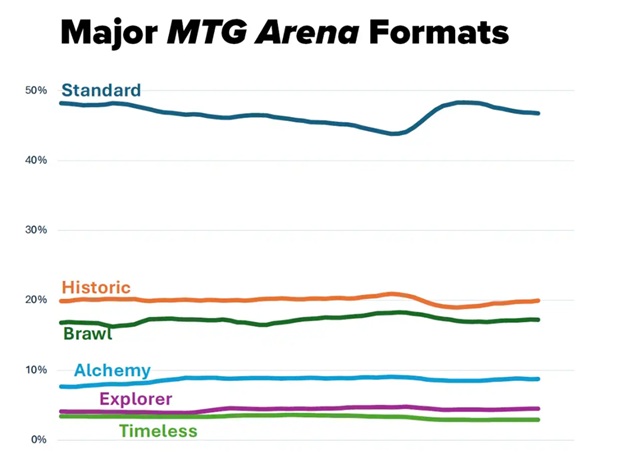
There are many other events available to try on Arena on any given day. The ones I touched on here are the mainstays - these are the formats you'll have access to pretty much every time you open the platform. Standard is by far the most popular, but you can see that players do appreciate the other options from time to time.
As for formats with "limited time only" vibes, there are too many to list here. Some include Direct events to win [physical] sealed product, different Cube variants, Jumpstart-like events, Qualifier Play-ins for higher stakes tournaments, Color Challenges, Mid-week events, Omniscience events, and more. The list of transient events is constantly evolving, designed to keep players coming back to the platform to see what's new.
One thing is clear: MTG Arena has come a long way since its inception in 2018. The more time passes, the closer Arena feels like a true reflection of paper Magic, with all the diversity in gameplay experiences and formats that come along with it. Perhaps given enough time, Arena will be a complete reflection of the physical environment. Even in advance of that, the platform provides a complete (enough) menu of formats to please nearly every Magic aficionado.