 Locations



Now, I know you've heard of Scrying, right? The mechanic where you peek at the top cards of your own deck and decide which ones to keep handy and which to tuck away for later? Well, now, imagine with me for a second if you could do that, but to your opponent's deck instead. And just like that, you got Fateseal, the mechanic I'll be covering in today's Mechanics Overview Segment.
What Is Fateseal?
Fateseal N (To Fateseal N, look at the top N cards of an opponent's library, then put any number of them on the bottom of that player's library and the rest on top in any order.)
Like I eluded to just a minute ago, Fateseal is almost exactly like Scry, but instead of peeking at the top cards of your library, you peek at the top cards of an opponent's library.
The History of Fateseal

Contrary to popular belief, Fateseal didn't simply emerge from the void of Future Sight (2007); in fact, it has deeper roots that trace all the way back to the Mirage (1996), one of Magic's early explorations into deck manipulation and hidden information.
The earliest hint of Fateseal's original concept can actually be found on the card Sealed Fate from Mirage. This innocuous little sorcery allowed you to look at the top X cards of target opponent's library, then exile one of those cards before putting the rest back on top of that player's library in any order. And while Sealed Fate didn't have the keyword Fateseal (because the keyword didn't exist yet), conceptually, we can think of it as Fateseal in its infancy since it effectively manipulates the top card of an opponent's library by disrupting their draws.
Now, let's fast forward to Future Sight, the final set of the Time Spiral block. Future Sight was designed as a window into Magic's future possibilities, featuring preview cards and mechanics that were wildly experimental. Undoubtedly, there couldn't be a better testing ground for a mechanic that manipulates an opponent's library's top cards. As such, the designers took it upon themselves here to improve upon the core idea of Sealed Fate and gave it its own formal keyword: Fateseal.
Moving right along, despite Fateseal's obvious ingenuity as a mechanic, only two cards ever got the Fateseal keyword: Mesmeric Sliver and Spin into Myth.
That's... it. Two Fateseal cards in all of Magic: The Gathering.
What happened? Well, Wizards ultimately found Fateseal to be too tricky a mechanic to balance properly (and by that, they simply found it to be too "anti-fun"). Future Sight's primary mission was to explore mechanics that might one day become everGreen or at least reappear in some form. And Fateseal, as it seems, turned out to be more of a fascinating experiment that just couldn't pass the fun test.
Fateseal and Lantern Control
If you've ever faced down a Lantern Control deck in Modern, you know exactly what I mean when I say "anti-fun." Lantern Control is Magic's ultimate puzzle deck and one that operates not by overwhelming your opponent with raw power or flashy combos, but by strangling their options until they simply can't play the game as they want to. In many ways, I consider Lantern Control to be the spiritual successor of Fateseal.
What Is Lantern Control?
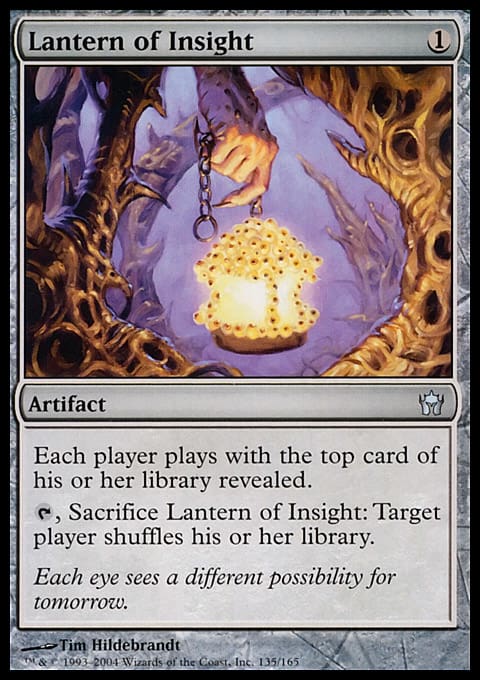
For the uninitiated, Lantern Control is a deck that slowly locks down your opponent by controlling the top card of their library and disrupting their draws with mill effects, while protecting itself with cards like Ensnaring Bridge to prevent damage. It's a deck built around perfect knowledge and control: you see what your opponent will draw, you decide what they get to draw, and you methodically close the game off until they have no outs.
If that all sounds a lot like Fateseal... you're certainly not wrong. Fateseal's defining trait is manipulating an opponent's draws, and Lantern Control takes this to the extreme.
Fateseal's Legacy in Lantern Control
While none of the cards in Lantern Control lists have the Fateseal keyword, all of its main pieces bring about a similar experience to that of getting Fatesealed (but forever).:
- Lantern of Insight (Lantern Control's namesake card) reveals the top card of each player's library, giving the Lantern pilot complete information at all times.
- Codex Shredder and Pyxis of Pandemonium both let you mill cards off the top of your opponent's deck at will, choosing which cards to remove (Lands can stay on top, and everything else can go).
- Whir of Invention grabs any artifact lock piece you still need, all at instant speed.
- Ensnaring Bridge locks the board and slows the opponent's progress to a crawl.
Why Do People Hate Playing Against This?
Because it's slow, it's grindy, and it's, for a lack of a better expression, disempowering. Fateseal and Lantern Control share this "anti-fun" reputation because they simply make your opponent's game feel out of their hands. Imagine having a bomb card sitting on top of your deck, but your opponent constantly tucks it to the bottom, and you can't do anything about it. Or, in Lantern Control, knowing you will almost always draw a useless card next turn, no matter how much you pray for something better.
Sealing the Fate of Fateseal
Fateseal is definitely one of Magic's most intriguing and divisive mechanics.
On one hand, Fateseal is a powerful and elegant tool for disruption. It taps into the sheer thrill of knowledge and control, giving you intimate insight into what your opponent might draw and allowing you to rearrange their deck to your advantage. That kind of play can lead to some truly skillful moments: deciding whether to let a land slip through or banish a game-winning spell to the bottom of their deck can surely feel like a satisfying chess move.
On the other hand, Fateseal sits firmly in the realm of "un-fun" design. When you're getting repeatedly Fatesealed, the game feels less like a battle of wits and more like a frustrating guessing game where the other player holds all the cards, quite literally. This asymmetry of information and control has a very real impact on how players experience the game, often tilting the fun meter toward frustration and helplessness. In my opinion, Wizards has rightly been cautious about printing Fateseal ever again, and as such, it remains one of the rarest, most experimental keywords in Magic's history.
And with all that said, that's all I've got to fuss about for Fateseal. As always, happy brewing, and may you always remember: with great topdeck manipulation comes great responsibility (and maybe just a little bit of salt). Until next time!