 Locations


Magic: The Gathering has been around for a long time, and in that time, the game has been updated repeatedly, with comprehensive rules so long they make fantasy novels blush in jealousy. After the COVID-related boom for the board game industry, Magic also has more rivals than ever now, including several designed by former Wizards of the Coast developers.
It's clear from some of these games, like Fantasy Flight's Star Wars Unlimited or Ravensburger's Lorcana, that these games are in many ways trying to 'fix' Magic's shortcomings. Today I wanted to take a look at those games, but with an eye specifically toward Magic's card frames and how they organize information - and what Magic can learn from it. Playing Lorcana with my son this summer, it struck me how much Magic's card frame has lagged behind the competition, and is either facing or will face a number of challenges in the future because of it.
This isn't going to be a history of Magic's card frame, and it would be impossible to top Sam from Rhystic Studies's video on that subject, so check that out if you want a deep dive into the history of the Magic card frame.
Magic's Card Frame: Then and Now
The original Magic card frame was a product of its time. Limitations with print capability, graphic design, and image fidelity all contributed to the final product. At the time, it was revolutionary. Looking at an early Magic card now, however, it's clear there were growing pains that needed to happen.
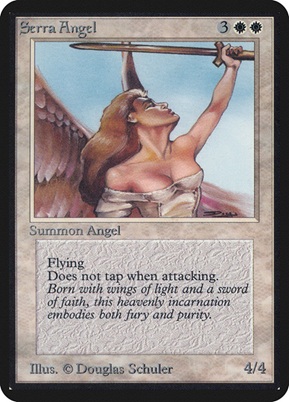
What is most striking about Magic's card frame is how little it has actually changed from Magic's first release in 1993. That comparison is most apt with cards that have been reprinted from Limited Edition Alpha, like Serra Angel. The placement and organization of the information on the card is virtually unchanged. The biggest differences are the additional boxes to highlight card name and cost, types and set symbol, and finally for power and toughness. The only real changes to the frame have been for legibility.
Magic cards are split at a ratio of about 40/60 art and mechanics. Like (almost) all TCGs, the name and costs are at the top, and other mechanical information is then placed below the illustration. A Magic card name sharing space with the card's cost has a hidden drawback - what a card can be named is often limited by how many 'pips' are in the mana cost in the top right.
The type line goes directly beneath the art, which I think was a great choice: it's immediately a subtitle for what the player is looking at in the art, and most competitors imitate that layout. We'll come back to the type line later, as I think this is one of the biggest weaknesses of the current Magic card design.
And then of course, below that is the text box, where mechanical text (what the card actually does) and flavor text (non-mechanical text meant to add some small bit of story to the card) fight for space in the same box. As a creative text writer, I'm all too aware at how much more economical flavor text has to be these days as the wordiness of the mechanical text has grown.
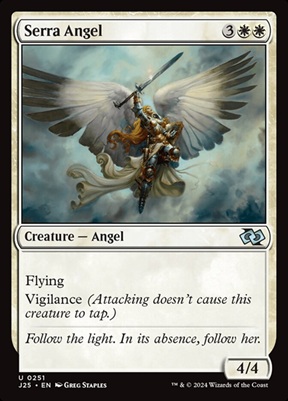
Finally, you've got the Power/Toughness box, which just highlights the numbers but doesn't explain them, and the legal text, which includes artist, copyright, and set information. Magic has dabbled with showing what that "4/4" means with sword and shield symbols, but it never stuck.
"Summon" may have become "Creature" here, but these are very obviously two cards from the same game. After 30 years, that's a pretty incredible accomplishment. I want to start off being very clear on that, Magic does an excellent job being cohesive with itself. Newer card types have gotten more experimental frames: the planeswalker card type, battles, sagas, etc, but at its core, the Magic frame has stayed consistent.
This, of course, doesn't get into special treatments, only the standard card frame. Pretty much all modern TCGs feature a variety of special frame treatments that feature way more art or experiment with the format. I'm only looking at the core gameplay piece here.
The Early Rivals: Pokemon and Yu-Gi-Oh
There's really only two other card games with Magic's longevity, and they both handled their 'modernization' differently. The Pokemon Trading Card Game (once managed by Wizards of the Coast in the USA) went through a similar iterative process as Magic.
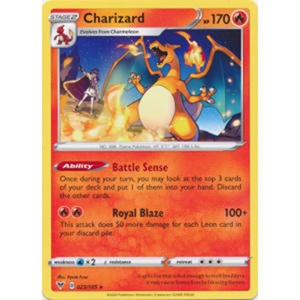
A Pokemon card is about 30/70 art and mechanics. At the top you have the Pokemon name, health, and information on evolutions. The illustration is given less space than a Magic card's, and the 'sub' box is actually just flavor: it's Pokemon stats. Below that is the real meat of the card, the mechanics, with any abilities featured above attacks. Finally, the bottom of the card shows type matchup info: weakness and resistance; as well as the retreat cost. At the very bottom there's very miniscule flavor text along with some legal text.
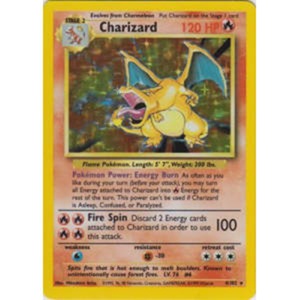
The card frames have been updated for readability, but they're really functionally the same, with the gameplay information in the same locations. You can tell that the original Charizard from the Base Set belongs to the same game as a newer Charizard from a more recent set. Like Magic, they've added newer specialized frames for whatever the current run's special mechanic is, but it's all fundamentally readable as the same game.
Then, of course, there's Yu-Gi-Oh, who's response was to apparently not change a thing about the game in 30 years. I was shocked to see, when my son picked up some Yu-Gi-Oh cards at a garage sale, how the graphic design simply... hasn't changed in all that time. A Yu-Gi-Oh card is the reverse of a Pokemon card, it's about 60/40 art to mechanics. A Yu-Gi-Oh card's name is at the top, sharing space with its attribute. Just below that is its monster level (or any other card type information), and the illustration in the center. Below that is a text box for the kitchen sink, literally everything else is squeezed in here, to the point where it sometimes feels like you need a magnifying glass to actually read it.
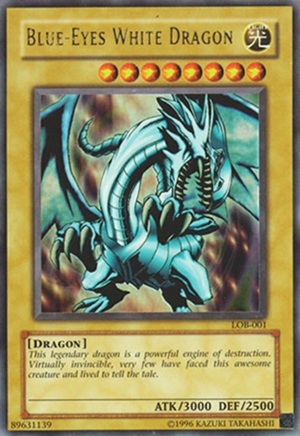
I was genuinely confused while trying to find an example card from then and now. The cards are the same. And no, this isn't an example of a 'throwback' frame like Magic does now. This is just what Yu-Gi-Oh cards still look like. It is both impressive and (looking at the text on a lot of more complicated Yu-Gi-Oh cards) a hot mess.
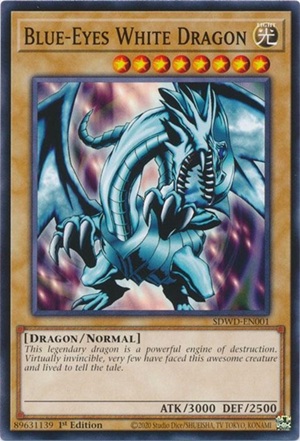
Style-wise, Yu-Gi-Oh has more in common with the design aesthetics of the modern batch of anime TCGs than with other modern TCGs.
The New Guys: Bandai Namco
Nowadays it seems like every popular anime has its own trading card game, and most of them are by Bandai Namco with a very similar design aesthetic. Bandai Namco's claims to fame are TCGs for Dragonball Super, One Piece, Digimon, and the upcoming Gundam TCG. Some of these games have 'Commander' like mechanics, in DBS and One Piece you pick a 'Leader' for your deck, but the rest do not.
These cards typically follow a rule of 80/20 art to mechanics. That's because the design aesthetic for all these card games are extremely minimalist, with the character art being the main draw and everything else being built around that - with even the mechanical text being placed so as to distract from the art as little as possible.
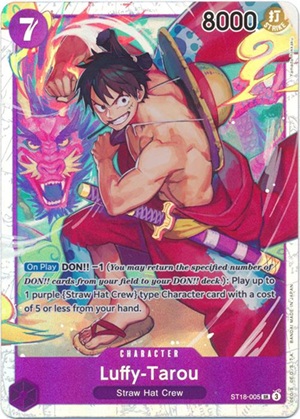
Many of these cards look like they could fit into a deck for any of the others. They all have the most important bit emblazoned in the top right: a huge number (usually in the thousands) representing their power. Costs are in the top left, and other important information is at the bottom. If there's rules text, it's usually directly in front of the art, sometimes with a semi-opaque layer behind it. Because all the rules information is squeezed in, these frames can feel really cluttered when there are complex mechanics.
Readability is not a concern here, and these games really require you to know what the jargon means to be able to play. Despite similar appearances, there's plenty of complexity and differences between the games, I just don't have space to get into them individually. One important note is that because the same characters pop-up again and again in these games, the 'type line' for these games are less about what a character is, and more about who they are and when this iteration is from. I'll come back to this later as well.
The New Guys: American Competitors
The newest competitors, Lorcana and Star Wars Unlimited, were both born from the COVID boom, and developed by former Wizards of the Coast staff. What's interesting is how independently they arrive at very similar places for how to 'fix' Magic, but many of the mechanics here are more emblematic of modern TCG design than anything else. The similarities largely lie with a 'color pie'-like deck-building systems, 'discarding a card' as your resource by playing them into your 'mana pool,' and very similar combat systems.
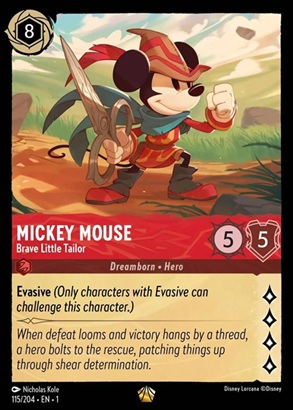
Lorcana is about 50/50 art and mechanics. Pretty much the entire top half of the card is taken up by the artwork, with the cost in the top left. These are largely iconic Disney characters, so the art usually speaks for itself, something unique in Western TCGS. The name only appears after the art. This is where the first 'fix' for Magic's frame comes in: the epithet following the name is presented in a subtitle, rather than alongside the name. This is also true of SWU. The name line shares space with whatever Lorcana calls Power and Toughness (which have unique symbols).
The "type" line here is below that, along with the card's characteristic 'color.' What's interesting here is the "types" are separated by interpuncts, which allows for multiple word "types", something Magic struggles with. Finally, the bottom of the card is the mechanical and flavor box, with a small side for the 'quest' value of the card.
Yes, I know my terminology isn't perfect, but I'm mostly trying to talk about these from a Magic perspective. Personally, I think Lorcana has the best card frame of any current TCG: it's legible and complex without being cluttered, and heavily features the great artwork that is a big selling point.
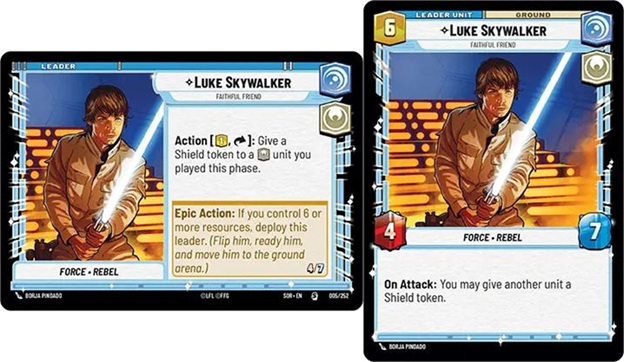
Star Wars Unlimited has a pretty similar design, although like many of the Bandai Namco games it adopts a "Commander" mechanic, where there's a lead character you choose for the deck. Otherwise, it's probably the more complicated of the card designs here, and drops us back down to a 40/60 art and mechanical ratio. There's no less than three lines at the type - a miniscule 'type' line, followed by a name line and then, like Lorcana, an epithet sub-title if needed. Both the cost and the deck-building restriction characteristics are at the top.
Below the illustration are the power and toughness, on either side of yet another type line (although this one, again, separated by an interpunct). And then finally there's some regular text at the bottom. As a leader card, it also has a horizontal, non-unit version on it's front face, but most cards look like the one on the right, so we're focusing on that.
Note other card types have specialized frames (sometimes swapping the place of the art and mechanics to clarify what is a permanent and what isn't), the majority of cards follow this layout.
What Can Magic Learn?
As Magic heads into a Universes Beyond future, what can it learn from all the other modern TCGs that are explicitly designed around other intellectual properties?
1. Names Are Important
That sounds obvious at first, but Magic is poorly equipped to express the 'characterness' of a card. For a long time, this didn't matter, there wasn't a character in Magic that had more than one or two cards. In today's environment, however, I think that approach needs a revisit. After all, when so many of your competitors have adopted a "Commander" variant as their main gameplay mechanic, it might be good to see how they factor that into the game.
Every modern competitor is designed to allow for character-centric gameplay. A card being Luffy, Luke Skywalker, or Mickey Mouse is a characteristic that matters, and they've formatted their card frames and rules in a way to make it possible. So why doesn't Magic? Magic has had this built into the card game since 2007 with Planeswalker sub-types. If being Jace matters for a planeswalker, why doesn't a card being Niv-Mizzet matter?
Let's use Gandalf, as an example. There are six Gandalf cards in Magic, but as a game, there's no characteristic to take advantage of the "Gandalf-ness" of a card. This didn't used to matter when Legends were more rare, but in the last few years, the number of Legends in Magic with three or more printings of the same character exploded.
I see two potential ways to solve this. Magic already has a 'subtitle' box designed for the Godzilla series and used for "reskinned" cards. This could be repurposed to put character epithets on a sub-line, but it would take rules changes. You'd need to redefine a unique card name as the combination of the two lines, while also making the primary name a unique quality akin to a sub-type. There's a lot of issues to work out there, design and rules wise, but I think it'd be worth it.
The simpler solution is to just make Legendary names a sub-type, like Planeswalker names are sub-types.
Regardless, this is an issue that's going to become more apparent as time goes on, especially in the Universes Beyond sphere. Fans of franchises are going to want to build decks around their favorite characters, and having no quality that makes being "Gandalf" a quality that matters will continue to be one of Magic's big flavor weaknesses. In an era of desparked planeswalkers, why can't their creature card also have the same 'sub-type'?
2. Sub-Types Can Go Smaller
Making new sub-types for characters introduces new problems, and Magic has struggled with making sub-types fit on the type line for a long time, especially on Legendary Creatures. The easiest solution for that, shown by Lorcana and... Well pretty much every other game here, is that the text of the type long can go a lot smaller and still be legible. In fact, I'd go so far as to advocate for splitting the type and sub-type lines altogether.
SWU solves the "Legendary" problem - the space taken up by the supertype being on the type line - with a simple star by the name, and most other games denote uniqueness when it matters through similar symbols as their solution. Taking that tactic can free up space on the type line, and feels like something that should have been implemented back when the Legendary "crown" frame debuted.
3. Embrace the Interpunct
This is the easiest to achieve of all my thoughts here. If you've paid attention to discussions around Doctor Who, you know that the introduction of a two word creature type in "Time Lord" caused a lot of consternation. You know what would fix that? An interpunct. Just a little friendly dot, and literally any issue with time lord as a concept is solved, because sub-types are separated by the interpunct rather than a space.
Modernity vs. Tradition
I want to be clear that I don't think Magic needs to redefine its iconic look simply for some competition, especially IP-based competitors that are unlikely to have Magic's longevity. However, playing with these other games and seeing how they organize their information definitely makes Magic feel dated, and I think these few relatively small changes could improve Magic in a big way going forward.