 Locations



Whether you're an avid TCG consumer, or someone who enjoys space-fantasy media, there's a high chance you're familiar with Star Wars.
Much like the multitude of adventures found within the ever-expanding Star Wars Universe, the Star Wars Unlimited TCG provides a vast multitude of gameplay options for you to build upon.
Today, I would like to go over this game with you, from the rules of the game, to the different ways you might want to build your own Star Wars Unlimited deck.

To start us off, before you begin creating a deck, you will need to pick out a Leader and a Base. Both are easily accessible due to their necessity within Star Wars Unlimited gameplay.
Let's go over how leaders operate within the Star Wars Unlimited TCG.

You will notice that there are two sides to every leader. One side of Horizontal, and the other is vertical. When you start a game of the Star Wars Unlimited Premier format, you place your leader in the middle of your board with the Horizontal side of your leader face up. In Darth Vader's case, he reads "Action: [Pay 1 and exhaust this character]: If you played a Villainous unit this phase, deal 1 damage to a unit and 1 damage to a base." In the bottom right hand corner of the box there is a yellow text box that reads "Epic Action: If you control 7 or more resources, deploy this leader." All that means is if you control 7 or more resources, you can flip this leader from being Horizontal (Just a leader with an activated ability) to a Leader - Unit. Each Leader can flip to its unit side once you, the player, achieve a certain number of resources. Your leader's epic action can only be used ONCE per game, and you have to meet the requirements in order to take this action.
Once your Leader - Unit is defeated, it will return to the leader zone on your field exhausted.
Your base goes above your leader on the field.
 |  |
 | 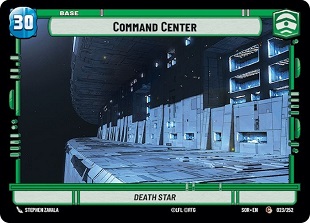 |
Each base has a number in the top lefthand corner and a colored circle with a symbol in the top righthand corner. The number represents your Life Total. If your base goes to zero, you have lost the game. There aren't any alternate win conditions at this time, but there are bases that come with abilities that allow you to play with either more or less health than the generic 30 health on a base.
For example...
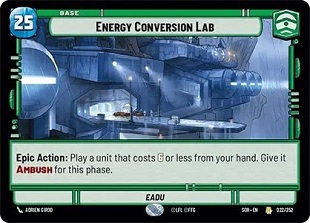 | 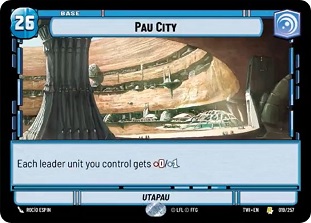 | 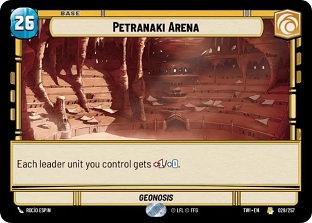 |
Those bases have effects, and thus the total health on the respective bases are adjusted from the standard 30 health.
As previously mentioned, every card (Including your base and leader) will have a symbol inside a colored circle in the top right of the card, and sometimes a white or black symbol underneath it. (This only applies to Leader cards, Unit Cards, Event cards, and Equipment cards)
There are a total of 6 aspects;
 |  |  |  |  |  |
- Aggression (Red)
- Command (Green)
- Vigilance (Blue)
- Cunning (Yellow)
- Heroic (White)
- Villainous (Black)
These aspects determine at cards you can play within your Star Wars Unlimited deck, to an extent.
Let's say our Leader is Darth Vader - Dark Lord of the Sith and we want to use the base Pau City. This means we would be inclined to use only cards with Cunning, Aggression and Villainous aspects. HOWEVER, you do have the option to play with cards outside of the base and leaders aspect at the cost of an extra 2 resources.
Let's look at the card Manufactured Soldiers from Twilight of the Republic.
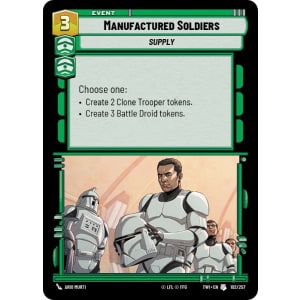
This card costs 3 resources and 2 pips of Command in your aspects. This means for this card to keep its cost of 3 resources, you would need to utilize both a Command aspect leader AND a Command aspect base. So, while you could use this card in a deck with a Cunning Aspect Leader and a Vigilance Base, it would end up costing you 7 resources just to play it. Or even if you had a Command leader and a Cunning base, it would still cost you 5 resources just to play it.
Playing cards outside of your Leader and base's aspects is risky, but it can be done and having the option is nice.
After you've chosen your Leader and Base, you can then proceed to build your deck. (Boy, there's a lot of ground to cover!)
A Star Wars Unlimited deck can have 3 copies of a card within a minimum of 50 cards in your deck. Unlike most TCG's, there isn't a maximum number of cards allowed in your deck but there is a minimum. But that is just for the Premier format, there are other formats within the Star Wars Unlimited universe but we won't go over that here. We are just going to focus on the main format.
However, make a 70-card deck if you want, that's fine.
To start the game, each player will place their leader in the middle of their field and the base above their leader. After this, each player will begin to shuffle their deck and then draw 6 cards from the top of their deck. At the beginning of the game you choose two cards in your hand to place face down as a Resource. If you are familiar with Magic: The Gathering, your Resources will function as your mana. After you have placed two cards in your hand face down as a resource, you will decide who will take the initiative.
Like most card games, this is normally decided by rolling a D6 or perhaps playing rock paper scissors, but if you take the Initiative your turn goes first during the Phase.
That's probably the most confusing part of the Star Wars Unlimited card game - Turn structure.
Instead of you taking your turn, turns are called "Phases" and you take them at the same time as your opponent.
For example, let's say that I won the high roll on a D6 and choose to take the initiative. Now, I can take one action. An Action could be playing a card by meeting the required cost, making an attack with a unit, or taking the initiative. After I have completed ONE action, I end my turn for the phase and your opponent will take their turn within this first phase. Once you run and your opponent runs out of actions to be taken within the phase, you and your opponent will enter a new phase where you both will draw two cards and have the OPTION to resource one card in your hand each phase after the first.
On the field you will notice two separate areas for Units. One space is designated by the player who took the initiative at the beginning of the game as "Space" and can only be occupied by Space units, and the other area is called "Ground" and can only be occupied by ground units. Units in different areas cannot attack one another, but Units within the same area can attack one another.
Let's actually take a look at combat and how that functions in this game.
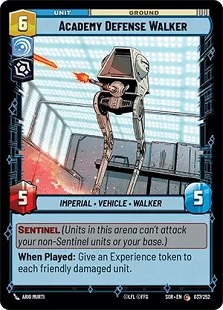
For this example, we will utilize two Ground units. You, the player, have AT-AT Suppressor and your opponent has just played an Academy Defense Walker.
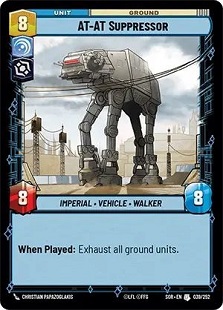 |  |
When looking at your Unit, the AT-AT Suppressor, you can see in the top hand corner that it costs 8 Resources, a vigilance pip, and a villainous pip.
While it does have an on play ability, we won't focus on that right now.
Instead, in the bottom lefthand corner you will see a white digit inside a red hexagon. That number represents the unit's power, as where the white digit on the bottom righthand side resembles its health.
When a unit's health is knocked to zero, just like our base, the unit will cease to exist on the field.
Just like in Magic: The Gathering, in order to attack with a unit you have to turn the unit sideways. (Or, in this game, we call that "Exhausted"). Once a unit is exhausted, it cannot attack again unless it is put back in the "Ready" state. It is important to note by default all units, whether they be Space units or Ground units, enter the board exhausted.
Unlike in Magic: The Gathering, you have two targets that can be attacked. You can choose to attack with your Ready unit at either an enemy unit or your enemy's base. Units DO NOT have to be exhausted to be attacked. Units can attack other units in the same area regardless of if they are exhausted or not. When a unit deals damage to another unit, damage on that unit's health does not default back to its base health as phases and turns pass by. Damage stays on your units until either they go to the discard pile or you have a card that heals damage from them.
Back to our example, YOU the player exhaust 8 resources to play the AT-AT Suppressor.
When you play it, all of your opponent's current ground units become exhausted. This means that your opponent's ground units cannot attack until the next phase begins.
However, after you have used your turn to play AT-AT Suppressor your opponent exhausts 6 resources to play an Academy Defense Walker which also has an On Play ability which reads "Give an Experience token to each friendly damaged unit"
An experience token is a token that can be placed on a unit and gives them +1/+1 to their Power and Health. However... Academy Defense Walker has another important keyword on it.
Sentinel - We won't go over ALL Keywords today, but we will cover the most prominent keywords you would find in the Star Wars Unlimited TCG.
Sentinel means that any of your opponents units that are in the same area as your unit with Sentinel cannot attack your base in that area UNLESS they get rid of the Sentinel unit. In other words, your opponent is FORCED to attack your Sentinel unit before they can do any damage to your base.
We will say you and your opponent have exhausted all available actions that could be taken after you played your AT-AT Suppressor and they played their Academy Defense Walker. You take the initiative and you both go to the next phase. You both draw two cards and resource one. Since you took initiative, you go first. From the ground, you have to swing into your opponent's Academy Defense Walker before you can hit the opposing base - So, you do that.
Their Academy Defense Walker has 5 Power and 5 Health, while your AT-AT Suppressor has 8 power and 8 health. Once you swing into their Academy Defense Walker your 8 power is dealt to the Walker's 5 Health and knocks them out. However, your Suppressor now holds 5 points of damage on its health meaning, unless it is healed, it will remain at 3 Health until it is knocked out.
But at its most fundamental level, a unit that is attacking deals damage equal to its power to the defending unit's health. The defending unit also deals damage to its power to the attacking unit as well in this regard.
With that attack, you have successfully taken the first action of the phase and then pass the turn over to your opponent.
Now that we've gone over some of the basics of combat in the Star War Unlimited TCG.... let's talk about some other prominent keywords you will come across while playing this game.
Ambush - Ambush is similar to "Haste" in Magic: The Gathering, or "Rush" in the One Piece TCG... However, there are a few important differences. A Unit with Ambush only comes into play ready if your opponent has a unit that is able to be attacked in play. Units with Ambush can also ONLY attack units; they cannot attack bases the turn they are played.
Restore (x) - Restore 1, Restore 2, and Restore whatever number may be present is a Keyword that allows the unit with Restore to heal your base for X when they attack. Whether a unit with Restore X attacks a unit or base, does not matter. Your base will be healed on that unit's attack.
Shielded - Units that are shielded come into play with a Shield token on them. If you played Magic: The Gathering during the New Capenna era (April of 2022), this keyword operates the exact same way as "Shield" did within Falco Spara's gang (Or, the wedge "Bant"). For those of you who have no idea what I'm talking about, this unit enters its respective field with a shield token on it. Any amount of damage that is initially dealt to this unit is negated by the shield token and the unit that was once shielded then sacrifices the shield instead of taking any damage.
Grit - Grit give a unit +1 to its power for each point of damage on it's Health.
Raid (X) - Raid states when a unit with Raid (x) attacks, the unit gains +X to their power equal to whatever the "X" is in the Raid ability.
I believe that just about covers the basics of the Star Wars Unlimited TCG.
I hope to see you out in the Galaxy soon, friend.