



 Locations



A few weeks ago, a new Magic: The Gathering trend hit social media. These happen frequently, highlighting specific types of cards or characters, and sometimes just for the meme of it all.
This time, however, things took a bit more of a personal approach.
The Latest Social Media Trend
If you've been around online, you may have seen a viral post asking people to share the nine video games that define them.
A variant of this took off in Japanese Magic: The Gathering circles, where players began sharing the nine MTG cards that define them.
going viral in the japanese mtg community right now is a nine-card image generator of cards you think made or represent you (@/black777cat). give it a try: soichirow.github.io/my-9-cards-m...
#?????????9? #My9MTGCards
— Phil Nguyen (@mtgbanding.com) March 5, 2026 at 9:38 AM
[image or embed]
Phil Nguyen brought this trend to a wider audience outside of Japan. It wasn't long before social media was inundated with players showing off their most beloved cards across the game's history.
This not only lets you show off who you are as a player, but it also lets you open up. It shows our journeys, cards that proved critical to our formative years, how long we've been playing, and more.
Every set of nine cards made for an interesting story and was a fun read.
I made one, too, which you can find here if you'd like a few spoilers. But the length was so limiting.
I've been playing Magic since picking it up in the middle of 1999. With so much history, narrowing it down to nine cards felt like it was doing me a disservice. I wanted to expand the concept into a full article of twenty cards - more than doubling the amount of my original post.
This lets me really dig into the cards that made me me, and how they've been part of my journey. Let's get started.
The Early Years
Let's kick things off right with a look at my earliest years with the game, which were my most casual. It was the definition of "Cards I Own" and I usually played at home with massive 150+ five color piles of nonsense.
Everyone starts somewhere, and this was it for me.
Llanowar Elves
The first card on my list is perhaps the most obvious of them all.
I am well known for being a major Elves player in just about every format and Llanowar Elves is a big factor in this. More importantly, though, it's a card that I've been playing as early as my very first game of Magic.
I got started with the game thanks to an older cousin seeing my sister and I playing the Pokemon TCG. He noticed the similarities to Magic and offered to teach us how to play.
I can still remember heading up to his room and playing my first game. He handed each of us a deck and walked us through the experience. Mine was a Black and Green list with cards that I can vividly remember, such as Living Armor, Scathe Zombies, and Fountain of Youth.
The top end threats the deck played were cards like Diabolic Machine and Skyshroud Troll. Llanowar Elves was key in making sure they came out on time. That moment is what first drew me to Ramp strategies, and it still shapes how I play today.
Howling Mine
After we learned how to play, my sister and I took these decks and started adding to them with the occasional booster pack. It was a fun time full of casual cards and a total lack of strategy.
It wouldn't be long before I would get my first taste of what a strategy looked like, though.
Both of my older cousins - including the one who taught me - would watch my siblings and I during our summer breaks. Of course, we'd play all kinds of games, including Magic.
One day, one of them brings a deck packed with powerful Artifact cards of the era. This was my first exposure to powerful cards like Nevinyrral's Disk, Black Vise, The Rack, and Ivory Tower. There were some oddities like Armageddon Clock and Booby Trap that made for memorable experiences, too.
The one that left the biggest impression at the time, was easily Howling Mine. I loved the element of drawing more cards and doing it symmetrically just enough to make it fun for everyone.
Even now, Howling Mine remains one of my favorite casual cards and is a staple in many of my Commander lists.
The Elder Dragon Legends
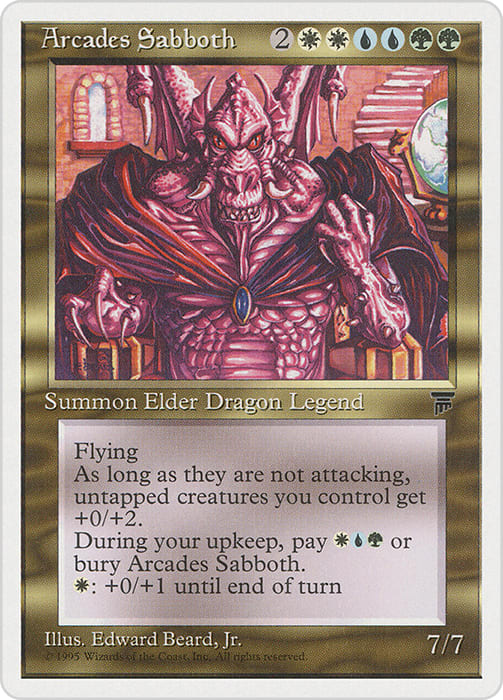 | 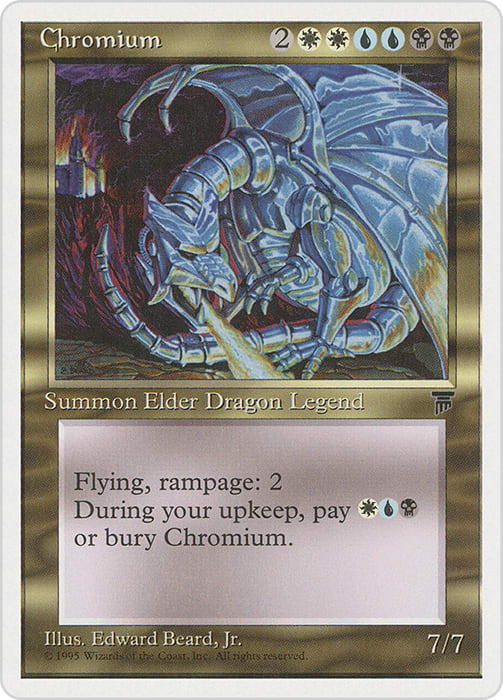 | 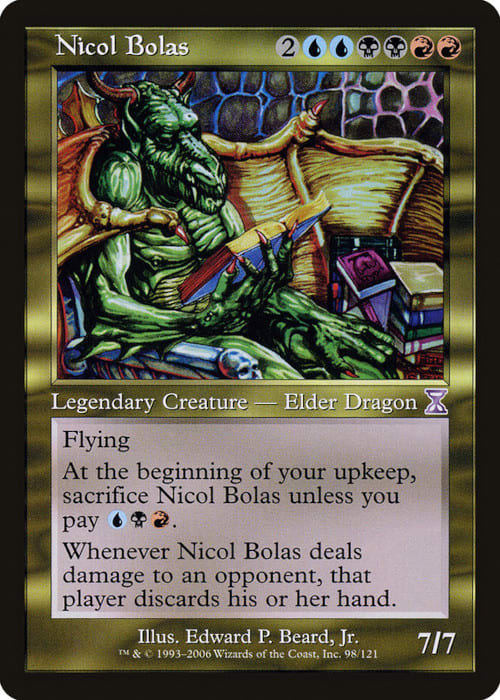 |  |  |
Choosing just one of these would be impossible. The original Elder Dragon Legends from Legends and later Chronicles remain icons of the game's early years.
They inspired not only one of Magic's greatest villains but the Commander format as a whole, originally named Elder Dragon Highlander.
I was introduced to these by my friend Zack in fourth grade. We would often go to each other's houses and play Pokemon and video games.
One day, we started talking about Magic. His older brother had been playing the game for years and was a big fan of the game. He broke out their collection and showed me the five Elder Dragons. Nowadays, they look quite paltry, but back in 1999 they blew my new-player mind.
I spent many of the following months trying to track down copies. Eventually, I got my hands on Arcades Sabboth, Palladia-Mors, and Nicol Bolas and the rest is history.
Sliver Queen
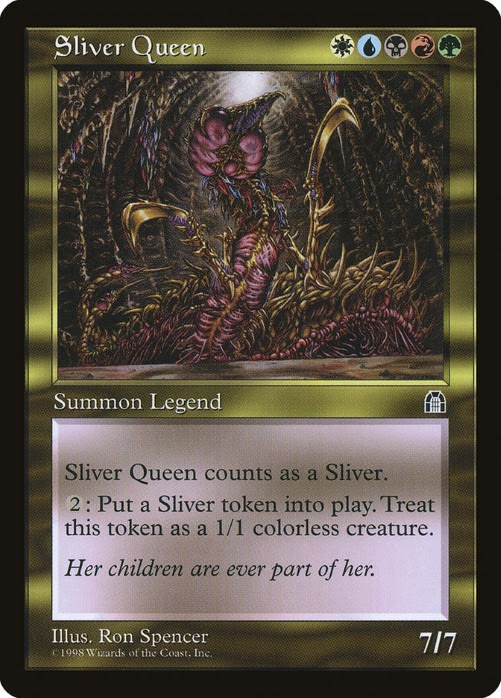
Like with the Elder Dragon Legends, I was at friend's place for some gaming when the conversation turned to Magic. So, he showed me a couple cards from his own collection.
Two stood out right away: an Enchantment that could deal 20 damage to you in one shot (Goblin Bomb) and the mighty Sliver Queen herself.
By then, I had a vague knowledge of what Slivers were. From booster packs and a singles binder at a local sports cards shop, I had come across quite a few. Victual Sliver, Heart Sliver, and Winged Sliver made for fun early pickups.
So naturally, when I saw this card it blew my mind - especially how powerful it was compared to the Dragons.
That same shop I mentioned earlier, B&L Sports Cards, wasn't really focused on trading card games. The owner mostly cared about sports cards, so he'd crack a few packs and toss everything into that singles' binder for a quarter each. One day I flipped through it and found a pack-fresh Sliver Queen. I picked it up on the spot, and it became an instant staple of my five-color nonsense deck.
Slivers would go on to be my first ever FNM level deck, though it was a poor excuse for a list. I'd eventually build one during Magic 2014 Standard, one in Pauper, and one for Commander to mixed success.
The Early FNM Years
Around middle school, following a stint playing Yu-Gi-Oh!, I found myself back playing Magic once more.
The internet was becoming a real thing in the early 2000s and as I spent more time online, I discovered things like Friday Night Magic (or FNM) and the then-new Magic Online.
I focused on mastering more serious decks, and learning the nuances of the game, which would carry through to high school.
Wellwisher

I absolutely love Wellwisher. So much so, that there's some solid argument that it's my favorite card of all time.
The card came at a time where I was beginning to play at FNM and - more importantly - play on Magic Online.
The game was brand new when Onslaught released and I picked up a copy at my local Electronics Boutique right around that time. Playing this little Elf taught me a lotof strong fundamentals about how the Stack works, what different keywords do, and more. It also got me to explore specific formats as opposed to "Cards I Own" and Standard.
Thanks to the heavy kindred theming of Onslaught block, a special format was created for MTGO: Tribal Wars. The format required at least one third of your deck to be Creatures of the same type.
That's how I found the Elves deck of the era. I could play a fairly affordable list, and it quickly showed how wild Wellwisher could get. Mirror matches would end with players' life totals in the thousands, teaching me that there were more ways to win than taking your opponent's life total to zero.
Wellwisher would continue to be a huge player in the Pauper deck I'm best known for, Elves, earning its place as one of my favorite cards of all time.
Thoughtcast

My original list that I shared on social media featured Cranial Plating because I've been a huge fan of Affinity. I played the deck during its Standard era, various forms in Modern, Legacy, and Pauper, and even a spiritual successor in Standard later on.
While Cranial Plating is a major part of most of these, it doesn't cover all of them. So, I tried to think of other cards from this era that defined me and settled on Thoughtcast.
I loved playing with Thoughtcast with Skullclamp to blitz through my deck and overwhelm my opponents in my early FNM days. It was so powerful that my friends refused to play with me if I played Affinity!
As the years went on, I'd run Thoughtcast in every build of Affinity as well as the rare non-Affinity, Artifact-heavy deck. To this day, the ability to draw two cards for 1 mana brings me tremendous joy every time I cast it.
It's no wonder that Artifact Aggro decks like Affinity have become such a core staple of my playstyle since.
Underworld Dreams
If you play Commander, chances are you're familiar with the beloved casual staple Underworld Dreams. While it's a favorite that inspired cards like Nekusar, the Mindrazer, I remember it from my mid-2000s FNM era.
Underworld Dreams saw its first reprint in Eighth Edition. This drew a lot of hype since it was first printed in Legends and had even been restricted in Vintage. But could it really be that good?
It wasn't, but still, it had a lot of fans. I was one of them, having run into a deck taking advantage of the card on Magic Online. The deck had other classics like Howling Mine, Teferi's Puzzle Box, and Kami of the Crescent Moon to force opponents to draw lots of cards.
You would then use lots of counter magic and removal to control the game until your opponents lost.
I'm perhaps best-known today for being a more Aggro, Midrange, and Combo lover, but this was a prime example of me grinding out games with a sweet, if janky, Control deck.
Dragonstorm/Bogardan Hellkite
 |  |
Speaking of being a Combo fan, Dragonstorm deck was one of my favorites that I remember playing in the era of Time Spiral and Lorwyn. Even if you aren't familiar with the deck, you might know of this famous moment where the deck was featured in a mirror match between Gabriel Nassif and Patrick Chapin.
This Dragonstorm deck won by using mana generation spells such as Rite of Flame, Lotus Bloom, and the Time Spiral Storage Lands to create absurd amounts of Red mana.
With that mana, you could then combo off powerful Storm cards such as Grapeshot, Ignite Memories, and Empty the Warrens.
Dragonstorm | LRW Standard | Gabriel Nassif, 3rd Place Gabriel Nassif
- Creatures (4)
- 4 Bogardan Hellkite
- Instants (12)
- 4 Incinerate
- 4 Rite of Flame
- 4 Shock
- Sorceries (12)
- 4 Dragonstorm
- 4 Grapeshot
- 4 Rift Bolt
- Enchantments (4)
- 4 Pyromancer's Swath
- Artifacts (4)
- 4 Lotus Bloom
- Lands (24)
- 12 Snow-Covered Mountain
- 4 Fungal Reaches
- 4 Molten Slagheap
- 4 Spinerock Knoll
- Sideboard (15)
- 1 Akroma, Angel of Fury
- 1 Pithing Needle
- 1 Wild Richochet
- 2 Ignite Memories
- 2 Ingot Chewer
- 2 Martyr of Ashes
- 2 Wheel of Fate
- 4 Dodecapod
The namesake card, Dragonstorm, was the primary way to achieve this victory. By casting a Dragonstorm with a Storm count of four, you could find all four copies of Bogardan Hellkite and put them into play.
Doing this deals 20 damage to your opponent, taking them out. Even if you can't deal the full amount, getting close and finishing your opponent off with direct damage spells was often good enough.
Dragonstorm was one of the first major competitive decks I could play on Magic Online and became an instant favorite of mine. It etched a love of Storm-style combo decks and Bogardan Hellkite in my mind forever.
The College Years
Shortly after graduating high school, I ended up taking a few year hiatus from Magic. Local events I attended had shockingly low turnouts and no one in my school played at the time, so it made sense to drop it for the time.
In my sophomore year of college, I discovered a new group that kickstarted my return to the game where I went deeper than I ever had before. I played lots of Commander and discovered a love of competitive play.
Sharuum the Hegemon
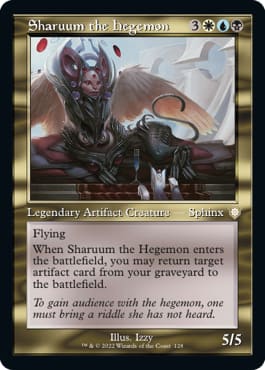
When I came back to the game, I primarily played in two ways: drafts at a local shop and games of Commander, then just called EDH, between classes. While I played with many different decks helmed by various Commanders, none exemplifies my time with the format like Sharuum the Hegemon.
When I picked back up playing in paper, Scars of Mirrodin was the newest set, which meant lots of Artifacts to play with. I also bought the Duel Decks: Elspeth vs. Tezzeret which boasted plenty of Artifacts.
Sharuum provided a great centerpiece for these many Artifacts and made for a fun deck to build upon as the years went on.
While most people know Sharuum as a Combo deck (mine certainly was), I played it a bit more as a Control deck, too. It was designed to counter and remove a few cards here and there while generating a board presence over time, along with some fun shenanigans along the way.
The goal was to keep my deck true to its spirit, but to not be so oppressive that no one else can enjoy the game.
On the rare occasion that I go back to Commander, Sharuum the Hegemon remains my top choice and strongly defines who I am as a result.
Tempered Steel

My history with Tempered Steel begins with Affinity, the same deck I mentioned earlier that ran Thoughtcast.
Shortly after Modern was announced in 2011, I began picking up cards to play Affinity in that format, along with some cards to get my foot in the door with Legacy. When I went to SCG Tampa 2012, I sought to play the deck in Modern and Legacy events. When I found that the Modern event would be later in the day, I decided to play in the Standard Open, too, to kill some time.
Tempered Steel | DKA Standard | Paige Smith
- Creatures (24)
- 4 Etched Champion
- 4 Glint Hawk
- 4 Memnite
- 4 Porcelain Legionnaire
- 4 Signal Pest
- 4 Vault Skirge
- Instants (4)
- 4 Dispatch
- Enchantments (4)
- 4 Tempered Steel
- Artifacts (8)
- 4 Glint Hawk Idol
- 4 Mox Opal
- Lands (20)
- 9 Plains
- 3 Gavony Township
- 4 Inkmoth Nexus
- 4 Razorverge Thicket
Since it shared some cards with the Affinity lists, I decided to try Tempered Steel. The deck is a straightforward Artifact Aggro list, using its namesake and other pump effects to deal serious damage fast.
I picked it up at the event and went 7?2, earning a bit of cash along the way. That performance showed me I could compete at a serious level and pushed me to keep going.
Thanks to this, I was inspired to pick up the deck on Magic Online. I tore up the Daily Events that were around at the time and began my first serious grind that would allow me to greatly expand my horizons as a competitive player.
High Tide

While Affinity provided a means to get my foot in the door with Legacy, I never really treated it as my first true Legacy experience. The deck was pretty much just the Modern list with Artifact Lands and Stoneforge Mystic - cards banned in the Modern format at the time.
Then, one day I pulled up Magic Online to get some games in and ran into an opponent who made one small sequence of cards that wowed me: High Tide, Turnabout, Time Spiral.
High Tide | Legacy (2012) | Paige Smith
- Instants (25)
- 1 Blue Sun's Zenith
- 1 Intuition
- 2 Flusterstorm
- 3 Cunning Wish
- 3 Meditate
- 3 Turnabout
- 4 Brainstorm
- 4 Force of Will
- 4 High Tide
- Sorceries (15)
- 3 Ponder
- 4 Merchant Scroll
- 4 Preordain
- 4 Time Spiral
- Artifacts (2)
- 2 Candelabra of Tawnos
- Lands (18)
- 12 Island
- 3 Misty Rainforest
- 3 Scalding Tarn
- Sideboard (15)
- 1 Blue Sun's Zenith
- 1 Brain Freeze
- 1 Echoing Truth
- 1 Flusterstorm
- 1 Rebuild
- 1 Snap
- 1 Turnabout
- 2 Defense Grid
- 2 Pact of Negation
- 2 Surgical Extraction
- 2 Wipe Away
From that match forward, I was hooked.
I went out of my way to pick up the cards needed so I could play High Tide and take it to some events. It was a difficult deck to pilot and often frustrated opponents, so I only brought it out on rare occasions.
It still became a favorite of mine and even led me to help push for High Tide's trial unbanning in Pauper last year. It didn't pan out, but it was a worthwhile experiment all the same - one I'm glad we tried.
Knight of the Reliquary
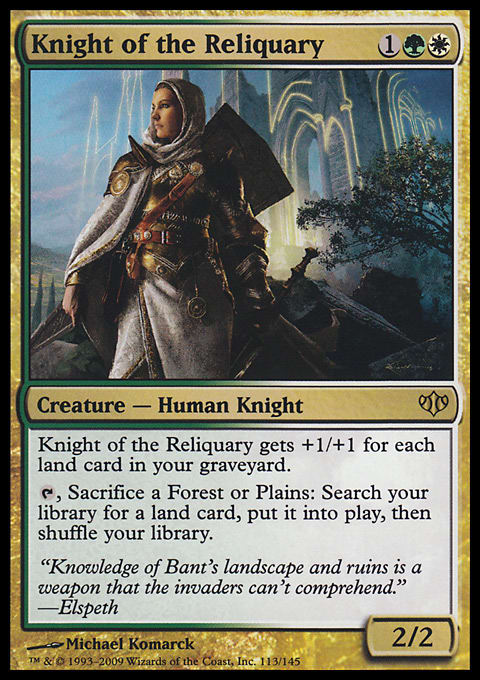
Now, we get to my favorite Legacy deck of all time.
If you follow me anywhere, you likely know me by my other name: TheMaverickGirl. You may ask where that name came from, and the answer is from one of the decks fueled by Knight of the Reliquary: Maverick.
Dark Maverick | Legacy (2013) | Paige Smith
- Creatures (23)
- 1 Gaddock Teeg
- 1 Qasali Pridemage
- 1 Sigarda, Host of Herons
- 1 Voice of Resurgence
- 2 Scavenging Ooze
- 2 Stoneforge Mystic
- 3 Thalia, Guardian of Thraben
- 4 Deathrite Shaman
- 4 Knight of the Reliquary
- 4 Mother of Runes
- Instants (5)
- 2 Abrupt Decay
- 3 Swords to Plowshares
- Sorceries (6)
- 2 Thoughtseize
- 4 Green Sun's Zenith
- Enchantments (1)
- 1 Sylvan Library
- Artifacts (2)
- 1 Batterskull
- 1 Umezawa's Jitte
- Lands (23)
- 1 Forest
- 1 Plains
- 1 Dark Depths
- 1 Dryad Arbor
- 1 Horizon Canopy
- 1 Karakas
- 1 Maze of Ith
- 1 Scrubland
- 1 Thespian's Stage
- 2 Bayou
- 2 Cavern of Souls
- 2 Savannah
- 2 Windswept Heath
- 3 Verdant Catacombs
- 3 Wasteland
Maverick is a toolbox deck that allows you to find surgical hate Creatures to shut down your opponents and let yourself take over the game. It also provided an Equipment package via Stoneforge Mystic and, of course, a Lands package with Knight of the Reliquary.
This card was more than just a Land tutor, though. It would often end games on its own by creating a massive threat that many decks struggled to break through.
The Knight's versatility inspired me as a player and helped solidify my love for Legacy and competitive Magic. It also became a core part of my identity as a player, making it one of my all-time favorite cards.
Gray Merchant of Asphodel

Players everywhere love Gray Merchant of Asphodel, or Gary as he's affectionately known. I'm no exception.
After several years of putting my focus on Legacy, I started gravitating toward the Mono-Black Devotion deck that was dominating in Standard. Cards like Thoughtseize, Pack Rat, Underworld Connections, and Nightveil Specter hooked me, but what sealed the deal were the powerful finishes that Gary enabled.
Gray Merchant of Asphodel wasn't just a card I loved in Standard, but it's also arguably the card that got me into Pauper in the first place! Despite having played a handful of small events prior to this with decks like Storm and Cloudpost, Mono-Black Devotion was the first serious Pauper deck I picked up in 2016.
This led me to discover decks like Tron, Stompy, Mono-Blue Delver, and Elves, and made me a longtime fan of the format. If you've enjoyed my work in Pauper, either as a player or a member of the Pauper Format Panel (PFP), you have this little card to thank.
The Grinder Years
While I guess you could consider my time in college my "grinder years," this is the point in my life where I started pushing my play as far as possible. Once Pauper firmly got its hooks in me in 2016, I was grinding several MTGO Leagues every day and attending major events whenever possible.
For me, this era was full of competitive play and every card on this list represents a major element of my competitive career since.
Archangel Avacyn // Avacyn, the Purifier
In 2015 and into early 2016, I was struggling to play Magic. I'd moved to the outskirts of Orlando, FL where there weren't many stores to play. Magic Online removed Daily Events, replacing them with basic single elimination options. It was rough.
Finally, in early 2016, MTGO brought Leagues back, which allowed me to get my foot in the door with Pauper and get back to it. Although this made people most strongly associate me with the format, I've always seen Pauper as a way to explore other formats.
In 2015-2016, I sold a large chunk of my collection, both due to the lack of local play and to help cover some medical costs. When I came back to the competitive scene, I really wanted to pick up Standard, Modern, and Legacy again, but couldn't afford it. Thus, Pauper became the compromise.
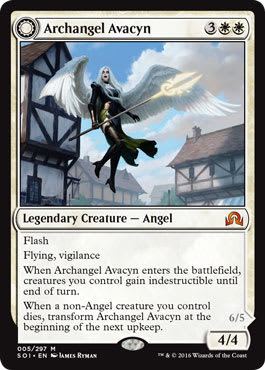
It wouldn't be long until I managed to get back to Standard, however. I picked up a copy of Blue-White Flash and played it to death at my friend's shop and on MTGO. I had the time of my life with it and while I could easily pick from many of the deck's cards for this slot, it's Archangel Avacyn // Avacyn, the Purifier who remains at the forefront of my memory from this time.
This powerful iteration of the beloved Legend would become a staple of Standard, providing a massive threat to protect your board and then wipe out your opponent's in turn. I loved it in every way and wish she were still viable.
Armadillo Cloak

After all these years playing Magic, it might seem strange that I'm only now getting to such an old card. There's a good reason for this, though!
When Invasion came out, I was playing surprisingly little Magic. Pokemon was red hot at the time and I was playing Pokemon League events at my local Toys R Us week after week. As a result, I missed when Armadillo Cloak was at its peak, only discovering it later as a Commander and Cube favorite.
While it was certainly a card I loved in both formats, I was truly hooked once I picked up Pauper Bogles. The deck boasts tons of powerful auras alongside a host of powerful Hexproof creatures. It really has become a staple of my time grinding through the format.
I could have chosen other great cards like Ancestral Mask, Ethereal Armor, or Rancor, but Armadillo Cloak has resonated with me more and for longer than any of them. It's a card that really captures how I play.
Hazoret the Fervent
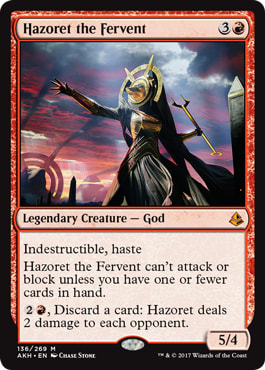
If things like Pauper and Blue-White Flash were the start of my serious journey in competitive Magic, Hazoret Red is where I went all-in.
Following the banning of Smuggler's Copter and Reflector Mage from Blue-White Flash, I took a break from Standard for a few years. Instead, I dove in on Pauper.
Picking up Hazoret Red following the ban of Ramunap Ruins and Rampaging Ferocidon was like a comeback to the format, and what a comeback it was.
I played this little Red Aggro deck into the ground, often multi-queueing on Magic Online for weeks at a time. Finally, I had the chance to take it to Grand Prix Seattle 2018.
Hazoret Red | RIX Standard | Paige Smith, 78th Place Grand Prix Seattle 2018
- Creatures (27)
- 2 Pia Nalaar
- 2 Rekindling Phoenix
- 3 Kari Zev, Skyship Raider
- 4 Ahn-Crop Crasher
- 4 Bomat Courier
- 4 Earthshaker Khenra
- 4 Fanatical Firebrand
- 4 Hazoret the Fervent
- Instants (9)
- 1 Abrade
- 1 Magma Spray
- 3 Shock
- 4 Lightning Strike
- Lands (24)
- 18 Mountain
- 3 Grasping Dunes
- 3 Scavenger Grounds
- Sideboard (15)
- 1 Glorybringer
- 2 Abrade
- 2 Aethersphere Harvester
- 2 Dire Fleet Daredevil
- 2 Magma Spray
- 3 Chandra, Torch of Defiance
- 3 Fiery Cannonade
The event was a life-changer in many ways; it was amazing meeting many friends in person for the first time and attending my first major convention in years. The highlight, though, was finishing day one undefeated, having taken down seasoned pros like Jeff Cunningham and Ben Friedman.
Even though I couldn't repeat that on day two, ending the event with a 10-5 record, it was still a major win for me. It was an incredible experience of playing at some of the game's highest levels and kicked off a year full of strong finishes.
Not only that, but the experience of trying to put together a deck for this event led to me getting my foot in the door writing, which I wouldn't be here today without.
Steel Leaf Champion

After my time with Hazoret Red, I became quickly enamored with another Aggro deck of a different color: Steel Leaf Stompy.
This Mono-Green deck leveraged the power of Llanowar Elves being reprinted in Dominaria to ramp out powerful threats. Threats like the deck's namesake Steel Leaf Champion, along with Rhonas the Indomitable, and Thrashing Brontodon.
With the high power of each of these, you could then spit out a mighty Ghalta, Primal Hunger in no time flat.
I was hooked on this deck and played it obsessively. I just barely missed a win-and-in for day two at Grand Prix Orlando 2018 with it. As a result, I've always been enamored with Steel Leaf Champion and the deck it enabled.
Maybe one day a deck will show up somewhere that can reliably take advantage of its high power level.
Storm the Festival

The Mono-Green continues, this time with my one piece of Pioneer representation.
Storm the Festival is one of the main defining cards of the Mono-Green Nykthos Ramp deck in the format.
Around the time Pioneer came to be, Nykthos Ramp became my go-to way to play the format, even if I fumbled through much of the deck's initial combo builds. Even if you didn't quite understand how to combo with the deck, it was still just good enough to be able to play Storm the Festival and go to town.
The banning of Karn, the Great Creator broke those combos but, I continued to play the deck. Spinning your whole library by turn two with Cavalier of Thorns, backed by Outcaster Trailblazer, and Kiora, Behemoth Beckoner for card draw, made the deck too powerful to quit.
Even now, I continue to love playing Nykthos Ramp in the format whenever I get the opportunity, making it a no-brainer to have this card on my list.
Raffine, Scheming Seer

For years, I've wanted to grind big events and make it onto the Pro Tour. For a period after college, I didn't have this opportunity due to work. After my 2018 grind, though, I started playing PTQs and the like in the era of the Player's Tour.
Sadly, the 2020 COVID-19 Pandemic put much of those aspirations on hold. I'd sold a lot of my collection to keep me afloat during this period and had a hard time competing in a time of social distancing.
In 2023, I tried my hand at the now-defunct VML on the back of Esper Legends helmed by Raffine, Scheming Seer. This kicked off my 2024 Standard RCQ season and ultimately earned me a spot in my first Regional Championship, all on the back of my Esper Midrange deck.
Esper Midrange | MKM Standard | Paige Smith, 2nd Place 2-Slot RCQ Millennium Games
- Creatures (16)
- 1 Lazav, Wearer of Faces
- 2 Dennick, Pious Apprentice // Dennick, Pious Apparition
- 2 Tishana's Tidebinder
- 3 Faerie Mastermind
- 4 Deep-Cavern Bat
- 4 Raffine, Scheming Seer
- Planeswalkers (2)
- 2 The Wandering Emperor
- Instants (10)
- 1 Destroy Evil
- 3 Cut Down
- 3 Go for the Throat
- 3 No More Lies
- Enchantments (6)
- 2 Virtue of Loyalty
- 4 Wedding Announcement // Wedding Festivity
While I may have lost horribly in the RC, I was able to cash the Super RCQ event that Sunday, ending in one of the most intense matches of Magic I've ever played. This made Raffine an instant favorite in my heart, where it has remained ever since.
Basking Broodscale

The most recent addition to this list was a tough choice between this and Cori-Steel Cutter. I've played quite a bit of Cutter over the last year, including reaching a day two record at Regional Championship Hartford 2025.
In the end, nothing could take this spot but Basking Broodscale.
The Basking Broodscale Combo deck from Pauper utilized the powerful combo of Sadistic Glee and the Broodscale itself to generate infinite mana, death triggers, life gain, and +1/+1 counters. As you can imagine, this Splinter Twin-esque deck proved to be extremely busted.
On the Pauper Format Panel, we were a bit slow due to the lack of paper representation and the mixed results from digital play. It wasn't long before I picked up the deck in paper and realized just how cracked it was.
At my local events I went undefeated for eight weeks in a row. That's a record of going 24-0 before someone finally took a match from me. This insane run would continue with me ultimately winning the Inaugural Upstate NY Pauper Open on March 1, 2025.
Broodscale Combo | Pauper (2025) | Paige Smith, 1st Place Inaugural Upstate NY Pauper Open
- Creatures (14)
- 1 Evolution Witness
- 2 Nadier's Nightblade
- 3 Shambling Ghast
- 4 Basking Broodscale
- 4 Writhing Chrysalis
- Instants (9)
- 2 Eviscerator's Insight
- 3 Tamiyo's Safekeeping
- 4 Deadly Dispute
- Sorceries (7)
- 3 Duress
- 4 Malevolent Rumble
- Enchantments (5)
- 1 Makeshift Munitions
- 4 Sadistic Glee
- Artifacts (5)
- 1 Energy Refractor
- 4 Ichor Wellspring
- Lands (20)
- 1 Mountain
- 3 Forest
- 5 Swamp
- 1 Drossforge Bridge
- 1 Slagwoods Bridge
- 1 Tree of Tales
- 1 Vault of Whispers
- 3 Khalni Garden
- 4 Twisted Landscape
- Sideboard (15)
- 1 Drown in Sorrow
- 1 Sylvok Lifestaff
- 2 Breath Weapon
- 2 Troublemaker Ouphe
- 2 Weather the Storm
- 3 Red Elemental Blast
- 4 Snuff Out
The PFP would ultimately ban the card at the end of that same month. I finished my time with the deck boasting a roughly 91% win rate, a clear indicator as to exactly why Broodscale Combo was as broken as it was.
To me, though? It represented a wild time as a player and as a clear moment as a PFP member where I could say confidently, "this is a problem and we need to do something about it."
Conclusion
I really enjoyed taking this look back on my history of playing Magic and what cards have made me into the player I am today. There is so much that I've been able to experience over the years that I still feel like I ended up only scratching the surface.
The cards and their respective decks that I talk about here are a small fraction of the ones that have meant something to me. I barely touched on cards that impacted me through Pauper, Modern, Pioneer, and Commander despite playing with dozens of decks in each of those formats.
I love this great game and, after 27 long years, could talk about it endlessly - something I'm thankful that I get to do in articles like these.
Best of all is the fact that Magic isn't going anywhere anytime soon. That means there's still plenty of time to make even more memories and discover even more cards that define my next chapters as a player.
Paige Smith
Bluesky: https://bsky.app/profile/themaverickgirl.bsky.social
Twitch: twitch.tv/themaverickgirl
YouTube: TheMaverickGal