 Locations



At the end of 2021, Wizards decided to take us back to Innistrad for another take on the beloved horror plane. The Shadows Over Innistrad block's Lovecraftian turn had a mixed reception and the hope was that Innistrad: Midnight Hunt and its follow-up - Innistrad: Crimson Vow - could be a strong return to form. In the end, both sets failed at this attempt, but they did bring us a bunch of really cool mythics to talk about nevertheless. Today, we're going to go through and rank them all!
Get those silver arrows and wooden stakes and let's charge in!
- 20. Sunstreak Phoenix
- 19. Jerren, Corrupted Bishop // Ormendahl, the Corrupter
- 18. Consuming Blob
- 17. Sigardian Savior
- 16. Hostile Hostel // Creeping Inn
- 15. Lord of the Forsaken
- 14. Enduring Angel // Angelic Enforcer
- 13. Poppet Stitcher // Poppet Factory
- 12. Sigarda, Champion of Light
- 11. Moonveil Regent
Number Ten

It turns out that a 2/3 deathtoucher is quite hard to deal with. It's the kind of statline that makes it difficult to block effectively yet can also block really well if you can't find a good attack with it. Even better, though, is the fact that you could pump even more mana into it. Not only does this pump the Adversary, but it also makes a huge heaping of decayed tokens. Even if those tokens only get one good hit in, that's a lot of power coming in such a small package, which made it a solid option for Black Aggro decks of the time.
Number Nine

Players had real high hopes for this card. Even if you only pay 3 mana, getting a 4/3 trampler is no joke and can take over games on its own. For every 2 mana you pay past that, though, you can make another 3/3, scaling to be better and better the more lands you have in play. In practice, the card was ultimately just fine, but when it was able to shine it would hit like a truck.
Number Eight

Almost everyone agrees now that the day and night mechanic was awful in execution, but at least it gave us a pretty awesome planeswalker. Arlinn, the Pack's Hope provided players with a great way to generate creature tokens, flash in other creatures from your hand, and even enable you to flip from day to night and vice versa. This made Arlinn a fun card, if somewhat more niche in her applications.
Number Seven

After several years of Teferi cards dominating Standard, many players were leery about the printing of a new one into the format. Thankfully, Teferi, Who Slows the Sunset was a much more modest option. Make no mistake: this still proved a great option for a variety of control decks as well as a frequent one-of in Pioneer Nykthos Ramp decks, but it wasn't anywhere near as dominant as cards like Teferi, Hero of Dominaria or Teferi, Time Raveler were in their respective formats.
Number Six

Spectral Adversary wasn't the most heavily played card around, but it had its place. Being able to flash it in to forcibly phase out as many opposing creatures as you had mana for made it a fantastic tempo play. Not only that, but Spirits was well known by this point for being a potent archetype in Pioneer, making this a rare inclusion there to fuel that deck's game plan.
Number Five

White Weenies is quite often a popular deck and Intrepid Adversary made it quite solid in this era. It made for an excellent beater in its own right, but by pouring a bit of extra mana into it, it pumped not only itself but your entire board. This made it among the best creatures in Standard at the time and it remains a strong option in various go-wide strategies in Commander as well as the occasional Humans build in Pioneer.
Number Four

Wrenn and Seven does a lot. Very few planeswalkers have had four loyalty abilities on them, with this being the sixth ever (including the Nicol Bolas flipwalker in Core Set 2019). Given this, it should hardly be a surprise that Wrenn and Seven became a powerhouse right out of the gate, fueling several decks in the process and spitting out tons of big creatures in the process. This made Wrenn and Seven the major chase rare out of the gate until The Meathook Massacre overtook it later on.
Number Three

Compared to many other cards on this list, Bloodthirsty Adversary looks quite tame. A 2/2 haste creature for 2 mana isn't the most exciting statline, but it just happened to be perfect for its relevant Standard environment. If the game went on long enough, you could pay even more mana for it and both make the Adversary bigger while also buying back a spell from your graveyard. It might not seem like much, but it was in many ways the glue holding Mono-Red Aggro decks together at the time.
Number Two

A repeatable flashback card? What could possibly go wrong? Many players weren't sure exactly how good the card would be thanks to the fact that you couldn't use it to counter spells, making it that much more challenging to protect. As it happens, you don't need counter magic when you're going off with big combo turns, something that Lier enabled not only in Standard but also in formats like Pioneer and Commander. Even now, it's not uncommon to see Lier tearing it up in Pioneer Lotus Field decks, making the card a true standout among the pack.
Number One
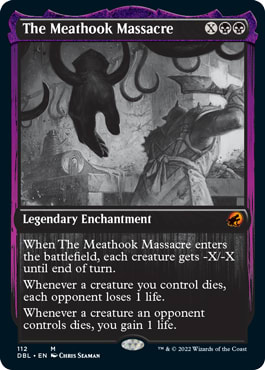
The Meathook Massacre is undoubtedly the best mythic in this set. Most players didn't get too long of an opportunity to play with it in Standard because it was banned swiftly out of the format after just a few months thanks to the overwhelming dominance of Black decks. If that weren't powerful enough, the card continues to see Pioneer and even Modern play to this day in addition to the obvious utility in Commander and Cube. The resume is long on this card, and it's more than deserving of top billing as a result.
Paige Smith
Bluesky: https://bsky.app/profile/themaverickgirl.bsky.social
Twitch: twitch.tv/themaverickgirl
YouTube: TheMaverickGal