


 Locations


Preparing for Avatar's debut, most of the attention was understandably on the splashy rares and mythics--that is, the Badgermole Cubs and Wan Shi Tong, Librarians of the set. We weren't expecting the highest impact cards from the set to be unassuming commons and uncommons, but the lower rarities of the set are currently defining our Standard metagame to the extent that you're as likely to see Boomerang Basics as Badgermole Cub at the top tables. I always love when cards below rare see tournament success--I have fond memories of playing ancient Standard formats with budget mono-Black aggro and Blue-Green Madness decks, and it's affirming to see the underdogs shine and add value to more than just the last couple slots in a pack. I expect more Avatar cards to show up as Standard develops, but the hits from the set's debut were mostly uncommons--an interesting change of pace for deckbuilders and a boon for Limited players. Among the early hits:
Honorable Mention: The Shrines
I've never been a fan of Shrines in Commander (let alone in the more competitive formats). The deck is easy to disrupt and requires maintaining a board state of escalating triggers that scale up each turn, which isn't my preferred way to play Magic.I feel the same way about Slivers. Still, they've had their fans since original Kamigawa Block, and the Avatar cycle of Shrines--plus a new chromatic Commander in Hei Bai, Forest Guardian--boosts the power of the deck significantly. With four full cycles of Shrines, you can now build a five-color Shrine deck that can hang with the lower brackets, and that wouldn't be possible without the cycle of uncommon Shrines from Avatar: The Last Airbender. Shrine decks even got an unexpected bonus in White Lotus Hideout, a budget land that helps solidify the mana base.
Fire Navy Trebuchet
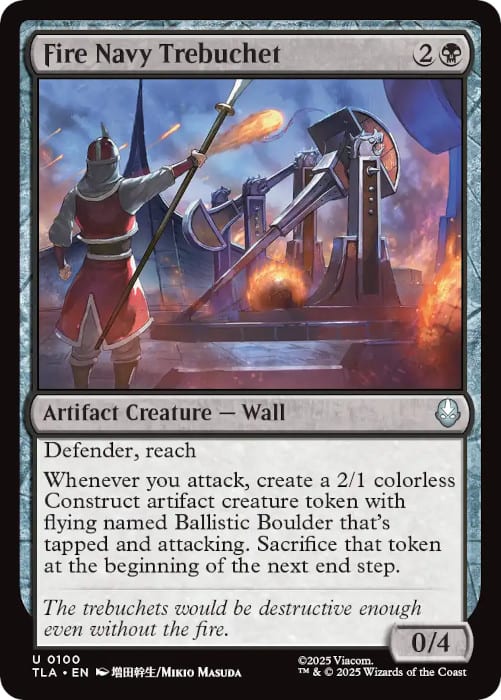
A bit over two years ago, Wizards of the Coast printed Mordor Trebuchet. It's nothing but a Limited roleplayer, but it's one I have a great fondness for. I'm apparently not the only one, as here's a riff in Avatar. Fire Navy Trebuchet trades a power for a toughness and gains Reach, and--crucially--loses the Orc or Goblin attack trigger in favor of any creature attacking. That's a huge upgrade, and it embodies the brilliance of Magic: these cards, once created, can be remixed and updated. A dozen choices were debated before the most anodyne of cards was printed, and every card, no matter how simple, means something in the larger context of its set and the larger context of Magic. Is Mordor Trebuchet better than Fire Navy Trebuchet? In most contexts, not directly, no, but in the ability to compare the two and to create hypothetical situations where it is, we understand Magic. Every heuristic we're taught through gameplay becomes important later as we analyze riffs off those previously-printed cards--it's a beautiful way to build player investment and connect with what makes the game Magical. Fire Navy Trebuchet will most likely never see a second of Constructed play, but I'll remember it as fondly as I do Mordor Trebuchet.
Gran-Gran

A one-drop depicting an elderly woman that filters cards upon tapping is perhaps the most unassuming card ever printed. Gran-Gran had a Jeskai Elder vibe in more ways than one, and while that's a fine card, it didn't define its Standard environment. But when that Elder can also serve as a Sapphire Medallion and doesn't even have to risk her life to filter a card, thanks to Crew and Station and Mount, she's a pillar of the format. An important reminder to respect our elders and to listen to them when they try to impart lessons. Notably, this gets us one card closer to a Sultai Grandmother typal deck along with Grandmother Sengir and Lily Bowen, Raging Grandma.
Boomerang Basics

Initially just a cute but uninspiring tie-in to the iconic Boomerang, Boomerang Basics does enough on multiple axes to define a Standard deck. On paper, Boomerang Basics is a temporary solution that has the added utility of bouncing your own permanent and replacing itself; in practice, and in the hands of Seth Manfield, it can take help take down the World Championship. As This Town Ain't Big Enough reminded us last year, bouncing your own permanents isn't a cost when they're the right permanents, and Boomeranging your own Stormchaser's Talent is a big game. Add that Basics is a Lesson, thus powering up your Gran-Gran and Accumulate Wisdom, you have a lot of utility in a very cheap package.
Abandon Attachments
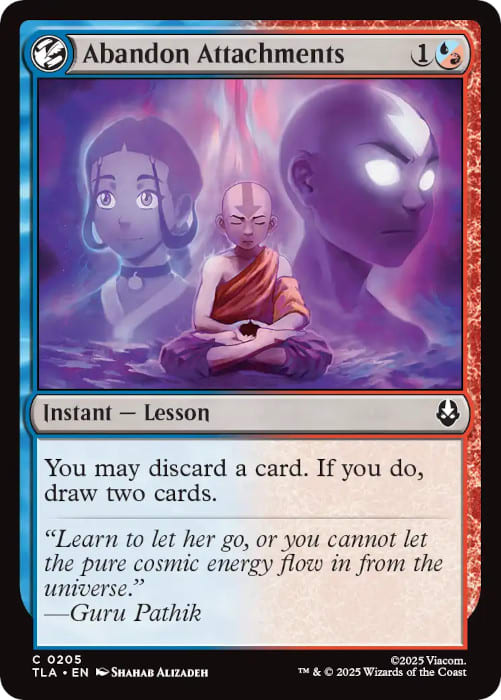
Cathartic Reunion has a decade-long history in Magic, even if it lacks a tournament pedigree. The original design was a bit clunky--by requiring a discard as part of the casting cost, you were setting yourself up to get two-for-one'd by an opponent's counterspell. Later iterations like Bitter Reunion and Witch's Mark gave minor additional upsides, and Highway Robbery and Kickoff Celebrations got a bit overcomplicated. Abandon Attachments is an extremely simple card--a Cathartic Reunion at Instant speed--but, like Boomerang Basics, that minor addition of the Lesson subtype changes everything. The current Izzet Lessons deck reminds me of the Champions of Kamigawa-Ravnica Izzet Magnivore deck, which was also a pile of dubiously-playable commons and uncommons that somehow furthered your deck's agenda just enough to prove more powerful in play than on paper. Twenty years ago, people laughed at the players registering Demolish and Sleight of Hand, and yet, those cards ramped up the velocity of the deck and powered up the Lhurgoyf.
Accumulate Wisdom

Back in February, we were having the debate of "Is Stock Up the best card selection spell printed since Brainstorm?" Now, at the close of the year, we know it wasn't even the best card selection spell slated to be printed in 2025. Accumulate Wisdom would be essentially fine as just an Instant-speed Strategic Planning, but with three Lessons in the graveyard, it's a two-mana Ancestral Recall (or one-mana, if you have Gran-Gran in play).
With Avatar, we got the critical mass of playable Lessons that we were missing in Strixhaven, and instead of running cards like Introduction to Prophecy, we get It'll Quench Ya! and Abandon Attachments. The designs of Strixhaven's Lessons were situationally useful cards you could fetch out of the sideboard; the designs of Avatar's Lessons are generally useful cards with the "Lesson" subtype appended, as we're not using Learn. Compare Airbender's Reversal to Reduce to Memory or Aang's Journey to Environmental Sciences, and you'll see the design shift. I don't think the Avatar Lessons are "pushed" so much as they are filling a different design niche--Lessons were initially meant to be a bonus to Learn cards in Strixhaven, while Avatar's Lessons are designed to meet a threshold for later spells. Still, we see the results: it's now trivial to draw three cards for two mana in Standard again.
There are other winners to be found at the lower rarities. Airbending Lesson keeps going up in my personal pick order, and Cycle of Renewal and Shared Roots mean we now have Rampant Growth and Harrow legal in Standard for the hyper-Landfall Tifa decks--but even if Avatar only contributed the above cards, it would still be a success. I've run into decks using Break Out or Manifest Dread to cheat out a Benevolent River Spirit--a two-uncommon Sneak Attack-like combo--and decks that are halfway to a Pauper brew with the number of Accumulate Wisdoms and Abandon Attachments they're running.
In reviewing these cards and recent 5-0 results, I'm inspired by how the format has shifted with the addition of Avatar--while some of the set's themes (Clues, Firebending) aren't showing up at the top tables, there are archetypes outside of the dominant decks that are using them and cards across the rarity spectrum showing up in even the top decks. Universes Beyond, at its best, is a way for Wizards to take inspiration and build a shared universe with an aligned popular property--it's clear that the design team loves Avatar and has adapted Aang's world with care and thought and has developed a complete Limited and Constructed environment, down to the commons. For example, It'll Quench Ya! is a reference to a specific moment in the show, but it's also a direct tie-in to Ravnica Allegiance's Quench, with the minor benefit of being a Lesson. It's a "hey, I get that reference" moment for both Magic players and Avatar fans, and, as a counterspell, one that leads to good stories. That, to me, is what Magic is all about: good stories that show up even at common.