 Locations



Card advantage is a popular theme and powerful strategy in Magic. The terms "two-for-one" and even "three-for-one" get thrown around more than a frisbee at a beach party. Classic examples include cards like Divination, but often the interaction during a game, such as during combat, can fuel the biggest of blowouts.
Did you know that there's a mechanic in Magic that basically bakes in a two-for-one right into the card? All you have to do is cast it and pay an extra cost, and guess what? Instead of the card going to the graveyard as it normally would, it instead goes back into your hand!
What ability does such a powerful thing, you ask? Say hello to one of my favorite classics, Buyback!
What's Buyback?
Buyback made its debut back in Tempest block, one of my all-time favorites and one of the first new sets I experienced when I first started playing back in 1997. Since then, Buyback has been reused sparingly, in Time Spiral block as well as Time Spiral Remastered and Modern Horizons. We haven't seen the mechanic back in Standard for a while.
Unlike some other old school Magic mechanics, Buyback has a simplistic, elegant design. The ability itself appears only on instants and sorceries (one play-test card exception), and has the ability, "You may pay an additional cost as you cast this spell. If the buyback cost was paid, put this spell into its owner's hand instead of that player's graveyard as it resolves."
Let's look at a quick example: Mystic Speculation from Future Sight.

Here we have a sorcery with the effect: Scry 3 for one Blue mana. For two extra mana - the Buyback cost - you can place this spell back into your hand as it resolves. Thus, Mystic Speculation acts like a split card of sorts:  to Scry 3 or
  to Scry 3 and keep the card in your hand.
A few noteworthy rulings associated with Buyback:
- Buyback returns the spell to your hand only if the spell resolves. If it's countered, the spell goes to the graveyard as normal.
- You can pay the Buyback cost on a copied spell, but since it's a copy and not the card itself, the copy will fizzle into nonexistence after it resolves.
- Similarly, if you flash back a spell with Buyback and pay the Buyback cost, you still don't get the card back - it'll go into exile upon resolution because of Flashback's replacement effect.
- Buyback costs don't count toward a spell's mana value, whether paid or not.
Since Buyback puts the spell back into its owner's hand, I hypothesize if you pay the Buyback cost on a spell you heisted using Arena's mechanics, the spell would go back into your opponent's hand. I'm not sure if this can actually be done or not, but it's a funny interaction to think about.
Noteworthy Spells with Buyback
Mystic Speculation is a simple example to demonstrate how Buyback works, but scrying for three repeatedly has diminishing returns since you'll be seeing some of the same cards repeatedly until you've drawn through them. You may ask if there are more interesting and impactful cards with Buyback.
In fact, there are! In total, I count 39 tournament-legal cards with Buyback across
Magic's 30+ year history. The most valuable of them all is Corpse Dance, from Tempest.

Reanimator is a perennially popular strategy in Eternal Magic, and cards that can cheat creatures from your graveyard directly into play are always popular. Even if the reanimation spell has limitations, if it can sneak something like Atraxa, Grand Unifier or Griselbrand into play for just a turn, the spell will see play. Corpse Dance's limitation is that you can only bring back the top creature from your graveyard (remember the days when the order of your graveyard mattered?). Having the creature in play for a turn, with haste, is certainly powerful enough to be worthwhile.
At the end of the turn, the creature is exiled. If you have another creature in your graveyard, then you can reanimate that one next thanks to Corpse Dance's Buyback cost. As long as you keep your graveyard filled with powerful creatures, 5 mana to reanimate and attack with one over and over again is a pretty good deal!
The next most popular and valuable Buyback card is Constant Mists.

This uncommon from Stronghold retails for over $10! I suspect Wizards of the Coast is hesitant to reprint it because it allows you to effectively cash in a land for a Fog effect turn after turn. Combine this with Crucible of Worlds, and your opponent can't ever damage you or your creatures in combat again.
That's the power of Buyback. Slap it on a card that says Scry 3, and it doesn't do much. Add Buyback to a powerful effect, and keep the Buyback cost too low, and you enter into a stalled-out game that no one can enjoy. Buyback can lead to some very repetitive gameplay.
Speaking of repetitive gameplay, one of the most controlling spells with Buyback has to be Capsize, a common from Tempest.

You could argue that being able to Boomerang a permanent repeatedly isn't very good if it costs 6 mana. During the first few turns of a game, you'd be correct. If you can manage to get to the late game with this card in hand, however, it can have a game-halting effect, especially if your opponent is playing a deck that struggles to cast multiple threats in the same turn.
Capsize can also combine with other prohibitive cards for extremely unfun games. Back in the 90s, I had built a deck that combined Stasis, Kismet, and Capsize to effectively lock my opponent out of casting spells or doing anything for the rest of the game.
 | 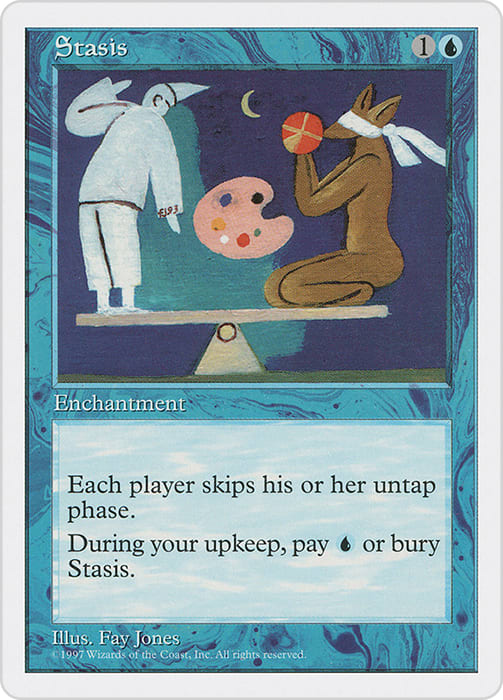 |
I'd cast Stasis and then Capsize it, with Buyback, at the end of their turn so that I could still untap. Then I'd cast Stasis again on my turn and repeat this combination until my opponent decked.
Yeah... it was really boring for everybody.
You know what else is miserable for everybody? A Counterspell with Buyback. Surely, Wizards would never have printed a card with the potential to create such an unfun atmosphere, right? Mark Rosewater would never approve of such a thing!
They did (and don't call me Shirley). Behold: the uncommon Forbid from Exodus!

Discarding two cards to keep a Counterspell in hand for repeat use may seem like a steep cost, but it's not so bad if you have ways of drawing extra cards repeatedly. In Commander, there are numerous ways to do just that, making Forbid a foreboding card to play against. Even if the card isn't overly powerful, it's still obnoxious!
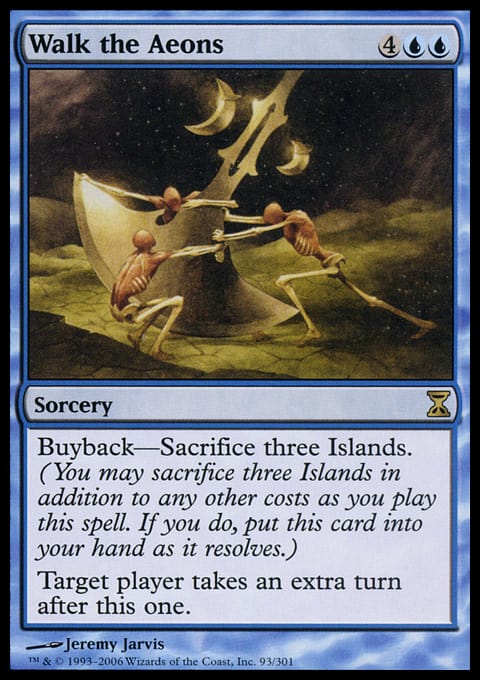
Speaking of obnoxious, how about a Time Walk with a Buyback cost? Yup, Wizards of the Coast gave us one of those too. Though, at least the Buyback cost on that one - sacrificing three Islands - is steep enough to keep this card from sucking too much fun out of a game.
We even have a Demonic Tutor with Buyback in Demonic Collusion.
 |  |
Five mana for a Tutor isn't a great mana cost, though. Being able to re-cast Collusion via buying it back by discarding two cards is also relatively unattractive. Thus, Wizards of the Coast did a fine job taking two classic cards and making them less playable even with the addition of Buyback. I'm not complaining, though. If they had printed these to be competitive cards, they would surely have been wholly unfun.
Let's just say I'm glad Wizards of the Coast is done experimenting with printing versions of Power 9 and other all-time powerful cards with Buyback. For now, at least.
Wrapping It Up and Honorable Mentions
Before wrapping up, there are two other cards that relate to the Buyback mechanic worth shouting out.
First, there's the artifact from Exodus that reduces Buyback costs by two generic mana: Memory Crystal.

Most Buyback costs come in the form of mana, so this artifact can transform a cost from being prohibitively high to quite competitive. Haze of Rage is a sorcery from Time Spiral Remastered that gives your creatures +1/+0 until end of turn, with a Buyback cost of two generic mana and Storm. With Crystal out, you can cast Haze of Rage over and over again, buying it back for free and exponentially growing the power of your board. For two mana you get +1/+0, for 4 mana it's +3/+0, for 6 mana it's +6/+0, and so on.
Lastly, there's the sole creature printed with Buyback: a Mystery Booster play-test card call Innocuous Insect.
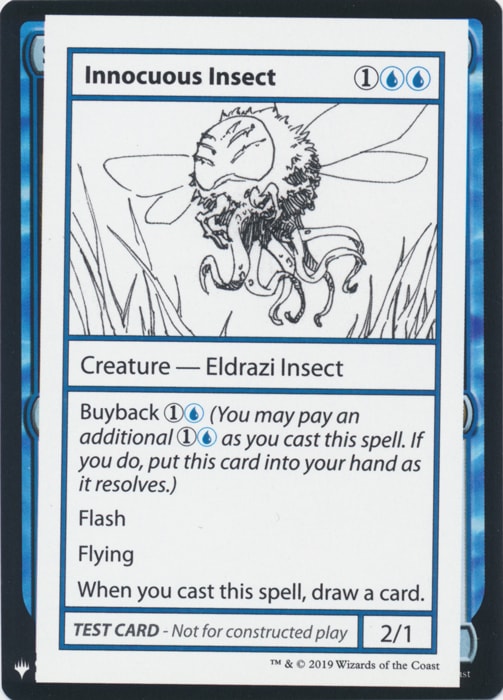
While placing Buyback on a permanent seems weird (if you pay the Buyback cost, the card stays in your hand), it leads to some interesting possibilities with cast triggers. With Innocuous Insect, you can pay at instant speed to draw a card and keep Innocuous Insect in your hand. Alternatively, for  you can let your Innocuous Insect hit the battlefield, giving you a card and a 2/1 flying creature. This opens up some very interesting design space!
Unfortunately, I'm not sure we're going to see Wizards of the Coast explore this or other Buyback design space much in the future. At least, not in very many Standard sets. Buyback is an 8 on the Storm Scale, meaning the stars would have to align to bring the mechanic back to a Standard set. Mark Rosewater shared in 2023 that they tried to bring Buyback back with Journey Into Nyx, but failed.
Honestly, I'm not complaining. While Buyback gives me all sorts of nostalgia, it also reminds me of how repetitive and unfun Buyback cards can be in a game of Magic. Being able to reuse your spells over and over again sounds powerful and interesting in theory, but in practice it leads to a stale play experience. Maybe it's best if for now, Buyback isn't brought back... at least not without a significant face lift.