


 Locations


It's not often that I run into a Commander deck so different, so interesting that I'm compelled to devote a column to talking about it, but that happened to me earlier this month. If you've ever played a large portion of an EDH game under a Possibility Storm, you may have a glimmering of an idea of what today's deck is like, only it's worse... or better... or maybe just weirder.
Most commander players have at least a few decks, play them a lot and are very familiar with what cards are in them and what they can do. They know the lines of play they are looking to follow, and they know what a good or bad topdeck might look like at any stage of the game.
What if the game were turned on its head?
What if instead of drawing from your own library, you instead drew from an opponent's library?
How would your experience of the game or your enjoyment of the game change?
That question is at the heart of today's column as we explore a deck built by Kyle Sumner, a Magic and Warhammer player who works at Tabletop Nexus in Plaistow, New Hampshire.
Before we dive into the deck, let's take a quick look at the deck's commander and the key card that is the centerpiece of this fantastic experiment in EDH deckbuilding.
 |
 |
Kyodai, Soul of Kamigawa is the commander for this deck, primarily for its ability to be cast at instant speed and to give another permanent indestructible for as long as you control Kyodai. The last ability on this 3/3 flying Dragon Spirit is rarely relevant for this deck, but it can give itself +5/+5 for five mana.
The inspiration for this deck is a five-mana enchantment from Mirrodin that turns the game on its head. If Shared Fate is in play, you no longer draw from your own deck. Instead you remove the top card of an opponent's library from the game face down. Each player can look at and play cards from their pile of exiled cards as though they were in his or her hand.
It's worth noting that if Shared Fate were to leave play or if the player who owns Shared Fate were to be removed from the game, all of those cards would remain in exile but players would no longer be able to look at or play them. They would again be able to draw cards. A new instance of Shared Fate would start a new set of exiled cards tied to that new enchantment.
Meet Kyle Sumner
I got to know Kyle Sumner when I started playing EDH on Saturdays at Tabletop Nexus in Plaistow, New Hampshire - though we had played years before at NexGen Comics in Pelham back when I ran a casual EDH league at that store. They work at Tabletop Nexus and play both Warhammer 40k and Commander there regularly.
They're nonbinary, so I'll be using them/them a lot in this column. Sporting a ponytail, a range of facial piercings and a genuinely nice disposition, Kyle at once puts you at ease and communicates the kind of "all are welcome" attitude you'd hope to find at every LGS you might play at.
Kyle's path to playing Commander started when they were a kid, trading Ninjago legos with a friend who had been building Pokemon decks. They got into TCGs through Pokemon, played some Yu-Gi-Oh in High School, and eventually met a Yu-Gi-Oh player who got them to try Magic. In 2014 and 2015 they were playing slivers but it took a few years before Shadows over Innistrad and Eldritch Moon came out and Kyle started buying booster packs and paying attention to the Magic story. Eldritch Moon is still their favorite set of all time, quite possibly because that set was when they really got into the game.
The Evolution of a Deck
Today's Kyodai deck has a bit of a story behind it. While it's easy to think of most commander decks just being the product of a few good ideas, some in-store purchases, and maybe some trading, most long-time players have decks that have evolved through many different versions to become the decks they are today.
Kyle's Kyodia deck was inspired by Their buddy Greg's Jeleva chaos deck. That deck had cards like Possibility Storm, Scrambleverse, and Warp World. That chaos deck also ran Shared Fate, but wasn't the focus of the deck and Kyle couldn't stop thinking about how a deck would play with Shared Fate as its centerpiece.
It's worth noting that the deck might not exist but for Tabletop Nexus. When Kyle came to the store, the owner Andrew got Kyle into Warhammer. The starting costs of getting into Warhammer are fairly steep, so Kyle decided to sell off much of their Magic collection. You need hundreds of dollars just to get a complete army on board, so Kyle stopped collecting Magic and just focused on playing Magic. Moving to proxies for their more expensive cards made a lot of sense, but Kyle decided not to sell out of Magic completely in order to keep a handful of "signature" decks.
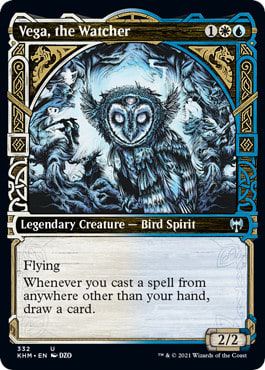
Kyle kept a 99 lands Child of Alara deck, a Muldrotha Shared Fate hug deck and a Jared Cathalion / Omori, the Collector "oops all planeswalkers" deck. The Muldrotha deck had originally started as a Vega, the Watcher Shared Fate deck, and that is what evolved into the Kyodai brew they play today.
 |
 |
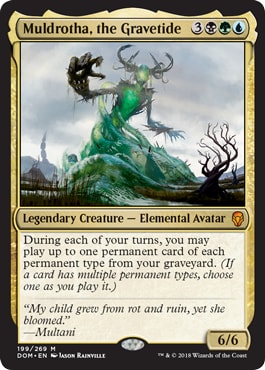 |
This deck's first version, built around Vega, the Watcher, was built to take advantage of Vega's card draw ability when you cast spells from anywhere other than your hand. Kyle then moved the deck over to Oloro, Ageless Ascetic as a way to help pad their life total while working to get and play Shared Fate. The pivot to Muldrotha was based upon a desire to easily recur Shared Fate from the graveyard if and when it gets removed.
The latest change over to Kyodai, Soul of Kamigawa was inspired by wanting to be able to protect it, along with a self-confessed "greedy" desire to have access to all five colors. Kyle wanted to be able to play a critical mass of wheel spells and ended up with a 5 color hug deck that leans on wheels to get to Shared Fate.
If you're an entrenched Commander player you're probably familiar with seeing a deck evolve from version to version. I've been regularly updating my mono-Red Goblins deck for years and it has changed commanders multiple times. What I did largely out of boredom and wanting to try something a little different just to vary my play experience, Kyle was doing with a keen eye for how to get the deck to function more smoothly and effectively. In my experience it's rare to find a casual EDH deck that has such a unique gameplan, and that has been honed and updated over the years to better play the game it's trying to impose on the table.
The Game Plan
Shared fate is not a "good" card.
Kyle didn't build this deck in order to win more games. They built it to turn the game upside down, shake it real hard, and see if they can get a little fun and excitement to fall out of their tablemates' pockets.
Shared Fate forces players to interact with each other in ways they often don't have to do, and to solve a kind of puzzle they may have never encountered in the course of playing Commander.
To quote Kyle...
"You're mechanically engaging with the social element of Commander through your cards, and I think that's really cool."
To be clear, winning is still winning, but when playing this deck Kyle considers it something of a victory to have stuck Shared Fate and resolved a wheel. When that happens, everyone discards their hand and then exiles cards from other players' libraries into their own "shared fate pile". They can play cards out of that pile for as long as that iteration of Shared Fate remains in play.
Suddenly everyone has to radically change their plan for how they want to try to win the game. They have to decide which opponent's library they will "draw" cards from, and it becomes a much more interesting and challenging puzzle to solve than just playing out your deck like it was a "normal" game of EDH.
You can't draw from your own deck, and Kyle encourages players to draw from their deck, as Kyle is running hug cards with no real wincons or ways to remove Shared Fate. If enough cards get drawn from the Shared Fate owner's deck it can turn into something like a sunk-cost fallacy.
If they kill the person playing the Shared Fate deck, they'll lose access to all of those cards that were exiled and available only thanks to Shared Fate. It might be the right choice to go after Kyle, but it can be easy to convince them to attack elsewhere so they don't lose that pile of cards.
Key Cards
When you are playing a deck that is designed to force players to play from each others' libraries, you end up having games where your key cards end up being stuff you never put into the 99 of your deck. Kyle has had a game where they went infinite with one player's Basalt Monolith and another player's Rings of Brighthearth.
The deck's main gameplan is pretty much limited to the turns up until Shared Fate hits the field. Kyle generally waits until they can play it with four mana available to cast Kyodai and make Shared Fate indestructible. Protecting the deck's centerpiece is always a concern.
The turns leading up to where they can make nine mana are where the deck's key plays happen. Setting up a value engine in preparation for everyone losing their hands and playing cards from exile is going to heavily impact how well the deck ends up playing in the mid and late game.
 |
 |
 |
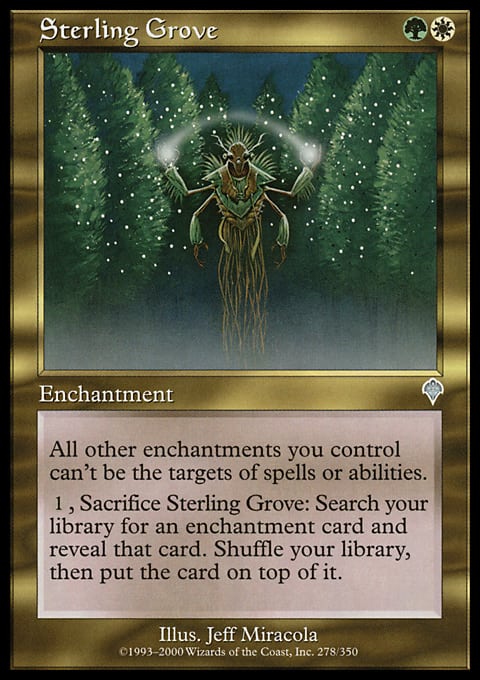
Sterling Grove serves two purposes in this deck, both of which are really important. This two-mana Selesnya enchantment will give Shared Fate shroud, meaning it can't be targeted by anyone. To get rid of Shared Fate with targeted removal you'll likely have to get rid of Sterling Grove first. It also has an activated ability that lets you pay 1 mana and sacrifice it to search for an enchantment and put it on top of your library.
This deck is built to do everything it can to avoid having players play their own cards, but if someone else has played Sterling Grove and Shared Fate is out, they won't be able to draw a card they put on top of their library. In fact, Kyle wants to avoid players accessing their own cards so much that they are running things like Teferi's Puzzle Box, which will serve as a check against anyone tutoring a card to their hand and trying to play that card on a later turn. Puzzle Box has you "bottom" your hand and then draw that many cards at the start of your turn, so if you luck into a tutor-to-hand card you had better use that card immediately.
Recursion was easy when this deck was running with Muldrotha, the Gravetide in the command zone. Under Kyodai, Kyle leans on a few cards including Hall of Heliod's Generosity. This legendary land can tap for a colorless mana, or for one and a White it can tap to put target enchantment card from your graveyard on top of your library. That ability will help get the deck back on track if Shared Fate has been put into the graveyard.
 |
 |
 |
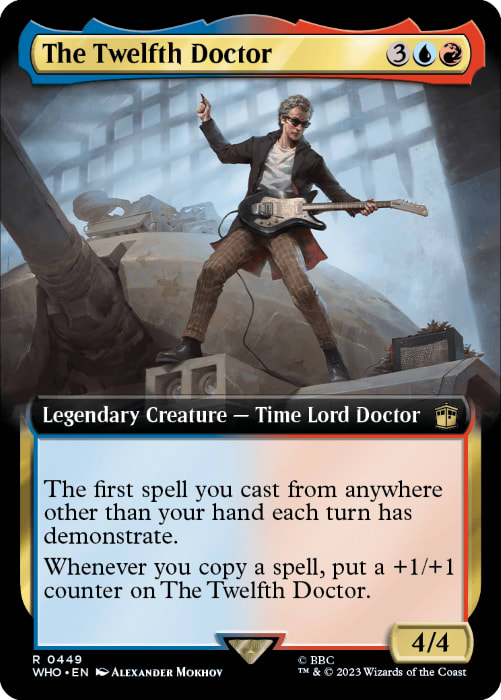
The Twelfth Doctor lets you demonstrate the first spell you cast from anywhere other than your hand. That means you may copy it and choose an opponent to also copy it. Whenever you copy a spell, you'll put a +1/+1 counter on The Twelfth Doctor. Copying spells like this with at least one hug deck (sometimes two) at the table can result in a "giga hug" game where folks are drawing cards and making mana at an incredible rate.
Kyle has had the fun of watching a tablemate play this card from the top of their deck while under Shared Fate. The tablemate read the Time Lord's textbox carefully, and Kyle got to see the realization of how much nonsense they'd be able to get up to slowly wash over their face, followed by an exclamation of "I'm going to have SO much fun on my next turn!"
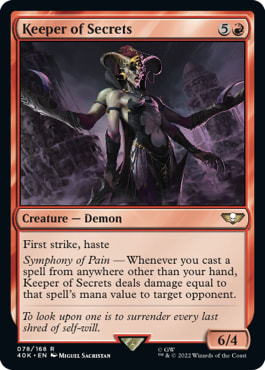
The only really concrete wincon in the deck might be Keeper of Secrets. This six-mana Demon is like a Warstorm Surge for what Shared Fate brings to the game. Whenever you cast a spell from anywhere other than your hand, Keeper of Secrets deals damage equal to that spell's mana value to target opponent. If you're not running this in your Etali, Primal Storm deck or your Possibility Storm chaos deck, you should give it a look.
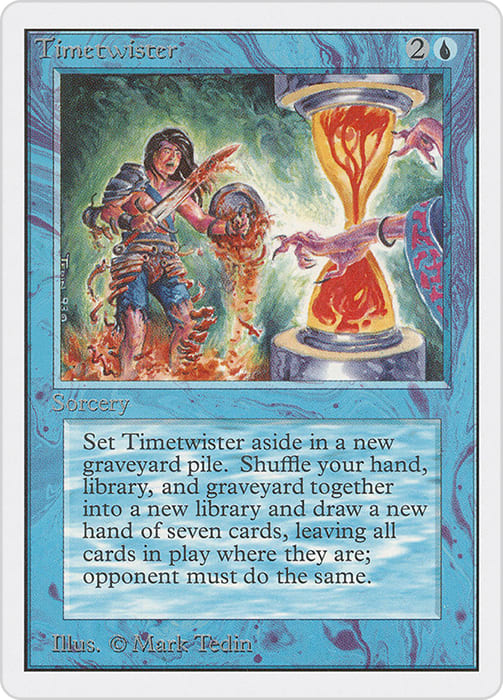
The elephant in the room in terms of budget for this deck is definitely Timetwister. Lots of players proxy cards, and when Kyle got into Warhammer they started proxying expensive cards and became more of a player than a collector. Timetwister does everything this deck wants in terms of wheels. Not only are you losing your hand, but you are also shuffling your graveyard back into your library. The cards exiled under Shared Fate are untouched, but this sorcery spell helps to keep players from playing cards from their deck either out of their hand or out of their graveyard.
When Things Go Wrong
If Kyle isn't able to pull into Shared Fate, the deck becomes a 5/c hug deck. It can be particularly deflating to have your Shared Fate get countered and have it stuck in the graveyard. The entire point behind the deck is to play and protect that old five mana enchantment. If a way to recur Shared Fate isn't readily available, it's hard to be excited about how the rest of the game will go.
You've got Kyodai as a 3/3 flyer that can be pumped +5/+5, but at its heart this is a hug deck. It's just not built to stop someone else from running away with the game. There are a few cards like Cybernetica Datasmith that can give another player 4/4 tokens to help balance out the game, but a hug deck's gonna hug.
If Shared Fate does get into play, it's possible to have a bit of a stalemate. If folks are drawing from each others' decks but the cards aren't really helping to progress anyone's board, the game can turn into a bit of a slog. Boardwipes will definitely slow things down. It's important when piloting the deck to remember that your real goal is less to achieve a conventional win as it is to enjoy having the players experience the game in a different and unconventional way.
Kyle hasn't ever had anyone get genuinely upset about playing against the deck, but they've been fortunate to play in relatively healthy playgroups. They do love to play the deck into a pod that isn't familiar with it. Sometimes opponents are excited about it. Sometimes not so much.
Kyle tries to hit a balance of telling players it's a "chaos hug" deck, but they see how it could be looked at as something of a stax deck. They are playing a deck that keeps players from playing their own cards. Usually there's at least one player who can reassure the rest of the table that the "surprise" of the deck isn't some degenerate cEDH wincon that will make it a non-game.
There have also been games where another hug deck is at the table and the two decks play "giga hug", drawing from each others' libraries and giving everyone just a ton of mana and card draw. This is definitely the kind of deck where there can be a lot of variance in how it plays, but also a lot of depth of possibility.
The highs when playing a Shared Fate game can be higher than playing a normal EDH deck into a normal pod.
Kyodai Shared Fate
At this point it's worth sharing the decklist. Keep in mind that this list is not tuned to be able to play against high powered decks and might even struggle against people playing bracket 3 decks with a real focus on winning. On some level we are all playing to win our games of Commander, but if you think your tablemates are going to be super focused on keeping your Shared Fate from ever hitting the table you might consider playing a different deck.
To some extent I can't blame someone for wanting to stop this deck from doing its thing. I build my decks to play them and I play enough new brews that it's rare for me to be interested in some weird experiment that will have me drawing from other players' libraries. I can tell you that if you can find a table where folks are open to this kind of experience, it can be a lot of fun. Kyle has had players excitedly plan out decks that they think will be super fun or just really interesting to play in the environment that Shared Fate creates.
Kyodai, Soul of Kamigawa EDH | Commander | Stephen Johnson
- Commander (1)
- 1 Kyodai, Soul of Kamigawa
- Creatures (16)
- 1 Argothian Elder
- 1 Cybernetica Datasmith
- 1 Flumph
- 1 Gonti, Night Minister
- 1 Humble Defector
- 1 Kami of the Crescent Moon
- 1 Keeper of Secrets
- 1 Kwain, Itinerant Meddler
- 1 Magus of the Wheel
- 1 Scrawling Crawler
- 1 Seizan, Perverter of Truth
- 1 Selvala, Explorer Returned
- 1 Tatyova, Benthic Druid
- 1 The Twelfth Doctor
- 1 Vega, the Watcher
- 1 Zhur-Taa Ancient
- Spells (19)
- 1 Jace Beleren
- 1 Abrupt Decay
- 1 Boros Charm
- 1 Case the Joint
- 1 Enlightened Tutor
- 1 Cultivate
- 1 Day of Judgment
- 1 Day's Undoing
- 1 Echo of Eons
- 1 Fractured Identity
- 1 Kodama's Reach
- 1 Minds Aglow
- 1 Rampant Growth
- 1 Supreme Verdict
- 1 Time Reversal
- 1 Time Spiral
- 1 Timetwister
- 1 Wheel of Fortune
- 1 Wrath of God
- Enchantments (11)
- 1 Curator's Ward
- 1 Dictate of Karametra
- 1 Dictate of Kruphix
- 1 Mana Flare
- 1 Mirrormade
- 1 Rhystic Study
- 1 Rites of Flourishing
- 1 Shared Fate
- 1 Sterling Grove
- 1 Tenuous Truce
- 1 Well of Ideas
- Artifacts (15)
- 1 Arcane Signet
- 1 Chromatic Lantern
- 1 Chromatic Orrery
- 1 Coveted Jewel
- 1 Fellwar Stone
- 1 Ghirapur Orrery
- 1 Gilded Lotus
- 1 Howling Mine
- 1 Prismatic Lens
- 1 Sol Ring
- 1 Sonic Screwdriver
- 1 Swiftfoot Boots
- 1 Teferi's Puzzle Box
- 1 Temple Bell
- 1 The Celestus
- Lands (38)
- 5 Forest
- 4 Island
- 1 Mountain
- 5 Plains
- 3 Swamp
- 1 Archway Commons
- 1 Bazaar of Baghdad
- 1 Command Tower
- 1 Crossroads Village
- 1 Exotic Orchard
- 1 Gateway Plaza
- 1 Geier Reach Sanitarium
- 1 Hall of Heliod's Generosity
- 1 Moonring Island
- 1 Night Market
- 1 Rainbow Vale
- 1 Rupture Spire
- 1 Temple of the Dragon Queen
- 1 Thespian's Stage
- 1 Thriving Grove
- 1 Thriving Heath
- 1 Thriving Isle
- 1 Urborg, Tomb of Yawgmoth
- 1 Valgavoth's Lair
- 1 Vesuva
Normally this is where I'd share suggestions on how to move a decklist up or down in power to try to get it to fit into your playgroup or LGS's meta more comfortably. That doesn't make a lot of sense here, but it is worth noting that building this exact list in paper will be a challenge. A few hundred dollars for Wheel of Fortune might not be out of your budget. Several thousand dollars for Bazaar of Baghdad and Timetwister is another matter entirely. You'll probably want to proxy those or look at making changes to the list.
Replacement Cards
Lots of us avoid using proxies outside of cEDH, where they are more generally accepted. Lots of us also don't want to just take a list found online and play it without making our changes in order to make it our own.
Whether you're changing just the two high price cards, or you're planning on making a lot more changes, there are some things to keep in mind. This list was designed around two basic principles. Kyle didn't want to see players playing with their own cards, and they also didn't want to give anyone cards that would help to remove Shared Fate.
To quote Kyle once more...
"I thought it would be cheeky and fun to deny players their own cards in favor of 100 other people's cards. If you're not doing that, your Shared Fate will need less protection than mine because I am mostly a hug deck. I am a hug deck unless you don't like how I'm hugging, and then my deck is engineered to stop you from stopping me."
There are a few cards that might be worth looking at if you were going to drop cards out of Kyle's list. The first is Jace's Archivist, a three mana Vedalken Wizard that can tap for a Blue mana to Windfall the table. This deck is all about wheels so Windfall-on-a-stick fits right in.
 |
 |
 |
Blood Scrivener is a two mana Zombie Wizard who will have you draw two cards and lose a life if you have no cards in hand. Kyle had it in an earlier version of the deck and had times where a player had to kill it with a wheel on the stack or they'd end up drawing 14, losing 7 life and dying. It's an interesting way to weaponize those wheels but it isn't in the current version of the deck.
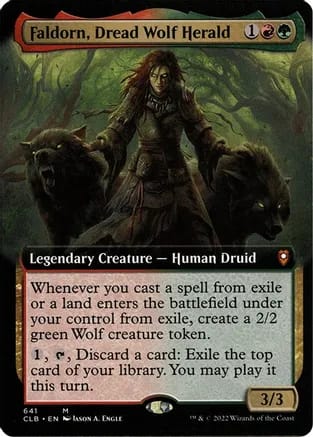
If you like wolves, you surely know Faldorn, Dread Wolf Herald. This three-mana Gruul human druid has you create a 2/2 Green Wolf whenever you cast a spell or play a land from exile. It isn't in the list because it gives you access to the top card of your library, and Kyle wanted to avoid letting players do that. Other cards that give "impulse draw" are similarly out of consideration for Kyle's deck but your version doesn't have to be quite as strict.
Skull of Orm is a three-mana artifact that can tap for five mana to return an enchantment card from graveyard to hand. It again breaks Kyle's restriction on playing cards that let you access your library or graveyard, but it's an option as a way to get Shared Fate from the graveyard back to your hand.
If you're going to stray from this list you will need to decide if you're going to follow any restrictions on what cards you will include in your version of the deck.
Do you want to have any "real" wincons beyond Keeper of Secrets?
Do you want to strictly prevent players from accessing the cards in their deck once Shared Fate hits the field?
There's no right answer, and there's always room to try some cards out and then change the deck a bit and try something else.
Final Thoughts
If you've gotten this far, I suspect you're not the kind of player who can only imagine playing a Commander deck that's finely tuned, well optimized, and designed to win at all costs. This is the kind of deck that can be incredibly fun to play and fulfilling to pilot, but you may need to change your expectations.
Winning doesn't have to only mean winning the game.
You can set a goal, as Kyle did when they told me the deck "wins" when they play Shared Fate and wheels the table. That doesn't mean they aren't also trying to win the game, but it's a more fulfilling challenge to win from under a Shared Fate. You have to cobble together your win out of cards you never imagined would be on your battlefield.
You might go infinite with cards from two other players' decks. You might beat everyone to death with Dragons, when you entered the game on an incredibly janky Kithkin deck. The fun is in the experience of letting go of your previous expectations and seeing where the game takes you.
I'd like to thank Kyle Sumner for letting me interview them and put together this column about their deck. It was a headache to play against the first time, but also a treat, and I'm looking forward to seeing it again at some point. If it wasn't such a neat concept, I probably wouldn't have been driven to have to write a column about it, but I'm glad I did.
This week was going to mark the transition from writing about Final Fantasy commanders to writing about Edge of Eternities, but I've got a Falcon I want to build a deck around and I might just write a column about it.
Thanks for reading and I'll see you next week!