 Locations


 In the simplest of terms, Magic the Gathering is a turn-based game. Each player takes turns playing land, casting spells and so forth. When they are finished, the turn is passed to the opponent. Excuse the rudimentary MTG lesson, it has a point. Fundamentally, turns are the core of Magic. Why then are so many of us willing to ignore that premise and 'waste' these precious things. Such a powerful effect is missing a turn, that it is represented in the Power Nine with Time Walk (the two mana cost is another factor). As of Magic 2010, taking an extra turn (or consecutive turns) runs you five mana in mythic rare form. However, the basic effect of Time Warp is often duplicated by unwitting duelists. These are players who do little or nothing to secure victory during a time when that is all they should be focused on.
[caption id="attachment_4037" align="alignright" width="239" caption="not the ideal image for a wizard"] [/caption]
Working towards victory means casting spells, fixing mana, tutoring up a combo piece, attacking, or even simply drawing more cards. When a player makes the mistake of doing none of the above it means, for all intents and purposes, their opponent played Time Warp for free. Strangely this is all too common among casual gamers. Even decks like turbo-fog are active drawing more counterspells and more fog effects. Yes, not playing spells does not equal not trying. Doing nothing at all? Well that is a different beast all together. In tournament MTG this kind of thing is laughable. The mantra for serious competitors remains, 'each turn brings me closer to winning'. Passing on a turn mid-game simply isn't done.
Turn-wasting comes in two forms. The first, as described above is willful lack of aggression, like having Silence played repeatedly. The second type of wasted turn comes at during the deciding moments of a close duel. The dead drawing in these moments can kill your chances at a win. In a battle of evenly matched forces drawing an eighth land can decide the game. Especially when the opposing side continues to draw killer spells. More than my fare share of game have been decided in this manner. For good and bad. Top-decking is nothing new to MTG and we certainly are not re-inventing the wheel by explaining its importance. It is the former example of squandering that needs correcting. Something that takes place during more important turns of a game.
[caption id="attachment_4038" align="alignleft" width="226" caption="avoid if you can"]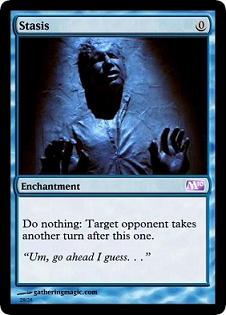 [/caption]
The idea is that turns can be ranked in order of importance and that ranking holds basically true each game. At least in a general sense. The more jaded wizard would say, 'your last turn is most important dummy.' That is rarely the case. Another theory goes that each turn is exponentially more important than the last, so holding on to cards and attackers for the coup de grace is smart. Again, that idea is generally a false one. The most important turn of an MTG game are in order: turn five, turn four, and turn six. And they should be treated as such. In fact let us just call them the Power Turns. Any inventive wizard should shuffle their newest deck, deal a one-sided game and see where they stand at the end of each of the Power Turns. If they find it difficult to execute their strategy by turn six then back to the drawing board. A good duelist need not always win on of before that point. However it is important that spells are played, mana is fixed, and the strategy takes shape during and hopefully before that point. Anything less, and it's a free Time Walk. With one major exception.
Multiplayer is a safe-house built to harbor those devious few choosing not to take advantage of the Power Turns. As criminal is it may be in one versus one, skipping these turns can be forgiven in multiplayer if not endorsed. The format's general principles show protruding nails get hammered back down. It pays to stay quiet. Or at the very least stick to mana-fixing. Once again multiplayer empties some from the skill bucket to further fill the fun bucket. But this is the exception to the rule. In single player formats such inactivity means losing.
[caption id="attachment_4039" align="alignright" width="227" caption="this is more like it"] [/caption]
All is not lost for those more sloth-like duelists. It is quite easy to fix this hampering issue. First, respect the mana-curve. It is pretty hard to cast spells on turn three when everything in your deck costs four. In fact this is such a simple rule of thumb it seems redundant to even write here. But due diligence must allow it, so a brief missive regarding turn use: Turn one is an acceptable skip, although anything here is a bonus as the opponent will also likely play nothing. Second turn and third turn are much more pressing. Not playing a spell or attacking may be forgivable during one or the other, but never both. And if three turns pass with only land drops then there better be an excellent back-up plan. During the Power Turns it is even more vital to cast, attack or activate something each turn.
The second fix is even more straight-forward. When faced with a dilemma between doing something or waiting (doing nothing) always choose the former. Nothing makes an opponent happier than waiting patiently for you to unleash holy hell then hearing, 'go ahead.' Doom Blade that Soul Warden instead of waiting to see if something better comes. Even if it does a key-piece was knocked out of the opponent's puzzle. This is not an endorsement of rash behavior in MTG, just a friendly nudge in the 'do-something' direction.
Consider this a public service announcement. Or a wake-up call. Eveyone playing MTGO, or sitting around the living room, or at the local coffee house may not yet realize. Turns are too important to let slip by and yet it happens all too often. Time is a wasting, and that is never a good thing.