


 Locations


-Mike Tyson
Everyone has a plan.
Plot Slickshot Show-Off to keep it away from Sorcery-speed removal. Add a friend, maybe. Explode them out for a heck of a turn.
Let your opponent land Jeskai Revelation. Get their mana good and tapped. Wipe away two Monk tokens (and all their prospects for winning this game) with a Deadly Cover-Up with Collect Evidence.
Play two Lands per turn with Icetill Explorer. Go wide. Wider than that. Win by about a thousand.
Everyone has a plan.
We can understand the games where the plans go off. If anything, we point at the ones where the plans go off and you somehow manage to lose as the ones worthy of review.
But what about all the other games? The ones where you didn't lace together A + B quite perfectly, but won anyway. Did your opponent slip? Did you get a free turn you didn't quite realize?
Many of these games seem random. We chalk them up to luck. But like many human experiences, they come up over and over. They actually help to give Standard structure.
Meaning they might not be that random after all. We might not be able to win coin flips every time, but we can identify them ahead of time and plan for some of them. Maybe we can at least identify that the game might be decided by something other than perfect execution.
Here are eight common play patterns that can determine games, even if they seem random or driven by luck.
1. Tablet of Discovery Gets Value on Turn Three (Or it Doesn't)
We've been saying from the first that Tablet of Discovery is the rare "mana rock" that you don't want to play on time. If you play it on turn three (at least with the initial decks we looked at) you were slicing off half of the Tablet's potential value.
 |
People have been twisting their spell selection from great cards like No More Lies to expensive weirdos like Swallowed By Leviathan just to accommodate the Tablet's contribution to the mana base.
But what if you do play it on turn three?
Why might you do that?
And can you profit?
Well, there are a number of valid reasons to play your Tablet on turn three. For example, you want to defend yourself with a four-mana sweeper the next turn and you don't have a fourth Land in your hand. Or you want to have five-six mana on turn four to help ensure you can play Jeskai Revelation on turn five. Or you're under pressure and every micron of speed counts. You don't need to extract every ounce of potential card advantage as long as you live. You're playing the biggest thing (and that's enough to win). The question is if you can live.
So, you play your Tablet on turn three. You even flip over a Steam Vents that you now absolutely, positively, can't deploy as a bonus. Does life just suck?
Remember just a moment ago when we talked about reworking decks to accommodate cards like Swallowed By Leviathan? Many Tablet of Discovery decks have cut Lightning Helixes to play more Sears, more Abrades, and cheaper options like Firebending Lesson or Thunder Magic.
Life might or might not suck... For the opponent! The Lessons version is even more likely to win the lottery on a turn-three Tablet. They can cast Abandon Attachments, a de facto card drawing spell, with Red mana.
What's the lesson here?
Just know you can do this if you're on the Tablet side. A little less greed might buy you an extra game or two per Event.
2. They Can't Cast Tablet of Discovery When They Want To
This is something that comes up more than you might imagine, despite the fact that most Tablet decks these days have a heavy percentage of Red-producing Lands.
Because the most important red-producing Land in Standard is Great Hall of the Biblioplex, which can tap for Red... But not a kind of Red mana that can cast a Tablet of Discovery.
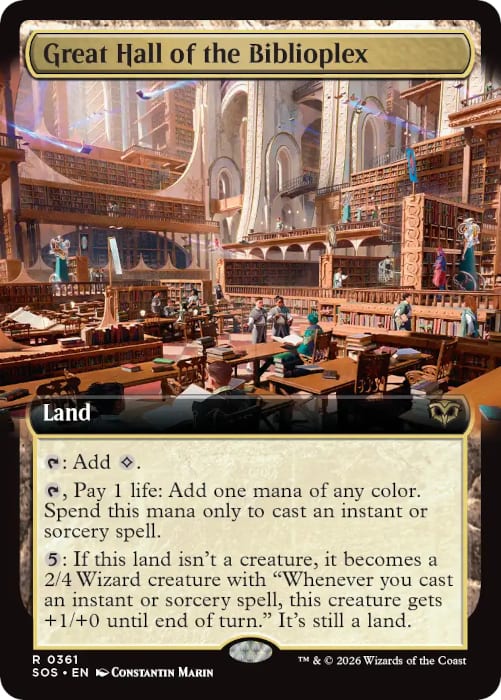 |
Obviously, an inability to cast your Tablet when you want to can mess up your curve. Say you already have Sear and you wanted to cast two spells. Or you have your next Land in hand already and you were setting up a quasi-discounted Stock Up. Maybe you'll have to Stock Up first, find the right mana and be completely backwards on your strategy and spell deployment. Needless to say, an "aware" opponent will be able to bury you on this kind of stumbling.
What's the lesson here?
This is just a condition of the Standard mana bases. You can't really plan to have a better or worse color distribution.
3. They Can't Cast North Wind Avatar on Time
This is a redux of the "Tablet of Discovery" issue one stumble up.
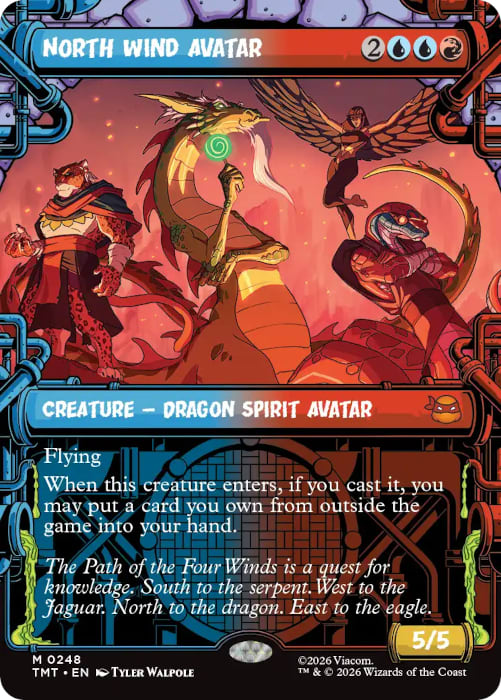
Great Hall of the Biblioplex can make Blue, but not the kind of Blue that necessarily summons a Dragon. This can be extra complicated because North Wind Avatar has  in its casting cost. What if you have a Starting Town for the first ... But rassin' frassin' stupid Great Hall!? Am I right?
North Wind Avatar is an increasingly interesting card to experiment with, especially since the arms race we started to talk about last week.
 |
Because you might get Covered-Up after casting a Jeskai Revelation, hiding the fourth copy in your sideboard... Where it's out of Deadly Cover-Up reach (but an Avatar can keep your hopes alive) creates some strategic complexity.
Is Jeskai Revelation really the most powerful thing? When we start opening up card choices beyond what one would reasonably play in a main deck, you can literally shift the rules of engagement In Game 1! You get access to "I win" cards like Riverchurn Monument and "I win more" ones like Outrageous Robbery.
For me, I think North Wind Avatar is a cool thing to try, because I was always interested in tapping out for Keiga, the Tide Star, and Together As One is super clunky. A giant Dragon blocks to save you just as much life total, and whatever it's getting is probably worth more than one card.
What's the lesson here?
Ditto on the last point, only magnified. Personally? My increasing reaction based on shifting win rate is to not play the North Wind Avatar version. You buy some ceiling but give up a ton of consistency.
4. They Either Have or Don't Have the Counterspell
You'll often see a streamer send out a Jeskai Revelation at the end of the opponent's turn and then say they don't care if it resolves. I mean... Resolving the best threat in Standard and then untapping with a pair of Monks is pretty much what you want to be doing if your deck can do that... But I think we all probably take their meaning. They might eat an It'll Quench Ya! or a No More Lies, but their plan is to untap and take another swing with Jeskai Revelation #2 or perhaps a Capstone.
Of course, there are other spots where you desperately need the four life from Revelation, and the Monks to chump, and a Spell Pierce is the last thing that you want to see.
That begs the question of whether Counterspells are even good in a particular matchup.
Both Superior Spider-Man and Kona, Rescue Beastie decks can beat you on the spot with a Cavern of Souls, erasing all the certainty you had when keeping your opener.
Some decks, like the Mono-Blue variant on Spellementals, use primarily Counterspells to control the pace of the game. They are making Eddymurk Crabs and Sunderflocks, yes, but permission is how they make sure they don't lose while they're building up a 5/5 or two.
Standard is a pretty elegant format right now. There might be a little too much Izzet Aggro-type, but the mid-game can be a pretty fun dance to watch.
What does a Mono-Blue deck do about Inevitable Defeat? It turns out you can Bounce Off your own Creature. That's not great, but it's something, it's in the range, and it can influence the outcome of games, even the ones where the player with the Defeat assumed defeat for the opponent and all their stupid, worthless, Counterspells.
 | 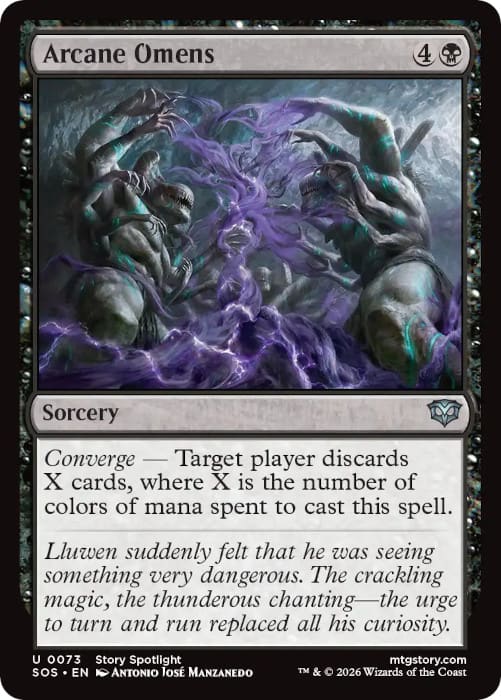 |
The classic for Control mid-games is actually just one player drawing Mistrise Village. Resolving your Jeskai Revelation is one thing (and not even something the opponent can't deal with, often with their own Jeskai Revelation). An un-counter-able Mind Twist, though? Converge! Happens every day.
5. Whether or Not Something is Put Into Exile
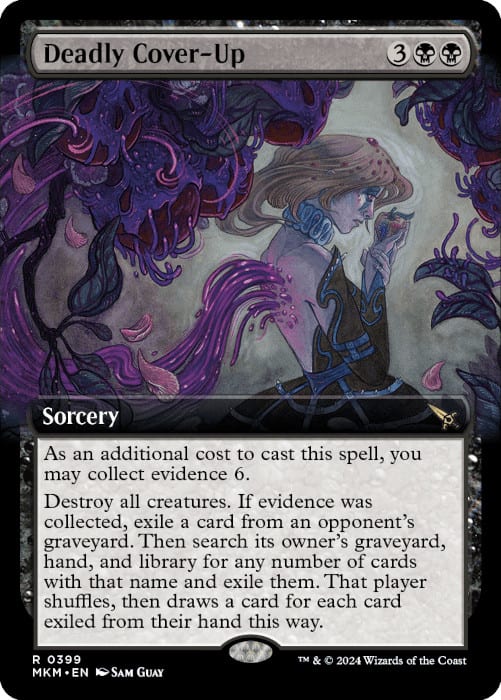
This is a further wrinkle for the Inevitable Defeat people. There are plenty of matchups where you would rather destroy a permanent than exile it, like a Simulacrum Synthesizer. Yes, blowing all of them up (the opponent only has four) however you can is probably going to help run them out of ways to win, but Abrade + Deadly Cover-Up is much simpler, and helps to clean up any token Creatures you might have missed.
 |  |
This goes double for Superior Spider-Man decks. The Superior Spider-Man (whatever guise it is in) is going to be an obvious target, but what you really want is the ability to take all the oomph out of their library.
What's the lesson here?
This is something that can increasingly be addressed via sideboarding. Play more Abrades and you'll be in a better position to set up your opponent.
6. The Kinds of Permanents Your Opponents Play
This is actually an increasingly big one, especially now that Standard Control decks are moving so universally toward Tablet of Discovery.
In the past,  Control decks were pretty good at dealing with Enchantments, because they had Get Lost. Literally none of them liked the fact that they had Get Lost, but they all played it.
Get Lost has largely made way for Abrade and other Red removal because these spells are easy to cast with Tablet of Discovery. Now we've gone from being able to easily deal with an Enchantment to being better at dealing with Artifacts. But you are also a little worse at dealing with large Creatures.
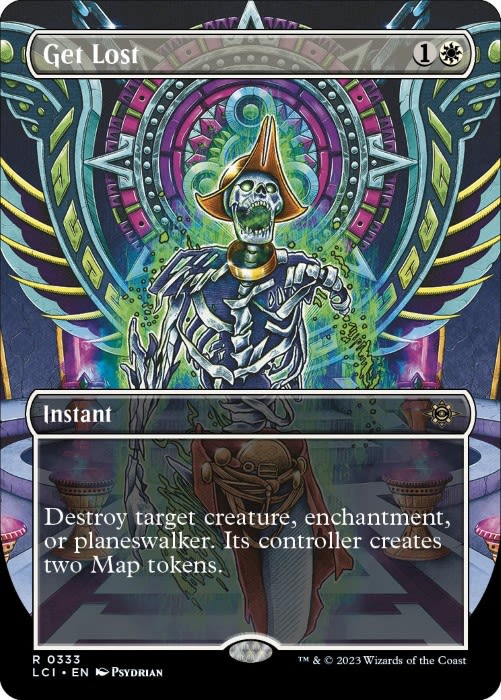 | 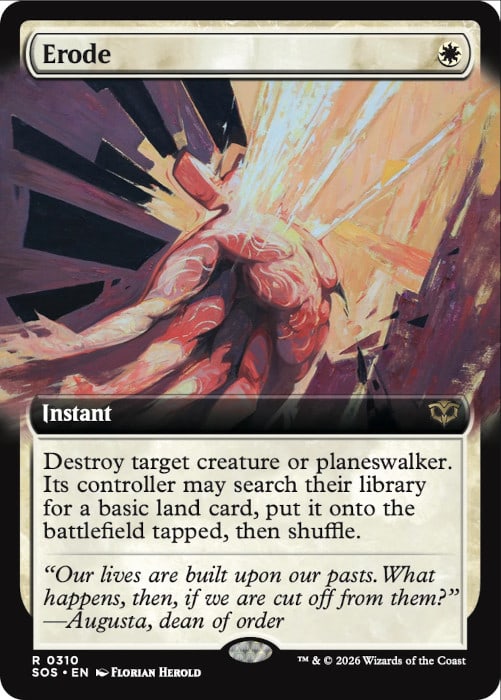 |
A Get Lost killed anything. Today, Control decks are somewhat gated at three or four toughness with their point removal, and often two toughness early in the game.
The quick, Tablet-synergistic, Red removal is probably better against some of the faster decks (Slickshot Show-Off, LandFall combo kills to a lesser degree), but the format is increasingly giving rise to deck construction sub-games.
For instance, what if you move from Get Lost to Erode? You lose some flexibility but can still hit a wide variety of threats. You do so at 50% of the cost of a Get Lost. Depending on how you make your deck you can increasingly tax the opponent's deck construction. I'm just wondering how the format might look if four Erode + four Price of Freedom (probably with some Demolition Fields) becomes a potential way of making decks.
7. Perfection
I made the cardinal error of going second.
Still, I had the draw I needed, which was basically Deadly Cover-Up.
The task was getting enough stuff into the graveyard so that I would be able to successfully Collect Evidence on turn five, but I had that too... a one-for-one and an Inevitable Defeat made six.
Unfortunately, my opponent had absolute perfection going first.
Some kind of setup two-drop (Overlord or maybe Cache Grab) stocked the graveyard with both Ardyn, the Usurper and Bringer of the Last Gift on the second turn...
Jean-Emmanuel Depraz put yet another card into the graveyard for Superior Spider-Man on turn three. Somehow Terror of the Peaks was already in the graveyard as well!
There was nothing I could have done. Going first probably wouldn't have done much because even if I had the Counterspell, they had the Cavern of Souls.
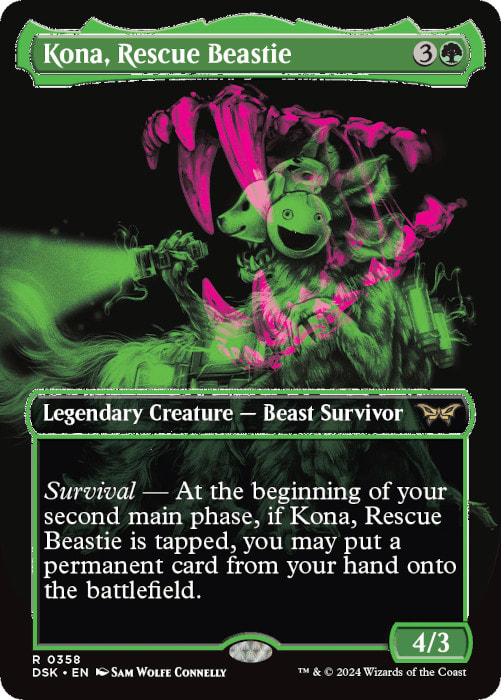 |  |
Kona can present the same kind of absolute perfection with Lost in the Maze into a natural Kona + Omniscience on turn four, with Counterspell backup.
No one can do anything about any of that. There aren't even interactive cards fast enough or widely applicable enough to do anything about any of that. A Standard format this big simply sets aside some percentage of games to proactive decks, and there is very little you can bring in terms of strategy or preparation you can bring to bear to win certain, individual, games.
What's the lesson here?
If anything, this kind of Magic must be dealt with via sideboarding. Get faster to pre-empt them. Take the air out of their tires. I'm a big fan of waiting until around turn three or four for Intimidation Tactics.
8. The Opponent Has Gone Completely Over the Top
Much of the format has settled, despite a whole new set becoming legal just one week ago.
As far as I can tell, Jennifer Walters is the only new card making significant waves so far, and even she is doing so in small numbers.
You have your Landfalls. You have your different brands of Izzet. And you have your Jeskai Revelation arms race. But there is a subset of lunatics who think they are playing in a completely different metagame, the people with Resonating Lute, and an absolute truckload of Ugins.
 |
These people go completely over the top of even the Jeskai Revelation decks on power level. You have to imagine they're getting punished by the faster decks, but when someone finds three Firdoch Cores, all their Lanterns, and a backup Ugin after a couple of turns of two-for-one-ing you, you can't imagine that the game was going to go any other way.
What's the lesson here?
The idea that you can undermine the opponent's ability to get to the ridiculous levels of resource necessary to win is somewhat of an illusion. What you actually have to do is win the game. To varying degrees, Duress, Disdainful Stroke, and Price of Freedom can pre-empt the opponent's setup turns. At some point, if they're still playing, they're going to go over the top of you.
Now that you know that, it should influence your decisions the next time you're presented with a Lute or giant colorless Planeswalker.
LOVE
MIKE