 Locations


 How did you learn to play Magic? Some of you probably saw it in its infancy, picked up some Alpha cards, read the somewhat vague rules and figured it out with your friends. As rules were updated and streamlined, you read or heard about the biggest relevant changes and adjusted your play accordingly. Others saw the light later on, being shown by a friend. Your friend explained the basic premise, walked you through some games (or mercilessly bludgeoned you, depending on his or her teaching skills) and let you get a feel for the general flow of the game while teaching you lingo (like "in response").
[caption id="attachment_5784" align="alignright" width="200" caption="Can you spot the Black Knight in this picture?"]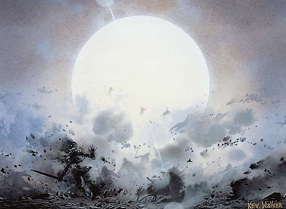 [/caption]
I've gotten the impression that most people learn Magic by the cards. Back in Alpha, with vague rules and a tiny card pool, there was little underlying structure. You didn't learn a framework into which the cards would fit, because many cards were unique in filling their roles. You didn't learn how mechanics worked together so much as you learned how card X interacts with card Y, and when a new card came out, you learned its interactions individually as well. Similarly, a newer player will often learn interactions on a card-by-card basis (like "Wrath kills Black Knight") rather than learning the underlying rules (like the definition of protection, which will not leave you wondering about Black Knight and Wrath of God even if you've never seen either card before).
There are some pros and cons to this trend. On the "pro" side, learning enough of the game to start flinging cardboard happens much more quickly if you don't stop to read pages and pages of rules first. Also, most people would rather learn as they go because reading a rules document, especially one as big as that of Magic: the Gathering, just isn't that interesting. (Actually, I sometimes read game rulebooks for fun, but I'm weird.) The downside of "learning by the cards," however, is that each time a new set comes out, you've got hundreds of new cards to learn. If you're willing to make the down payment and learn the underlying rules, however, you have a lot less learning to do when something comes along that seems intimidating. Warp World isn't scary. Cascade is just another triggered ability, no more confusing than drawing a card from Elvish Visionary.
 Now, my goal here is not simply to spend 1,500 words on a glorified "RTFM". Rather, I want to give examples of the types of issues I see most commonly, so that if you'd like to begin your investment of learning the rules in greater detail, you'll have a place to start that will yield the greatest immediate returns.
Here's an example from the Alara Reborn pre-release (the debut of the infamous Cascade mechanic) in which I bit my tongue while the local judge-in-training actually ruled incorrectly. Player A controls some Hill Giant-esque creature while Player B is at 3 life and controls a Tukatongue Thallid. Player A casts Demonic Dread on the fungus, and Cascades into Terminate, which he also points at the little green man. Terminate resolves, and Player B puts out a saproling. Player A then calls the judge to see if Demonic Dread can keep the token from blocking and thus seal the game. The judge rules (incorrectly) that it works. Let me show you why that's not the case.
The Tukatongue Thallid died from a Terminate cast via Cascade. In order for Cascade to have triggered in the first place, Demonic Dread had to have been cast, which includes choosing a target (the Thallid). This means that once we get to the point where we try to resolve the DD, we see that its target, which was already chosen (about six priority passes ago), is no longer on the battlefield and therefore isn't a legal target anymore. We can't choose a new target (like the saproling) because targets are chosen during casting. Therefore, Demonic Dread is countered on resolution due to having no remaining legal targets.
 To segue into my next point, it's very important to note that spells or abilities with no remaining legal targets are countered. Now, I'm sure it's clear enough that Demonic Dread, which does exactly one thing to its only target, ends up doing nothing if its target is gone - you can get that far on common sense alone. But what about more complicated cards? Maelstrom Pulse can affect plenty more objects than it targets. Cruel Ultimatum has only one target (an opponent) but does all kinds of crazy things. What happens when a target gets out of the way, but the spell wants to do more things? If I sacrifice my Vampire Hexmage in response to your Path to Exile, do I still get a land? Many people operate under the assumption that a spell will do everything it can, and just skip the part that was made illegal. Unfortunately, this is incorrect.
Let me make a distinction here: if a spell or ability has multiple targets, and only some of them become illegal, then yes, the effect resolves, doing as much as it can. However, when a spell's only target becomes invalid, the entire spell is countered, and you don't perform any of its effects, even if some of those effects appear unrelated to the target. So if you try to Narrow Escape your Turntimber Ranger(no doubt with shenanigans in mind) and I kill it with a Doom Blade, your Narrow Escape will be countered and you won't gain any life at all.
I feel like telling another story, so how about another Cascade example? This one is all about priority, a rules term that is part of every game yet is very rarely mentioned during play. Pre-Zendikar, I was testing a Naya Cascade deck (mediocre, but tons of fun) on Magic Workstation against a Jund-wielding opponent. I cast an Enlisted Wurm and popped out a free Chandra Nalaar (I told you it was fun). Once we established that Chandra and the fatty had both resolved, my opponent tapped some lands and aimed a Bituminous Blast at the wurm (perhaps he had a Bolt in hand?), then before I could stop him he'd flipped up a Maelstrom Pulse and pointed it at Chandra, no doubt pleased with himself that I hadn't gotten to use any of her abilities yet. Unfortunately for him, he'd just made an illegal play. What was wrong?
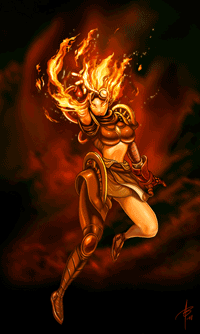 Now, Chandra does resolve before the Enlisted Wurm, and since her abilities are sorcery speed, there is a window while the wurm is still a spell that my opponent can mess with the fire chick with instants (double Lightning Bolt or whatever). But, since he was relying on the Bituminous Blast, he had to wait for the Enlisted Wurm to resolve as well. The surprisingly little-known rule that now becomes relevant is this: whenever an object on the stack resolves, the active player is the first to receive priority. This means that by the time the wurm is on the battlefield and able to be targeted by Bituminous Blast, my opponent is stuck waiting for my before he can do anything. Heck, I could even play a land or activate mana abilities (neither uses the stack or requires a pass of priority) and my opponent would have to just sit and wait patiently. Since he can't cast that B-Blast until I pass priority to him, I'm able to activate one of Chandra's abilities (if I don't try to do something else first, like change phases) before he can even think about flipping a free Pulse onto her.
Here's the neat thing about all these stories: what you just read doesn't just explain a couple of scenarios; it explains how to decode and decipher anything else that involves triggers, targets or timing. Knowing the rules involved in these examples will help you tackle Storm, Landfall, Warp World, interactions with Oblivion Ring, and any other related shenanigans that WotC manages to dream up. All of them. Ever. Suddenly, these rules and definitions start to look a little more worthwhile, don't they?
 Now, I'm not suggesting that you go and read the entire Comprehensive Rules from start to finish right now. However, there are some things that come up more often than others and would be worth reading up on. You may never need to know that the effects of Mutavault and Giant Growth use different sublayers. However, have you ever regenerated a creature? Given it protection from red? Needed to activate an ability during the first strike combat damage step, before the regular combat damage step? Do you know when your opponent’s last chance is to tap your potential attackers? Do you know why it can be best to pump your shade one point at a time? All of these are areas in which you can give yourself an edge. If you do your homework now, it will pay off for as long as you keep playing Magic. And that, my friends, seems like a worthwhile investment.