 Locations


First added to the game in Alara block, Cascade is a powerful and contentious mechanic. What is all the fuss about, though? Let's find out what makes it tick.
What is Cascade?
Cascade is a Triggered Ability that lets you cast a second spell for free when you put Cascade on the stack. If it sounds powerful, that's because it is. The second spell must be cheaper than the first, but since you're casting it for nothing, that's not much of a downside.
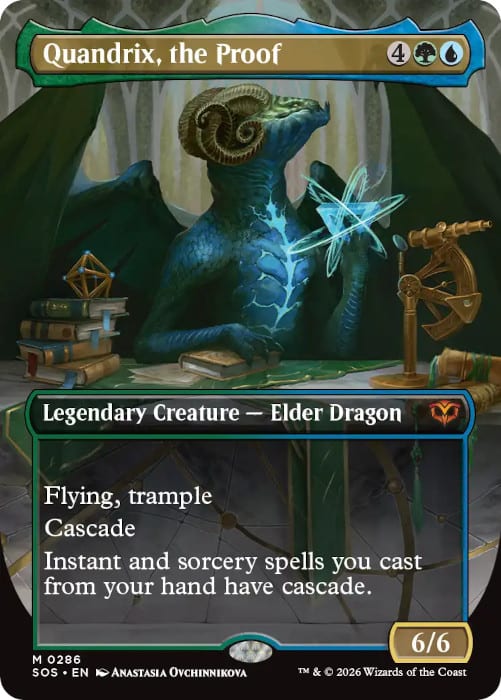
It's a very wordy ability, but in practice it's quite simple. You cast your Quandrix, the Proof for 

 and exile cards from the top of your deck until you hit something with a mana value of five or less. Then, you cast that for free. Finally, you resolve the Quandrix.
Cascading Through Time
Cascade's history is unique. It was first introduced in Alara block, back in 2009. Despite being over a decade old, though, it has only been printed on 54 cards. Over half of those were part of the initial release. The mechanic has never returned to Standard, appearing only in supplemental products.
The reason for its scarcity is not a mystery. Cascade is incredibly powerful, and Wizards uses it sparingly.
 |  |
During its time in Standard, Jund (
 ) decks dominated the format for long stretches of time. The Cascade package of five-mana Bituminous Blast and four-mana Bloodbraid Elf was extremely oppressive.
Other decks struggled to keep with the easy two- and three-for ones. Even control decks had a hard time going over the top of Jund decks, because Cascade demands multiple answers from an opponent. Even if you have a counter for the Bloodbraid Elf, the Blightning is still going to resolve.
It didn't stop there, either. Bloodbraid Elf was banned in Modern for a long time. When it was unshackled, it quickly showed why it had been banned in the first place. It appeared in multiple decks for multiple years, only recently being pushed out of the meta game.
 | 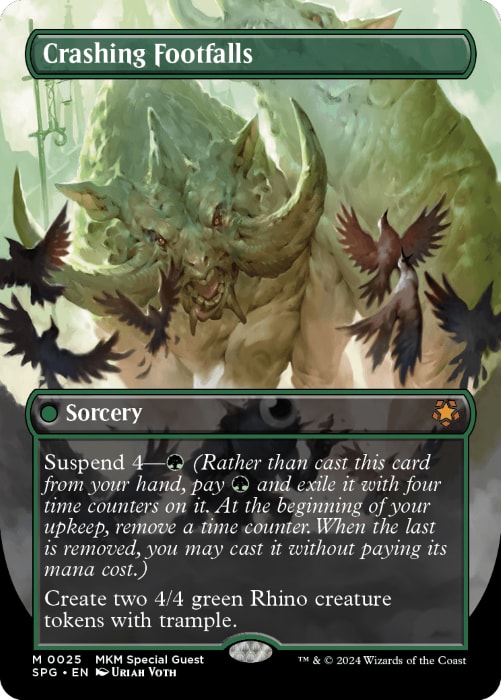 |  |
Cascade also played an integral part in decks that have defined the Modern format. Thanks to its positive interaction with Suspend cards, cheap Cascade cards allowed Living End and Crashing Footfalls decks to exist.
Violent Outburst might look like a mediocre pump spell, but it was also banned in Modern for a while because of the combos it enabled.
In Commander, Cascade is less of a specific strategy and more of a great top-end. Maelstrom Wanderer remains popular, years after its initial release, despite costing  in an increasingly quick format. Ten-mana Apex Devastator is similarly well liked and even sillier when cast.
The Best Cascade Creatures
6. Maelstrom Wanderer / Apex Devastator
 |  |
Maelstrom Wanderer and Apex Devastator are similar in many ways. They both require a lot of mana. They're both aimed squarely at casual Commander players. They both do something incredibly splashy which should probably end the game.
They're at the bottom of the list because they're just so expensive to cast, but you do get your mana's worth.
5. Zhulodok, Void Gorger
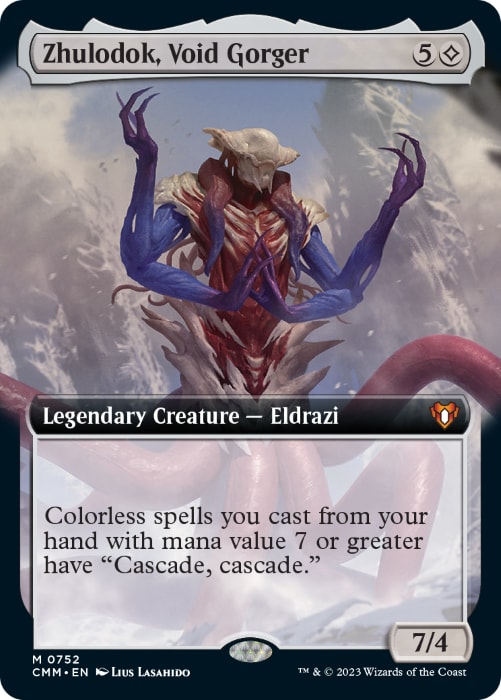
Another Commander all-star. Zhulodok, Void Gorger one is perhaps the best general for the much-loved Eldrazi Creature type. Costing six, it hits the sweet spot of being expensive enough to warrant a good ability, but not so expensive that you never get to cast it.
You will probably need to have Zhulodok survive a turn to get the best out of it, but "Cascade, Cascade" is exceptionally powerful.
4. The First Sliver

Technically, this seven drop is legal in more formats than just Commander, but that's where it does its best work.
The First Sliver is another great general for another popular Tribe. Giving all your Creatures Cascade is very strong. This can also be used as a combo piece from the Command Zone, if that's your jam.
3. Shardless Agent
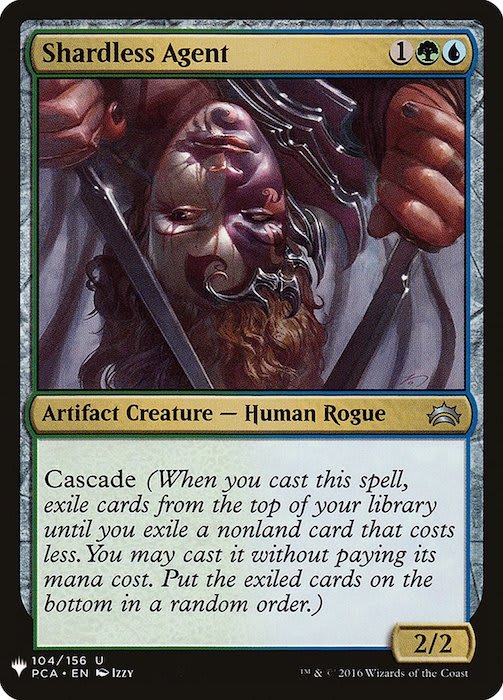
Once upon a time, this three drop was one of the more Spike-focused cards printed specifically for Commander. It quickly appeared in Legacy, in fair decks and combo decks alike. After its Modern Horizons reprint, Shardless Agent became a staple in Modern, too.
It continues to fuel combo decks in both formats to this day. It's also pretty good in Limited, making it a true cross-format superstar.
2. Violent Outburst
Violent Outburst could have been included with Shardless Agent, except for one thing. Being able to go off at Instant speed is a huge upgrade in formats like Modern and Legacy.
There's a reason this card was banned, and Agent wasn't, despite doing such similar things at the same low cost of three mana.
1. Bloodbraid Elf

Bloodbraid Elf might have been power crept out of Modern, but its history earns it a spot on this list. Whether this is the best card on the list by many objectives metrics nowadays is disputable.
By vibes, though, this is the poster child of the Cascade mechanic. It terrorized Standard for two years straight and was deemed too good for Modern for years. Competitive players of a certain vintage still have nightmares about Bloodbraid into Blightning.
Cascade Mechanic FAQs
What card types can have Cascade?
Pretty much anything can have Cascade. Because it triggers when you cast a spell with Cascade, any type of card that needs to be cast could theoretically be given Cascade. Only Lands are ruled out, since they do not need to be cast.
How do multiple instances of Cascade work?
You resolve each Cascade trigger individually, which can lead to a lot of crazy stuff happening. The most important aspect here is that the Cascade comes from the original spell. In theory, you could Cascade into four nine-mana spells.
What happens if Cascade misses?
Cascade can't miss in a technical sense, as it doesn't target. However, if you cast the two-mana Bloodbraid Marauder and don't have any one or zero cost spells left in your deck, then don't worry.
You will flip cards from the top of your deck until you run out of cards. Then, you randomize the entire deck and move on with the game. Your Cascade trigger won't give you any value, but you won't mill out either.
How does Cascading into another Cascade card work?
Short answer: incredibly well. One Cascade card can cast another one and both will trigger their own Cascade ability. When Cascade first came out during Alara block, Bituminous Blast could hit some incredible sequences.
Cascading into a Bloodbraid Elf, which then Cascaded into a Blightning was as oppressive as it sounds. Just remember that they resolve in reverse order, so the Blightning is the first effect to actually resolve in this example.
What happens if you Cascade into a free spell?
Suspend Cards like Living End and Crashing Footfalls have a mana value of zero. If you Cascade into them, then you get to cast them for nothing and effectively ignore the Suspend text.
How does Cascade work with flip cards?
This one is more of an "it depends" situation. The Cascade rules were updated in 2021 to stop players casting Tibalt, Cosmic Imposter for three mana. So, with Modal Double Face Cards, Cascade can only hit the side that costs less than the original spell.
For example, Opposition Agent can Cascade into two-mana Valki, God of Lies, but it cannot Cascade into the flip side, seven-mana Tibalt.
However, there are examples where you can cast either side of an MDFC. An expensive Cascade card like seven-mana Annoyed Altisaur can Cascade into three-mana Esika, God of The Tree or The Prismatic Bridge, which costs five. Because both sides of the card cost less than Annoyed Altisaur, you can choose which one to cast if you Cascade into it.
Flip cards which need to be transformed are different again. If you Cascade into Search for Azcanta at two mana, you get Search for Azcanta. You cannot choose to "cast" Azcanta, the Sunken Ruin, because lands cannot be cast.
Can you Cascade into split cards?
Yes, but it's difficult. Split cards are complicated, and when they're not on the stack, their mana value is equal to the combined value of both halves. For example, a Room like Smoky Lounge // Misty Salon has a mana value of seven. You could Cascade into that, but you're going to need one of the more expensive Cascade cards to do it.
Fuse cards are slightly different. Because of their specific wording, you can never Cascade into both halves of a Fuse card, even if you can meet the mana requirements. You can only cast both halves of a Fuse card from your hand. Even if you Cascade successfully into a Breaking // Entering, you still have to choose either the two mana side or the six mana side.
How does giving spells Cascade work?
Maelstrom Nexus says "the first spell you cast each turn has Cascade." This adds Cascade to any other effect of that spell, and it works on each player's turn, not just yours. If you cast the three-mana Fierce Guardianship on your opponent's turn, you will get to Cascade into another spell that costs two or less.
Can Cascade cast Creatures at Instant speed?
Yes, there are plenty of ways to Cascade at Instant speed, and they work quite well with Creatures and Sorceries. Cascade is worded in a way that ignores normal timing restrictions. Forceful Denial at five mana can Cascade into a Creature, even on your opponent's turn.
How does Cascade and X spells work?
This is an instance that isn't very beneficial for the player casting the Cascade spell, as X counts as zero in this situation. In other words, you will Cascade into Fireball but it won't do much. You can cast the Fireball for X = 0 if you would like.
Do I have to Cascade?
Yes and no. Although Cascade is mandatory, casting the spell you Cascade into is not. It works like this: you must exile cards until you hit a spell with a lower mana value than the original Cascade spell. Because Cascade says you may cast that spell, you can also choose not to. Everything else then resolves as normal.
What happens if I copy a Cascade spell?
Not a lot. Because Cascade triggers when you cast the spell, copying that spell doesn't quite do what you hope it does. If you use Narset's Reversal to copy an opponent's Deny Reality, you will get to bounce another permanent, but you will not get to Cascade.
Conclusion
Even when used fairly, Cascade is a very powerful ability. Despite being over a decade old, it has never returned as a fully supported mechanic in a mainline set. Even in more powerful supplemental sets, like Commander and Modern Horizons, Cascade is used sparingly. Mark Rosewater went so far as to call it "developmentally dangerous."
Cascade is so good that Wizards designed an entire new mechanic to try and emulate it without being too strong. Discover hasn't been nearly as problematic as its forebear. We've got Cascade's long history of competitive dominance to thank for that.