 Locations



Let's say you want to cast a giant, game-changing creature spell. Right NOW. Not on your turn, not when "timing restrictions would apply," but in the middle of combat, or in response to that smug control player across the table tapping out for a board wipe. Normally, you'd need Flash, tons of mana, or at the very least, a way ticked up Aether Vial.
But what if I told you that all you had to do was make an Offering?
In today's Mechanics Overview Segment, let's talk a bit about Offering, the quirky little mechanic that showed up for like five minutes in Betrayers of Kamigawa (2005), dropped a bunch of giant Spirit creatures that wanted to eat their own kind, and then promptly vanished into the shadows for over a decade.
Join me as I break it all down, one sacrificial Offering at a time.
What Is Offering?
[Subtype] Offering (You may cast this card any time you could cast an instant by sacrificing a [Subtype] and paying the difference in mana costs between this and the sacrificed [Subtype]. Mana cost includes color.)
Offering is a keyword ability that modifies when you can cast a spell and how much you have to pay to do it. You might be looking at the reminder text above and think, "Boy, that looks like a whole lot of stuff I don't really want to read." Let me help you out a bit:
Sacrifice a specific type of creature -> cast your big Offering creature as if it had Flash -> reduce the cost by whatever the sacrificed thing cost.
So, as you can see, Offering's kind of a two-for-one special: Flash and cost reduction!
The History of Offering
Offering debuted in Betrayers of Kamigawa, the second set of the original Kamigawa block, which...let's be honest, was all-in-all kind of a design experiment gone rogue. This block leaned very heavily into Spirit kindred, Arcane spells, and flavor that was so thick, you needed a Ronin Warclub just to build a decent deck.
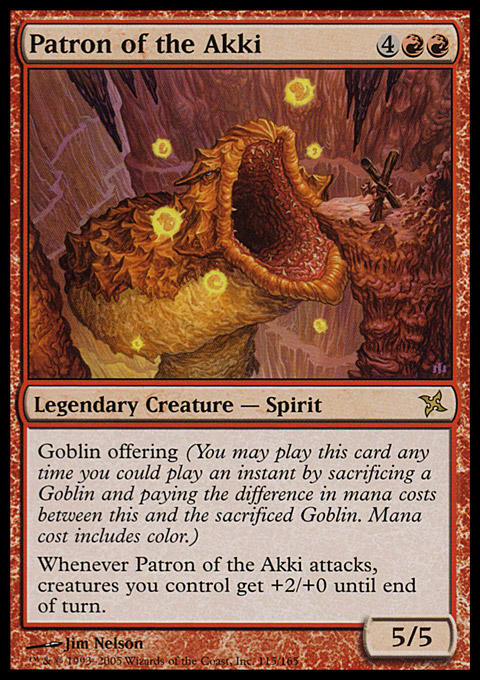
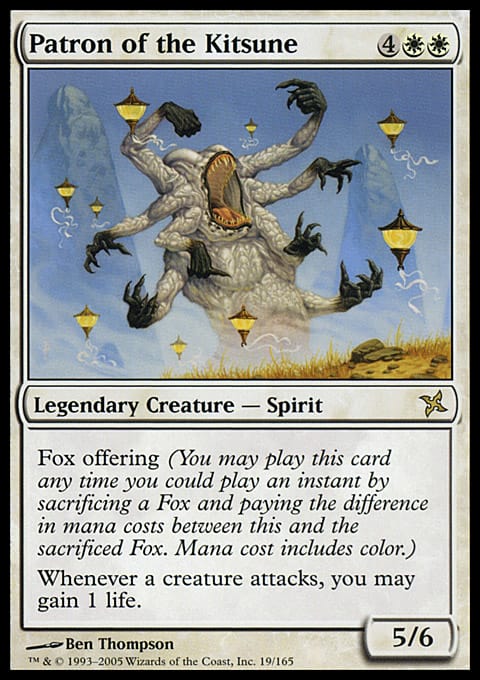
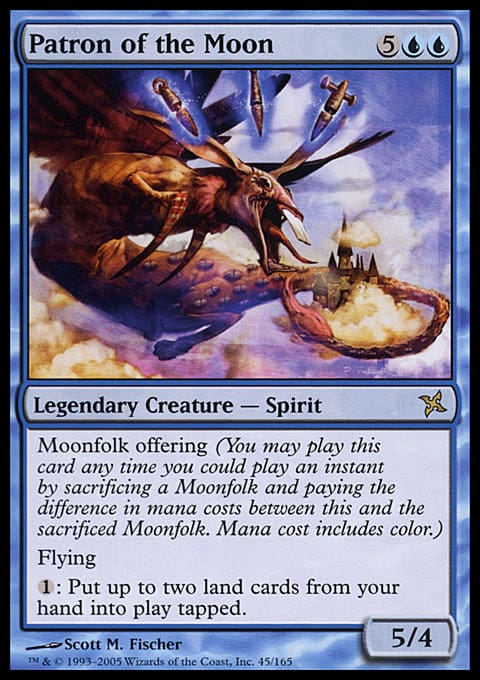
And with it, also came the Patron cycle, five massive Spirit creatures, each representing a different tribe from the plane:
 |  |
- Patron of the Akki (Goblin Offering)
- Patron of the Kitsune (Fox Offering)
- Patron of the Moon (Moonfolk Offering)
- Patron of the Nezumi (Rat Offering)
- Patron of the Orochi (Snake Offering)
Each Patron could be cast normally, or, if you sacrificed a creature of the matching type, you could cast it as though it had Flash and reduce its mana cost.
Flavorful? You bet! New and exciting? No doubt! But the mechanic didn't land at all.
Why? Well, because Offering hit that awkward design trifecta:
- Too Narrow: Each Offering card had you locked into a specific creature type, some of which (*cough* Moonfolk *cough*) barely had enough support to make a casual deck, let alone something competitive.
- Too Complicated: The mana cost reduction rules were sometimes a bit of a head-scratcher, especially back in 2005 when fewer players were cracking open the comprehensive rules for kicks.
- Too Isolated: Offering showed up, dropped its five Patrons, and then...just left. There was no follow-up, no expansion, no uncommon support creatures that synergized accordingly. Mechanically speaking, it was nothing short of a one-night stand.
Add in the fact that Kamigawa as a whole wasn't the most well-received block, and it's really no surprise that Offering ended up on the long list of mechanics that Wizards tried once and shelved forever.
Or so we thought.
Fast-forward a mere seventeen years. The world has changed. Commander is the most popular format in Magic. Dragons are cool again. And out of nowhere, Wizards drops a single new Offering card into the Mishra's Burnished Banner Commander deck from The Brothers' War (2022) Commander release:
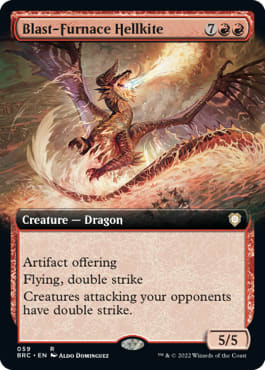
Yup. Not a Spirit. Not even tied to the original Kamigawa flavor. Just a giant fire-breathing dragon with an appetite for mana rocks.
And you know what? It worked.
In Commander, especially, sacrificing an artifact like Mind Stone or Arcane Signet to cheat out a 5/5 Flying, Double-Striking Dragon at instant speed? Now, that's what I call value. Suddenly, Offering had a real home. Not in super narrow kindred decks, but in open-ended, artifact-laden Commander brews where sacrificing a mana rock felt more like actual progression rather than a loss.
Blast-Furnace Hellkite showed that the idea of Offering isn't the problem. The original implementation, locked behind gates and underwhelming payoffs, was what held it back. But the mechanic itself? I'd say it's got some serious legs if you just give it room to stretch.
FAQs About Offering
Offering is certainly another one of those mechanics that seems simple at first: Sac a dude, cast a bigger dude on the cheap. But then you start doing the mana math, mix in some color pips, and suddenly everyone's looking for the judge.
So, let me help break it all down for you.
1. Is Offering an Additional Cost?
Yes! Offering is an additional cost to cast the spell. As the famous saying goes, "Every Magic: The Gathering mechanic is just Kicker or Horsemanship", except in the case of Offering, instead of paying more mana, you're paying with blood. Or more specifically, with a creature. Or a Fox. Or a Moonfolk. Or a mana rock if you're part of the new generation of MTG player who got to play Blast-Furnace Hellkite.
2. Is Offering an Alternative Cost?
Nope. Offering doesn't replace the spell's normal casting cost, like Overload or Evoke or Suspend.
3. How Does the Mana Cost Reduction Actually Work?
Each mana symbol in the sacrificed permanent's mana cost reduces matching color costs first. Any leftover mana of a color the spell doesn't use becomes a reduction to generic mana.
Example 1:
 |  |
You offer up a Gobhobbler Rats to cast a Patron of the Nezumi for its Rat Offering cost.
Black matches, so it reduces one Black mana.
Red doesn't match, so it counts toward generic.
Total cost reduction: 2
Final cost of Patron of the Nezumi: 5
Example 2:
 | |
You offer up a Mr. Foxglove to cast a Patron of the Kitsune for its Fox Offering cost. White matches, so it reduces one White mana. Nothing else matches, so Mr. Foxglove's remaining four mana will fortunately all count toward generic.
Final cost of Patron of the Nezumi: Just one White.
4. Can I Sacrifice a Permanent With Mana Value 0?
Yes...but don't expect a discount. But hey, Flashing in a Blast-Furnace Hellkite by sacrificing a Lotus Petal before declaring blockers can still put in plenty of work.
5. Can I Respond to an Offering Sacrifice?
Nope. You actually cannot respond to the sacrifice itself. The sacrifice happens as part of casting the spell--specifically, during the announcement of the Offering spell. No one gets priority until the entire process of casting is complete and the Offering spell is officially on the stack.
This means that if your opponent sacrifices their random Genku, Future Shaper to cast their Patron of the Moon via Moonfolk Offering, you can't Doom Blade the Moonfolk in response. It's already gone. Guess you just have to Doomblade the Patron instead.
Final Offering
To me, Offering is a mechanic released ahead of its time, or at the very least, in the wrong time. Sandwiched between overcomplicated, underwhelming Spirit synergies and rigid creature type restrictions, it never got the room it needed to breathe, let alone shine.
Wizards printed Offering into a tiny corner and then forgot it existed. Remember, the mechanic only appeared on a mere six cards over the course of 20 years. And each card wants a different type of creature sacrifice. There's no genuine support, no synergy, and no unifying thread that ties them together into a deck, a strategy, or even a theme.
And that's all such a shame. Because as Blast-Furnace Hellkite showed us, Offering should have some serious potential if we just let it off itskindred leash more often.
With all that said though, I've just about sacrificed every last ounce of my devotion onto the altar of Offering and passed the mana discount on to you! As always, happy brewing, and may your Patrons continue to descend upon your opponents at Flash speed and your poor, unsuspecting Offerings know they died for a noble cause. Until next time.