


 Locations



Magic: The Gathering has always been a game of many faces, and few things showcase its personality more than the mechanics that come and go with each set, plane, and its respective story arc. Some mechanics, rightfully so, stand the test of time and pop up again and again. For example, mechanics like Kicker, Cycling, Scry, etc, are generally accepted to always be around. On the flip side, there are a plethora of mechanics that are more like unexpected party guests who show up once, say hi, and then quickly never seen again.
Well, in today's Mechanics Overview Segment, we're dusting off yet another one of those one-of mechanics: Unleash. Now, if you played during the Return to Ravnica block, you probably saw it stapled to some aggressively costed creatures in Black and Red. And if you didn't, well, prepare to experience the joy of saying: "Why block when I can attack, attack, attack?"
What Is Unleash?
Unleash (You may have this creature enter with a +1/+1 counter on it. It can't block as long as it has a +1/+1 counter on it.)
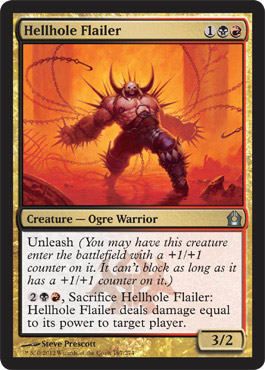
At its core, Unleash is about choice (but it's realistically a choice with only one answer). When you play a creature with Unleash, you decide whether it enters the battlefield with a +1/+1 counter or not. If you do, then, great, your creature is now likely swinging way above the typical creature stat lines for its cost. If you don't, well, there's very little reason to play Unleash creatures with the intention of not saying yes, but we will get more into that a bit later.
The History of Unleash
Unleash first hit the tables in Return to Ravnica (2012) as the mechanic for the Cult of Rakdos. Thematically, it's perfect: Rakdos never cared about defense, survival, or restraint. It's all about dealing damage quickly and recklessly. Living life on the edge, you know?
The mechanic also popped up in Gatecrash (2013) and made one final main-set appearance in Dragon's Maze (2013), the capstone of the block. Since then, the mechanic has been relegated to reprints and the occasional nod, like Garbage Elemental from Unstable (2017) and Tesak, Judith's Hellhound from Murders at Karlov Manor Commander (2024).

Unleash Rulings
Now, before we get to dusting off all those bulk Rakdos Unleash cards, let's go over some of the more important nuances behind the mechanic.
The Choice Happens as the Creature Enters
You don't make the Unleash decision when you cast the creature spell; you make it as the creature actually enters the battlefield. This is important because:
- Your opponent can counter the creature spell on the stack, but they can't wait to see if you Unleash it first. By the time it resolves and enters, the decision is already made.
- Popular Stax cards like Torpor Orb or Hushbringer, which care strictly about enter-the-battlefield (ETB) triggers, don't matter here as Unleash is a static ability and not a trigger ability.
Any +1/+1 Counter Shuts Down Blocking
A creature with Unleash can't block if it has any +1/+1 counter, not just the one it entered with from Unleash. So, if an opponent randomly decides to give your Chaos Imps a +/1+1 counter via Subtle Strike, your creature is still locked out of blocking. Unleash doesn't care how the counter got there; it just cares that it's there.
Already Blocking? It Stays in Combat
What if your Unleash creature is already declared as a blocker, and then it somehow gets a +1/+1 counter? Well, good news, once it's in combat, it stays in combat. But, naturally, in future turns, as long as that pesky counter is still on it, you won't be able to declare it as a blocker again.
The Unleash Choice Applies Everywhere
The reminder text doesn't specify "when cast from hand," and that's deliberate. The Unleash effect applies no matter where the creature enters from. From hand, graveyard, exile, or even directly from the library, it's the same choice, every time an Unleash creature would enter.
What Unleash Taught Design
The biggest strike against Unleash is that it rarely gave players a genuinely interesting decision. Aggressive decks, by nature, were almost always going to choose the extra +1/+1 counter. Conversely, slower mid-range decks or control decks were almost never going to Unleash at all. And this meant the "decision" built into the mechanic was almost always predetermined rather than an impactful gameplay decision.
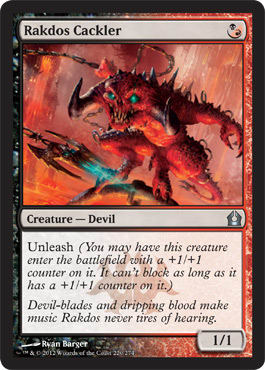
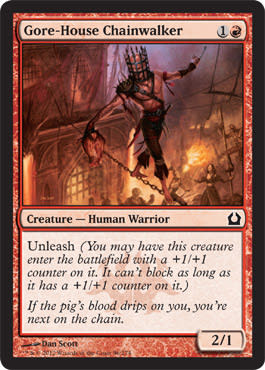
This lack of decision naturally extended beyond gameplay and into deck construction as well. Take Tom Ross's mono-Red Boss Sligh deck from back in the day. It leaned into hyper-efficient, low-curve Red creatures and burn spells, with playsets of cards like Rakdos Cackler and Gore-House Chainwalker fitting in seamlessly. The Unleash ability was essentially irrelevant as the deck was built to always Unleash. And in the rare event where Tom would even consider not Unleashing, the game was practically lost already.
 |  |
Compare all this with newer mechanics like the Ability Counters from Ikoria: Lair of Behemoths (2020) or Oil Counters from Phyrexia: All Will Be One (2023). These mechanics still put counters on creatures, but they also tie the counters to interactivity:
- Ability Counters often grant impactful keywords like Flying, Lifelink, Trample, etc, giving you an actual decision on how to best deploy them.
- Oil Counters can be spent, removed, or manipulated, creating a resource to manage over time rather than a permanent lock-in.
Unleash, by comparison, always just sat there. A creature either came in bigger but unable to block, or smaller but able to block. And, in my opinion, that's flat. Downright boring, even.
Do I still have my foil playsets of Rakdos Cackler and Gore-House Chainwalker from when I took down back-to-back Locals over the course of that Standard Block? Absolutely. But it still doesn't make the mechanic itself anything more than a blunt instrument. It won me games, sure, but it never made me really think. And I suppose that's what Unleash is to me: it's only somewhat memorable because of the strategy that focused around it and not because the mechanic itself added any lasting depth.
Closing the Curtain on Unleash
Unleash did exactly what it promised: gave you the option to trade defense for aggression, to throw yourself headlong into combat without worrying about the consequences. And for that, it deserves some credit. After all, not every mechanic needs to be a Swiss army knife of versatility. Sometimes, a mechanic is just about embodying a guild's philosophy, and Unleash nailed that.
But at the same time, Unleash also showed us the limitations of narrow design. It was too one-note, too easy to "solve." Aggro decks would almost always Unleash; control or midrange decks almost always wouldn't. It didn't invite clever interactions and, perhaps more importantly, it didn't encourage deckbuilders to explore outside of the obvious.
Still, Unleash wasn't a total dead end. It undoubtedly played an important role in MTG's design history by testing the waters of utilizing counters as trade-offs. And while it may have been a bit rocky in execution, it paved the way for more nuanced mechanics like the aforementioned Ability Counters and Oil Counters, which proved that counters as costs could create dynamic, interesting gameplay when given more to work with. Without Unleash, those later mechanics might not have had as clear a Blueprint of what not to do.
Well, anyways, I've probably already Unleashed more words on you than most Rakdos players have patience for, so I'll cut it off here before I start demanding Spectacle triggers for your attention. As always, happy brewing, and may your Rakdos Cacklers always come down on turn one, your Gore-House Chainwalkers never bother blocking, and your opponents learn the hard way what happens when you take your foot off the brakes in Rakdos territory. Until next time!