 Locations



When Innistrad: Crimson Vow arrived in 2021, it carried with it a surprising new mechanic that looked like it came straight from a tester card: Cleave. And in a game filled with a plethora of mechanics that range from reducing casting costs to completely rewriting the inherent rules from time to time, Cleave stood out to me because it, quite literally, cuts out text from spells. But behind that playful concept lies a reasonably smart, flexible design that gives players new choices about how to cast and shape their spells and strategies.
In today's Mechanics Overview Segment, let's cut deep into what Cleave is, where it came from, and why it's perhaps one of the most interesting "kicker-like" mechanics MTG has ever printed.
What Is Cleave?
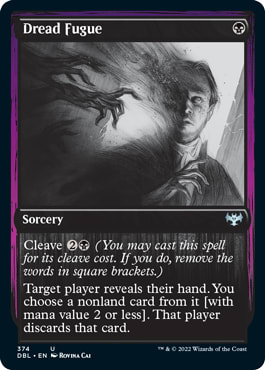
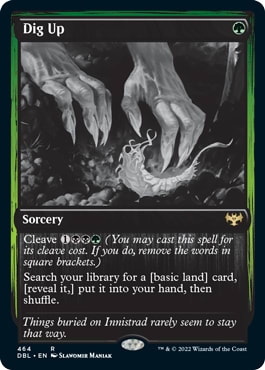
Cleave (You may cast this spell for its cleave cost. If you do, remove the words in square brackets.)

Cleave is a keyword ability that appears only on instants and sorceries. It offers an alternative cost, allowing you to modify a spell's effect by "removing" part of its rules text:
You can cast the spell normally for its regular mana cost.
Or
You can "cleave" the spell by paying its alternative Cleave cost instead. And if you do, you ignore all words printed inside the square brackets.
As an example, let's take a quick look at Inspired Idea.

For three mana, Inspired Idea lets you draw three cards for three mana, not the best rate but also not the worst. However, if you can see, at three mana, Inspired Idea also causes your maximum hand size to be reduced by three for the rest of the game. That's a pretty substantial downside, if you ask me.
However, pay five mana instead, and suddenly, the spell reads just "Draw three cards", turning it into just draw three for five, which, again, while not super great, for Standard, especially, it's certainly not nothing.
The History of Cleave
Unsurprisingly, the story of Cleave begins long before it appeared in Innistrad: Crimson Vow (2021).
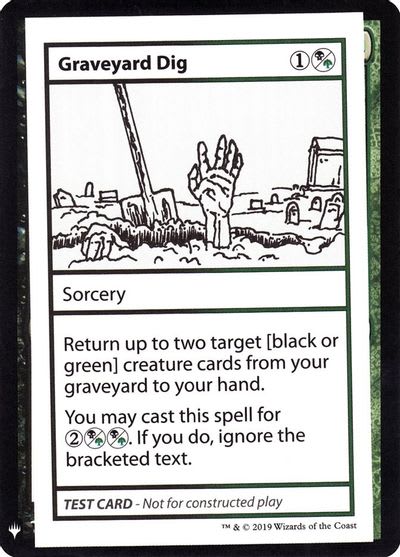
The earliest seed of the idea appeared not in a Standard-legal set but in the Mystery Booster (2020) playtest cards. One of those quirky experimental designs, Graveyard Dig, previewed a mechanic that would later become Cleave. The card was originally created by Linus Ulyssus Hamilton during The Great Designer Search 3, a public design competition held by Wizards of the Coast to discover new game designers.
Graveyard Dig hinted at the same design space: a spell whose effect changed when you "ignored" part of its text. Though the test card was never printed in a real set, it established the key design question: What if the cost you pay determines which part of a spell's text actually matters?
This idea lingered in the background of Magic R&D for years, waiting for a suitable world and flavor hook to make it work.
Innistrad, with its themes of transformation, hunger, and release from constraint, turned out to be the perfect home. The "cutting away" of text mirrored the gothic concept of losing control, of breaking your limits. In my opinion, even the mechanic's name "Cleave" beautifully captured the set's overall dual nature: to cut apart and to cling to, a contradiction reflected throughout Innistrad's storytelling.
Comparing Cleave and Kicker
As I hinted earlier, Cleave often draws comparisons to Kicker, one of the most flexible and meme-generating mechanics in Magic's history. Both offer two versions of a spell based on how much mana you spend, but they operate differently:
| Mechanic | Type | How It Works |
| Kicker | Additional cost | You pay the regular cost plus an optional bonus to add extra effects. |
| Cleave | Alternative cost | You pay a different cost instead, which changes the spell's text. |
Because Kicker is additive, it stacks with other costs (like Flashback or Cascade). Cleave, on the other hand, doesn't; it's a total replacement. This distinction especially matters for interactions with cost-reducing or free-cast effects.
Cleaving It Close
Cleave stands as one of Magic's most evocative and underrated mechanics with a design that, quite literally, cuts to the core of what makes casting spells exciting and fun. It takes something familiar, a simple line of text, and transforms it into something of a choice. Do you accept the limitations fate (or your mana curve) gives you, or do you push beyond and rewrite the spell itself?
And while Cleave hasn't returned since Innistrad: Crimson Vow, it remains a shining example of how much innovation is still possible within Magic's 30-year framework. Like other one-set mechanics, such as Surveil or Exploit, I believe it certainly carved its mark (see what I did here?) by doing the one thing it sought to do perfectly.
So, at the end of the day, will you pay the full cost or just let the brackets stay on your Cleave spells? Well, that's the beauty of it all, isn't it? Cleave lets you choose how efficient and/or empowering you want your spells to be. Sometimes restraint is the smart play, and sometimes it's worth pouring every drop of mana you have just to see what happens when you cut loose.
Regardless of which way you want to go, though, I'm going to go ahead and cut it short for this segment before I start Cleaving my own sentences in half. As always, happy brewing and may your mana curve stay smooth, your brackets forever cleared, and your spells always hit harder when you cut them free. Until next time.