


 Locations



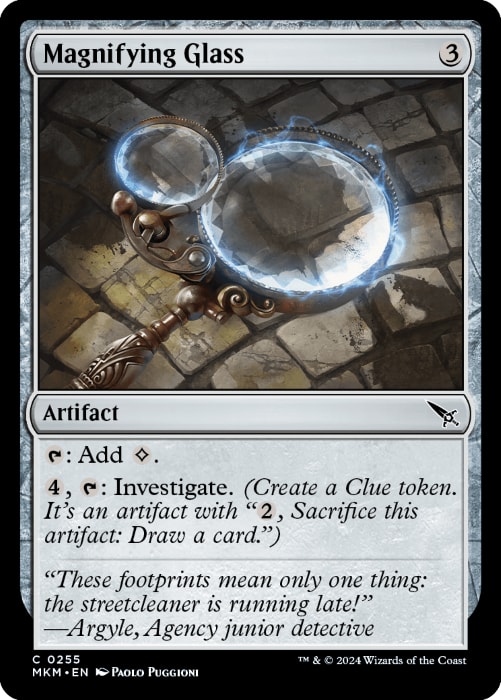
If you've ever asked yourself, "What is Investigate in MTG?" or "What's a Clue token even do in MTG?" then congratulations: you are standing at the right crime scene. In today's Mechanics Overview Segment, we're breaking down MTG's Investigate mechanic, how Clue tokens work, and the top cards for players who like their card advantage to come with a Magnifying Glass.
What does Investigate mean in MTG?
 , Sacrifice this artifact: Draw a card.")
First and foremost, Investigate is a keyword action that tells you to create a Clue token.
Well, what does a Clue token do exactly? I'm glad you asked.

, Sacrifice this artifact: Draw a card."
So, as you can see, whenever a spell or ability tells you to Investigate, what you're really doing is making a Clue that can be turned into a card later.
Now, wasn't that elementary, my dear Watson?
The History of Investigate in MTG
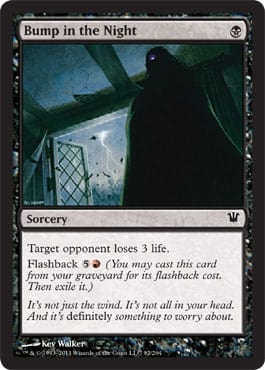
Investigate first showed up in Shadows over Innistrad back in 2016, and it could not have debuted in a more fitting set. Innistrad had always been a spooky plane, full of monsters, gothic horror, and things going Bump in the Night, but Shadows over Innistrad gave that horror a different kind of tension. After all, this time around, it wasn't just about surviving the darkness, but figuring out what was creating that darkness in the first place.
I'd dare wager Wizards didn't put Investigate into Shadows for the sole purpose of Clues being a flavorful motif, but because they wanted the mechanic to properly convey how the world itself worked. On a plane now full of strange disappearances, unsettling discoveries, and townsfolk trying to piece together what is happening, Investigate essentially lets us players do the same.
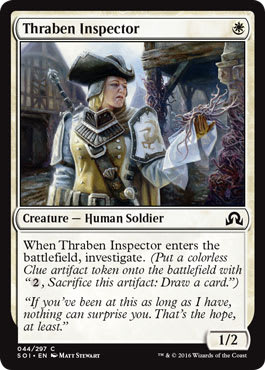 | 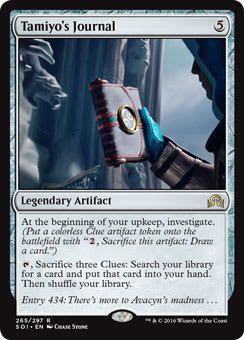 |  |
Instead of solving problems immediately by just drawing a card, Investigate has you gather evidence first (e.g., gaining a tangible resource via the Clue token). Then, once you gather enough, you'd arrive at the truth, so to speak, and are rewarded for all your efforts (e.g., finally being rewarded with card draw), which made the gameplay feel naturally tied to Innistrad's slow-burn horror and unraveling secrets.
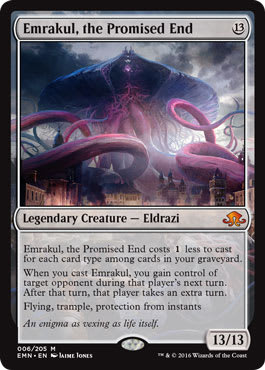
Then, it wasn't all too long into our Ongoing Investigation that Eldritch Moon happened, and the tone of the overarching story changed significantly. While Shadows over Innistrad was about trying to figure out what was going on, Eldritch Moon was more like, "Emrakul's back? But why? How? I don't even-."
Naturally, once the Eldrazi Titan entered the picture, the mystery part of the story gave way to full-on Madness and body horror, so Investigate largely disappeared with it. And flavor-wise, this made a whole lot of sense. I mean, there's not a whole lot of meaning behind doing meticulous detective work once the sky itself became ridden with giant space tentacles.

And even after Emrakul was finally imprisoned, Investigate didn't really step back into the spotlight for a long while. Sure, the mechanic popped up from time to time in supplemental products, but it wasn't really until Murders at Karlov Manor that it really got its big moment again.
 |  | 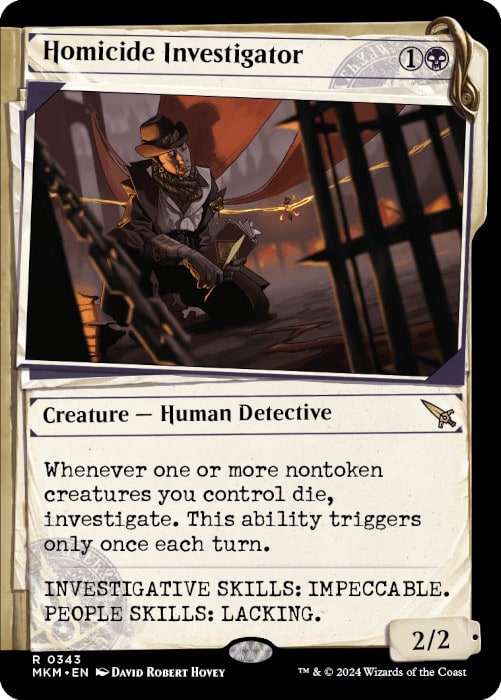 |
I think it goes without saying that a full-on murder mystery was always going to want Clues, Detectives, and suspicious activity everywhere, and Investigate fits that theme perfectly yet again.
What's the difference between Investigate, Suspect, and Collect Evidence in MTG?
At a glance, Investigate, Suspect, and Collect Evidence can come off like they're all doing the same sort of thing. After all, they were all present in Murders at Karlov Manor, and they all sound like detective-esque mechanics. But I'm sorry to report that in actual gameplay, these three mechanics all do very different things.

Investigate is the card advantage mechanic. When you Investigate, you create a Clue token, which you can later sacrifice for to draw a card. So, this one is all about building resources over time.

Suspect is the combat mechanic. When a Creature becomes Suspected, it gains Menace and can't block. So, instead of helping you draw cards or build resources, this one changes how a Creature functions in combat. It's much more immediate and aggressive.

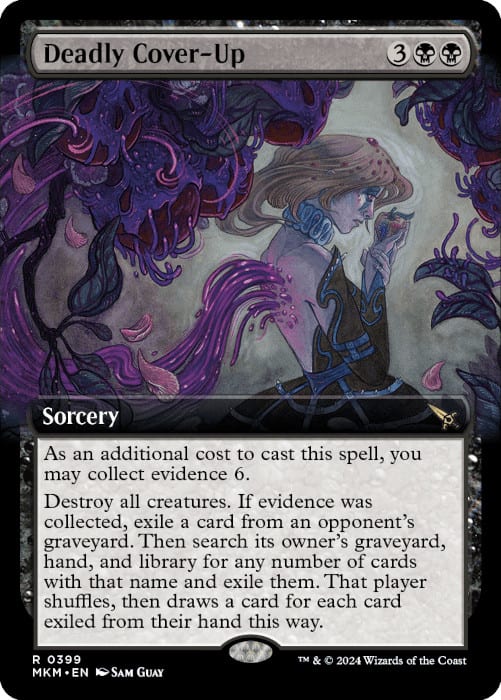
Collect Evidence is the graveyard mechanic. To Collect Evidence, you exile cards from your graveyard with a total mana value equal to or greater than the number the card asks for. So this one is really about using your graveyard as a resource to get bonus effects and/or abilities.
So yes, while they all share the same detective-style flavor, each represents a different part of the case. Investigate is gathering Clues. Suspect is identifying who looks guilty. And Collect Evidence is putting the pieces together so you can actually prove you're right about something.
 |  |
The Most Unique Investigate Cards in MTG
There are plenty of cards in MTG that can make Clue tokens, but some stand out more than others because of how differently they use the mechanic. Instead of just being the strongest or most efficient options, here are my five picks for Investigate cards that make the mechanic feel especially interesting, flavorful, and/or memorable:
5. Declaration in Stone
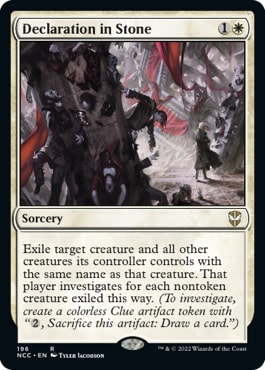
Kicking things off is Declaration in Stone, which is still one of the cleanest White removal spells ever printed if you don't mind handing out a few Clues. It exiles a Creature and can sweep up other Creatures with the same name (RIP token decks), with the tradeoff being that the affected player Investigates for each non-token Creature exiled that way.
And while this means it's not exactly a dedicated build-around card, it is still a very memorable part of Investigate's history because it showed early on that Clues could be used as part of a balancing mechanism and not just as an upside.
4. April O'Neil, Live on the Scene

This one is a newer and more niche pick, but it's certainly a fun and interesting one. April O'Neil, Live on the Scene Investigates whenever a Mutant, Ninja, or Turtle you control enters the battlefield, which gives those Creature types a very flavorful way to generate value over time.
Now, she's obviously not a generic Clue staple for every deck, but in the right shell, she can efficiently turn your board of obscure night-dwellers into a steady stream of evidence. And honestly, a reporter generating Clues every time suspicious characters show up in New York City is exactly the kind of top-down design I can get behind.
3. Dennick, Pious Apprentice // Dennick, Pious Apparition
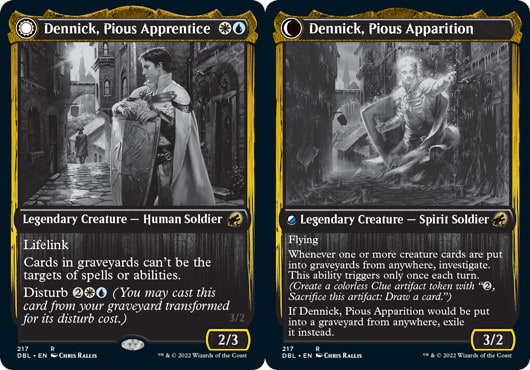
Dennick, Pious Apprentice is a great reminder that an Investigate card doesn't need to be flashy to be genuinely strong. On the front side, he's already doing quite a lot for just 
 : he has Lifelink, comes with a relevant graveyard-hate clause, and generally does a good job of being annoying in all the right ways. Then, once your opponent finally answers him, you can bring him right back with Disturb as Dennick, Pious Apparition, which lets him keep generating you value instead of just fading away.
That back side, in particular, is where he really starts to shine in grindy games. Dennick, Pious Apparition helps keep the cards flowing by letting you Investigate whenever one or more Creature cards are put into graveyards from anywhere, which means normal gameplay actions like trades in combat, removal, milling, self-mill, all of it, can quietly keep feeding you Clues and making sure you don't ever run out of gas.
2. Forensic Gadgeteer
This Vedalken Artificer Detective lets you Investigate whenever you cast an Artifact spell, which already gives it a solid home in any Artifact-heavy deck. Still, Forensic Gadgeteer gets especially nasty in Commander once you start pairing it with cards like Urza, Lord High Artificer.
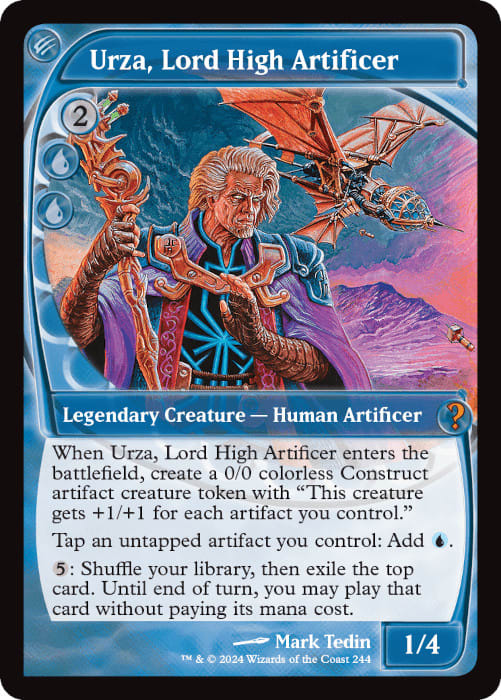
Now, all of a sudden, all the Clues you pile up aren't just future card advantage, but they're now also extra Artifacts that can be tapped, sacrificed, or otherwise turned into mana and value, which makes the whole engine feel a lot more explosive than it first appears.
 |  |
And if you really want to get silly, cards like Cyberdrive Awakener and Tangletrove Kelp can turn that massive stockpile of Clues into an actual win condition by animating your board and swinging for huge chunks of damage out of nowhere.
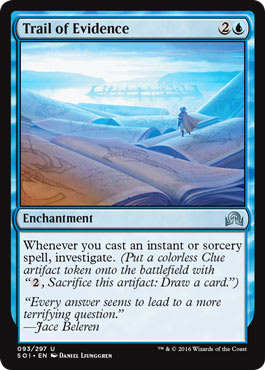
1. Trail of Evidence
If I'm putting one card at the top of the list, it has to be the surprisingly Uncommon Trail of Evidence. With Trail of Evidence out, whenever you cast an Instant or Sorcery spell, you Investigate. Pretty straightforward effect, right? But it's this clean line of text that makes this Enchantment so absurdly good.
In the right deck, every cantrip, every removal spell, and every counterspell will always leave behind a Clue. And what do those Clues get you? You guessed it: even more spells to cast for even more Clues.
What really pushes Trail of Evidence over the top for me, though, is just how well it ties into the overall Investigate strategy, regardless of where you want to focus your Clue production and utility.
If you like pairing Forensic Gadgeteer with Urza, Lord High Artificer because all those harmless-looking Clues can suddenly become mana, then Trail of Evidence fits beautifully into that same kind of game plan. Instead of rewarding you for casting Artifact spells, Trail rewards you for doing what Blue decks already want to do anyway, casting lots of Instants and Sorceries. And it still floods the board with Artifacts for something like an Urza to exploit later.
Or if you're leaning into bigger aggressive payoff cards like Cyberdrive Awakener, Trail gets even sillier. All those Clues you've been quietly stockpiling can suddenly turn into a massive airborne threat, which means Trail isn't just feeding your hand over time; it's also helping you set up a very real way to inevitably close out the game.
Trail of Evidence is steady, cost-efficient, and deceptively powerful, and more than almost any other Investigate card, it eloquently captures what makes Investigate so satisfying. You're never in a rush, you're never out of resources for long, and every spell you cast feels like one more piece of the case falling neatly into place.
Conclusion
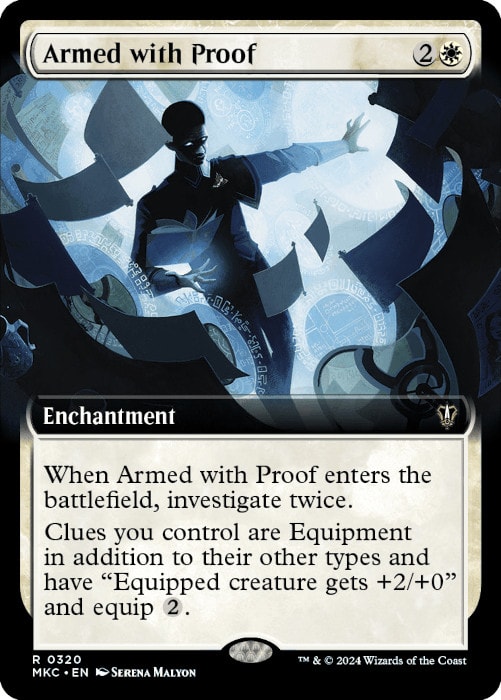
From its debut in Shadows over Innistrad to its more recent return in Murders at Karlov Manor, Investigate has definitively proven it's a lot more than just a clever flavor mechanic. Sure, on the surface, it looks simple: make a Clue token, crack it later, draw a card.
But the more you dig into the mechanic, the more interesting it gets. Not only does it add flexibility to your card draw, but it also opens the door for Artifact synergies from numerous angles, all while creating all kinds of small decisions that can really reward patient play.
As a notorious Blue player, Investigate feels exactly like the kind of mechanic I want to always be experimenting with. It doesn't just hand me value all willy-nilly; it lets me stockpile it, work around it, and turn it into something bigger later. Sometimes that means just cashing in a Clue when I need to hit a Land drop on time. Other times, it could mean letting them pile up menacingly until I get a combo piece to close up the game.
With all that said, whether you came here wondering what Investigate means in MTG, trying to sort out how Clues actually work, or just looking for some sweet Investigate cards to build around, I hope this guide helped make the mechanic a little clearer.
Investigate may look simple at first, but as you've seen today, it has a lot more depth to it once you start digging into the rules, the synergies, and all the different ways Magic has used it over the years. And honestly, that's probably a big part of its charm.
After all, in a game full of Big Stompy, Land Pass, and Infinite Combos dot decks, there's just something so whimsically satisfying about solving your problems the old-fashioned way: by cracking one Clue at a time.