


 Locations


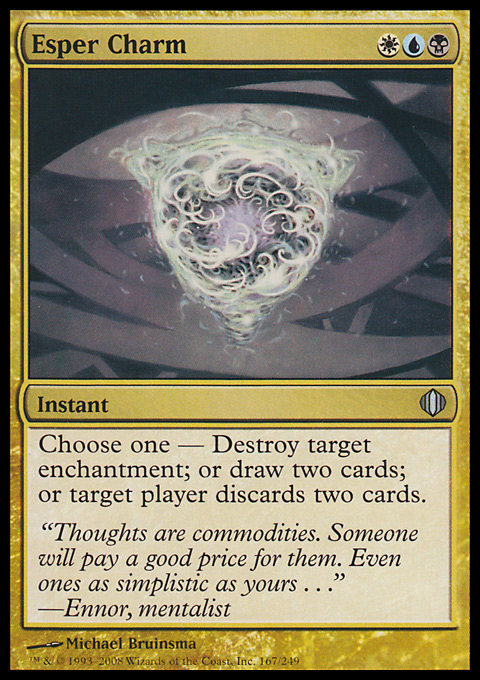 Cedric Phillps drew a lot of ire for his play against an opponent (Premium SCG Required) at the Columbus Midwest Masters. To recap, his opponent played an Esper Charm, targeting himself. Cedric confirmed, "you are targeting yourself." Opponent confirmed. Cedric called a judge, and had the opponent confirm to the judge. Opponent confirmed again, he was targeting himself with Esper Charm. The opponent was then forced to discard two cards, since that is the only mode of Esper Charm that targets a player.
This has brought on numerous calls of 'Scum!' and questions about sportsmanship. Personally, I am fine him calling the judge, and I don't think it was scummy. I'm not sure that the opponent should have been forced to discard two, but I'm as long as there are a number of high level judges debating this, I don't want to get in the middle. Cedric was practicing good sportsmanship in the sense that he was holding his opponent to the same level of play that he is holding himself to.
The problem comes from poor communication. His opponent wanted to draw two cards with Esper Charm, but what he actually did was target himself with it, and (by the floor judge's ruling) chose the wrong mode. Now, let's take the same situation and instead have the opponent say something slightly different. "Esper Charm, draw two, target myself." In this situation, it is clear to both players what the opponent wants to do, even if it is technically not legal. If a judge was called, the intention of drawing cards is obvious, and he would have been able to draw them.
I don't know what the player was thinking by only saying "target me", but that seems by far to be the least relevant thing to mention when casting the spell. Even if the draw part was targeted, it would have been far better to only announce the 'draw' part. Whenever you have the option of giving partial information, or full information, give the full information. Ambiguity is only going to lead to situations like the situation above.
A lot of newer players, or players who feel they are on the edge of making it big, like to hide information. They think it gives them a big advantage, or makes them look smart. They like to keep their lands in a haphazard order (so their opponents don't know what they can cast, or what mainlands they have), they like to gain and lose life silently (so their opponents don't notice if they actually gained life from a Soul Warden), and they like to be as coy as possible about what their cards do. Here's the problem with that – you set yourself up to fight a judge battle instead of a Magic battle.
Take a very common example – Plated Geopede and Landfall. Because Plated Geopede is a 'must' ability, and not a 'may', you don't technically need to announce his +2/+2 from landfall. You can play a land, and swing with your 3/3. This in and of itself is not a problem. The problem comes when a player doesn't announce his land drop, or his Geopede's trigger. It isn't uncommon at all for players to not announce land drops – especially in the middle of the game – but when the playing of a land matters, you should be making some kind of note of it. You attack, they block with a 2/2. You tell them that their guy dies, they say you didn't play a land, and unless you have some reasonable proof that you did, it is possible that you will get ruled against. If you had at least announced the land drop when it happened, there would have been less confusion, and the game would have been in a clearer state for both players.
Life totals too are something that players like to be very mum about, and often with disastrous consequences. I try and confirm both life totals with my opponent about once a turn, and always before and after an attack. Why? Because sometimes I miss things too, and I don't want to find out two or three turns later that I missed something important.
It's always better to resolve any discrepancies earlier rather than later. Much like the example above, say you play a Plated Geopede on turn 2, then next turn play a land (without announcing it) and attack. You mark down -3, opponent marks down -1. This happens again the next turn. The turn after that, your opponent plays a life gain spell, and announces their life total at the wrong number. Now you correct them, and you need to bring a judge in to confirm everything, and you always risk being ruled against.
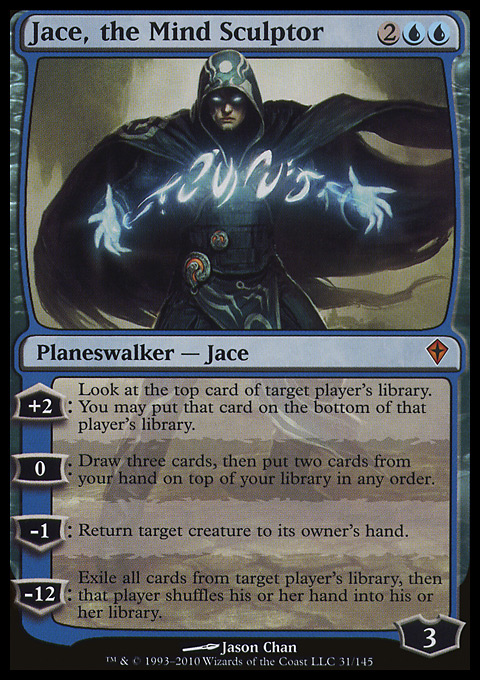 Now, what if the opposite was true – you have Jace with 3 counters. Your opponent has a Goblin Guide and a Hellspark Elemental. The Guide attacks you, and the Hellspark attacks Jace – but for whatever reason (error or malice) they mark down -5 to your life total. The next turn they unearth the Hellspark and attack you. The game goes on a few more turns, and they top deck a bolt and send it at your face. Now you argue that you are at 3 and not 0 when the bolt resolves. So, the judge comes in. Several turns have passed, and the chances are you aren't going to be able to rebuild the last three or four turns worth of attacks that easily. You just have to hope the notes you have will be enough to prove your position.
In all of these situations, the chances are that things are going to be ruled in your favor – but that's just what they are: chances. The advantage you get from hiding information is usually very small. Being as clear as possible about what spells you are casting, what lands you are tapping, and what life totals are
On the flip side, never make assumptions about the state of the game if you don't have to. When your opponent attacks with creatures, confirm their power and toughness before blocking. Confirm it before taking damage – basically, just make sure that you aren't missing anything on board that is going to blow you out of the water. It happens far more often than you think, and is a very embarrassing way to lose a game. You may want to prevent yourself from looking dumb by asking seemingly obvious questions over and over again, but you are making the smart play. You may not be rewarded for being trisksy, but you will never be penalized for making a stupid error or lose a coin-flip ruling.