 Locations



The One Piece Trading Card Game is broken down into distinct colors that represent different playstyles. Whether you are a seasoned player who is familiar with the ins and outs of Trading Card Games or just someone who plays them casually, everyone's playstyle is different.
Magic: The Gathering has a color system with unique color philosophies. The Pokemon Trading Card Game makes use of Pokemon types such as Metal, Water, Psychic, etc. One Piece is no different.
I'd like to go on a colorful journey with you and explore the realms of each color within the One Piece Trading Card Game!
The Six Colors of the One Piece Trading Card Game
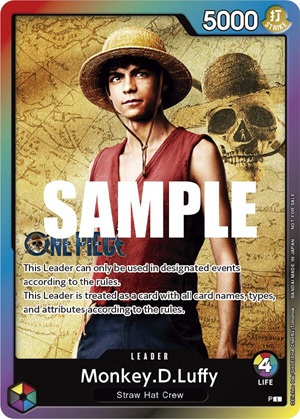
Before we dive in, I'd like to highlight a useful little symbol in the bottom left of every One Piece card. That small hexagon has six segments that represent the color identity of the card. From the top right of the hexagon, moving in a clockwise direction, we have Red, Green, Blue, Purple, Black, and Yellow.
These colors represent a card's color identity, but these color identities also determine what cards you are able to play in your One Piece deck. But we're not here to talk about game rules this time. We're here to talk about the fun possibilities each color brings to the table. So, let's set sail.
Red - Known for Aggression
One of the initial four colors introduced to One Piece at launch, Red embodied what seasoned players from other card games might've expected. It had cards with low costs and competitive stats, and it enabled aggression with abilities like Rush. This early printing of Zoro is a great example of the color's early feel.
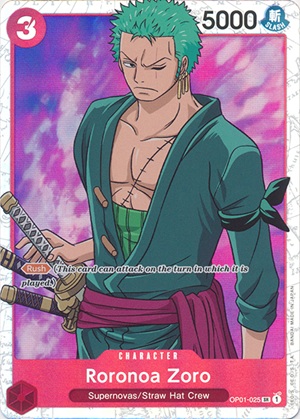
When the game was in its early stages, between the first set Romance Dawn and third set Pillars of Strength, this card stood at around a $17 price point. It was for good reason. Coming down with 5000 power immediately able to swing into your opponent on turn two was invaluable at the time. Back then, all leaders (beside Edward Newgate) had a base power of 5000. This created an environment for decks that fell under the moniker "Red Deck Wins" to thrive. Those decks could close out a game within four to five turns.
Yet, as the game has developed, Red broadened its horizons. Look at Red Haired Shanks leader from the ninth set, Emperors in the New World.
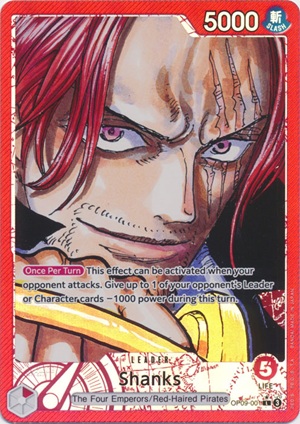
Shanks doesn't promote a truly aggressive strategy. Rather, he allows you to dwindle down the power of one of your opponent's characters when they attack to ensure that they can't strike through to your life pile. That strategy aligns more with a playstyle many describe as "Pillowfort."
Reducing opposing characters' power has become commonplace for Red in One Piece nowadays. When you sit at the table against someone who is playing Red, you're either in for a drawn out experience full of power reduction, or a lightning-fast game defined by aggression.
Green - Keep them Rested
One of the most prominent mechanics in One Piece is whether a Character, DON!!, or Leader is Rested or Active. In Magic: The Gathering, this would be referred to as something being Tapped or Untapped. If a Land is Tapped, it cannot be utilized to produce Mana. If a creature is Tapped, until it is Untapped, it cannot attack. The same is true for Rested and Active.
If a DON!! is Rested, it cannot be utilized to pay the cost of a card. If a Character is rested, it cannot attack a second time without being turned Active. Now, consider a scenario in which one color capitalized on this mechanic?
Green has stayed true to the one thing that makes it unique since the beginning of the game, and that's Resting your characters while turning their own characters, or even DON!!, Active as much as possible. For an example, look at Eustass "Captain" Kid from Set 1 Romance Dawn.
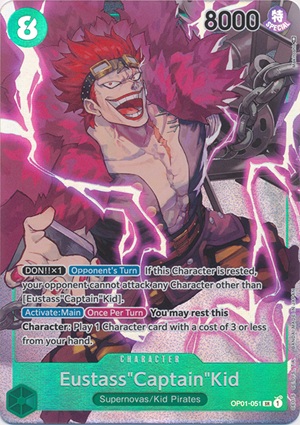
Eustass "Captain" Kid is huge at 8000 power, and he enables you to Rest himself even if he can't safely attack, and ensure your opponents can only attack him. It isn't exactly easy to attack through 8000 power. To date, this particular Character is a staple many Green fortress-style decks, not to be confused with the previously mentioned Pillowfort. Instead, these strategies are more aligned with Control. You HAVE to get past Eustass "Captain" Kid in order to hit your opponent for life, and Green always has something planned to ensure you can't do that.
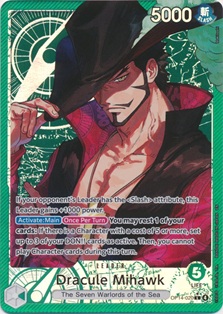
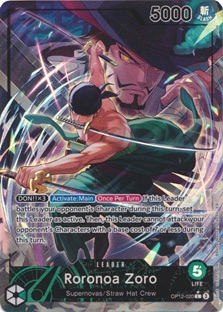
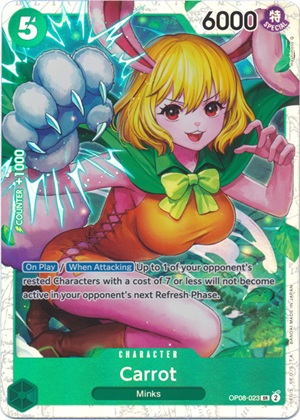
Likewise, there are cards such as Carrot that On Play and On Attack ensure one of your opponent's Rested characters remains Rested for the foreseeable future. She costs five, has 6000 power, and promises to lock down one of your opponent's Rested Characters during their next Refresh Phase. This trend of working specifically around Resting and turning cards Active continues to this day in leaders such as Dracule Mihawk and Roronoa Zoro.
 |  |
If you want to turn things horizontal and vertical constantly, paving the way for your own attacks strike true, Green might just be the color for you.
Blue - It's more than just a Bounce House
Blue is a color known for being in direct opposition to combat. Well... somewhat.
Blue, much like Red, has the potential to be incredibly versatile. Early on, Blue had Leaders like Donquixote Doflamingo that tried put Characters on the board as quickly as possible by manipulating the top of your deck. Doflamingo had us believing early on that Blue was going to be full of midrange potential by cheating out Seven Warlord Characters with a cost of four or less in addition to what you may already have on your board.
Going wide? Red already did that. Outside of top deck manipulation, what was the difference?
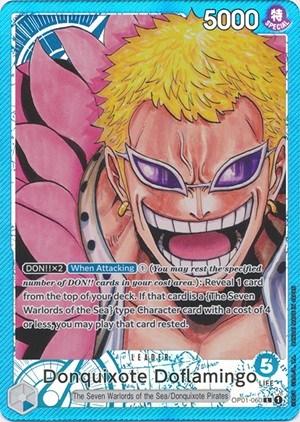
Of course, Doflamingo and other leaders from the first few sets stood in the spotlight for years and continue to see play now. However, we quickly discovered that Blue wasn't just a copycat of Red with extra steps. The color brought the potential of knowledge.
This knowledge came to us in the form of card draw and bouncing opposing characters, all while continuing to ensure you get what you need from your deck. Leaders like Boa Hancock, and cards like Gravity Blade Raging Tiger further explored this attribute of Blue.
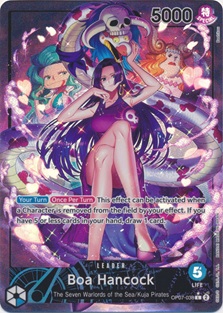 | 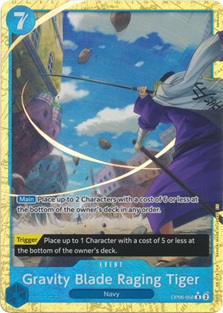 |
As One Piece has further evolved, Blue has returned to its roots. Leaders such as Jinbe reward you for creating more of a board presence, while other Leaders like Kuzan want you to filter cards from your hand to ensure you draw what you need as soon as possible.
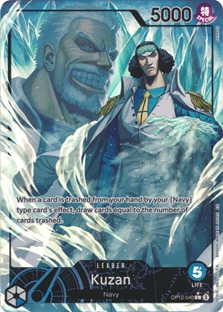 | 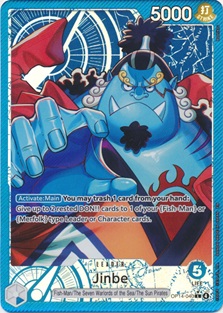 |
Blue in One Piece has an abnormal playstyle that plays outside of typical combat-focused strategies. There's nothing like drawing a fresh new hand, after all.
Purple - DON!!, on DON!!, on DON!!
The term Ramp has been used to describe the game action of putting more Resources into play that can be used to pay the cost of cards. Pokemon has Energy, Magic has Mana, Lorcana has Ink, Riftbound has Runes, and One Piece has DON!!. While Ramp originated in Magic: The Gathering, you can easily identify what Purple does with DON!! in One Piece as Ramping. It is a central part of Purple's identity.
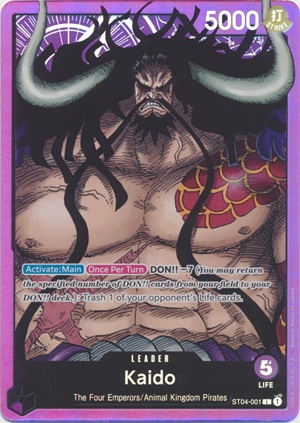
From the beginning, Leaders such as Starter Deck Kaido had abilities that would require you to return DON!! Back to your DON!! Deck for its full effect. You could throw seven DON!! back into your DON!! deck and just trash one of their life cards. Seven DON!! is absolutely a large price to pay, but you don't have to take part in combat to attack their life pile, avoiding opposing triggers from life, and potentially closing out the game if you can guarantee a swing. That's a bit more of a highlight for Kaido than it is Purple as a whole.
A lot of cards have been printed in Purple that benefit Kaido and other Purple leaders that manipulate DON!! to their advantage. Purple Donquixote Doflamingo, Foxy, Black Maria, and Monkey .D. Luffy are all great examples of this.
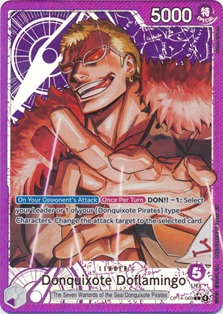 | 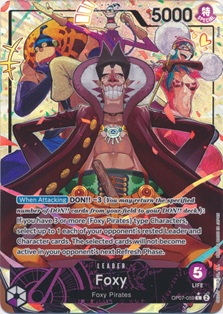 | 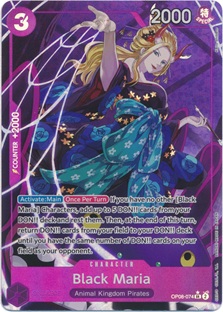 | 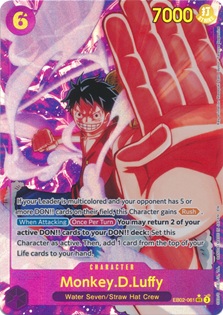 |
These cards all require you to utilize your DON!! for beneficial value. Doflamingo changes the target of an attack. Luffy has the ability to swing in twice as soon as he hits the board. Black Maria can recuperate the DON!! previously lost to paying minus DON!! costs. Foxy can straight up stop a Character and Leader from attacking the next turn.
There are plenty of different playstyles found in Purple, but all of them require you to manipulate your DON!!.
Black - From Removal to Reanimate
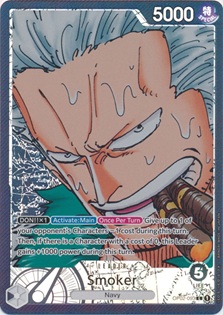
When One Piece was originally released, there were only four colors represented among the starter decks: Red, Green, Blue, and Purple. This is because Bandai did not introduce Black until Set 2, Paramount War. Black embodied the spirit of removal, clearing opposing Characters from the board by reducing their cost while on the board. This was highlighted early on in leaders like Smoker who benefited from reducing the cost of your opponent's Characters to zero and then buffing his own stats.
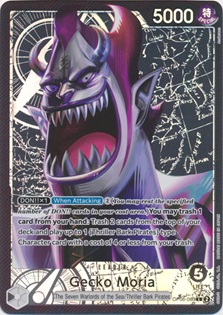
Early on, Black wanted to be the main Control color, but as time went on, removal became an overarching problem within the game. With this realization, Bandai began transitioning Black's identify from removal to reanimation. This transition can be seen in the leader Gecko Moria from Set 6, Wings of the Captain. On attack, Moria could reanimate Thriller Bark type Characters back to the field from your Trash.
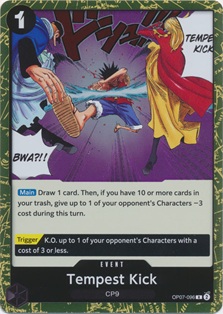
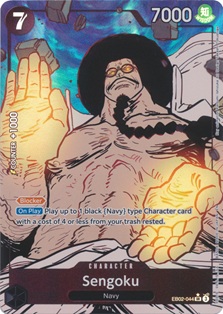
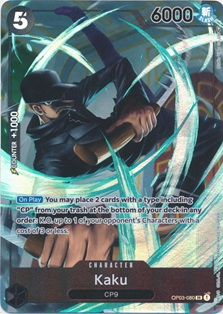
Black made use of your Trash early on in the game's lifespan, but it really became more apparent around Set 6. Some examples can be seen in Tempest Kick, Sengoku, and Kaku.
 |  |  |
Removal is one of the weaker playstyles as of 2025 due to the amount of anti-removal pieces available within every color. However, this doesn't keep Black from seeing tournament play. You can reanimate to your heart's content and enjoy your time playing with your Trash.
Trash is your friend, and cards being thrown into your Trash doesn't mean they're gone forever. Those cards could be put back on the bottom of your Library, or perhaps a Character could be returned to the battlefield. You don't have to fear Trash, you just have to embrace it. Black embraces it's boundless potential as it's moved more towards a philosophy of recycling your used cards.
Yellow - Big Life Piles Matter
The last color on our list, and the last color introduced in the game is Yellow. Making its debut in Set 3 Pillars of Strength, Yellow is the color that just doesn't know when to stay down. Yellow takes a normal life pile of five cards and turns it into a like six or eight card life pile. It can even make use of your life pile by just flipping a life card face up.
Flipping your life pile cards face-up lets your opponent know what your next card is, and warns them if you have an upcoming Trigger. This puts a pitfall right in front of your opponent and forces them to figure out how to avoid falling into it.
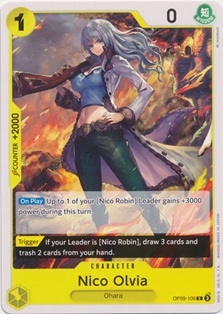 | 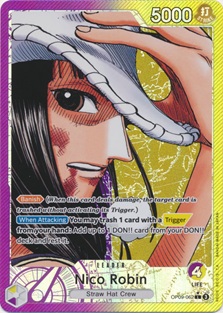 |
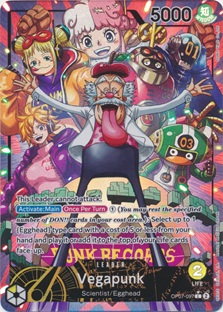
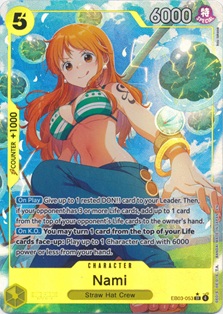
Take Nico Olvia, for example. If you were to flip her face-up in your life pile while your leader is Nico Robin, your opponent now has to consider what counter actions may be necessary to work around that trigger. You could potentially be drawing three cards and trashing two if you decide to resolve the trigger, or you can just put Nico Olvia into your hand. Vegapunk and Nami also offer ways to take advantage of flipping your life cards face-up.
Vegapunk starts off with a super low life total, and can't attack, but don't let that fool you. The ability to pay one DON!! and stack your life pile can get out of hand very fast. Nami's On K.O. ability requires you to flip a life card from your life pile to replace her 6000-power body with another 6000-power Character.
 |  |
Yellow constantly adding cards to their life pile is another thing it excels at. Even if you drop a Yellow deck's life pile down to one, that could easily just turn into a three-card life pile on their next turn.
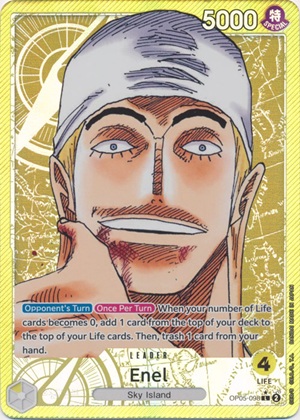
Look at Enel Leader. In order to win against him you need to hit him a minimum of three times after his life is brought down to one. One hit to get rid of the card in their life pile, one more hit to get rid of the replacement card in their life pile, and then a final hit to actually win the game. Yellow makes it difficult to kill them, and asks if you have the resources to finally close out the game.
Conclusion
Each color in the One Piece Trading Card Game brings it's own unique strategy to the table. Hopefully now you have a better understanding of each color's philosophy. Pick the color that aligns with how you want to play the game and you can't go wrong.
'Til the seas bring us together again, fellow seafarers.