 Locations



In September 2016, Standard rotation was upon us as Dragons of Tarkir and Magic Origins exited to make way for the newest set: Kaladesh.
This set took place on an all-new world first revealed in Magic Origins, crafting an Indian-inspired steampunk world. That world was Kaladesh, a bright plane of swirling aether that was holding the Inventors' Fair as Chandra, Nissa, and Liliana gathered on the plane.
Coming up on the 10th anniversary, now is a great opportunity to look back at this classic release. Not only did it give us powerful new mechanics like Energy and Vehicles, but it would also warp Standard around it, leading to drastic changes in design philosophies.
Due to its phonetic similarity to a derogatory, colorist term in some Hindi dialects, Kaladesh was renamed to Avishkar with the release of Aetherdrift in 2025. This article refers to the plane by its original name as it coincides with the set name.
With that, let's explore the plane of Avishkar.
Kaladesh Essential Info
Kaladesh was released on September 30th, 2016. With it came the annual rotation and launched the beginning of the Bolas Arc that would culminate in the major event set War of the Spark.
It had the codename of Lock, as part of "Lock, Stock, and Barrel," along with a few other clandestine titles during development.
The set contained approximately 264 cards as well as 10 cards that were exclusive to the Planeswalker Decks. Each of these were Standard legal, though players could also find a selection of foil Kaladesh Inventions that would only be legal in their original formats and did not enter Standard with this release.
The design team - credited as Exploratory Design and Vision Design - consisted of the following people:
- Mark Rosewater (co-lead)
- Shawn Main (co-lead)
- Doug Beyer
- Scott Van Essen
- Mark Gottlieb
- Adam Prosak
- Ben Hayes
- Drew Nolosco
- Jonathon Loucks
The development team - credited as Set Design and Play Design - included:
- Erik Lauer (co-lead)
- Ian Duke (co-lead)
- Doug Beyer
- Ben Hayes
- Gavin Verhey
- Tim Aten
- Melissa DeTora
Matt Tabak and Eli Shiffrin would also provide additional contributions to the set.
Products
Kaladesh came with several different products, even though many of them look different from what you might expect today.
Booster Boxes and Packs

Kaladesh was primarily sold in 15-card Booster Packs. Booster Boxes would contain 36 of these Booster Packs. Each pack came with 10 Commons, three Uncommons, one Rare or Mythic Rare, a Basic Land, and a Token or ad card inside. Select Booster Packs would replace a Common card for a premium foil card of any rarity.
No other types of individual Boosters were released for this set because Kaladesh predated them all.
Bundles

Bundles saw their initial release with Kaladesh. Well, sort of anyways.
In truth, the Bundles were a rework of the existing "Fat Pack" line of products that had accompanied every release since Mercadian Masques. This simplified the name and tidied away the negative connotation that could come with it.
Additionally, it went from nine to ten Booster Packs while also adding in some small boxes for tokens, counters, dice, and the like.
Bundles of this era were also known for including a Player's Guide. This would provide players with an overview of all the cards in Kaladesh, showcase a few of the best, and provide insights on the best ways to use them.
Planeswalker Decks
Kaladesh also saw the introduction of the Planeswalker Deck line of products. These replaced the previous "Intro Packs" and were designed to put greater focus on the popular Planeswalker card type and relevant story characters.
Each Planeswalker Deck would include one 60-card deck. Each of these featured a handful of exclusive designs including a low-powered Planeswalker and some synergistic cards. You'd also get two Booster Packs.
These would continue through Core Set 2021, after which they were retired in favor of Commander decks that would accompany each release.
Deck Builder's Toolkit

The Deck Builder's Toolkit had been a fan favorite item throughout the early 2010s. Versions of these were released in 2009 and 2011 before being attached to each year's Core Set release starting with Magic 2013. With Shadows Over Innistrad, they started to be associated more directly with expansion releases instead, with Kaladesh marking the entry that would follow it.
Each Deck Builder's Toolkit included a semi-random assortment of cards inside that players could use to build simple decks and four Standard-legal Booster Packs. The semi-random cards could contain popular Constructed Commons and Uncommons, making for a solid deal for newer players looking to get into the game.
The last set to feature these would be Theros Beyond Death.
Booster Battle Packs

Booster Battle Packs returned with Kaladesh once again. These were introduced with the release of Magic 2012 and took a hiatus after Magic 2014, having been replaced with Clash Packs. Shadows Over Innistrad brought them back once more and continued into Kaladesh.
Each Booster Battle Pack contains a pair of starter-level Welcome Decks for new players to learn the game with, as well as two Booster Packs to take their experience further. Due to the beginner nature of the product, you could only find them in big box stores like Wal-Mart or Target.
The Masterpiece Series: Kaladesh Inventions
One year before the release of Kaladesh came out, Battle for Zendikar was released. With it came a series of ultra rare Expedition Land cards, kicking off what would become known as The Masterpiece Series.
Each of these would play into a theme of the set or block and would be extremely rare items, often showing up only once in several Booster Boxes. They had special full-art and foiling treatments. In addition to the ones in Battle for Zendikar, another set of these Lands appeared in Oath of the Gatewatch.


After a break during the Shadows Over Innistrad block, this series continued in Kaladesh with the Kaladesh Inventions. This included 30 cards from throughout Magic's history, all of which were Artifacts. They were given a special filigree frame reminiscent of Kaladesh Artifacts and once again had a special foil treatment.
Each of the Kaladesh Inventions that could be found in this set were meant to represent the story's Inventors' Fair. They were meant to represent the inventions on display for others to look at. While most were classic favorites, five slots were used for the cycle of Mythic Rare Gearhulks.
Mechanics
Kaladesh introduced three mechanics and one new Artifact subtype to go alongside one of those mechanics. Each of them brough something a little different to the game.
Energy


Energy might be the most well-known mechanic of Kaladesh. Mark Rosewater famously came up with the mechanic in Mirrodin but removed it due to the set's already high complexity. It was held off until it could find the right home which turned out to be Kaladesh.
This mechanic generated an alternate costing source by means of Energy Counters that you as a player could obtain. You could then use these Energy Counters to fuel a variety of card abilities or scale select spells.
This mechanic was extremely powerful and somewhat parasitic, as Energy didn't work well with non-Energy cards. It would dominate Standard in its era and go on to be a major player in older formats thanks to the eventual release of Modern Horizons 3.
Vehicles (and Crew)


Kaladesh also introduced a whole new Artifact subtype in Vehicles. These have since become deciduous and fairly close to evergreen, showing up in many sets these days in some capacity.
Vehicles worked as normal Artifacts that could be turned into Artifact Creatures by utilizing the new Crew mechanic. This lets you tap a certain number of Creatures with the listed power to turn the Vehicle into the aforementioned Artifact Creature. Later Vehicles would find creative new ways to Crew instead, but here they were all power based.
Some cards would also interact with the Crew mechanic. For example, Speedway Fanatic gives a Vehicle Haste when you Crew with it.
Fabricate
 | 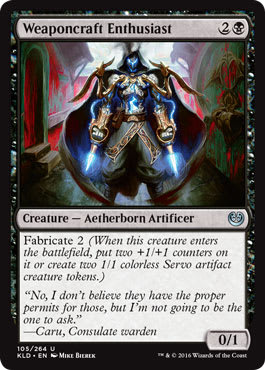 |  |
The last mechanic of this set was Fabricate. This ability would trigger as a Creature entered the battlefield and would give you the option to put that many +1/+1 counters on the Creature or create that many 1/1 Servo tokens. Only White, Black, and Green cards would have this, as well as two Colorless Artifact Creatures.
Limited Archetypes
Kaladesh had a fairly fun Limited environment. Despite the parasitic nature of Energy and some unbalanced Vehicles, there was a good variety of things you could do.
Here are the ten Draft archetypes that you could build around with the set:
- White-Blue

 : Blink and Enters Effects
 - Blue-Black
 : Artifact Control
 - Black-Red
 : Artifact Aggro
 - Red-Green
 : Energy Beatdown
 - Green-White : Fabricate Go-tall/Go-wide
- White-Black : Recursion
- Blue-Red : Energy & Artifacts
- Black-Green : Fabricate Midrange
- Red-White : Vehicle Aggro
- Green-Red : Energy Tempo
White-Blue: Blink and Enters Effects
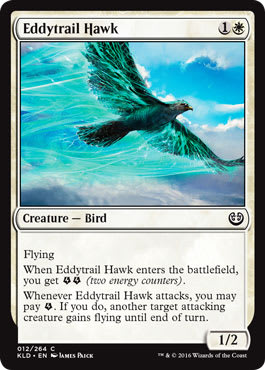 | 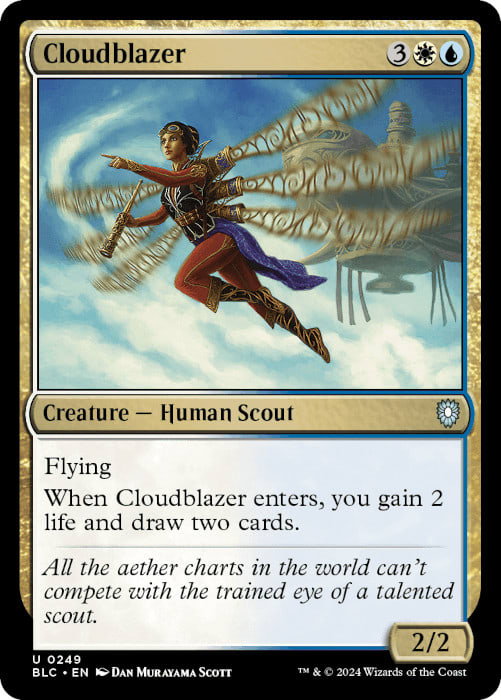 | 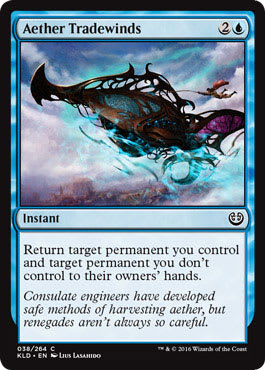 |
White-Blue went all in on enters (the battlefield) abilities from Creatures so you could exploit their value and overwhelm a table. With the aid of cards like Acrobatic Maneuver, Aviary Mechanic, and Aether Tradewinds, picking up your stuff to replay it was a breeze.
These abilities let you do things like generate additional Energy, get extra value from your Fabricate effects, or even just replay a Creature to have it up as a blocker. Eddytrail Hawk was a beater in just about every White deck, but it especially excelled here thanks to the ability to repeatedly get more Energy to fuel its ability to give a team wings.
Blue-Black: Artifact Control
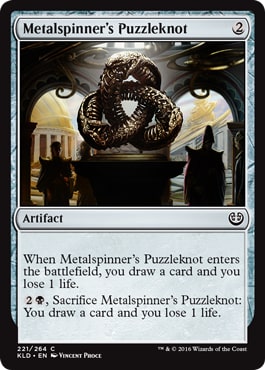 | 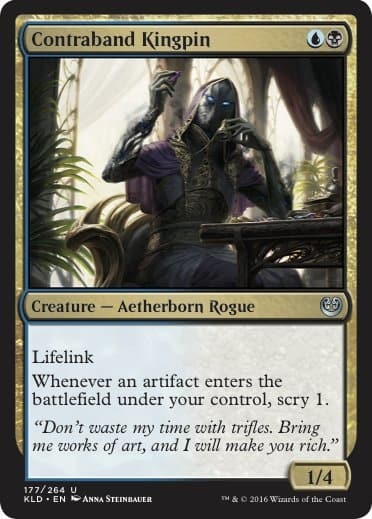 | 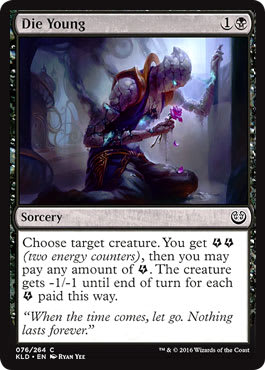 |
Blue-Black was a pretty typical Control strategy in this format. Various cards like Metalspinner's Puzzleknot and Prophetic Prism would generate you card advantage while removal like Die Young and Subtle Strike dealt with problematic Creatures.
This version used some minor Artifact theming, as noted by the signpost Uncommon Contraband Kingpin. It's subtle, but cards like Foundry Screecher, Ovalchase Daredevil, and Gearseeker Serpent can provide strong payoffs.
Black-Red: Artifact Aggro
 | 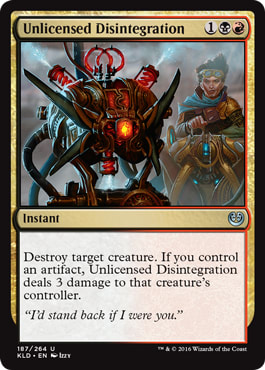 | 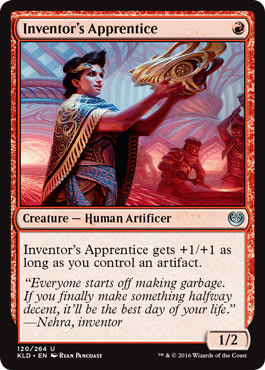 |
Several of those Black Artifact synergy cards also make a strong showing in the Black-Red strategy of Artifact Aggro. Many of them, along with Red ones like Inventor's Apprentice and Reckless Fireweaver dish out the damage as you make use of your Artifacts.
Many of the Artifacts themselves are great as aggressive threats too. In particular, something like Weldfast Monitor could go a long way if you gave it Haste. If you could go heavy on these Artifacts, Chief of the Foundry would make them even more potent.
Red-Green: Energy Beatdown
 | 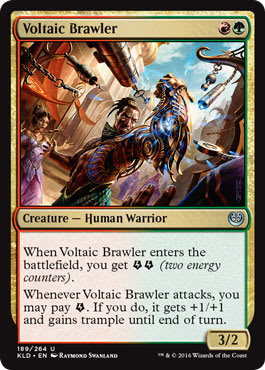 | 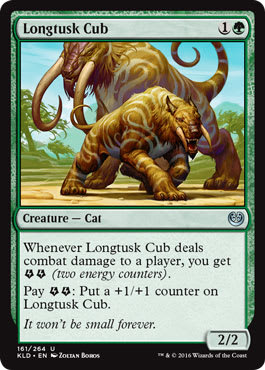 |
One of the stronger archetypes, if you could make it happen, was definitely the Red-Green Energy Beatdown plan. It was so potent that many of the cards used here would go on to form the backbone for Standard Energy decks and lead to multiple bans.
If you can pull together enough Energy-granting effects like Attune with Aether and Sage of Dhaila's Claim, you'll be off to the races. Play them alongside huge beaters like these:
Your opponents will struggle to come back against you.
Green-White: Fabricate Go-tall/Go-wide
 |  |  |
Fabricate was largely focused on three colors: White, Black, and Green. Naturally, when you put two of those colors together, you'll get an archetype that loves this mechanic, as was the case with Green-White.
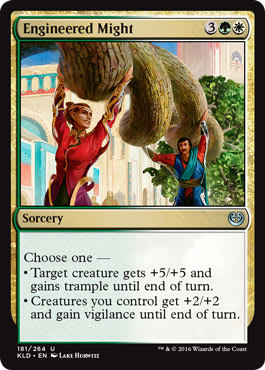
Thanks to Fabricate, you can either Go-Wide or Go-Tall. Regardless of which approach you take, you can find ways to pump your board with Engineered Might or else get benefits for your counters like with Armorcraft Judge.
Many of the White bounce/blink effects work can also wonders with your Fabricate Creatures. As such, they're great for this deck too, provided you could fight over them.
White-Black: Recursion Midrange
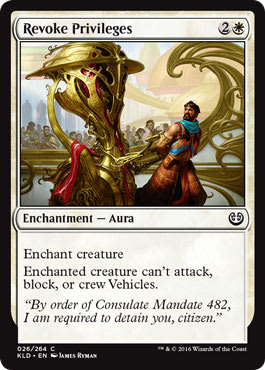 |  |  |
The White-Black archetype is a little elusive, but has been referred to as "Recursion" by some players, thanks to Restoration Gearsmith and cards like Fortuitous Find and Refurbish.
For the most part, though, there isn't exactly any payoffs for pulling cards out of your graveyard, and it's more an aspect of the strategy.
In truth, this is more like a typical Midrange list. This includes a solid mix of aggressive threats and blockers with good removal options. Buying back many of these cards allows you to maintain your momentum in your game and overwhelm your opponents, especially as you play out these colors' Fabricate threats.
Blue-Red: Energy & Artifacts
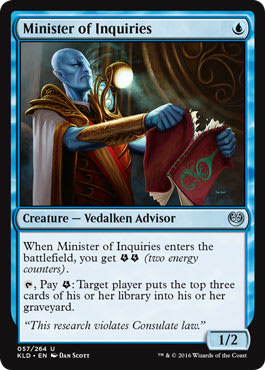 |  |  |
Blue-Red continues the Energy theme that made Temur (Blue, Red, and Green) so potent in Standard. In truth, Izzet is probably the weaker of the two-color pairs you could use, but it still has some outstanding threats. Cards like Whirler Virtuoso and Harnessed Lightning can be overwhelming for your opponents.
You can also make good use of alternate threats like Minister of Inquiries and Reckless Fireweaver to whittle away at your opponents' chances of victory. Further impede their progress to maximize the effectiveness of these cards with your myriad controlling Blue effects.
Black-Green: Fabricate Midrange
|  | |
Black-Green is all about the +1/+1 counters, as is clear by Hazardous Conditions taking out just about anything without them.
While this strategy would be much more fleshed out in the following set, here your goal was to spam big threats with Fabricate and overwhelm your opponents. Use Black's removal suite and pave your way to an easy victory.
Red-White: Vehicle Aggro
 | 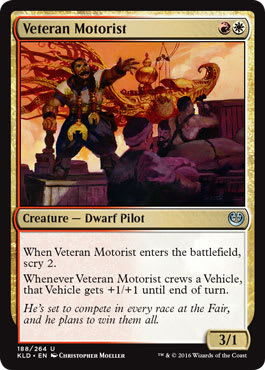 | 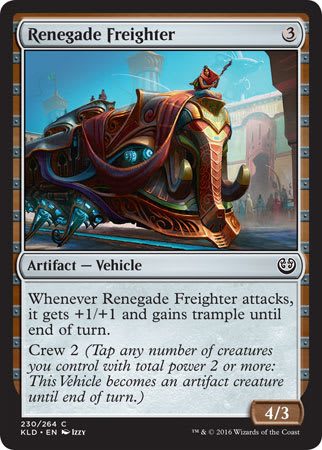 |
In just about any Limited format for the last several years, your average Boros strategy is going to lean hyper-aggressive. That's especially the case with Kaladesh, with many of the Red and White cards enabling the all-new Vehicle subtype.
This includes Gearshift Ace, Speedway Fanatic, and Veteran Motorist.
Naturally, though, the real king of the archetype were the various Vehicles. Cards like Renegade Freighter, Sky Skiff, and Ovalchase Dragster were forces to be reckoned with.
If you could get real lucky and hit something like a Smuggler's Copter or a Fleetwheel Cruiser, you were really ready to roll.
Green-Blue: Energy Tempo
 |  |  |
Much like how the Energy cards are a huge threat on the Green side of Red-Green Energy Beatdown, the same is true here. All your big threats are just as good while also continuing to benefit from the many strong Energy enabler effects.
The best part, though, is how these super aggressive threats pair with Blue's ability to stop your opponents in their tracks. Cards like Aether Meltdown, Disappearing Act, and Malfunction are all ways to slow things down and pave your way to victory.
Major Cards
The best cards from the set, typically, are the ones that had some of the biggest impacts on the Standard of the era, Commander favorites, or certain major cards for older formats.
Kaladesh is a set loaded with powerful cards, so these are just a few highlights.
The Gearhulks


One of the most defining elements of Kaladesh was easily the cycle of Gearhulks. This cycle of five Artifact Creatures made a huge impact in Standard at the time.
Torrential Gearhulk, Noxious Gearhulk, and Verdurous Gearhulk got the majority of the play.
Cataclysmic Gearhulk saw some minor play and Combustible Gearhulk ended up being a fringe player that would go on to see more play in older formats.
Torrential Gearhulk was easily the most noteworthy of the five, appearing in a wide variety of Control and Midrange decks of the era.
This cycle of cards became so beloved and popular that when we revisited the plane in Aetherdrift, a new cycle of Multicolored Gearhulks were made, though their impact was more modest.
The Enemy Fast Lands


Kaladesh also brought us five Enemy-Colored Fast Lands:
These Lands come from the era when Wizards would frequently only print five of ten of a specific type of dual Land and save the rest for a later set. Here, this completes a cycle that originally began in Scars of Mirrodin where the Allied-Color ones appeared.
Not only did these define Standard at the time but have also seen quite a bit of play in both Pioneer and Modern. In fact, they were pretty important in the early days of Pioneer as Scars of Mirrodin wasn't included as part of the format.
The Energy Package
Energy was the core mechanic of Kaladesh and the following set Aether Revolt.


Cards like
- Glimmer of Genius
- Harnessed Lightning
- Attune with Aether
- Servant of the Conduit
- Voltaic Brawler
- Whirler Virtuoso
Were cards that saw significant to modest play, in order.
What made them so good were the many powerful threats you could build up using them. It could fuel powerful combos like Aetherworks Marvel and Electrostatic Pummeler or just help make an already dangerous threat like Bristling Hydra more potent. This would lead to the banning of multiple cards just to rein it in, but it was the greater synergy of the mechanic as a whole that really made it work.
Paradoxical Outcome

In most instances, a card like Paradoxical Outcome doesn't seem like it does all that much so, it might surprise you to learn that this random Johnny/Jenny Rare ended up turning a powerful format like Vintage on its head.
Thanks to Vintage's use of cards like the Power 9 - six of which are  mana Artifacts - along with Sol Ring, Mana Vault, and Mana Crypt, it's easy to pick up lots of cards and replay them with ease. Since many of these cards generate mana, you could even plus on mana while drawing tons of cards. This would enable a wave of Paradoxical Outcome decks still showing up in the format.
Gonti, Lord of Luxury

Gonti, Lord of Luxury became an instant hit among Casual players everywhere from the moment the card was released here. Commander players loved the card, using it to steal stuff from unsuspecting opponents out of the Command Zone while Cube players loved the card for its versatility. It would even go on to have a modest Constructed pedigree doing some time in Standard.
It's a fantastically well-rounded option that many players continue to love as time goes on.
Chandra, Torch of Defiance

Chandra was front and center for the story of Kaladesh. After all, Kaladesh was her home.
To really showcase this, Wizards made her card have four loyalty abilities. This was a huge deal, as the only other Planeswalker to have done this at this point was the broken (for its era) Jace, the Mind Sculptor. Players were eagerly excited to see just how well she would perform.
Chandra, Torch of Defiance became a rock-solid role player in the Standard format. Wizards learned from the power of Jace and toned her down, though it would become common to see her in various decks of the time.
The card was loved by many and has continued to see use in a number of settings over the years. An updated Chandra is also slated to appear in Reality Fracture in 2026 alongside her alternate reality form: Chandra, Chill of Compliance.
Saheeli Rai

Saheeli Rai became a beloved Planeswalker as the face of the Kaladesh set. Chandra was the original choice, but Wizards felt she was a better option for Aether Revolt. Thus, Saheeli Rai was created.
At first, she seemed neat, allowing you to do some fun things with Artifacts. When Aether Revolt finally came out, players quickly realized you could create an infinite win condition with her and Felidar Guardian. This would lead to the so-called Copy-Cat deck dominating Standard and leading to a Felidar Guardian ban. The same thing would eventually happen in Pioneer.
Aetherflux Reservoir
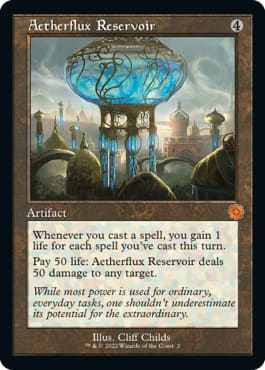
Aetherflux Reservoir was the sort of card destined to become a fan favorite in Commander. There, players love to gain life and especially as they cast spells. Once you gain enough life, you can one-shot players directly out of the game, making for a powerful finisher effect that has steadily grown in popularity over the years.
The card has even managed to find its way into Competitive formats from time to time thanks to this ability. Perhaps most notably, it showed up as an additional victory method for Amalia Combo decks in Pioneer prior to the banning of Amalia Benavides Aguirre.
Panharmonicon

Commander players love to double their stuff, and Panharmonicon was the first to double up on all abilities triggering when permanents enter the battlefield. This has made it an Instant fan favorite that has since led to numerous designs riffing off the effect. It's also known for being an all-time favorite of content creator SaffronOlive.
Smuggler's Copter

No card is as infamous as Smuggler's Copter when it comes to Kaladesh.
This powerful Vehicle provided a prime example of a solid effort in playing with new territory taken too far, much like Skullclamp and Umezawa's Jitte were with Equipment.
Thanks to its cheap mana cost of  , its low Crew
  cost, and its evasiveness, it proved to be a real beating. Most critically, though, was its draw/discard ability that triggered both attacking and blocking, providing you with plenty of card filtration.
This combination of abilities led to it being swiftly banned from Standard during the Banned and Restricted announcement on January 9, 2017. It would eventually be banned in Pioneer during the format's early days as well, though would eventually come off the ban list.
Ceremonious Rejection
Ceremonious Rejection may look rather innocuous in a world where Consign to Memory exists.
At the time, however, there were very few clean, cheap answers to deal with powerful Colorless spells, particularly coming shortly after the infamous Eldrazi Winter. This made the card a must-play in older formats for many years.
The Planeswalker Decks
Kaladesh brought with it two Planeswalker Decks - the first of their kind. For this set, they featured Chandra and Nissa to represent the world.

Headliner: Chandra, Pyrogenius
Exclusive Cards: Liberating Combustion, Renegade Firebrand, Flame Lash, and Stone Quarry.
Chandra Planeswalker Deck (Kaladesh) | Wizards of the Coast
- Creatures (17)
- 1 Brazen Scourge
- 1 Gearshift Ace
- 1 Skyswirl Harrier
- 1 Snare Thopter
- 1 Speedway Fanatic
- 1 Weldfast Monitor
- 2 Aerial Responder
- 2 Spireside Infiltrator
- 2 Trusty Companion
- 2 Veteran Motorist
- 3 Renegade Firebrand
- Planeswalkers (1)
- 1 Chandra, Pyrogenius
- Instants (7)
- 1 Fateful Showdown
- 2 Built to Last
- 4 Flame Lash
- Sorceries (3)
- 1 Cathartic Reunion
- 2 Liberating Combustion
- Artifacts (7)
- 1 Bomat Bazaar Barge
- 1 Fleetwheel Cruiser
- 1 Ovalchase Dragster
- 2 Renegade Freighter
- 2 Sky Skiff
- Lands (25)
- 10 Plains
- 11 Mountain
- 4 Stone Quarry
As is typical of Chandra, this deck featured a simple, aggressive Red-White strategy perfect for new players to learn the basics of the game with.

Headliner: Nissa, Nature's Artisan
Exclusive Cards: Verdant Crescendo, Guardian of the Great Conduit, Terrain Elemental, and Woodland Stream.
Nissa Planeswalker Deck (Kaladesh) | Wizards of the Coast
- Creatures (25)
- 1 Aethersquall Ancient
- 1 Bristling Hydra
- 1 Riparian Tiger
- 1 Sage of Shaila's Claim
- 2 Arborback Stomper
- 2 Empyreal Voyager
- 2 Janjeet Sentry
- 2 Long-Finned Skywhale
- 2 Longtusk Cub
- 2 Servant of the Conduit
- 2 Thriving Turtle
- 3 Guardian of the Great Conduit
- 4 Terrain Elemental
- Planeswalkers (1)
- 1 Nissa, Nature's Artisan
- Instants (2)
- 2 Appetite for the Unnatural
- Sorceries (5)
- 2 Verdant Crescendo
- 3 Attune with Aether
- Enchantments (2)
- 2 Malfunction
- Lands (23)
- 8 Island
- 11 Forest
- 4 Woodland Stream
While Nissa is best associated with Ramp strategies and animating Lands, here her deck focuses instead on the set's Energy mechanic. The deck's colors are Green and Blue.
Tournament Decks of the Era
Kaladesh block was known for its infamously powerful Standard environment. There was perhaps no better showing of this than at the Pro Tour, where several powerful cards from Kaladesh made their appearance.
Let's take a look and see what some of the top-eight lists from Pro Tour Kaladesh looked like.
Mardu Vehicles | KLD Standard | Lee Shi Tian, 7th Place Pro Tour Kaladesh
- Creatures (23)
- 3 Depala, Pilot Exemplar
- 4 Inventor's Apprentice
- 4 Scrapheap Scrounger
- 4 Thraben Inspector
- 4 Toolcraft Exemplar
- 4 Veteran Motorist
- Planeswalkers (2)
- 2 Gideon, Ally of Zendikar
- Instants (6)
- 2 Unlicensed Disintegration
- 4 Harnessed Lightning
- Artifacts (7)
- 3 Cultivator's Caravan
- 4 Smuggler's Copter
- Lands (22)
- 3 Mountain
- 3 Plains
- 4 Aether Hub
- 4 Concealed Courtyard
- 4 Inspiring Vantage
- 4 Spirebluff Canal
Mardu Vehicles was one of the best examples for what a deck utilizing a set's mechanics to the fullest looks like. The core strategy was Vehicles or synergy with your Vehicles relying on the powerful Smuggler's Copter and Cultivator's Caravan, allowing you to dish out some huge damage.
Ultimately, only seven Vehicles appeared in the main deck and one in the sideboard. Instead, the deck's real draw involves casting a series of cheap, aggressive threats. Doing so pressures your opponent's life total fast.
When you do finally hit your Vehicles, this will allow you to finish the job in short order.
The dominance of this deck alongside White-Blue Flash would ultimately lead to the banning of Smuggler's Copter. When Aether Revolt came out, though, Heart of Kiran would replace it with ease. Though Boros builds were more prominent at this time, lists would more commonly lean Mardu after that set as well thanks to the printing of Fatal Push.
One of the other decks that would lead to some bans would be the Temur Aetherworks deck that put Matt Nass in the top eight of this event. The deck sought to utilize Kaladesh's Energy mechanic to go all-in on the powerful Aetherworks Marvel card.
Temur Aetherworks | KLD Standard | Matt Nass, 6th Place Pro Tour Kaladesh
- Creatures (12)
- 4 Emrakul, the Promised End
- 4 Glint-Nest Crane
- 4 Ulamog, the Ceaseless Hunger
- Instants (3)
- 3 Kozilek's Return
- Sorceries (7)
- 3 Contingency Plan
- 4 Attune with Aether
- Enchantments (4)
- 2 Aether Meltdown
- 2 Vessel of Nascency
- Artifacts (12)
- 4 Aetherworks Marvel
- 4 Glassblower's Puzzleknot
- 4 Woodweaver's Puzzleknot
- Lands (22)
- 1 Mountain
- 3 Island
- 7 Forest
- 3 Spirebluff Canal
- 4 Aether Hub
- 4 Botanical Sanctum
- Sideboard (15)
- 1 Aether Meltdown
- 1 Kozilek's Return
- 1 Negate
- 4 Ceremonious Rejection
- 4 Dispel
- 4 Glimmer of Genius
Using Attune with Aether, Glassblower's Puzzleknot, and Woodweaver's Puzzleknot, you'd rapidly generate tons of Energy.
Once you did, this would give you the opportunity to spin the wheel on the deck's namesake card in order to try finding an Emrakul, the Promised End or an Ulamog, the Ceaseless Hunger. Because of the wording on Aetherworks Marvel, you got to cast both threats, allowing you to take advantage of their powerful effects.
This - combined with the era's powerful Black-Green Delirium deck - would lead to the banning of Emrakul, the Promised End due to its omnipresence as finisher. That didn't slow it down enough so Aetherworks Marvel was banned as well. Players of all levels just found this type of deck unfun, even if it didn't have the greatest overall winrate.
The finals of this Pro Tour saw Brazil's Carlos Romao on Jeskai Control facing off against Japan's Shota Yasooka on Grixis Control . The two Control masters dueled it out in what is an all-time great finals match.
Ultimately, Shota would go on to win the event, but it feels more appropriate to look at Carlos' list for this coverage.
Jeskai Control | KLD Standard | Carlos Romao, 2nd Place Pro Tour Kaladesh
- Creatures (5)
- 2 Archangel Avacyn // Avacyn, the Purifier
- 3 Torrential Gearhulk
- Planeswalkers (2)
- 2 Dovin Baan
- Instants (20)
- 1 Blessed Alliance
- 2 Summary Dismissal
- 3 Anticipate
- 3 Immolating Glare
- 3 Void Shatter
- 4 Glimmer of Genius
- 4 Harnessed Lightning
- Sorceries (5)
- 2 Fumigate
- 3 Radiant Flames
- Enchantments (2)
- 1 Quarantine Field
- 1 Stasis Snare
- Lands (26)
- 4 Island
- 6 Plains
- 1 Spirebluff Canal
- 3 Inspiring Vantage
- 4 Aether Hub
- 4 Port Town
- 4 Wandering Fumarole
- Sideboard (15)
- 1 Blessed Alliance
- 1 Fumigate
- 1 Linvala, the Preserver
- 3 Ceremonious Rejection
- 3 Gideon, Ally of Zendikar
- 3 Negate
- 3 Spell Queller
At the time, Shota's Grixis Control list was a bit less played than its contemporaries, with most builds featuring an Azorius shell that would sometimes splash into other colors. This is where Carlos' list comes into play.
Many of the classic Control cards are here, with counter magic and removal abound. These Control builds made the best use out of cards like Glimmer of Genius to find the right cards at the right time.
A well-timed Torrential Gearhulk could even let you replay it, granting you even more cards to shut the door on your opponent. If that all failed, you could always fall back onto Dovin Baan - especially if you can activate his Static Orb ultimate like Carlos did in this finals match.
Weird Facts
Of course, there's some standout tidbits associated with Kaladesh and its release. Let's take a look at some of them.
Aether Term Change
With the release of Kaladesh, the world introduced the fact that it was a plane forged by Aether. Since the substance covered the plane and the very next set would use the term in its name, Wizards decided to change how they spelled the word.
Previously, the term used a conjoined letter representing the A and E. This caused unexpected headaches, especially in online databases and during printing. Wizards cleaned it up and turning it into the "aether" that we know today.
In the grand scheme, it's a relatively minor change, but at the time it was big news.
Kaladesh Invention Variants
With the release of the Kaladesh Inventions Masterpiece sub-set came an unusual phenomenon. Due to differences in printing processes, American and European Kaladesh Invention cards each have different finishes.
The American printings use an extra glossy finish that heavily reflects light, making them extra shiny. Conversely, the European prints have a more matte finish over the art and text box, with the filigree framing featuring the bright glossy sheen.
These visual differences can appeal to collectors who prefer one or the other, though it doesn't create much discrepancy in prices.
Holiday Buy-a-Box Promotion

At the time of Kaladesh's release, Standard Showdown events had become a mainstay of local game stores. While these events typically give special promos to the winners, they used to give out were the precursors to these Promo Packs.
For the holiday season, any booster box of Kaladesh purchased also came with two special Buy-a-Box promo packs. These included the same types of cards you'd expect to find in the Standard Showdown packs.
These included a non-double-faced foil card from a Standard legal set (except for Oath of the Gatewatch). Additionally, they featured two random Rares or Mythic Rares from any Standard release of the time.
Conclusion
Kaladesh was a wild set. The Energy mechanic and the confusing addition of the Vehicle subtype warped Standard heavily around it, leading to several bans as a result.
We're still feeling the impact a decade later, as the Kaladesh block would make Wizards take a long hard look at how they did Artifacts going forward. Rather than designing them as Colorless cards, they would start to produce them more frequently as colored ones to make them less likely to break in the future.
Nevertheless, Kaladesh remains a well-loved set with a modestly popular Limited experience. It's no surprise that many were excited to see its return as Avishkar in Aetherdrift, only to be somewhat let down by what the set ultimately proved to be.

Paige Smith
Bluesky: https://bsky.app/profile/themaverickgirl.bsky.social
Twitch: twitch.tv/themaverickgirl
YouTube: TheMaverickGal