 Locations


Who's up for penguin sledding?
Avatar: The Last Airbender has been fully revealed, and with it, mechanical representations of each elemental style. It's always interesting to see how WotC adapts abilities outside of Magicinto cardboard form, and this new set is no exception. Each technique thematically slots into specific colors and functions intuitively. The pyromantic Firebending produces explosive bursts of Red mana. Earthbending animates lands into soldiers. Waterbending acts as combination of Convoke and Improvise, allowing for communal efforts to power larger impact.

And then there's the titular Airbending, a lost art at the beginning of Avatar. While I won't delve too heavily into lore, some background is in order. No worries, I'm not about to condense the deep storyline. M. Night Shyamalan already demonstrated how disastrous that can go. I'll simply set the stage: At the start of the series, nearly all practitioners of airbending have been wiped out, as prophecy foretold the next Avatar - a peacekeeping being who masters all four styles - would hail from the Air Nomads. The Fire Nation, seeking to cement their dominance over the world, attempted to eliminate the Airbenders so a new Avatar wouldn't rise to oppose them. Little did they know, wisecracking prodigy Aang wasn't home at the time, accidentally finding himself frozen into a iceberg for a century.
Now he's not only the last Airbender, but as Avatar, the world's only hope.
So how did this set translate mastery of wind into card form?
Let's glide in and find out!
Mechanics of Magic: Airbender
 |  |  |
Airbending is primarily associated with Azorius: White and Blue. A perfect fit, as the closest mechanical analogues to Airbending - Blink effects and spell taxing - are heavily tied to those colors. Whenever you Airbend, you'll target one or more specific permanent types and exile them. Some effects let you hit any nonland permanent (Appa, Loyal Sky Bison) or creature (Gilder Staff), while others only target permanents or creatures you control (Appa, Steadfast Guardian, Airbender's Reversal).
The sole exception is Aang, Swift Savior, who can also Airbend spells, acting as an Aven Interrupter with extra taxes. Very Azorius, indeed.
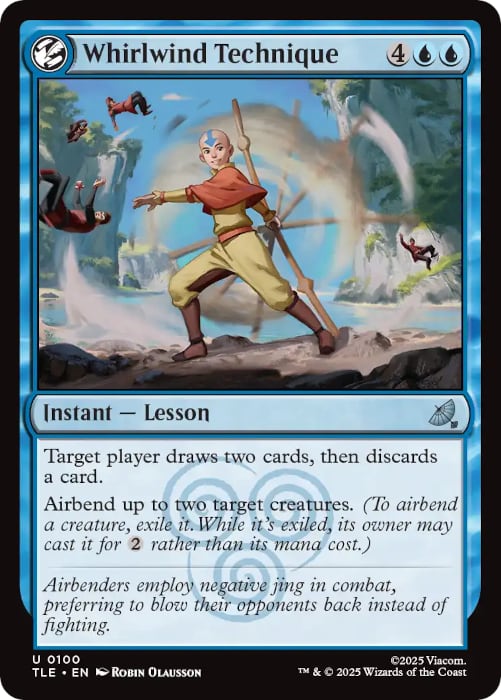
Despite the color pairing, Blue only receives two sources of the effect: the aforementioned Aang, Swift Savior, and Whirlwind Technique. Avatar Aang doesn't count, as Airbending only triggers his ability. The final eleven Airbending cards are all White and illustrate not only Aang's talents (Airbender's Ascension, Avatar's Wrath), but also those of his forebears (Monk Gyatso, The Legend of Yangchen).
Rulings
 |  |  |
When you Airbend a permanent, it's immediately exiled from the board. This can work defensively, negating removal spells aimed at your own troops, or offensively, removing enemy blockers so your own attackers can charge through. If someone fires Terminate at your creature, responding with Airbending Lesson whisks it to safety while drawing you a card. Airbending Lesson is also useful in combat, blowing back attackers before dealing you damage. Alternatively, If an opponent throws down The Walls of Ba Sing Se, that same Airbending Lession could remove it from play, opening the door for your army to advance. These are the benefits typically offered by 'Blink' effects, especially those that don't return the creature to the battlefield until the Endstep, but Airbending goes even further in how it taxes the permanent before it can return to play.
Once a permanent or spell is exiled via Airbending, its owner can only return it to play via recast it for two generic mana. This counts as an alternate cost, so any other alternate costs inherent to the exiled cards are effectively overruled. Exiled cards are still subject to timing restrictions on when they can be recast, so opponents will have to wait until their turn before getting back any exiled permanents without Flash.
Because the permanent or spell must be cast for two mana in order to return to play, the ability becomes rather dangerous for certain permanent types. Tokens cease to exist after being exiled, so you'll never have the chance to return them to play. If you want to get really nasty, Airbending can also function as a form of land destruction, as lands are played, not cast, so players never get the option to pay the alternate cost. You'll notice the more flexible Airbending cards make a point to exclude lands (Ex. Aang, the Last Airbender). Thematically, this makes sense, as you'd hardly suspect pacifist monks to start firing Stone Rains, but like all things in this lovely game of ours, there are exceptions to the rule.
 |  |  |
Animating lands via cards like Natural Affinity or Animate Land won't work with any card that specifies non-land permanents (Ex. Airbending Lesson), as lands rather their original type after becoming creatures. However, this is case where a targeting restriction actually helps more than hurts, because if the Airbending source targets only creatures (Ex. Aang, Airbending Master), animated lands can then be exiled. If an opponent drops an Urborg, Tomb of Yawgmoth and follows it up with Kormus Bell, that Avatar's Wrath in your hand just became an Armageddon. Given this loophole, you can imagine why Wizards added the 'or exiled' clause to the Earthbending ability. Ponza was never intended to sink its fiery claws into a Limited environment.
Finally, note that exiling a permanent and/or returning it to play works very well with enters- (Sun Titan) or leaves-the-battlefield abilities (Boreas Charger). Brago, King Eternal has demonstrated the power of mass-blink, and while Airbending is requires an additional cost, it makes up for by applying those same costs to opponents when you target their permanents. Just remember they'll also get any enters- or leaves-the-battlefield bonuses of their own, so think twice before casting Airbending Lesson on an opponent's Mulldrifter.
The Future
 |  |  |
Flexible as Airbending may be, it's potential is severely hampered by one key factor: Licensing. Wizards of the Coast would have to rename the ability in order for it to appear in a future non-Avatar set, which isn't impossible, but does make the odds of seeing the ability again less likely. It's a bummer, as these sort of versatile mechanics open up all sorts of shenanigans. Despite only having a small pool of cards with the mechanic, there countless other cards that synergize with it. Check out Nigel Kurtz's Top 10 Cards to Support Airbending to learn more.
Here's hoping the beloved world of Avatar: The Last Airbender fits seamlessly into an already rich tapestry of Magic the Gathering sets. The set's reception has been wildly positive thus far, and with the array of uses Airbending offers, I imagine it'll be a popular ability. So pack all your best enters-the-battlefield effects and make the most of it!
Thanks for reading, and may you balance all of life's elements.
-Matt Lotti-