


 Locations


Killing your opponent's creature has been one of the finest feelings in Magic since the first play-tester hit a Shivan Dragon with a Terror back in the early nineties. For those with a slightly more sadistic bent, rendering your opponent's creature useless while tantalizingly leaving them on the field is an even better feeling.
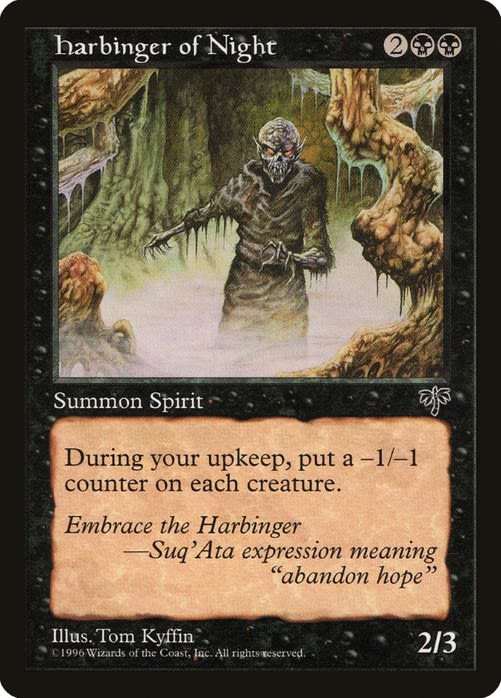
Whether it's locking a creature under a Darksteel Mutation, hitting it with a Curse of Chains, or shrinking it to an ignorable 1/1 with a stack of -1/-1 counters, there's something absurdly satisfying about your opponent staring at their theoretical game-winner wallowing in irrelevance. One of the old-school cruelest ways to humble your opponents' boards (and your own) was Mirage's Harbinger of Night, which, over a decade later, inspired the mechanic Wither.
Wither debuted in 2008 with Shadowmoor and Eventide. The nocturnal side of the pastoral Lorwyn after the shift of the Great Aurora, Shadowmoor was a gloomy place full of perverse mirrors of Lorwyn's bucolic brightness. Incremental Growth became Incremental Blight, Daily Regimen became Torture, and regular combat damage, which wears off at the end of every turn as creatures heal, became the persistent damage of Wither.
Mark Rosewater had an interesting contemporaneous account of how Wither came to be during Shadowmoor preview season that walks through the various iterations of what we now know as Wither, but the actual mechanic is very simple: "This deals damage to creatures in the form of -1/-1 counters." It adds an interesting component to combat; with Wither, your 2/2 with Wither can block their 4/4 - their 4/4 will live, but will become a 2/2 itself. Suddenly, a chump block becomes an act not of desperate sacrifice, but of strategic utility.
The word "wither" comes, suitably enough, from a dialectical corruption of the late Middle English "weather," suggesting a natural process, contrasting it with the epidemiology vibes of Infect or Toxic. It matches the Anglo-Celtic folklore ethos of Lorwyn/Shadowmoor and, while being sadistic and demoralizing, makes the mechanic feel organic and still connected to the low-tech, cozy witchcraft world of Lorwyn. As Rosewater notes, Wither was originally tested out for Lorwyn as a less fatal form of combat damage, but the in-game feeling was different than the design team expected. When you shrink a creature with -1/-1 counters, it feels like cruelty, like you're toying with prey. Watching your board dwindle away, combat after combat, until they withered away into death felt melancholy and fatalistic - blending the aesthetics of the plane of Shadowmoor into actual gameplay.
 |  |  |
Note that Wither, like Infect, applies to all damage, not just combat damage. A pinger given Wither with Blight Sickle, like Goblin Sharpshooter, can pass out -1/-1 counters outside of combat - a niche application of the keyword, but a fun and frustrating one. Note also that, since 2006, -1/-1 counters and +1/+1 counters negate each other - an Ouroboroid can neutralize your opponents' Wither cards nicely.
Wither is, in most cases, an upgrade to regular combat damage, but it was treated (and cost) as neutral, so creatures with Wither were generally the same cost as their non-Withering compatriots of the time - compare Smoldering Butcher to Giant Cockroach or Sickle Ripper to Krovikan Scoundrel or Wildslayer Elves to Norwood Archers.
Wither also specifically mattered in the context of Shadowmoor Block, where many of the creatures had Persist. If a creature with Persist died in combat to a creature with Wither, the Persister wouldn't come back, as it would have -1/-1 counters on it when it died. You saw this play out most often with Boggart Ram-Gang and Kitchen Finks - where the Finks player was expecting another shot of life against the mono-Red player, they instead got a dead Finks.
In Limited, there was interesting tension with Wither - some cards, like Leech Bonder and Grim Poppet, used -1/-1 counters as a resource, and the Persist issue meant that you had to consider the options when blocking a creature with Wither. Wither synergizes very well with First Strike/Double Strike, as in Rustrazor Butcher, and can be profoundly annoying with Regeneration, as in Cinderbones. Wizards seemed cognizant that too many Wither creatures could lead to frustrating board stalls, and so they were judicious about creating too many combinations of Regeneration or First Strike with Wither.
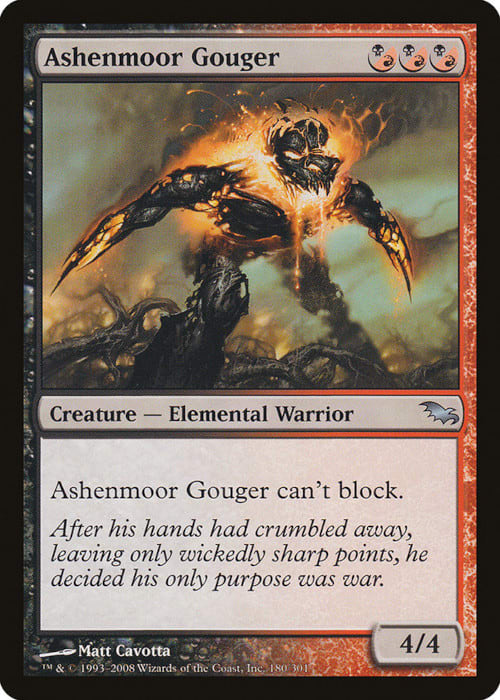
Fists of the Demigod was a high pick for the combination of First Strike and Wither - putting a Fists on an Ashenmoor Gouger was combat-dominating - and demonstrated how dangerous the ability could be on a large enough creature. Indeed, Wizards was careful about printing too many creatures with Wither at all - there are fewer than three dozen cards with Wither, all but two of which come directly from Shadowmoor or Eventide.
 |  |
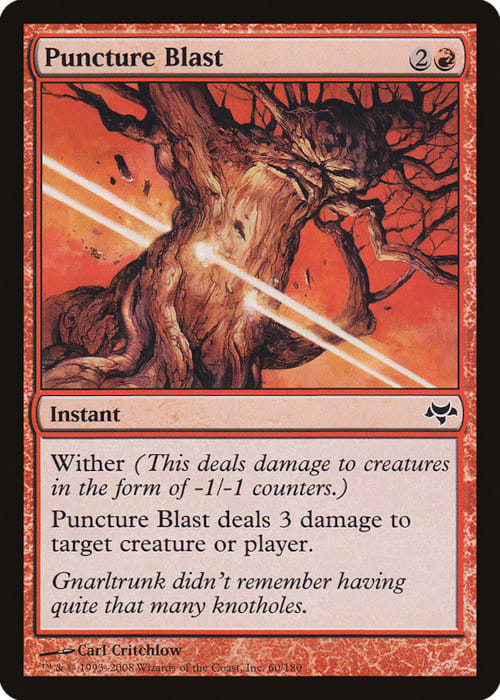
In Standard, Wither didn't do much. The creatures were balanced for Limited, and only Stigma Lasher, Boggart Ram-Gang, and Tower Above made the jump to tournament play. In a Standard format dominated by Faeries, Giant Cockroach wasn't going to get there, even with Wither. Necroskitter has, following the introduction of Infect and Proliferate, become a Commander staple for some archetypes, but otherwise, Wither simply wasn't a Constructed mechanic. There are some extremely cool Wither designs - Everlasting Torment is a very flavorful card that can put in work in Rakdos decks, particularly in conjunction with Kulrath Knight, and Puncture Blast demonstrates further utility for Wither outside of combat - but the stats aren't there for modern Magic, so Wither has mostly been left behind.
Amonkhet block explored -1/-1 counters as a resource, playing off of the cruel attrition inherent in the plane's society, but left Wither alone. The Modern Horizons sets, somewhat surprisingly, didn't revisit Wither, and so we only have the 35 cards with Wither (36, if you count Planechase's Raven's Run). Personally, I would have made the argument that the Nazgul should have had Wither for flavor, but, outside of the context of Shadowmoor, Deathtouch is effectively an upgrade. Scars of Mirrodin block also both supplemented and supplanted Wither, further diluting it - Infect isn't a strict upgrade, and it tends to draw the fire and ire of the table, but cards like Contagion Engine and Phyrexian Crusader are a bit more exciting than Midnight Banshee and Corrosive Mentor.
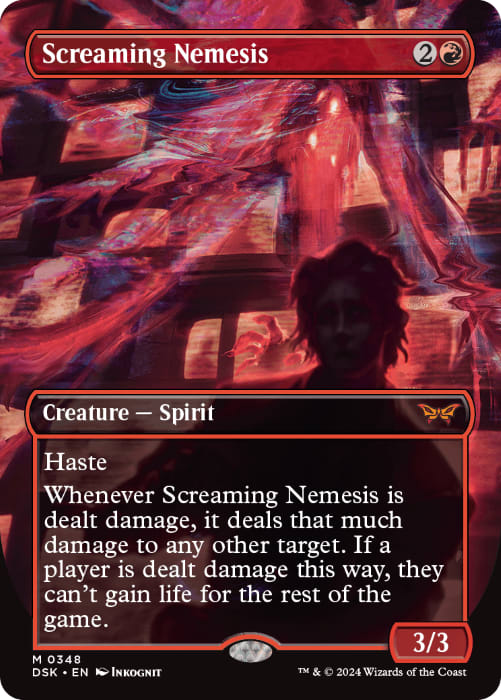
Stigma Lasher is an interesting proto-Screaming Nemesis, Corrosive Mentor isn't embarrassing as a backup Massacre Girl, Known Killer, and I run Puncture Blast and Blight Sickle in my autumnal Cube, but overall, Wither hasn't made much of an impact.
 |  |  |
There is one notable recent exception to Wither's obsolescence. From 2008 to 2024, we didn't get a single card with Wither, until Murder at Karlov Manor's cameo card Massacre Girl, Known Killer. Until Edge of Eternities, the 
 slot in Standard was thoroughly dominated by Sheoldred, the Apocalypse, but with rotation, Wither may surface in Standard again. A Black aggro deck that tops out with Massacre Girl is promising - Timeline Culler and Bloodghast are recurring threats that become much better when given Wither, and Nowhere to Run and Tragic Trajectory are primo removal that interact well with our Girl.
So whither Wither in 2025? I expect Wither to make a return in 2026's Lorwyn Eclipsed. Judging by the name of the set, we won't be shying away from the darker side of the dual plane, and it would create interesting tension in a Standard format that involves a lot of "power matters," thanks to Vehicles and Station. Massacre Girl may yet beat out Elegy Acolyte as the high-impact threat as the curve-topper for aggro decks, as she's immune to Shoot the Sheriff and can, like Acolyte, help refill your hand.
We may have to wait until January to see if Wither can salvage its reputation, but as someone with fond memories of casting Tower Above on a Hungry Spriggan, I have high hopes, even if they never get beyond the best-of-one queue on Arena.
Magic's willingness to revisit old mechanics, whether straightforwardly or with adaptations, is one of its strengths, and Wither - or some evolution of Wither - makes combat choices more interesting and challenging, while being cost-neutral enough to read as pure upside. On Mark Rosewater's Storm Scale, it fluctuates between 3 and 8, meaning Wither proper is unlikely to return, but as we return to Lorwyn and creatures become more powerful, Wither waits in the wings to keep creatures humble.