 Locations


Returning creatures from the graveyard to hand was part of Magic's DNA from the very beginning, with Alpha's Raise Dead, but buying back a creature from the graveyard to your hand proved not to be worth a card, particularly when Animate Dead brought it directly into play for only one more mana. A few years later, Visions came along and introduced a new class of creatures with abilities that triggered when they came into play, many of which were classic Magic spells--Unsummon wasn't worth a card, but Unsummon plus a Grizzly Bears was, as Man-o'-War definitively proved. Later that year, Gravedigger was a minor revelation--it could Raise Dead, chump block, and even loop itself in multiples. While a 2/2 for 3B is seriously outdated, at the time, it was a reasonable card in Limited and an important lesson for newer players about card advantage, seeing print 34 times in sets geared towards Magical neophytes, from 1997's Portal to 2024's Jumpstart.
Seven years later, after Avalanche Riders and Deranged Hermit and Flametongue Kavu and Goblin Ringleader, the pattern of "comes into play" or "187"* creatures was firmly established and a huge part of high-level play. These creatures could attack and block, sure, but they also had an immediate impact on the game when played--even if your opponent immediately killed your Deranged Hermit, you were left with a drey's worth of Squirrels. As Wizards was designing Champions of Kamigawa, they went back to the Gravedigger model--but in reverse. Death triggers were a large part of Kamigawa block--the Spirit Dragons (Yosei, Kokusho, etc.) ameliorated the sting of having your massive threat meet a Dark Banishing and Soulshift was designed to buy back Spirits lower on the mana curve when one of your larger Spirits died, netting card advantage while representing the ephemeral but persistent nature of the kami. Like a lot of Kamigawa Block, Soulshift was conceptually strong on the page but incredibly underpowered in play.
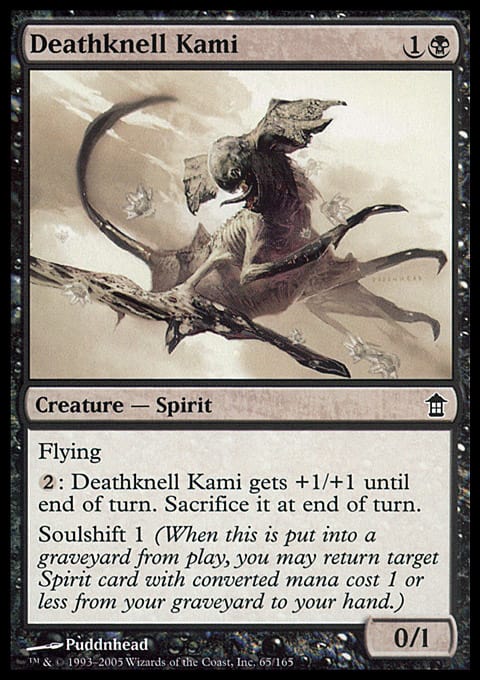
There were 27 creatures printed with Soulshift in Kamigawa Block, from the humble Deathknell Kami to the massive Body of Jukai. The idea was that you would get a Spirit to attack and block and then, when it died or traded in combat, you would Raise Dead on a Spirit in your graveyard, making each Soulshift creature essentially a two-for-one. In practice, though, these were not Gravedigger. Most of the Soulshift Spirits were dramatically overcosted to keep them from stalling the board in Limited with Soulshift loops or from buying back another copy of themselves, so we wound up with truly terrible cards like a 2/2 for six in Crawling Filth, a 2/1 for 4G in Harbinger of Spring, and a 2/3 with Reach for five in Venerable Kumo. A couple on the cheaper side of things showed promise--Thief of Hope is still decent in Spirit typal decks and in certain Cubes, Elder Pine of Jukai draws lands and rebuys Tallowisp or Hana Kami, and Promised Kannushi brings back a Kokusho or Keiga that had been dispatched. Back in the days of damage going on the stack, Scuttling Death could block and kill a 4/4, kill a 1/1 with its sacrifice ability, and buy back a four-drop, which wasn't terrible in Limited. Several of the Soulshift cards have even improved in the intervening two decades as Wizards has printed more potent Spirits. Forked-Branch Garami, an unassuming but beefy 4/4, gets back two four-drops upon death, which, at the time, meant Keening Banshee, Kodama of the South Tree, or Haru-Onna. Twenty years on, you can snag any two from among Crypt Ghast, Teval, the Balanced Scale, Eidolon of Blossoms, or Deepfathom Echo, which is quite an upgrade. If you find yourself running a Kamigawa Cube or a Spirit typal Commander deck, these are worth considering, but for the most part, Soulshift is justifiably relegated to Magic's ancient history.
Unlike some Kamigawa mechanics, like Epic or Sweep, there's nothing wrong with the design of Soulshift, only the numbers. It's easy to imagine a creature with more modern stats, perhaps a 4/4 for four with Trample and Soulshift 3 that could hit Geist of Saint Traft, Screaming Nemesis, or Kodama of the West Tree. Still, the fact that there wasn't even a Soulshift riff in Neon Dynasty, nor did it show up in a Modern Horizons set or Commander preconstructed deck, implies that Wizards is sour on the mechanic, so I wouldn't hold out hope for its return.
That said, Wizards isn't going to stop printing Spirits, and so Soulshift, like so many mechanics, gradually grows in value with each year. We may never see the actual mechanic again, but as Wizards prints more desirable spirits at two to five mana (and as they keep printing Insidious Roots effects), it's worth keeping an eye on Elder Pine of Jukai, Thief of Hope, Promised Kannushi, He Who Hungers, Forked-Branch Garami, and Rootrunner. Thanks in part to Kamigawa and to the recent Tarkir Spirit Dragon cycle, there are 127 Legendary Spirits, and it may be that Ureni, Teval, Kodama, Betor, or Miirym players may want to test out members of the Soulshift squad. If nothing else, we can at least say "I'll sacrifice my Pus Kami to Soulshift Yargle and Multani to my hand" and that, I would say, makes the mechanic worth it.
*Named after the California Penal Code Sect. 187, which defines murder. One of the original Visions comes-into-play creatures was Nekrataal, which murdered a creature upon entering, hence the slangy shorthand. It really should be Sect. 422, as that defines "terrorist threat" and Nekrataal casts Terror, but that came years later and 187 was in the culture thanks to West Coast hip-hop.