 Locations


Magic is a game built on variance. Your game pieces are randomized at the start of each game and are rerandomized any time your library is searched, and your cards are subject to interaction from your opponent's unpredictable deck. That variance can be wildly frustrating, as anyone who's been left sitting on three lands on turn six can tell you, and higher-level play has historically centered around reducing variance through card draw, tutors, and library manipulation. To put it another way, Magic is a game about the tension between variance and consistency. When the game is too random--when you are running lands and spells and drawing them out of order--it's incredibly frustrating. When the game is too consistent--when you are Vampiric Tutoring your combo piece and backing it up with Force of Will to protect the combo--it's also incredibly frustrating. Nothing plays into this dialectic more than Coldsnap's Ripple.
Coldsnap was a standalone set designed as a one-off slot-filler between Ravnica and Time Spiral blocks. It was announced with a cheeky kayfabe "we found the lost 1996 design file for this set in a closet, so we decided to print it into Standard" article, which added to the confusion. Was that true? Why now? Why complete the Ice Age block ten years after Alliances? Why is it Standard legal, adding to one of the largest Standard formats in Magic's history to that point? We never got compelling answers, and Coldsnap ended up being a flawed experiment. It added Snow-Covered Lands to the Modern card pool, and gave us a handful of archetype-defining cards like Skred, Counterbalance, the "pitch two" free spell cycle (Soul Spike, Allosaurus Rider), and Dark Depths, but in general, it's poorly remembered. A huge part of that is the set's mechanics: Recover, which is a fiddly and time-sensitive Buyback-style mechanic, and Ripple, which should have remained in the "lost" design file instead of in print. I try to be generous with Magic's mechanics--even the failed mechanics are interesting experiments in what the game can accommodate--but Ripple is the epitome of high-variance, low-consistency mechanics.
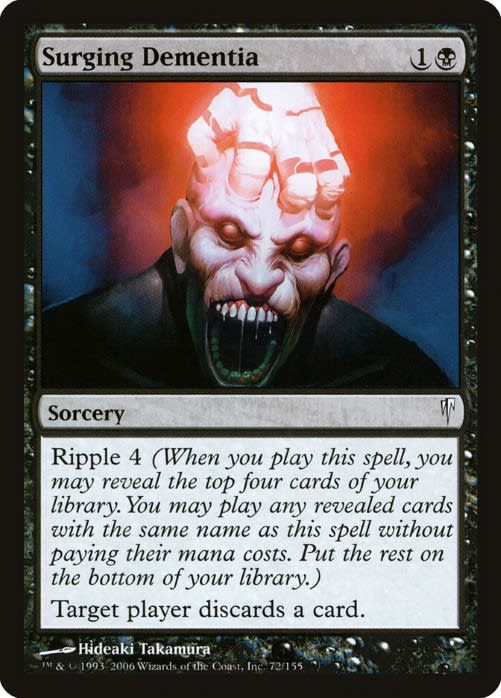
Ripple, in rules text, means "When you cast this spell, you may reveal the top four cards of your library. You may cast spells with the same name as this spell from among those cards without paying their mana costs. Put the rest on the bottom of your library." Since any cards Rippled up are cast, you then get to repeat this process. So, in a Constructed format, it's theoretically possibly to chain through every copy with the same name in a single turn if you get lucky (or stack your deck somehow), thus, for example, passing out eight total damage with four copies of Surging Flame.

The most valuable card in the set, Thrumming Stone, is the showcase card for Ripple, which gives all your spells Ripple 4. There are only six cards with Ripple: Surging Sentinels, Surging Aether, Surging Dementia, Surging Flame, Surging Might, and Thrumming Stone.
Here's the issue with Ripple: as printed in Coldsnap, it's only ever existed as Ripple 4. In Constructed, assuming you're casting on curve, casting Surging Sentinels will give you approximately a 1-in-16 chance of seeing another of your three copies, with diminishing returns after that. There's our undesirable level of high variance.
 |  |  |
Ripple had worse issues in Limited. As Coldsnap was a small set of 155 cards that was drafted alone, you had three packs to find several copies of your Ripple cards. Coldsnap's commons had a theme of "cards with the same name power themselves up" with the Ripple spells and the Kindle-inspired cycle of Kjeldoran War Cry, Rune Snag, Feast of Flesh, Rite of Flame, and Sound the Call. This warped Draft and Sealed around it, as it was entirely possible to end up with four or five copies of a Surging spell and completely blow out a game by flipping up three copies of Surging Sentinels on turn three or wiping your opponent's board with a grip of Surging Flame. The inbred nature of the draft pool meant that even Thrumming Stone was a weirdly high pick--Frank Karsten once drafted nine copies of Disciple of Tevesh Szat and a Thrumming Stone, making an essentially unbeatable deck if he lived to turn six. There's our undesirable level of high consistency.
Ripple was hated at the time, but it's also aged poorly, as it's notably useless in Commander outside of Thrumming Stone. Since you'd only be able to run a single copy of Surging Sentinels, Aether, Dementia, Flame, or Might, you are guaranteed to not hit another copy, meaning you just tapped two for a Skull Fracture or the world's worst Shock. The only time you'll see Ripple on your table, outside of the most fringe of fringe Pauper decks, is when you're facing the one-trick pony of Thrumming Stone plus a stack of "a deck can have any number of cards named [THIS]" cards, most famously Relentless Rats. Thrumming Rats was a deck that would periodically show up at the casual tables circa 2006-2010, and some maniacs tried it in Extended, but it's mostly been a Commander deck, where you can tutor up a Thrumming Stone with Enlightened Tutor or Demonic Tutor and then cascade out an army of Hares Apparent or Rat Colonies. It's an established deck and it has its proponents, but it's easy to disrupt and the gimmick wears thin quickly.
Wizards of the Coast could theoretically bring back Ripple and modify it with higher Ripple numbers, making it more consistent, and could add it to more desirable cards than the Surging cycle. The issue is that Ripple is fundamentally unstable: if the Ripple number is too high, you have a Cascade-style blowout, but if it's too low, you end up with an overcosted spell and a disappointing outcome for the Rippling player. This means that Ripple feels bad when it whiffs and bad when it hits--the mark of a terrible mechanic. As of 2013, Ripple was an 8 on Mark Rosewater's Storm scale, meaning "[i]t's unlikely to return, but possible if the stars align." I would put it even higher--it's been more than a decade since that rating was assigned, and we haven't seen it return even as a self-referential cameo in a Modern Horizons set, which is where it would be most likely to appear. It's easy to imagine Modern Horizons 4 bringing us Surging Rats or similar, with a higher Ripple number that is more likely to hit additional copies, but even then, the juice doesn't seem worth the squeeze. Cascade mostly covers the same ground with the fun kind of variance tweaked up. That said, so long as there are Persistent Petitioner-type cards, from Relentless Rats to Templar Knight to Tempest Hawk, Thrumming Stone will be a gimmick deck that surfaces at kitchen tables and Commander nights in perpetuity, so it's worth familiarizing yourself with the mechanic--and if you're the sort of player who likes Cascading or Clashing or other gambling mechanics, it's worth picking up a Stone yourself. Coldsnap may have been an odd outlier of a set that has few defenders, but, even almost twenty years on, its innovations ripple out.