 Locations


Cards on the table: I've never seen Avatar: The Last Airbender. I was twenty when it aired and (like a lot of twenty-somethings) at my peak aesthetic snobbery, and it seemed geared to a younger demographic. Now that I'm forty and more open-minded about genre and all-ages entertainment, I'm looking forward to diving in with my own child. It'll be a bit before she's ready for that, though, and until then, we have hundreds of cards set in the world of Avatar: The Last Airbender (presumably with, depending on sales metrics, The Legend of Korra soon to follow, now that we see what that trajectory looks like with Tales of Middle-Earth and The Hobbit).
As a newcomer to the franchise, the world of Avatar comes off as a much better fit for Magic than New York City or, arguably, even New Capenna. There are chimerical animals, competing schools of Magical praxis, and clans that dwell in swamps and mythical monasteries--blessedly, there's actual Magic throughout the set. For me, Magic: the Gathering requires rogues with daggers and mages emitting wisps of power and schools of Magical philosophy that are tied to elemental resonances, and so I'm quite sanguine about Avatar: The Last Airbender and its place in Magic's larger ecosystem.
From a general design perspective, I find Avatar: The Last Airbender's mechanics overly wordy and fiddly--Waterbending as a sidegraded Convoke, Airbending as a version of Foretell that can play disruption, Earthbending as a fixed Awaken, etc.--but the individual cards are cleverly designed and worth discussing in depth. We have a Blood Moon riff, a host of powerful Sagas, a handful of "hate bears," and splashy double-sided Mythics with a paragraph of text on both sides of the card. While it's difficult to prognosticate what will be valuable in Standard--particularly with a formerly stagnant metagame that has just experienced upheaval from a ban--these are the cards I see with the most potential in a newly-revived Standard.
Aang's Iceberg--Oblivion Ring has been long outclassed, but it's still a useful barometer for an exile effect. For the same cost as Banishing Light or Stormplain Detainment, both currently legal in Standard, Aang's Iceberg adds a very welcome instance of Flash and a curious side benefit--the ability to Waterbend 3 and sacrifice the Iceberg to scry 2. This seems of dubious utility, as it'll return the exiled permanent to your opponent's board, but sometimes you're desperate to dig for a different answer. As Waterbending allows you to tap creatures to pay for it, it could intersect well with Duskmourn's Survivors and as a self-sacrificing Enchantment, it could push you over for Delirium. If nothing else, it's an upgrade to Cast Out and Prayer of Binding and a welcome replacement for Leyline Binding.
United Front

At five mana with no further board presence, this puts a minimum of six power on the board in the guise of three 2/2's. That's not terrifically inspiring on its own merits, but it's still a respectable floor. If you curve out--say, with a turn one Momo, turn two Voice of Victory--then even at three mana this can overwhelm your opponent. I have a soft spot for anything that puts out 2/2's at a reasonable rate, from Waylay to History of Benalia to Summon: Knights of the Round.
Wan Shi Tong, Librarian
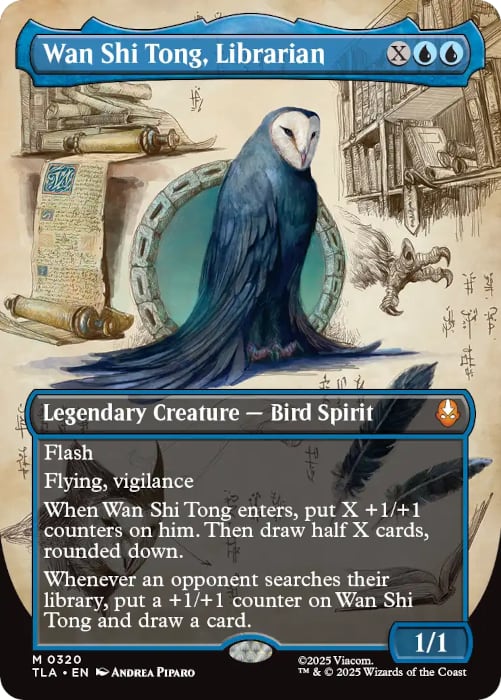
Hydroid Krasis was a Standard staple throughout its lifespan, and Wan Shi Tong seems like a stark upgrade to the flexible Hydra. Wan Shi gives you Flash, which can allow you to snipe an opponent's Evolving Wilds or Summon: Fenrir for a counter and a card--or play off your own Assassin's Trophy. You get a Phantom Monster with Vigilance and Flash that draws you a card upon entering. At six mana, which isn't an unreasonable expectation, you have a 5/5 Flier with Vigilance and Flash that can block an opponent's attacker and draw you two cards. In a world of Quantum Riddler, this may never soar, but the base version is already one of the most expensive cards in the set already, so people have high hopes for the bibliophilic bird.
Firebending Student

Monastery Slowspear here is a somewhat awkward card, like a lot of neophyte students, but it has serious potential. The issue is that you want to pump the power before attacking, so that you can maximize Firebending, but then you can't surprise your opponent once they block. That's maybe moot--Firebending Student is rarely going to be blocked. Anything that is reminiscent of Monastery Swiftspear is worth paying attention to, and Firebending Student rewards you for casting burn spells, while simultaneously making burn spells easier to cast. That's a winning formula, especially for a two-drop.
Redirect Lightning

Deflecting Swat is most frequently cast for free, but you're also generally happy to cast it when necessary. Five life is as steep as 2 mana is cheap, but you'll be more than happy to have the option when you need it. The fact that Redirect Lightning is a Lesson is currently just flavor text--Learn/Lesson doesn't function in Commander and we don't currently have Learn cards in Standard--but I would be surprised if it doesn't matter by the time Avatar rotates out of Standard with a Strixhaven set waiting in the wings.
Badgermole Cub

A ludicrous typeline for a ludicrous card. The Badger Mole brings three power and three toughness over two bodies for two and doubles the mana production of your Llanowar Elves and Earthbent lands. Earthbending solves the issue of animating lands--that is, your opponent's removal spell is now a Stone Rain in addition to a Terror--by returning the land to play tapped upon death or exile. This not only prevents you from being down a land, but also can trigger Landfall. If nothing else, this teams up with a personal favorite undersung Standard card, Tender Wildguide, to make an absurd amount of mana.
Great Divide Guide

The two-mana chromatic tapper is always a pallid copy of Birds of Paradise, but since we haven't had Birds in Standard in decades, they do pop up periodically. Great Divide Guide is one of the better ones--Fifth Dawn's Joiner Adept was disappointing, but the Guide's 2/3 body is an upgrade if you're in the market for a Chromatic Lantern effect for cheap. In Standard, it competes with 12 two-drops that make the mana, the best of which are Herd Heirloom, Poison Dart Frog, Tender Wildguide, Torgal, A Fine Hound, and Twitching Doll, which is a surprisingly deep roster, but if Allies--or Lorwyn's Changelings--show up in any numbers, I think the Guide rises above the pack.
Aang, Swift Savior

Spell Queller was always a superb tempo card. Aang here has Spell Queller stats and can temporarily detain any spell or creature, including your own. Waterbending 8 is a significant cost, but it's an appealing bonus--it's not hard to imagine transforming Aang for five mana and tapping three other creatures. A card that's both a tempo play early on (and can even protect your own board) while serving as a game-winning creature once the game goes on long enough is a control deck's dream.
November's combo of a much-needed ban and the advent of Avatar will shake up Standard--even if none of the cards are poised to make an immediate impact (an uncertain proposition), the loss of Vivi Ornitier, Screaming Nemesis, and Proft's Eidetic Memory has left a more open field. Personally, the card I'm most excited for is Mai, Scornful Striker, as someone who loves Kambal, Consul of Allocation and Lotho, Corrupt Shiriff and Maralen of the Mornsong, but she's not exciting in the same way as, say, Badgermole Cub or Wan Shi Tong. The overall design trends of Avatar leave me cold, but the individual cards are tremendous--I don't expect to Earthbend or Airbend much outside of Limited, but I expect to see these cards in Standard and Commander for years to come, and that's all we can ask from Universes Beyond.