 Locations


One of Richard Garfield's strokes of brilliance in designing Magic was that the game taught players heuristics as they played the cards. In Alpha/Beta, there was a vertical cycle of creatures: Gray Ogre at common, Uthden Troll at uncommon, and Sedge Troll at rare. From this elegant evolution, players could learn and internalize that three mana buys you a blank 2/2 at common, a 2/2 with a benefit at uncommon, or a situational 3/3 with a benefit at rare. By establishing that Gray Ogre was the baseline, Magic created a way to set simple patterns and make it exciting when new cards were released that broke those patterns. Some people categorize this as "power creep," but it's a longform version of ludic evolution--the progression from Ravenous Baloth to Questing Beast sells packs, excites players, and gives old heads the opportunity to reminiscence and kvetch.
On the subject of reminiscing and kvetching: it's sometimes forgotten that the most exciting cards in Magic's earliest years weren't the Moxen or the dual lands. Many casual-minded players traded those mana-producing cards for the more exciting heavy hitters like Serra Angel, Sengir Vampire, and the two biggest creatures in Alpha/Beta: Force of Nature and Lord of the Pit. Unlike Sengir Vampire and Serra Angel, which were pure upside, Force of Nature and Lord of the Pit embodied the tension of early Magic by balancing table-disrupting stats with a serious drawback. You could tap into power beyond what your opponent could summon, but it would require a continuous sacrifice or payment from you, and one that your opponent could interact with through creature removal or land denial--many Forces of Nature turned on their caster after an opponent's well-timed Armageddon, and many Lords of the Pit punched their summoner to death after a Terror or Pyroclasm hit their intended sacrifice.
Premillennial Magic was obsessed with upkeep costs, from Cumulative Upkeep to recurring upkeep payments of resources. Some were punitive, like Lord of the Pit, while others were completely nugatory, like Minion of Tevesh Szat or Deep Spawn. They were especially dominant in Black--something this list reflects--but were present in all colors, from Nettletooth Djinn to Phantasmal Sphere to Tethered Griffin. Magic has moved away from creatures with upkeep costs, as Commander has become the primary way players engage with the game, and "you have to sacrifice your creature because you skipped that upkeep payment" is an easy way to cause friction at the table. For the most part, these upkeep costs were "gotcha" moments, so their loss isn't especially disruptive.
That said, we still get creatures with drawbacks that hearken back to Lord of the Pit and to Carnophage. Former Standard champion Archfiend of the Dross is a riff on Lord of the Pit, while current Standard stalwart Cecil, Dark Knight is essentially an updated Carnophage. Not every creature is pure upside, a la Frenzied Baloth or Quantum Riddler, even in modern Magic, and that makes the long legacy of creatures with tradeoffs still feel relevant. Magic is a game of pattern recognition and resource management, and cards like Lord of the Pit will always have a place, from casual tables to tournament brackets. Historically, creatures that trade efficiency for a drawback have seen prominent play, but the best of the best include:
Honorary Mention: The Echo Squad
Originally pitched for Tempest before being pushed to Urza's Block, Echo was a mechanic that let you get a creature for a significant mana discount with a significant drawback: you had to pay the mana cost again the next turn or sacrifice the creature. This seems like a poor trade, but Urza's Block was full of unique ways to get value out of Echo--aside from the standard "cheap beater at a discount" iterations like Pouncing Jaguar, Albino Troll, and Lightning Dragon, Urza's Legacy and Destiny let the mechanic evolve through creatures with "enters and leaves play" abilities. If you had nothing better to do on turn six, it was fine to pay an extra five to keep Deranged Hermit around, but a card like Multani's Acolyte could come in, replace itself, then chump block before you ever had to pay the Echo cost. Hunting Moa could either be a 4/3 for six paid over two installments, or could pass out a +1/+1 counter to a preexisting creature, stick around to ward off an attack, and then share another counter when you failed to pay the Echo. Echo proved unpopular with players and only appears on 53 (52 without Old Fogey) cards across Magic's history, but it's crucial to Magic's design trajectory and to tournament players' understanding of the game. Simian Grunts may be unimpressive now, but in a counterspell-heavy metagame, it let Green players play in the end step as much as Blue players or ambush a 3/3. Avalanche Riders was a curious kind of Stone Rain until Reveillark turned the drawback of Echo into a way to get the Riders into the graveyard for future reanimation. On paper, Echo is a drawback; in play, it offers you options and opportunities, so I consider it more of a mechanic than a drawback.
Juzam Djinn

Richard Garfield helped make Magic a success, but Juzam Djinn help make it a phenomenon. It's not just the stats, or the Mark Tedin art--which is both threatening and charming in equal measure, like a woodcut in a forbidden book--but the feeling of a demonic pact that made Juzam Djinn iconic. In exchange for a tiny fraction of your life, Juzam Djinn offered to take a huge chunk of your opponent's--but should they neutralize the Djinn with a Pacifism or an Icy Manipulator, the Djinn would still inexorably drain you to death. Wizards tried to recapture the Magic in 2002 with the clunky Grinning Demon, but removal and creatures had both gotten better, and the Demon was no Djinn. Wizards even quietly colorshifted Juzam Djinn into Modern with Modern Horizons' Ravenous Giant, but even a quasi-reprinting didn't bring back the glory days of Juzam Djinn (outside of Old School).
Blastoderm

Like Echo before it, Fading explored how cheap a creature could be, if it was only temporary. A card like Skyshroud Ridgeback could come down early and attack and block productively, but only for a couple of turns, and the threatening Skyshroud Behemoth could be chump blocked for the scant two turns it was able to attack. Fading succeeded at the top tables, though, because it didn't matter if Blastoderm was "temporary" if the game was over by the time the final Fading counter was removed. Zvi Mowshowitz took Blastoderm to the Top 8 at Pro Tour Chicago 2000 in his "My Fires" deck, which could open with a turn one Birds of Paradise, a turn two Fires of Yavimaya, and a turn three Blastoderm, swinging in for five thanks to Fires. On that timeline, you don't need more than four attacks with your pseudo-Juzam.
Notably, Zvi's "My Fires" deck ran not just Blastoderm, but another 5/5 for 2GG with a punishing drawback: the Derelor-inspired Jade Leech. A quarter-century later, we regularly get 5/5's for 2GG with upside, from Deadbridge Goliath to Bristlebud Farmer to Lasyd Prowler, but back in 2000, a Blastoderm or Jade Leech was the best you could find.
Phyrexian Dreadnought

The initial conceit behind Mirage's Phyrexian Dreadnought, back before we understood card advantage or tempo, was to upgrade your army of mopey 2/2's and 3/3's into an unstoppable but voracious 12/12. In practice, that meant putting your eggs into a single basket only for it to eat a Dark Banishing. Once Stifle was printed in Scourge, however, we had a two-card combo that let you pay two mana for a 12/12 without a drawback, and the changing of Illusionary Mask's wording even gave the deck a backup combo and a string of successes in Legacy. Stifle-Nought has consistently been a top deck in Premodern, and it's an illustrative example of how a drawback can be exploited by later cards. Mirage was great for that--both Phyrexian Dreadnought and Lion's Eye Diamond were risible cards when they were first printed; with the later context of other cards, both are worth hundreds of dollars and define Legacy archetypes. That's an important lesson in regards to drawbacks: sometimes, they're only drawbacks until later cards are printed that turn them into crucial text.
Phyrexian Negator
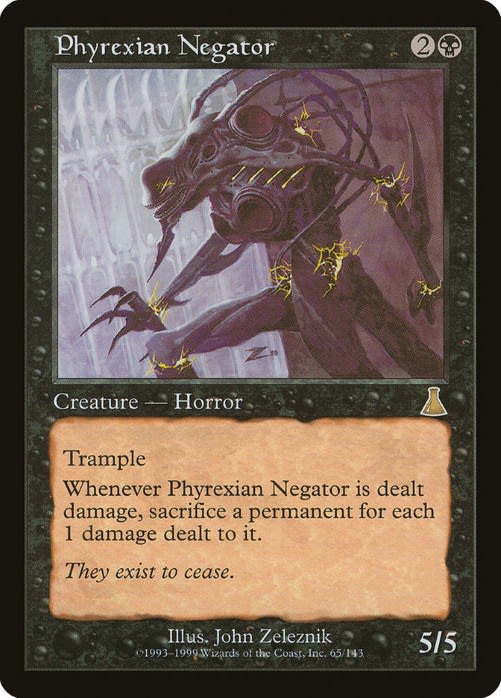
From one massive Phyrexian to another. Phyrexian Negator was one of the most wonderfully binary cards ever printed when it dropped in Urza's Destiny. Here's two options for how games went back in 1999:
Your first turn: "Swamp, Dark Ritual, Negator."
Opponent's first turn: "Mountain, Shock your Negator."
You: "Sacrifice the Negator and my Swamp, scoop."
-OR-
Your first turn: "Swamp, Dark Ritual, Negator"
Opponent (looking at their hand of Land Grants and Llanowar Elves): "Scoop."
The drawback on Phyrexian Negator is so punishing, and its stats so overpowered by the standard of its era, that you often knew as soon as you cast it who was winning that game. It came out concurrently with the tournament-defining Masticore, which was generally the preferred pick, but for the Hatred-based Black decks at the time, Negator could come down a turn earlier and start trampling over for damage. Some players tried to break the Negator by feeding it Rancor or Nether Spirit, but the actual correct way to play Negator was to jam it out and committedly ride it to victory or defeat. Twenty-five years on, Phyrexian Negator is not an impressive card--Phyrexian Obliterator has made it obsolete, even as a nostalgic curio, but in the context of Magic design up to its printing, it was incredibly exciting. Like Juzam Djinn before it, Phyrexian Negator felt like you had made a pact with dark forces--especially when you summoned it off a Dark Ritual. The mono-Black deck that exploited Negator best also used the Tempest Block drawback squad--Carnophage, Sarcomancy, and Dauthi Slayer--with a combo finish in Hatred. It was fickle, susceptible to disruption, and capable of winning on turn three.
Masticore

As mentioned, Masticore held reign over Urza's Standard post-Combo Winter bans, when the format settled down to something more approaching a normal game of Magic. A 4/4 for four mana that could be used in any deck was a huge innovation, even with a drawback that could lock you out of drawing cards. Eventually, Squee, Goblin Nabob made that drawback negligible, but you were happy to cast the resilient Masticore and machine-gun your opponent's board even if you had to discard a card each turn. Masticore was an entire game plan in a single card and was perceived as so overpowered that Wizards of the Coast would reference its "brokenness" in Torment's Deep Analysis and riff on the card through (drastically less successful) Masticores like Molten-Tail Masticore, Sparkhunter Masticore, and Argentum Masticore.
Unlike later cards like Rotted Regisaur, which sticks around even if you can't feed it carrion, Masticore sacrifices itself if you don't discard. As discussed, that's a suboptimal play pattern in modern Magic, which would rather reward than punish. Sometimes, though, pedigree trumps design trends, and even the recent Argentum gets sacc'ed if you can't discard.
With the surge in interest in Premodern, where Masticore is still a force, the original Urza's Destiny copies have risen from $4 to $15--while you can still pick up From the Vault: Relics copies for half that price, that old border and iconic and off-kilter Parente art come with perceived value from nostalgia. Masticore may not be the powerhouse it once was, but those who played it twenty-six years ago still respect it.
"Drawback" is a pretty nebulous word. "This creature can't block" is a drawback, as it removes part of the basic functionality of a creature, but it doesn't feel like a drawback on a card like Gravecrawler, but more of a balancing mechanic. Likewise, being Legendary is a drawback and was treated as such until the rise of singleton formats and the dominance of Commander made it essentially flavor; back pre-Commander, you had to consider how many copies of Legendary permanents to run to maximize the odds of drawing only one copy by a crucial turn. For me, "drawback" means something that could potentially lose you the game--Eviscerator can't be cast if you're at five or fewer life, and a topdecked Devouring Strossus after a Wrath of God is an insult. The best creatures with drawbacks are cheaper than expected with an upkeep cost that only matters if you're already losing--Carnophage, Vampire Lacerator, Goblin Guide--or allow the game to develop on a different axis. Ichorid was the world's worst Ball Lightning until the printing of Golgari Grave-Troll.