 Locations


I love the implications of creatures with drawbacks. Creatures with Fading or Echo are imperfect copies, pulled out of the aether too quickly and dissolving back into it. Cards like Eviscerator and Phyrexian Negator represent apex predators from a warped ecosystem that require sacrifice and turn on their summoner if not properly fed. Cards like the Hunted cycle tell a story of a creature and its nemesis/nemeses. For years, I was disappointed as Wizards moved away from creatures with bona fide drawbacks towards creatures that were all upside or ones that had minimal tradeoffs--I love Questing Beast and Frenzied Baloth, but I also loved Kezzerdrix and Masticore in their time. Wizards has recently been exploring drawbacks on powerful creatures again--more on this in the third and final article in this series--so I thought it was worth revisiting the class of cards that punch you, pinch you, tax you, and stax you more than they do your opponent. Here's the best of the beasts from 2004-2014.
Honorable Mention: Ravnica: City of Guild's Hunted Cycle
Hunted Lamasu, Hunted Phantasm, Hunted Horror, Hunted Dragon, and Hunted Troll could be the basis of an entire article--the design of each, and how their stats are matched or mirrored in the creature tokens they create, tells a tiny story on each card. You can race the tokens in some cases, you can remove them in others, or you can puzzle out how you could mitigate Hunted Horror's vicious drawback (hint: Guildpact brought Leyline of Singularity).
Hunted Dragon was the only one to see tournament play, where it was a backup Dragon in the hilarious Dragonstorm combo deck, but the others saw occasional casual play and remain quirky cards for certain Commander decks. The inherent tension in the design of the Hunted cycle is great in a vacuum--Hunted Phantasm kills them in five turns, while the Goblins kill you in four, Hunted Troll can be chump blocked by the Faeries for a while, but will eventually overpower them, etc. There's a narrative in how the drawback interacts with the creature, and I think the cycle deserves a ton of praise, even if they've been mostly forgotten (and, weirdly, never revisited).
Abyssal Persecutor
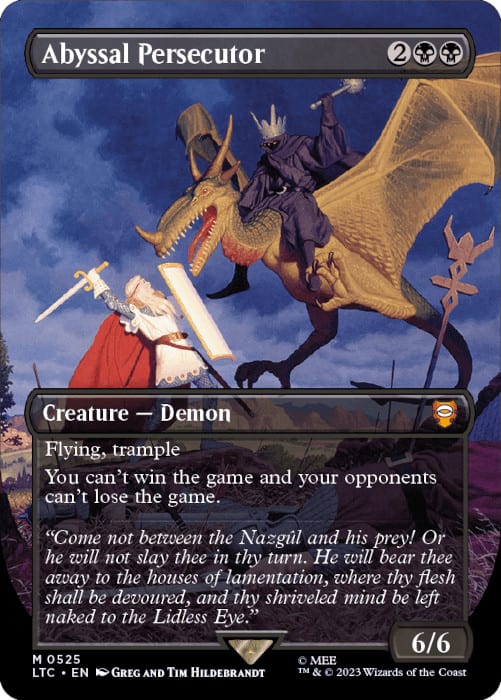
I love to remind people that Abyssal Persecutor pre-ordered for more money than Jace, the Mind Sculptor, just as Innistrad's Skaab Ruinator preordered for more than Liliana of the Veil. At the time, Platinum Angel was a huge casual staple, and there was an assumption that both casual and tournament players would be drawn to the massive Demon with the most massive drawback yet printed. The intent was to swing with Abyssal Persecutor until they were at negative life, then hit it with a removal spell and win on the spot. Here's the thing, though: Abyssal Persecutor came out at an inflection point in Magic's history. Creatures were getting better at a rapid clip, and Persecutor dropped a mere year before the Titan cycle and Wurmcoil Engine. It turns out that it's worth paying two more mana for a better creature--one that won't preclude you from winning the game--and so Persecutor never saw the play it was promised. That said, from a design standpoint, it's so reminiscent of Lord of the Pit and has such a devastating but tantalizing drawback that it's absolutely part of Magic's history, even if just as an anecdote about how bad Magic players are at analyzing value.
Jotun Grunt

There's a theme in the creatures with drawbacks of this era of Magic's history: they're mostly hyperefficient, rather than extremely splashy. Rather than Lord of the Pit or Force of Nature, the trend for this specific cohort is closer to the Shadow/Echo/Fading design model.
Coldsnap is one of the weirder sets in Magic's history, with a design ethos that was directly inspired by Ice Age's reliance on cumulative upkeep and other drawback-based designs. Unlike Ice Age, though, which used mana and life payments for cumulative upkeep, Coldsnap played around in the space more, with cards like Braid of Fire and Phyrexian Etchings. Jotun Grunt was (at the time) a very powerful creature with a purported drawback that could be exploited to your benefit, whether it was tucking fetchlands from your graveyard back into your deck or neutralizing your opponent's Ichorids and Bridge from Below.
Early iterations of Death and Taxes and Naya Zoo decks employed the Grunt to counter Dredge decks in early Modern metagames, which is unimaginable in a world post-Scavenging Ooze or the variety of Grafdigger's Cage variants we have access to for the sideboard now. A 4/4 for two isn't terrifically impressive in this day and age, but back in 2012, it neutralized a Tarmogoyf well on two axes at a time when Modern was defined by the Lhurgoyf.
Dark Confidant

Black's legacy of 2/2's for two was strong by 2005. Black bears with tournament pedigrees included Dauthi Slayer/Dauthi Horror, Crypt Creeper, and Withered Wretch, so Black was used to getting efficient attackers at that mana value. What we weren't used to getting was an efficient attacker that also offered card advantage. Bob Maher's Invitational card turned every upkeep into an exciting moment and let the Black (or, most frequently, Jund) player bury their opponent in card advantage. In a well-built, low-to-the-ground deck, Dark Confidant is effectively a Phyrexian Arena that swings for two--with a low curve and 35-40% of your deck being lands, you'll average out to taking one damage per card.
Dark Confidant is so powerful and so iconic that I seriously debated including it on this list. We're so used to how potent and omnipresent the card has been in tournament Magic that the life loss barely registers as a drawback; still, I've died to my own Bob enough times that it can't be considered anything but. Greatness at any cost still comes with a cost.
Goblin Guide
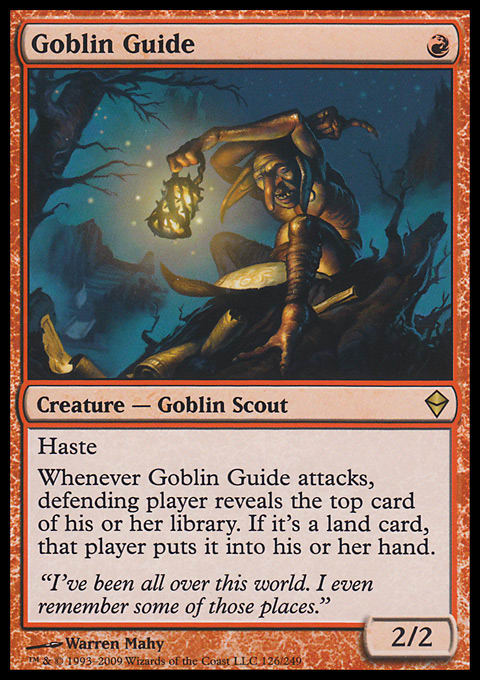
The legacy of Red one-drops with drawbacks reached an early plateau with Tempest's Jackal Pup, which let aggressive mono-Red decks exploit their own Savannah Lions. While it was possible to die to your own Pup, it mostly just killed your opponent when backed up by Cursed Scroll and cheap burn--if they can't block your Jackal Pup, your Jackal Pup can't deal you damage. Pup was a staple for years, and was in the tournament pantheon with other (now obsolete) creatures like Kird Ape and Masticore. But it was 2009's Zendikar that left Jackal Pup in the dust: Goblin Guide hit red decks like Homo sapiens hit the veldt.
Goblin Guide, once a Burn and Goblins stalwart in Modern, has faded a bit with the release of Ragavan, Nimble Pilferer. Even a relatively minimal drawback like Goblin Guide's seems insurmountable when compared to the all-upside-all-the-time of the Monkey Pirate. But at the time of printing, Goblin Guide was a huge upgrade in power for Red decks, which had been previously been happy to play Tattermunge Maniac. The drawback even creates a fun and flavorful minigame each combat--while anyone who ground out a decade of Modern is sick of losing to Goblin Guide, it was an extremely fun card in the context of Zendikar's landfall environment.
In my three decades of playing Magic, I've literally never been a mono-Red player, but I respect the archetype for the same reason I respect speed-running video games or Formula 1--it's not how I like to engage with my hobbies, but I have to respect anyone who strips away every scrap of extraneous material and goes as fast as humanly possible.
We see a clear trend in how creatures with drawbacks were released in Magic's middle years--we've pivoted from massive "Timmy" creatures with huge upkeep costs or "enters" effects to a smaller, more efficient model. Now that we'd been trained to know what creatures should cost, one of the ways to build player excitement was to break that pattern with an efficient creature that required considered deckbuilding to fully unlock. We'd moved from Force of Nature or Verdant Force being among the most exciting cards in Magic to being replaced by Tarmogoyf and Goblin Guide. As Magic continues to evolve, and as we near the advent of FIRE design and the COVID pandemic, creatures are changing, and the drawback model is changing with it--but there's always a place in Magic for a huge beater with a punishing drawback, and certainly always a place in my heart for the same.