


 Locations



I'm going to date myself a bit here, but does anybody remember the old television game show, Win, Lose, or Draw? The title was a play on words because the game involved literally drawing with markers on paper, and of course the teams would either win or lose.
There aren't any mechanics in Magic yet that involve drawing cards (though that sounds viable in Mark Rosewater's next Un-set). Instead, when the phrase, "Win, Lose, or Draw" is stated in the context of Magic, we're of course describing the three possible outcomes of a game.
Nearly every time, the winner(s) and loser(s) of a game is definitive, assuming it is allowed to play through to completion. Draws are extremely rare. I don't have precise data quantifying how many games of Magic end in a draw, but it has to be tiny. Google's AI claims 1-3% using Arena data, but I don't know if I believe it. That may include situations where a player is dropped or there's a bug in the game--I have seen that weird draw situation before.
This scenario probably inflates the number of drawn games by quite a bit. I'm not sure I've ever seen a fully played out game end in a draw in my five years' experience playing on Arena.
Rules of the Draw
The Magic Fandom Wiki page contains detailed rules explaining how games can be won, lost, or drawn. In the official rulebook, section 104.4 describes several ways for the game to be drawn. Examples, paraphrased to be a little less technical, are as follows:
- The players lose simultaneously
- Gameplay enters a loop of mandatory actions with no way to stop it.
- An effect that states the game is a draw
- In a tournament, players may agree to an intentional draw
The rulebook lists specific rules for multiplayer formats such as Emperor, team play, and variants like Star. Simplifying it all down, there are basically four ways for a draw to occur. Let's take a look at some examples of each situation to bring this idea to life.
Draw Situation 1: Players Losing Simultaneously
Outside of tournament play, I'd wager this is the most well-known and common way for games to end in a draw. If all players lose at the exact same time due to some sort of card combination or effect, then the game ends in a draw.
There are countless ways something like this can happen, especially when considering that dealing lethal damage to all players simultaneously gets the job done. For example, a card like Earthquake or Hurricane can singlehandedly accomplish a draw. As long as the value for X is high enough, all players' life totals will drop below 0 at the same time, and the game will end in a draw.
 |
While straightforward, this kind of draw is relatively uninspired. Surely, there are more flavorful and complex ways of forcing everyone to lose the game at once, right?
Well, another X spell that can do the trick is Prosperity. With a large enough X, you can force all players to draw their entire deck and lose from decking.
 |
Usually, players have more cards left in their deck than their life total, so drawing everyone out with a large Prosperity often requires infinite or near-infinite mana. There are, of course, many ways to accomplish this, such as Zirda, the Dawnmaker and Basalt Monolith. While decking delivers the draw with an extra style point or two, it's still not the most exciting way to force everyone to lose simultaneously.
A slightly fancier combination of cards would be Heartless Hidetsugu and Furnace of Rath.
 | 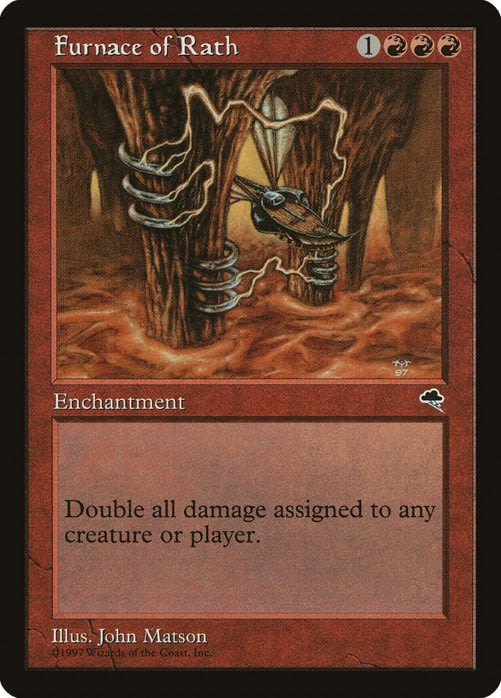 |
This combination is a little finicky because all players have to have an even life total when you activate Heartless Hidetsugu. Otherwise, since the lost life is rounded down, players with an odd life total would manage to survive.
The possibilities in this category are truly endless because there are so many cards in Magic that deal damage to all players or force all players to draw cards simultaneously.
Draw Situation 2: Intentional Draws
Contrast the diversity of possibilities above with the singular situation of the intentional draw. There's not much to dwell on here. In a situation where you have two players paired against each other in a tournament, and they only need a draw to make Top 8, the players will often agree to an intentional draw (ID for short) to secure that point and Top 8 spot. The game is not even played out.
Draw Situation 3: Specific Cards & Effects
Wizards of the Coast does their best not to print cards that can straight-up draw the game. They didn't always follow this principle, however, and a couple of noteworthy cards made it to the printers that can do just that.
The first one to be printed was Divine Intervention, from Legends.
 |
Yes, this is a real card. My friend once snuck it into play against me by casting an early Show and Tell, thereby dooming the game to end in a draw after two more turns. To be fair, the flavor is fantastic! You have some sort of divine power stepping in and declaring the conflict at play is over, and all players must abide by the decree. The effect on a game itself, however, is rather disappointing. Not like this...not like this.
The other card that can lead to a draw should life totals be balanced just so is Celestial Convergence.
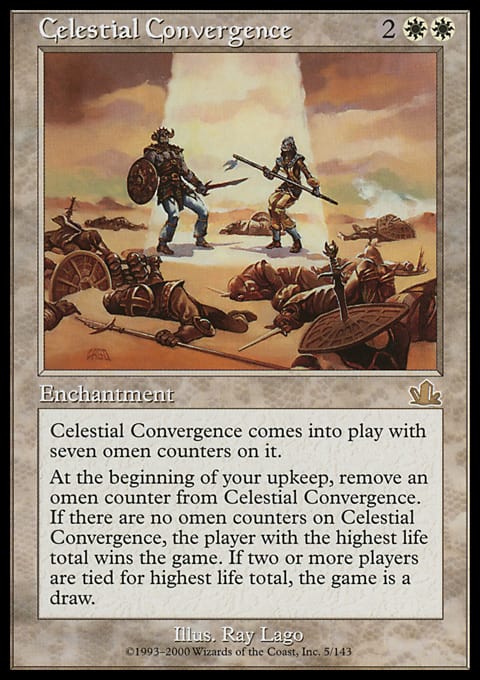 |
Back during the days of Prophecy block, I was purely a casual player. There was nothing more I would have wanted than to win a game using Celestial Convergence. Sadly, seven is a lot of counters to remove, and I didn't have tools like Vampire Hexmage at the time. In any event, a situation where at least two players are tied for the highest life total right as that seventh omen counter was removed is about as frequent as the planets aligning, especially in a multiplayer game.
While Celestial Convergence has likely caused far fewer draws than Divine Intervention, I don't think Wizards prints cards like this anymore. These are the only two such cards I can think of, and when I search Scryfall for "game is a draw" they're the only two to show up. There's a decent chance these will remain the only two for the foreseeable future.
Draw Situation 4: Endless Inescapable Loops
This brings us to the fourth and final situation that leads to a drawn game: when a forced, infinite, unescapable loop is entered during the game. When something like this happens, theory plays out and states that such a loop will last forever, stalling the game out and preventing anyone from winning. Therefore, the game is declared a draw.
This is perhaps the most abstract of the four cases, so let's take a look at a couple examples.
I'll start with my all-time favorite; you can watch the situation unfold via YouTube. Luis Scott-Vargas was recording a MTGO video when he ran into an unlikely scenario involving Oblivion Rings. If you haven't seen this before, I'd highly recommend watching the five minute video (you can skip to 2:50). In a nutshell, his opponent had their own Oblivion Ring under an Oblivion Ring. They then cast a third copy and LSV killed his only legal target, forcing his opponent to O-Ring their O-Ring, releasing the other O-Ring which then comes into play and exiles one of the other O-Rings, etc. etc.
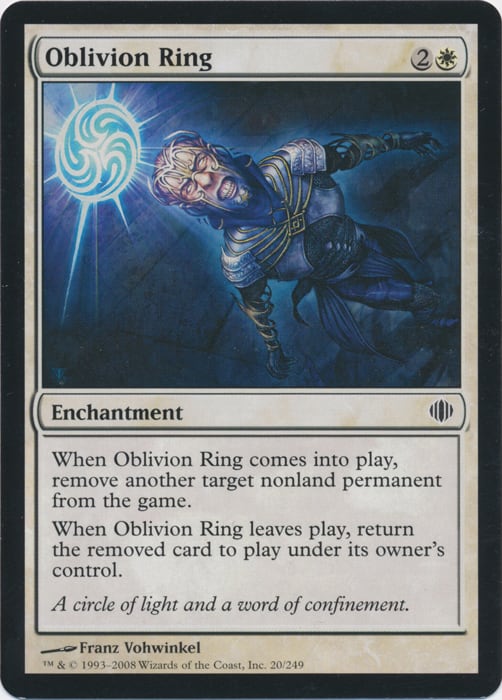 |
With Oblivion Ring, if your opponent has no legal targets then you have to exile one of your own cards. No one wants to be forced to do that. Have you ever wondered why newer versions of this effect, such as Banishing Light, specify that you can only exile permanents an opponent controls? The clause helps avoid endless loops like the one LSV encountered!
Another infinite loop combination led to a banning! There is a simple two-card combo that forced a game to end in a draw, and Wizards of the Coast didn't want this combo to disrupt tournaments.
The combination was simple. Step 1: get Worldgorger Dragon into your graveyard (this can be done any number of ways, though Entomb would have been a popular choice). Step 2: cast Animate Dead on Worldgorger Dragon.
Up until January 2015, the poor dragon was actually banned from Legacy because of this combination. The problem was that Animate Dead would bring Worldgorger Dragon back to the battlefield and attach itself to the creature. But then Worldgorger Dragon's ETB effect would trigger, exiling Animate Dead and all your other permanents. Since Animate Dead left the battlefield, Worldgorger Dragon would have to be sacrificed, bringing all your permanents back into play, including Animate Dead. If Worldgorger Dragon is the only legal target, Animate Dead would have to target it, bringing the dragon back into play and creating an infinite loop! The result: the game ends in a draw.
With about 20,000 unique cards in Magic, you're bound to encounter these bizarre interactions. You can google combinations of cards that force a draw if you want to find all sorts of creative ideas. I have time to share one more that I found entertaining.
When Torment first came out, I found Transcendence a fascinating card. I wanted to crack this enchantment from a pack to surprise my friends with it! I found the way it turned Magic's rules on its head fascinating. Then years later, Wizards of the Coast printed a card in Dissension that forced a draw with Transcendence: Rain of Gore. (False Cure could also do this.)
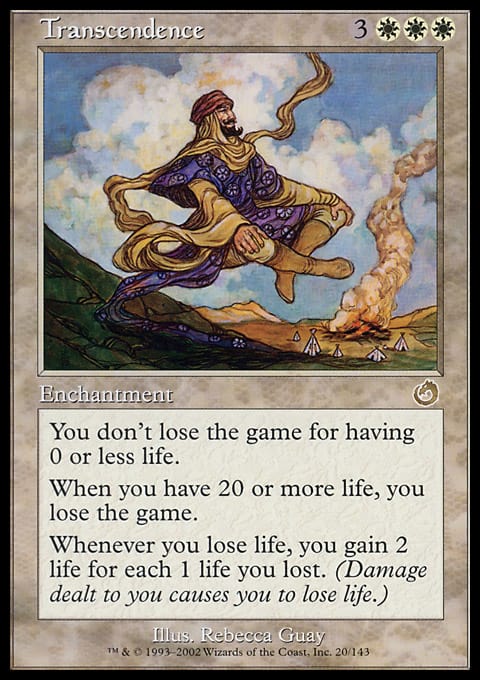 | 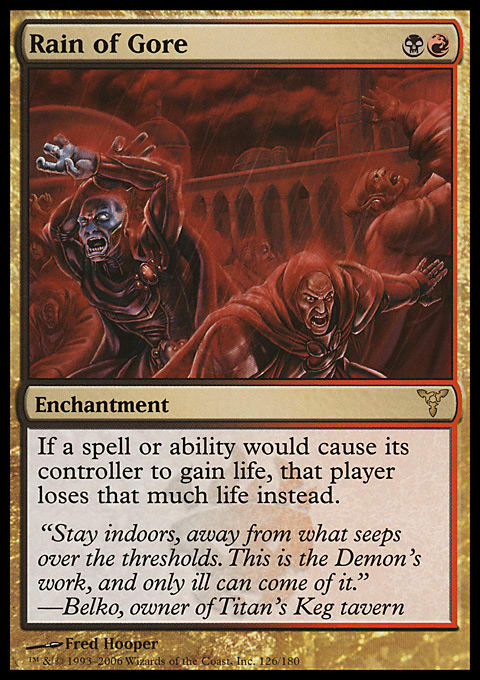 |
That's what happens when Wizards creates cards that mess with a fundamental rule of Magic! With both enchantments in play, if you were to lose one life, Transcendence would have you gain two life instead. Rain of Gore steps in and says you can't gain two life--instead, you lose two life. Now you've lost two life, so Transcendence says you gain four life, only for Rain of Gore to force you to lose four life.
The end result of this chain is your life total becomes infinitely negative (which doesn't kill you thanks to Transcendence's first clause). It sounds cool, but there's no way to exit this endless loop unless one of these enchantments are destroyed at instant speed. Thus, your life total drifts more negative exponentially for eternity, so the game can't advance and ends in a draw.
Wrapping It Up
It's fun to explore other combinations of cards that can draw a game of Magic. Many such combinations are obscure and hard to pull off, often leveraging two disparate cards printed years apart from each other. The tools are there, for any who want to stretch their creative muscles. If you want to discover more, I'd recommend researching cards that break Magic's fundamental rules, such as Transcendence and Rain of Gore. Powerful effects like these are bound to create problematic combinations.
As for me, while I appreciate the history of cards like Divine Intervention and Celestial Convergence, I'd much rather engage in game play with a definitive winner and loser. As a collector, I own a copy of Divine Intervention for its place in Magic's history. As a player, however, I think I'll leave those stalemate-inducing card combinations to the professionals.