


 Locations



Understanding the various phases throughout a turn in Magic is fundamental to learning this beloved, yet complicated game. Each phase plays a critical role throughout the game, but admittedly some phases receive more attention than others, especially for beginners.
Combat, for example, is a step rarely overlooked by players old and new. No one wants to skip their untap or draw steps, and most players learn early on that damage "heals" during the end of the turn, even if they don't refer to it as the cleanup step. These phases are entrenched into the rules of a game, even when the most basic of cards are played.
One important phase that can often be overlooked, especially in simpler games or in the first few turns of a game, is the upkeep phase. Certain cards demand a cost be paid during your upkeep. What cards care about this phase? This week I'm diving into cards with upkeep costs, including the obsoleted cumulative upkeep cost, to explore a sometimes under-appreciated ability and phase in Magic.
The Basic Rules of Upkeep Costs
Upkeep costs have been around since the beginning of Magic, dating all the way back to Alpha with cards like Lord of the Pit and Force of Nature. I believe it was Richard Garfield's way of creating juiced, above-the-line power level cards with an ongoing drawback to enable a balanced card.
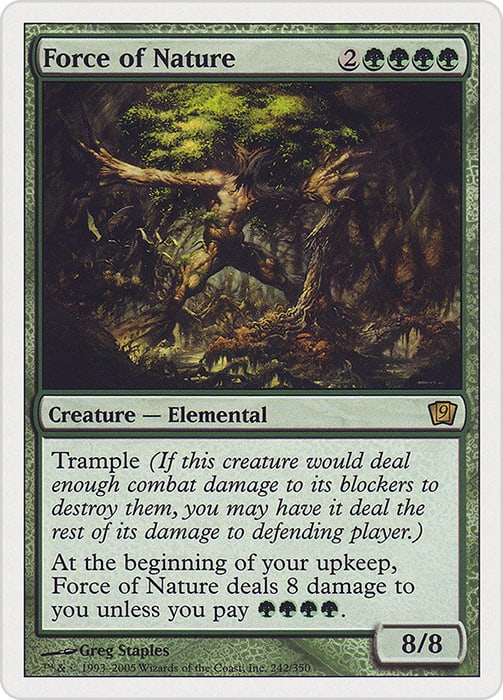
For example, Force of Nature is an 8/8 trampling creature for just six mana! Contrast this with a common from the same set, Craw Wurm, which is 6/4 for six mana. In addition to the increased Green mana pips, Garfield also required an upkeep cost be paid or else a significant drawback would ensue; namely, Force of Will would do eight damage directly to you as the controller! Therefore, at the beginning of your upkeep phase you'd technically have two choices: pay the cost or take the damage.
Wizards of the Coast has made subtle changes to the rules and wording on cards with upkeep costs over the years. Instead of "during your upkeep," these upkeep costs are now triggered abilities prompting for payments which activate at the beginning of the upkeep step. Those costs could cover an array of possibilities, ranging from some sort of benefit (e.g., Farmstead), preventing a negative consequence like Force of Nature's above, or avoiding the obligation to sacrifice a permanent, such as on the Legends card Nicol Bolas.
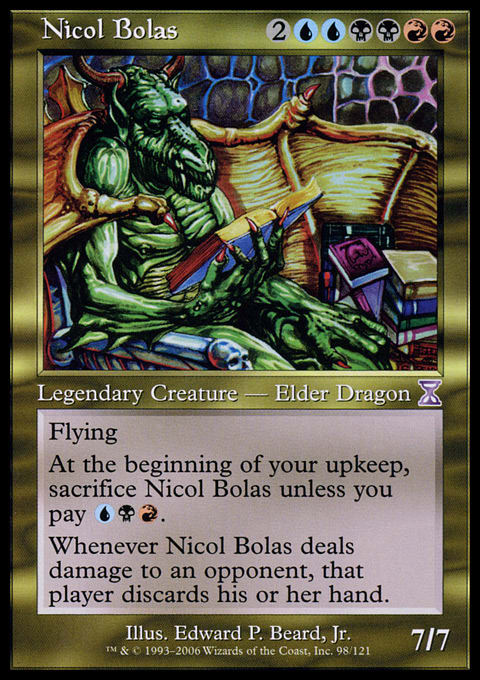
Whatever the flavor of upkeep cost, you have to decide whether you're going to pay said cost right at the beginning of your upkeep. According to the
Iconic Upkeep Cards
Despite the confusion these cards may cause in tournament play, Wizards of the Coast has printed hundreds and hundreds of cards that mention the upkeep. Only a fraction of these demand a cost at the beginning of its controller's upkeep, but that still leaves plenty to uncover. Punishments for not paying a cost range from taking damage, to losing control of the creature, to losing the game!
There's no time to go through every significant upkeep card, so I'll try to focus more on a selection of high-profile cards that demand a cost of some sort.
Let's begin with one of the most iconic Magic cards of all time. The big, bad Juzam Djinn.

Back during the time of Arabian Nights, a 5/5 creature for just 2BB was incredibly powerful. To balance it out, Juzam Djinn was given a small upkeep cost: it did one damage to its controller each upkeep. While players generally don't like taking damage, this was a very small price to pay on such a powerful card at the time. Juzam's fellow djinn, Erhnam Djinn, was also quite powerful and had a bizarre upkeep cost you'd never seen on a modern-day Magic card: it granted one of your opponent's creatures Forestwalk for a turn!
This illustrates the breadth of possibilities when it came to upkeep costs. Some upkeep costs are even stranger still. I chuckle every time I read the upkeep cost and penalty (when the cost isn't paid) on Rohgahh of Kher Keep.

While an absolute flavor win, the concept of having your opponent gain control of Rohgahh of Kher Keep and all of your Kobolds of Kher Keep is a steep penalty for not paying the Legend his due. At least you get to keep your Crookshank Kobolds and Crimson Kobolds, I guess? Only the Kobolds of Kher Keep move to your opponent? Oh, and tokens you created using the land Kher Keep, I suppose. Weird.
One underutilized card with a strange upkeep cost is Koskun Falls. That's right, I'm talking about a Homelands card here!
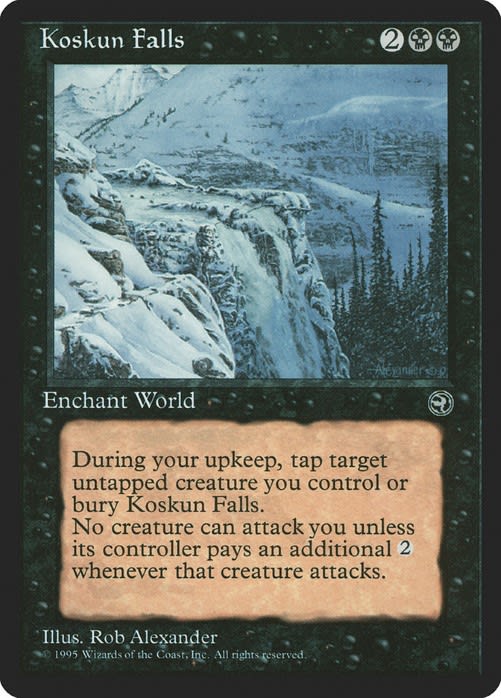
Is this card as strong as Ghostly Prison or Propaganda? Of course not! If you're not playing White or Blue, however, and are interested in this sort of taxing effect, Koskun Falls can be a more than acceptable replacement. It costs one more mana, but the upkeep cost isn't too prohibitive--just make sure you have a creature lying around you don't mind tapping each turn. If you want to convert this "cost" into a benefit, combine it with a creature that rewards you for tapping it or untapping it afterward. My favorite combination with Koskun Falls is King Macar, the Gold-Cursed.
Tapping a creature seems like a fairly pain-free upkeep cost. Some of the more creative upkeep costs are not nearly so forgiving. Back in Mirage, Wizards of the Coast printed a five-mana 7/7 creature in Blue. Talk about powerful! The only drawback...all of your lands phased out at the beginning of your upkeep!

Thus, after resolving Taniwha, you only have your lands every other turn. Oh, and Taniwha also has Phasing, so you only have the creature itself every other turn. I guess your board alternates between Taniwha and no lands or your lands but no Taniwha.
Even though many of the strangest upkeep costs and punishments were printed in Magic's early days, there is no shortage of modern-day cards that also leverage an upkeep cost. One such recent card, which ended up being a haymaker in Standard, is Archfiend of the Dross.
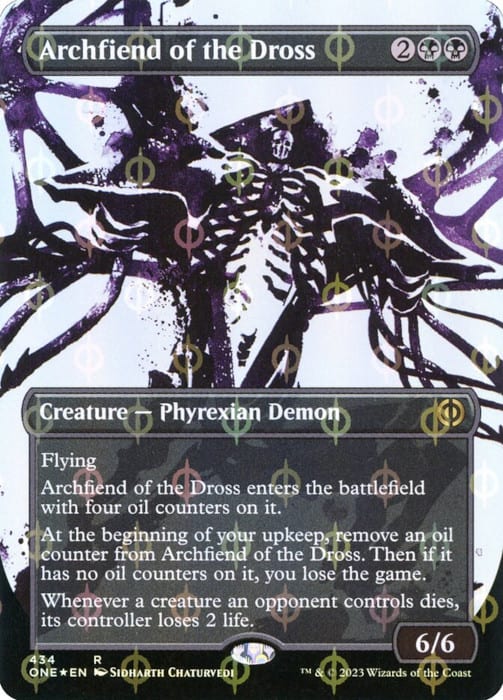
Remember how Juzam Djinn used to be considered powerful because it was a 5/5 for four mana? How about a 6/6 flyer for the same cost?! Though, I'd argue Archfiend of the Dross has a slightly steeper upkeep cost. If it runs out of oil counters to remove at the beginning of your upkeep, you lose the game! You'd better keep this Phyrexian Demon sufficiently oiled!
Speaking of losing the game, the last bucket of cards I'll mention here is the cycle of Pacts from Future Sight. In this cycle, each color had an instant that cost 0 mana but demanded a cost during your next upkeep. Fail to pay that cost and you lose the game.

A Brief Look at Cumulative Upkeep
There are so many interesting cards with upkeep costs, but I need to move on and touch on Cumulative Upkeep cards at least briefly. These are cards with upkeep costs that cumulate over each turn, as the name implies. Let's look at an example that uses modern day oracle text.
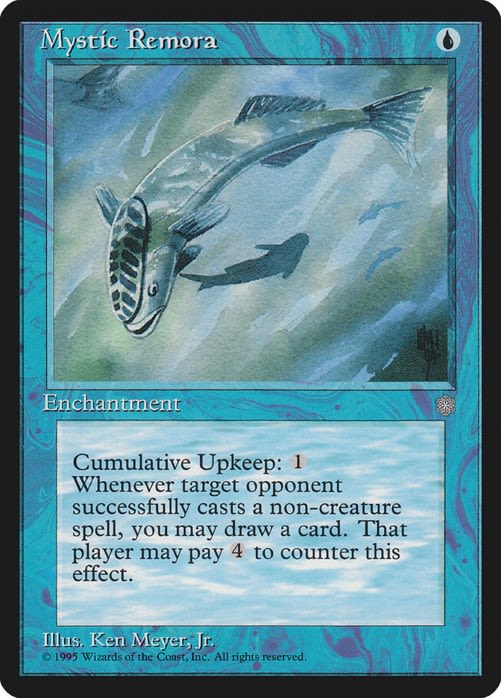
Mystic Remora was originally printed as a common in Ice Age to little effect. After the rise in Commander's popularity, competitive players started leveraging the Enchantment as a way to draw extra cards in the early game, while opponents deployed all their mana rocks and ramping spells. The nice thing about this printing from Dominaria Remastered, is that it uses the most up-to-date templating for Cumulative Upkeep.
In short, Cumulative Upkeep has been re-written to use age counters. You add an age counter to the permanent and then sacrifice the permanent unless you pay the upkeep cost for each age counter. In Mystic Remora's case, you pay one generic mana during your next upkeep, then two mana, then three, and so on until you don't pay the cost anymore. Paying this cumulative upkeep cost is always optional (unlike some of the regular upkeep costs); you can always choose to sacrifice the permanent if you don't wish to pay the cost.
It's a good thing, too, because some of these cumulative upkeep costs can be quite oppressive! Polar Kraken, for example, demands a cumulative upkeep cost of sacrificing a land! That means you start by sacrificing one land, then two on your next upkeep, then three, etc.

Is it worth such a steep cost to play an 11/11 trampling creature that already costs eleven mana? Probably not.
As with the upkeep cards, Wizards of the Coast also developed some creative costs for cumulative upkeep. Wall of Shards, for example, is a two mana 1/8 flying defender that has a cumulative upkeep cost of an opponent gaining life. Herald of Leshrac's cumulative upkeep is gaining control of a land you don't control (meaning eventually you'll run of out lands to steal). Braid of Fire's cumulative upkeep costs actually gives you a red mana--back when mana burn was around, this was an actual cost. Nowadays, it's not such a bad thing.
The last one I'll mention is an interesting combo-enabling card with cumulative upkeep: Thought Lash.

If you are in the market for a card that immediately, at instant speed, empties your library, while also keeping you alive in the meantime, then Thought Lash is the card for you. The card's ability can help you prevent damage while you try to draw and stick your Laboratory Maniac or Thassa's Oracle. It's certainly a strange card with an even stranger bit of art!
Wrapping It Up
While upkeep costs are likely going to show up from time to time, I'm sad to say that cumulative upkeep is a mechanic of Magic's past, unlikely to return. How unlikely? According to a November 2023 entry on Mark Rosewater's Blogatog, "Cumulative Upkeep is a 10 [on the Storm Scale]. I'm skeptical of it returning to a premier set. There is design space paying other costs, but it's not particularly fun gameplay."
I guess if the stars align exactly and we have a major miracle, then cumulative upkeep could return. Until then, we may see the mechanic dusted off and reused in a Masters set of some sort, where enfranchised players with more experience are likely to engage and leverage the strange timing and rules associated with cumulative upkeep. My personal favorite is to combine a cumulative upkeep card with Chisei, Heart of the Oceans.

This creature has an upkeep cost that keeps a cumulative upkeep cost in check! Because cumulative upkeep now uses age counters, Chisei, Heart of the Oceans can eat an age counter from a cumulative upkeep card, thus keep the cumulative upkeep cost manageable while also keeping the 4/4 flying creature alive. Maybe one day there will be a mechanic built around eating counters, and we'll see upkeep and cumulative upkeep join forces once again.