


 Locations



Thinking back to when I started playing Magic, my friends and I were truly poor players at the beginning. We never utilized all the phases of the turn, we would nearly always play our spells and creatures in our pre-combat main phases, and the word "priority" never came up in conversation (then again, I don't think priority and the stack were a thing until after we had been playing a couple years).
Another faulty play pattern we adopted involved combat - we never considered blocking an attacking creature with multiple creatures. We either took the damage or we blocked with a single creature. That's it. I'm not sure why we were so fixated on these being the only two options, but I wonder if it had a little to do with a little-known ability known as Rampage.
What is Rampage?
Rampage (more officially known as Rampage N) is a creature ability that involves combat stats. The reminder text defines the keyword most elegantly: "Whenever this creature becomes blocked, it gets +N/+N until end of turn for each creature blocking it beyond the first." It's a straightforward mechanic, but let's look at an example to bring the ability to life.
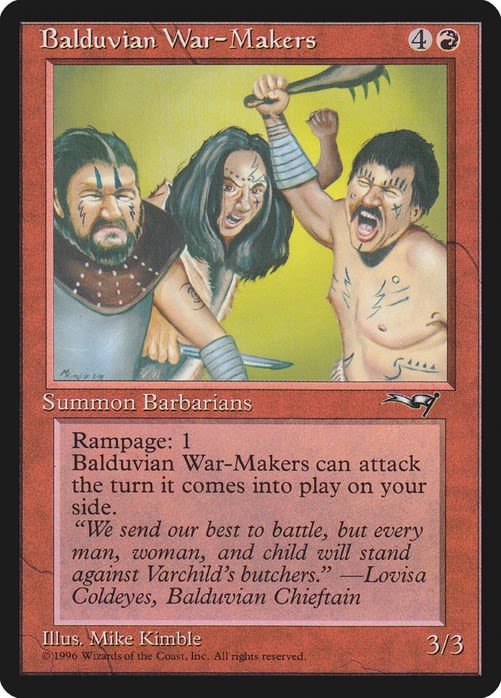
When I started playing Magic, I developed an appreciation for creatures "unaffected by summoning sickness" that "can attack the turn it comes into play on your side." Nowadays, we simply call it haste, and you'd better believe I jammed every copy of Balduvian War-Makers I owned into the deck. Note that first line of rules text in the card's text box: Rampage 1. This means that not only did Balduvian War-Makers have haste, but it also got +1/+1 for each creature beyond the first that blocked the creature. Blocking with two creatures gave Balduvian War-Makers +1/+1, blocking with three creatures gave it +2/+2, etc.
Rampage was initially introduced in Legends, and then saw subsequent appearances in Mirage and Alliances along with reprints in Fifth Edition, Chronicles, and Time Spiral. Looking back, this keyword punishes blocking with multiple creatures and came out at a time when my friends and I were brand new to the game. Technically, Rampage only appears on 17 cards as of July 2025, but I wonder if in a subtle way this mechanic, being so new at the time when we started playing, discouraged us from considering multiple blockers on the same attacking creature.
Additional Rules Regarding Rampage
While Rampage is relatively easy to understand, there are a couple rules nuances you should be aware of if you intend on dusting off an old Rampage creature for your next Commander deck.

- Rampage is a triggered ability and is only calculated once per combat, when the triggered ability resolves.
- Adding or removing blockers later in combat won't change the bonus.
- If a creature has multiple instances of Rampage, each triggers separately (meaning this ability stacks, which is pretty cool...granted, I believe there's exactly one card in all of Magic that grants Rampage, Rapid Fire, so giving a creature with Rampage another instance of Rampage won't come up much).
- If a creature with Rampage is blocked by a single creature, the ability still triggers but provides no bonus.
- The number of blocking creatures is determined when the ability resolves.
That about sums up this keyword. The comprehensive rule book details Rampage in just three short bullet points under section 702.23.
Iconic and Noteworthy Rampage Cards
Despite being a sparsely used mechanic, Rampage shows up on a few influential and noteworthy cards. Let's look at a couple of my favorites.
First off, did you know that one of the original Elder Dragon Legends printed in Legends has Rampage?
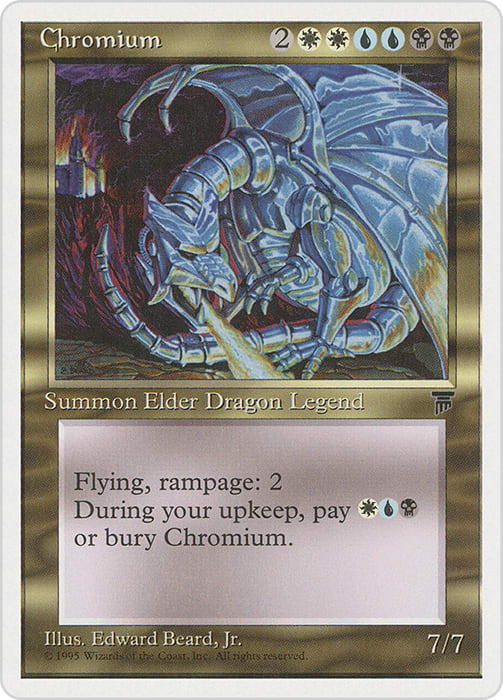
That's right! Chromium, the Esper Elder Dragon Legend, has both flying and Rampage 2. That means if your opponent somehow had multiple flying creatures with which to block Chromium, the dragon would receive +2/+2 for each blocker beyond the first. I am picturing a scenario where an opponent has a Shivan Dragon and four Thunder Spirits in play. No matter what combination of those five creatures they choose to block with, it won't be able to kill Chromium. Four Serendib Efreets would likewise be unable to block and kill Chromium. Outside of weird corner cases like this, however, it feels like Chromium's Rampage ability is mostly for flavor.
Another large Dragon that we marveled at back in the day was Mirage's Teeka's Dragon, a nine mana 5/5 flying artifact creature with flying, trample, and rampage 4!

Teeka's Dragon has the special distinction of being the only creature with Rampage 4 and thus, the creature with the highest Rampage number ever printed. As the reminder text points out, attempting to block Teeka's Dragon with multiple creatures will give it a whopping +4/+4 for each creature assigned to block beyond the first. Even a field of 20 Air Elementals won't stand a chance at blocking and killing Teeka's Dragon. While Teeka's Dragon isn't considered a highly playable card nowadays, it is still worth around $6 for its iconic nature and presence on the Reserved List.
While Teeka's Dragon is the only creature with Rampage 4, there have been two creatures printed previously with Rampage 3: AErathi Berserker and Gabriel Angelfire.
 | 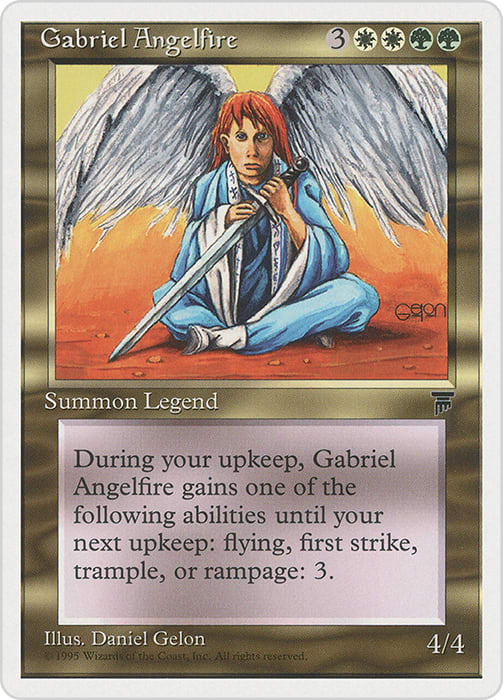 |
My friends and I started playing Magic sometime around 1997, so no one in our play group had the AErathi Berserker (printed as rathi Berserker because the printers couldn't create the "Æ"). We definitely played Gabriel Angelfire, however, since we were able to obtain Chronicles copies readily. Yes, the Angel from Legends is prohibitively costed. Yes, seven mana for a 4/4 creature with just one ability at a time is well below the curve. Yes, out of the four abilities available, we basically never chose rampage: 3. None of that mattered - the creature looked sweet and always made waves when it hit the battlefield, so we played it.
The last card I want to touch on is perhaps one of the most interesting and creative creature to have Rampage: Varchild's War-Riders.

Varchild's War-Riders has to be one of the most mechanically creative cards in all of Alliances, and possibly one of the most creative from its era. Let's break this card's rules text down one line at a time.
First off, it's a two mana 3/4, creature, making it well above the curve even by today's standards. Wizards of the Coast has never printed another 
 3/4 creature since. Next, Varchild's War-Riders has trample and Rampage 1 - a respectable pair of stats. The next bit of rules text is where things get interesting, though. Varchild's War-Riders has a cumulative upkeep cost of putting a 1/1 Survivor creature token into play under target opponent's control.
Thus, on your next upkeep you have to give an opponent a 1/1 creature token. On your following upkeep, you give an opponent two 1/1 creature tokens. Then three, then four, etc. While in a one-on-one matchup, this downside is significant, the ability can create fun political discussions in a multiplayer game of Commander. Imagine developing alliances with key opponents throughout the course of the game by offering them a stack of 1/1 creature tokens.
Here's my favorite part of the card though: even if you're forced to give dozens of 1/1 creature tokens to an enemy, those tokens still can't profitably block Varchild's War-Riders! Because of the creature's Rampage 1 ability, each incremental 1/1 blocker pumps Varchild's War-Riders +1/+1. Therefore, the tokens can never block and kill Varchild's War-Riders, no will incremental 1/1 blockers ever reduce the trample damage dealt. This interaction has always tickled my fancy, and I find it to be incredibly creative on WOTC's part. This is truly a balanced, well-designed card in my opinion!
Wrapping It Up
There you have it. This wraps up my exploration into the Rampage mechanic. Given its straightforward nature and interaction with combat, which Wizards of the Coast always likes to encourage, you'd think the mechanic would be on more than just 17 cards, two of those cards being from silver-bordered sets (Old Fogey and Our Market Research Shows... Longest Card Name Elemental). Why did Wizards basically stop printing new cards with Rampage after Mirage?
When asked about the mechanic, Mark Rosewater posted in his Blogatog that any reappearance of Rampage would involve a "New Rampage." He goes on to say "old rampage with 'each blocker beyond the first' was a design failure. According to the wiki fandom page, "Rampage had issues of development since all the cards with it were costed and sized like it was a significant bonus in every combat, as opposed to one that never realistically activated." As I mentioned in my introduction, Rampage discouraged double blocking altogether, but none of the Rampage creatures were so large as to demand double blocking in the first place.
Therefore, later cards were given a derivative form of Rampage, which Mark Rosewater calls "new rampage." The ability isn't keyworded, and shows up on cards like Gang of Elk and Beastmaster's Magemark.
 |  |
The wiki page goes on to explain that even this "new rampage" was to be deprecated due to its added complexity. Nowadays, to discourage double blocking, Wizards of the Coast simply grants creatures the "stalking" ability, meaning the creatures straight up can't be blocked by more than one creature. This is a much cleaner design.
Unsurprisingly, this places Rampage at about an 8 on the Storm Scale. Mark Rosewater once posted to his Blogatog that "[Rampage] not working on the first creature to block it is a huge flaw. Not a lot of blocking happens with two creatures." As a result, the few of us who are diehard Rampage fans will have to accept the 17 creatures printed with that keyword as likely the exhaustive list for the foreseeable future.
Maybe a future set will involve a central, flavorful arc designed around blocking with many creatures, and Rampage will have a chance to shine. Until then, Rampage will continue to go down in my personal history as one of the most influential mechanics on my early gameplay while never really triggering in a relevant fashion. Just the threat of a creature's growth from double blocking was enough to scare us from wanting to do it. Given how this leads to highly suboptimal play, I can see why Wizards of the Coast is a little shy about reintroducing such a mechanic into modern day Magic.