


 Locations



Who doesn't love a solid two-for-one in Magic? Many games are decided by incremental advantage a player can grind from the synergies designed within their deck. Often times, combining the right couple of cards can truly generate a step-change in power level.
Other times, a card is designed with a two-for-one already built into it. A card that cantrips, for example, provides an automatic two-for-one because you get the effect of the card itself while also drawing a replacement. Another example is Virus Beetle, a recent reprint in Edge of Eternities that gives you a 1/1 artifact creature on the battlefield while also forcing your opponent to discard a card--an inherent two-for-one.
Then there are mechanics that provide you with this incremental value by definition. This week I'm going to talk about one such mechanic: Rebound. This keyword, when thrown on spells, generate extra value naturally, no synergies required!
Rebound: A Brief Overview
The Rebound mechanic was initially introduced in Rise of the Eldrazi back in 2010. The mechanic sounds simple in description, though there are a few nuances to be aware of when interacting with the keyword. The reminder text for Rebound is as follows: "If this spell was cast from your hand, instead of putting it into your graveyard as it resolves, exile it and, at the beginning of your next upkeep, you may cast this card from exile without paying its mana cost."
That's right. When you cast this spell from your hand, you have the opportunity to cast it a second time on your following upkeep for free!
Let's brings this to life with an example - Staggershock, from Rise of the Eldrazi.
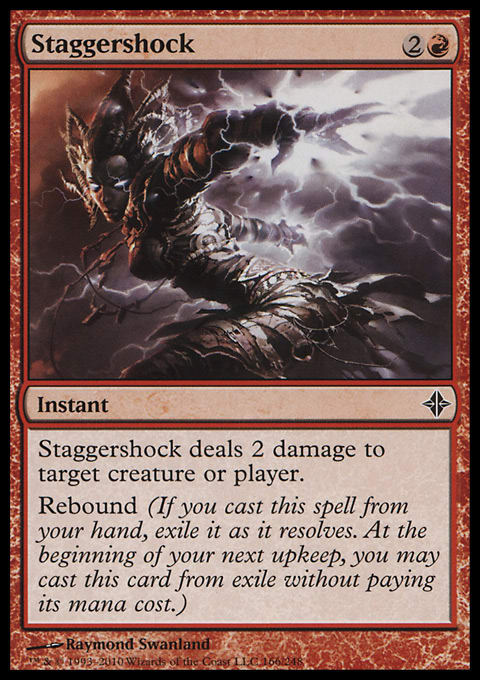
I remember this being a desirable pick in Limited for its ability to pick off two of an opponent's creatures for just one card. At instant speed you could pay three mana to shock a creature or player. Paying three to deal two damage isn't all that impressive. However, at the beginning of your next upkeep, you can cast Staggershock again (I mean, why wouldn't you?), and deal two damage to another creature or player.
That second, free copy of the spell is where the Rebound mechanic really shines. It also combines well with other effects, such as Flurry, Prowess, and Storm. There can be some real synergies with a Rebound card, but being a Rebound card is often enough to make it worthwhile.
After its initial appearance in Rise of the Eldrazi, Rebound has also been printed in Commander 2017, Modern Horizons, Modern Horizon 2, Adventures in the Forgotten Realms Commander, The Lost Caverns of Ixalan, Dragons of Tarkir, Doctor Who, and Final Fantasy Commander. While Rebound appears on 30 cards, it's clear Wizards of the Coast isn't shy about sprinkling the keyword into a set now and then. Let's take a look at some of the noteworthy Rebound cards from over the years.
Noteworthy Rebound Cards
One of the most valuable Rebound cards from Rise of the Eldrazi is World at War, a Red sorcery spell that grants you a second combat phase and additional main phase.
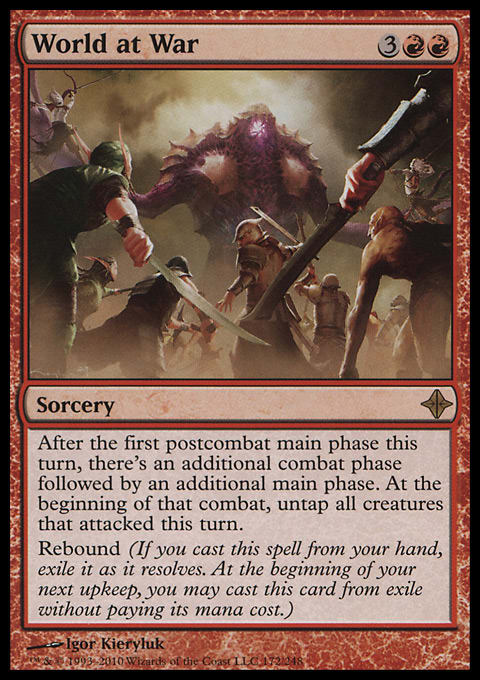
This kind of effect is always popular amongst players, and getting to cast such a spell twice--once for free during your upkeep via Rebound - is sure to be a hit. This card has been reprinted just once, on The List, and is therefore hovering in the $8 range. World at War is definitely one of the splashier Rebound cards out there.
You may be wondering if Red has a disproportionate number of Rebound cards. The answer is a resounding "no." Every color has had its share of Rebound action, including Transpose, the most recent Rebound card printed in Final Fantasy Commander.
That's right! Even as recently as Summer 2025 Rebound has shown up on new Magic cards. Transpose is a value generating machine. For three mana, you loot, lose a life, and create a 0/1 Wizard creature token with that pesky pinging ability. Then on your next upkeep you can do it all over again, only the second time you don't get the 0/1 token since you'd be casting Transpose from Exile instead of your hand. It's a clever way to dial back a Rebound card's power, and I suspect we'll see an exception clause like this again in the future.
Another popular Rebound card with a few bucks is Ephemerate, a one mana instant printed numerous times.
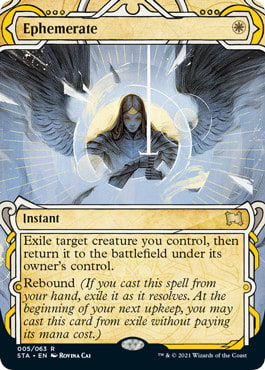
This card has all sorts of interplay in Commander, making it a versatile counter to removal spells, board wipes, etc. It also triggers ETB abilities, which can lead to some powerful interactions. While your opponents will see Ephemerate coming the second time, it still offers you the opportunity to blink something a second time should the game call for it.
Going back to Rise of the Eldrazi, Consuming Vapors is another throwback I remember playing back in the day. Four mana is a lot for an edict effect, even with the life gain, but being able to edict someone twice, the second time for free, can swing the game to your favor. The incremental life gain (twice!) also helps keep you alive while you prepare your next move.
Another Rebound card worth mentioning is the Doctor Who Sorcery Into the Time Vortex, a spell with two words of rules text (not counting the extensive reminder text): Cascade and Rebound.

For five mana, you cast this sorcery and exile cards from the top of your library until you find a nonland that costs less. You get to cast that spell without paying its cost. Then at the beginning of your upkeep, you get to spin the wheel all over again! Fans of random effects like these must love casting Into the Time Vortex, although such a card must have extremely high variance.
In addition to cards with Rebound, I also wanted to touch on a couple noteworthy cards that grant spells Rebound. Two immediately come to mind. Cast Through Time, an Enchantment from Rise of the Eldrazi that grants all your instants and sorceries Rebound, and Narset Transcendent, a Dragons of Tarkir Planeswalker with a -2 ability granting your next instant or sorcery spell Rebound.
While these cards don't carry the same cache they may have back when they were printed, both are noteworthy for their Rebound-granting abilities and overall power level. In the same boat (although a little less splashy) is Taigam, Ojutai Master.

This legendary creature was originally printed in Commander 2017 and then was reprinted as a Multiverse Legend. In order to grant an instant or sorcery Rebound, you have to first attack with Taigam, Ojutai Master, making him much more vulnerable than Cast Through Time and Narset Transcendent. Still, there's a combo here worth exploiting with Ephemerate or Center Soul, which can protect Taigam, Ojutai Master while also already having Rebound.
Speaking of which, does double Rebound do anything noteworthy?
Advanced Rebound Rulings
With the examples above, it would seem like Rebound is straightforward, right? The reality is this kind of replacement effect can lead to some uncommon and complicated interactions. From the MTG Fandom Wiki, Here are some advanced rulings about Rebound--strange and infrequent interaction - to know about before you craft your first Rebound-themed deck.
- If a spell with rebound cast from your hand is countered, the spell doesn't resolve and rebound has no effect. The card goes straight to your graveyard; no passing go, no collecting $200.
- If you manage to flashback a card with Rebound or otherwise cast it from anywhere outside your hand, the Rebound doesn't trigger. Conversely, casting a card with Rebound from your hand in any way (even if you didn't pay mana for it) does trigger Rebound, giving you the free spell the following turn.
- If an opponent has something like Leyline of the Void out, you can choose whether you want to apply the rebound effect or the Leyline effect.
- Copies of a spell with Rebound don't trigger Rebound because you don't cast the copies from your hand.
- A spell you cast from your hand with Rebound is never put into the graveyard, so effects that care about cards going to your graveyard won't trigger.
- At the beginning of your upkeep, all delayed triggered abilities created by rebound effects trigger. You can choose to handle them in any order. Timing restrictions based on the card's type (i.e., sorceries) are ignored. However, other restrictions are not (e.g., Rule of Law, Teferi, Mage of Zhalfir.
- If you are unable to cast a card from exile after it is placed there via Rebound, the card remains exiled for the rest of the game. The same is true if the ability is countered (due to Stifle or Trickbind).
- Once you cast a card from exile via Rebound, it does go into your graveyard when it resolves, or it is countered.
- Multiple instances of rebound on the same spell are redundant (that answers my question from the last section!).
This isn't even an exhaustive list. The article goes on to describe other interactions, such as combining Rebound with Flashback and Buyback--interactions that occur only rarely. If you want to dive deeper, I'd encourage you to check out the Wiki page.
Wrapping It Up
While powerful in nature, doesn't it seem like Rebound is a bit of a nightmare for the Magic rules committee? You'd think that such complexity would reduce the likelihood of Rebound's return to premier play. However, despite all these corner case interactions, Mark Rosewater gives Rebound just a 3 on the Storm Scale. "This is a popular, flexible mechanic with fun gameplay. I expect we will see it in Magic's future many times. It already came back once in Dragons of Tarkir."
With this context, it's worth brushing up on those obscure rulings. It sounds very likely we'll see Rebound return to Standard, bringing with it a whole new wave of powerful two-for-ones and interactions.

Personally, I would view the reincarnation of Rebound in Standard as a good thing. The ability is versatile in design space and can lead to some surprisingly fun interactions throughout the course of a game. With the effect behaving as intended 99% of the time, it's worth the occasional complexity.