

 Locations



Imagine this scenario:
You've built your newest deck, eager to show it off at your local game shop. It's chock-full of cards from Magic's latest set (in this case, Spider-Man). What's more, you've built a sweet, synergistic deck that revolves around one of the set's new keywords, Web-slinging.
You sit down against an unknown opponent, and as you're shuffling your deck, your opponent offers, "No Web-slinging?"
Sounds ridiculous, right? This brand-new mechanic, just recently launched, is getting singled out by players at your local shop?! How can you deviate from the rules by effectively "rule zeroing" out an entire mechanic?
Nowadays this would never transpire, but this is precisely what happened to the most detested mechanic of all time.
Ante: Magic's Biggest Mechanical Mistake
This week I'm going to cover what is arguably the most hated mechanic of all time. So much so that when players would sit down and battle each other back in 1993-1996, they would agree first not to play any cards using Ante before beginning the match. Starting in 1997, I missed Ante in its "heyday," but distinctly remember opening Ante-related cards from my Homelands, Chronicles, and Fourth Edition booster packs and realizing that the rare was completely useless.
We're talking literally unplayable. Not because the cards were bad, but because people wouldn't play against you in a game if you played them. Why is Ante such a maligned mechanic? Let's look at an example card that talks about Ante and use that to explain the rule.

Even if you are completely unfamiliar with the Ante mechanic, the first clause on Demonic Attorney indicates the gravity of the situation. Not many cards outright states, "If opponent doesn't concede the game immediately..." Simply put, upon resolution of Demonic Attorney, your opponent either concedes the game or both players ante an additional card.
What does it mean to "ante an additional card?" It ups the stakes of the game, because when you play for Ante, you play for keeps! The MTG Wiki explains, "If players agree to play for ante, at the beginning of the game, before drawing starting hands, each player puts a random card from their library into the ante zone. The winner of the game receives permanent ownership of all cards in that zone."
That's right. The Alpha rulebook includes terms for gambling! Magic was meant to be a game played for keeps. There were concerns within WOTC that playing for ante might result in official tournaments legally sanctioning gambling. That could create all sorts of legal ramifications. Luckily for them, Ante was rejected by the vast majority of players. When WOTC banned Ante cards from tournament play, the decision was met with little resistance.
Ante Rules
Ante is covered in section 407 in the official rulebook. There are four components to the rule:
407.1. Playing Magic games for ante is now considered an optional variation of the game, and it's allowed only where it's not forbidden by law or other rules. Playing for ante is strictly forbidden under tournament rules.
407.2. When playing for ante, each player puts one random card from their deck into the ante zone after determining which player goes first but before players draw any cards. Cards in the ante zone may be examined by any player at any time. At the end of the game, the winner becomes the owner of all the cards in the ante zone.
407.3. Cards that have text "Remove [this card] from your deck before playing if you're not playing for ante' can't be included in decks and sideboards if you're not playing for ante.
407.4. To ante an object is to put that object into the ante zone from whichever zone it's currently in. The owner of an object is the only person who can ante that object.
These rules sound strange; they're out of place in the Magic universe. Yet Ante dates all the way back to the game's early beginnings, and is a part of Richard Garfield's original vision for Magic.
The Ante Cards
Nine ante cards were printed between Alpha and Homelands. Demonic Attorney is one of them, pictured above. Let's take a look at the other eight.
First, from Alpha there were two other Black cards that involved Ante: Contract from Below and Darkpact.
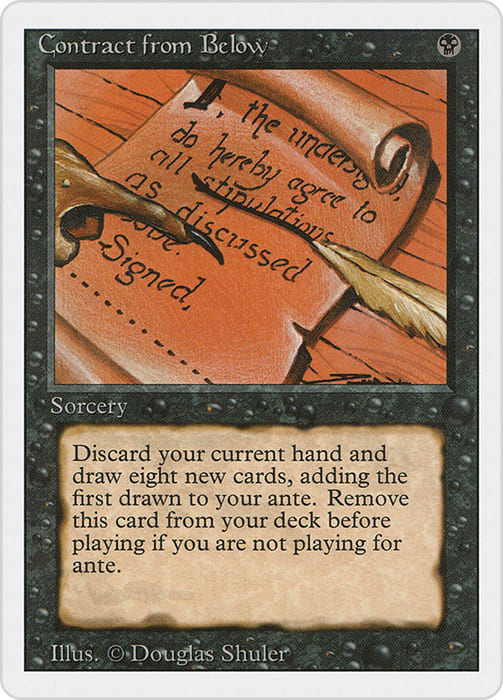 |  |
Players will debate the most powerful card ever printed. Some will say Black Lotus, others will insist it's Ancestral Recall or Time Walk. The real answer is likely Contract from Below--it's a one mana sorcery that draws you seven cards! Sure, you have to put another card from your collection at risk. If you're drawing seven fresh cards, though, you should be well on your way to winning the game regardless!
Darkpact is our first card that interacts with the Ante zone. Casting this sorcery allows you to swap the top card of your library with either ante card--yes, even your opponent's! If your opponent flipped a valuable card for ante in that particular game, Darkpact is one way of locking in that exchange. Even if you end up losing the match, you still get to keep the swapped card. Not only that, the card goes directly to the top of your deck! Your opponent's ante is a Black Lotus? Not only does Darkpact allow you to take it [permanently], but you also get to draw and cast it the following turn!
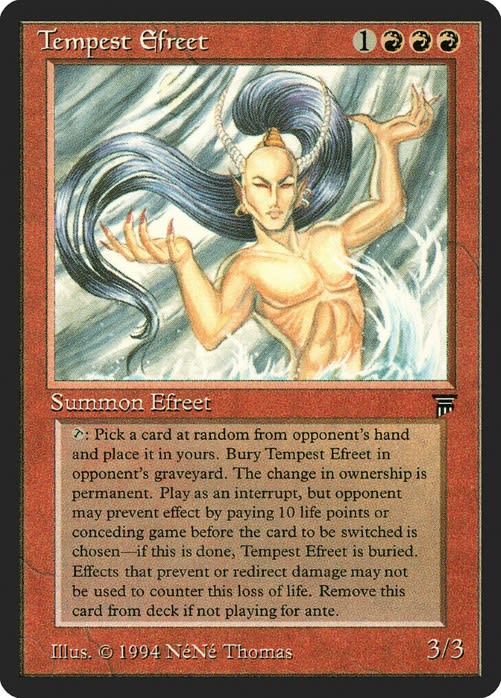
Arabian Nights, Magic's first expansion, introduced two new Ante cards--one is an artifact and one is a Red creature. Both were reprinted in White border.
 |  |
Jeweled Bird is a one-mana pseudo-cantripping artifact. When you activate it, you draw a card and then take your Ante card and place it into your graveyard, swapping it with Jeweled Bird. This is a great way of protecting a valuable Ante card you don't wish to lose.
Tempest Efreet is a really strange one! Again, it's hard to believe these are actual Magic cards. The lengthy text box on Tempest Efreet can be summarized into this: you take a random card from your opponent's hand and place it into your hand, and you now own that card. In exchange, your opponent owns Tempest Efreet, which goes into their graveyard. Your opponent can concede the game or pay 10 life(!!) to effectively counter the ability. No one likes losing, but if you're holding a valuable card in your hand and your opponent is threatening to take it, you may choose to concede to protect your ownership of that card!
Legends and Antiquities each introduced one new Ante card: Rebirth and Bronze Tablet, respectively. These were also reprinted, which is why I opened so many ante cards despite not playing between 1993 and 1996. Many were reprinted in Fourth Edition or Chronicles, which were readily available sets for a couple years.
Rebirth is the first Green Ante card and, in my opinion, one of the worst. For six mana, any player may choose to return to 20 life by anteing an additional card. The symmetric nature of this sorcery makes it very narrow, and I would have liked to see more power for such a prohibitive mana cost.
Bronze Tablet costs six mana to cast and four to activate! It also enters tapped, so you can't use it until your following turn. This seems steep, but when you activate Bronze Tablet, you steal a targeted card under your opponent's control! That's right, there's no randomness to this effect. If your opponent has a Juzam Djinn out, you can swap ownership with Bronze Tablet--you get the Juzam, they get the Tablet. In the game itself, that permanent is exiled. As we've seen before, a player can pay 10 life to counter the effect.
The last two ante cards were printed in Ice Age and Homelands. Thankfully, these two cards were never reprinted.
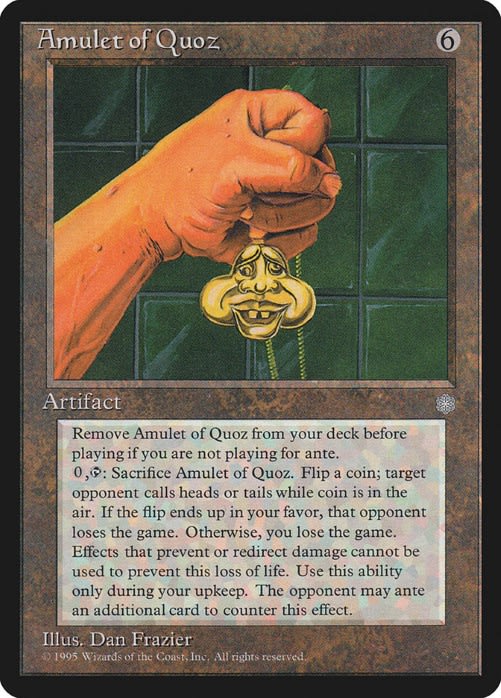 |  |
Amulet of Quoz is yet another six-mana artifact. Unlike Bronze Tablet, the Amulet costs 0 to activate and doesn't enter tapped. When you activate Amulet of Quoz, you sacrifice it and flip a coin. If you win the flip, your opponent loses! Hey, that's pretty powerful! What happens if you lose the flip? You lose the game! Whoa, we're talking the highest stakes here. If your opponent doesn't want to take the game down to a coin flip, they can ante an additional card instead. I'm not sure I like the random nature of this artifact!
The last card ever to be printed with Ante is Timmerian Fiends, with artwork I always found bizarre. You have a happy skeleton creature hanging out with a half-man, half-reindeer.
Anyway, we have another creature--a1/1 "Summon Fiends" (errata'd to be a Horror) for 1BB. Then for BBB you can Sacrifice Timmerian Fiends to destroy an artifact. Only, instead of placing Timmerian Fiends into your graveyard, you place it into your opponent's graveyard. The artifact you destroy ends up in your graveyard, and the exchange in ownership is permanent. There's no buyout for your opponents on this one--the exchange in ownership is inevitable. Though, if your opponent had a way of reanimating the Timmerian Fiends, they could use it themselves (if they have triple Black mana) and turn the tides!
Wrapping It Up
Talk about a wild handful of cards! When you're dealing with permanent exchanges of card ownership, you can raise the stakes of a Magic game to the max. That's precisely what Wizards of the Coast did with some of these cards, forcing either unfavorable trades on opponents or an immediate concession.
These abilities seem so far outside the realm of Magic that it's hard to imagine they were once a core part of the game, even if only for a limited period of time. What's easy to understand, however, is the player base's tendency to ban Ante within their playgroups from the get go. It's no wonder one of the most common phrases at a hobby shop in the mid-90s was, "No Ante?" before the games began. To play with Ante was to gamble with your cards!
It's fortunate that Wizards of the Coast saw the rejection of Ante by players, and since removed it from the game. Only hardcore Old School players occasionally play with the ability, making it one of the least used mechanics. Thankfully, it's also a 10 on the Storm Scale. Mark Rosewater states, "Ante cards are as 10 as it gets."
In other words, we're not likely to see Ante return to Standard (or any other new Magic product) ever again. Yes, I tend to enjoy old, quirky mechanics. Yes, these Ante cards are bizarre curiosities. That being said, this is one mechanic I am grateful to never have to deal with again.