


 Locations



The original Mirrodin set introduced a handful of powerful and popular mechanics. Affinity became one of the most broken abilities of its time, leading to numerous cards being banned from Standard. Entwine gave us the ever-powerful Tooth and Nail decks. And of course, who could forget the introduction of Equipment, a brand-new artifact subtype that has since been used on over 500 cards.
Amongst this competition, it may be easy for players to forget yet another breakthrough keyword also introduced in Mirrodin: Imprint. The Imprint mechanic may seem slightly less recognizable compared to other novel abilities from the same block, but it still has left a mark on Magic. Although far less proliferated compared to Affinity and Equipment, Imprint has stuck around across a handful of sets (mostly related to returns to Mirrodin), and has even branched into non-artifact cards more recently.
Mechanics of Magic: Imprint
The typical text on Imprint cards takes the form of, "...exile [a card] ... [do something with exiled card]. Pretty vague, right? Essentially, a card with Imprint demands that you exile another card--it could be from your hand, from play, or even from a graveyard--that card becomes "imprinted" onto the Imprint card, and then has an effect that depends on what you exiled.
This is much easier to explain with an example: Mirror Golem.

This uncommon from Mirrodin costs six mana and is a 3/4 creature. This in and of itself is quite underwhelming. However, it has an additional Imprint ability: when Mirror Golem enters, you may remove target card in a graveyard from the game. As the reminder text helpfully mentions, that exiled card is "imprinted" on Mirror Golem. Then, Mirror Golem has the additional ability that it has protection from each of the imprinted card's card types (funnily enough, Mirror Golem was printed before a few card types were introduced, so the reminder text fails to mention planeswalkers, battles, and kindred spells).
Using this example as reference, the play pattern is intuitive. Cast your permanent spell, upon entering you exile something and it effectively becomes "imprinted" onto your permanent, and your permanent's rules text tells you how the imprinted card impacts what the card does.
The effect is vague in concept, but easy to understand in practice. In fact, the ability is so intuitive that the comprehensive rules don't list Imprint as a keyword anymore. According to the
Because of this change, Imprint-like cards can be printed without using the term "Imprint." They are just permanents that exile a card from zone and then have their effect based on what was exiled. It functions virtually the same as Imprint, but doesn't directly use the Imprint keyword. Sometimes, Wizards will still put Imprint onto a card that does this (presumably for flavor reasons).
Iconic Imprint Cards
I mentioned earlier how Imprint has made itself known in Magic history. Let's take a look at the handful of cards that put Imprint on the map, despite only existing on 25 cards total.
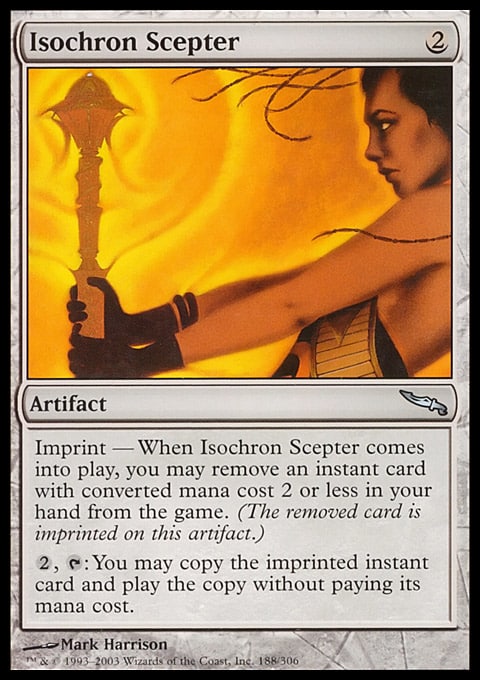
Isochron Scepter is up there as my all-time favorite card with Imprint. For two mana, you can cast Isochron Scepter and imprint an instant card from your hand that costs two mana or less. Then, you can pay two generic mana and activate Isochron Scepter to copy the exiled card. This means you can play the exiled instant once every turn cycle.
The two-mana cap may seem restrictive, but the reality is that there are all types of powerful spells that players would love to cast repeatedly. Counterspell is a great option, as is Swords to Plowshares. Even a repeatable Lightning Bolt can do some real damage. How about imprinting Fog or Tangle, shutting down an opponent's ability to do damage in combat indefinitely?
In fact, the most powerful thing that players have done with Isochron Scepter is to imprint Orim's Chant.

It turns out, casting Orim's Chant on your opponent's turn with Isochron Scepter, every single turn, is a potent combination. This combo was so powerful that it sparked an entire Legacy deck, dubbed "Scepter-Chant!"
What if you want to cast an Instant that costs more than two mana every turn? Better yet, how about a card that lets you cast a sorcery every turn! That would be fun, right?! Look no further than Panoptic Mirror:
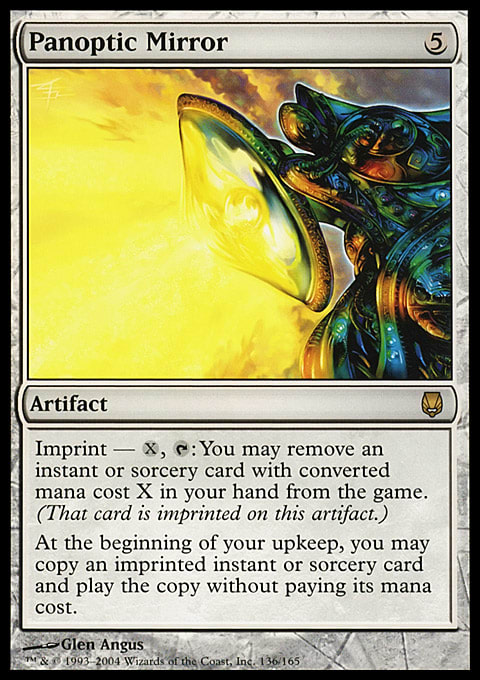
This artifact from Darksteel is getting rather valuable ($30-$40) since it hasn't seen print since it's original debut in 2004. Panoptic Mirror is a five-mana artifact with an activated ability: pay X mana and tap Panoptic Mirror to exile an instant or sorcery with mana value X in your hand from the game. Then, whatever you choose to Exile is effectively imprinted onto Panoptic Mirror.
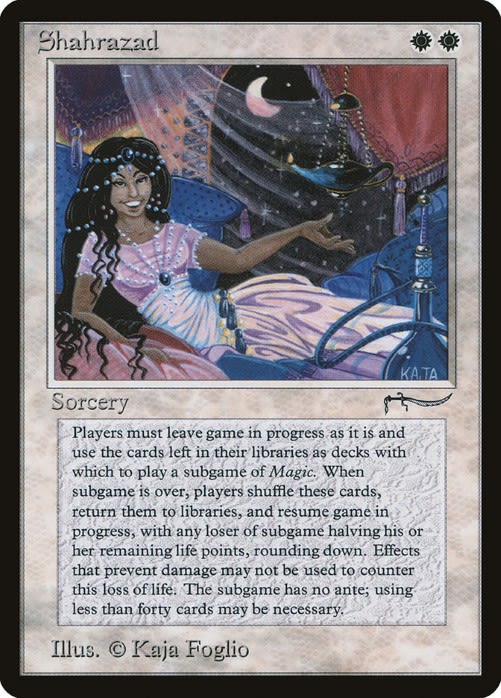
What do you get for imprinting something? At the beginning of your upkeep, you copy the imprinted card and play it without paying the spell's mana cost! That means you get to cast that instant or sorcery during your upkeep every turn! Imagine imprinting something like Wrath of God (no more creatures!), Armageddon (you won't have many friends after that game), or Inspired Ultimatum! There are endless powerful spells you could imprint here. My personal choice, which I laugh about but would never actually play, would be to imprint Shahrazad onto Panoptic Mirror. Evil, I know!
While Isochron Scepter and Panoptic Mirror are most attractive to Timmy/Tammy and Johnny/Jenny players nowadays, our next Imprint card has Spike written all over it. Check out the most valuable Imprint card, Chrome Mox!

Chrome Mox is arguably the most powerful and played Imprint card in Magic history. To use the zero-mana artifact effectively, you have to two-for-one yourself. You cast the artifact, and then exile another card from your hand. In return, you have a Mox! That is, you have an artifact that can tap for one mana of any color of the exiled card's colors to your mana pool. Thus, with an aggressively competitive bent, Chrome Mox accelerates your mana by a turn indefinitely, much like the original Moxes in Magic. This card is a powerhouse in Legacy and cEDH, but banned in Modern for being too strong. Despite all this, plus its numerous reprints, Chrome Mox remains a $100+ card!
Imprint cards have historically been concentrated in artifacts, and most were printed as part of Mirrodin or Scars of Mirrodin blocks. A few one-offs were printed outside of those sets, however, and a couple are quite noteworthy.
For instance, consider Ugin's Labyrinth, a land with Imprint from Modern Horizons 3.
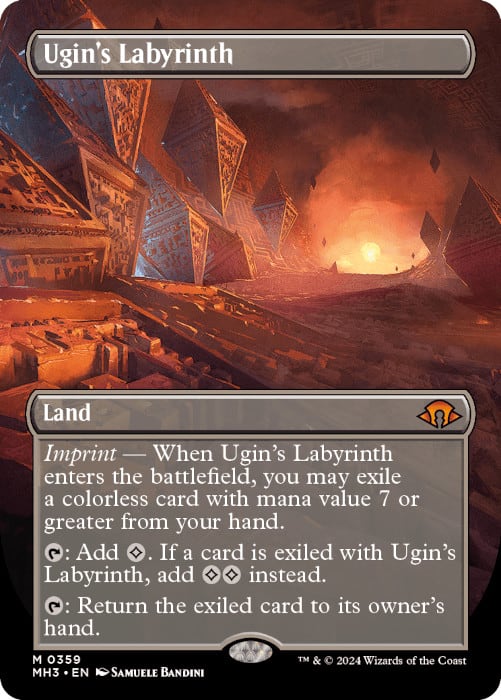
With that Imprint ability word, you know Ugin's Labyrinth will ask you to exile something when it enters. Sure enough, in this case, Ugin's Labyrinth allows you to exile a colorless card with mana value seven or greater from your hand (Eldrazi, anyone?). If you had something to exile, you could tap Ugin's Labyrinth for two colorless mana instead of just one. You can also activate Ugin's Labyrinth to return the exiled card to your hand. Thus, if you have a high-mana colorless card in your hand, you can protect it from discard effects with Ugin's Labyrinth while also accelerating your mana. When you're ready to cast it, bring it back to your hand! Not a bad deal, if you ask me!
In additional to MH3, Imprint cards have also made cameo appearances in Commander sets, such as Commander 2018 and Commander 2019. It's even shown up in Dr. Who, and Jurassic World Collection!
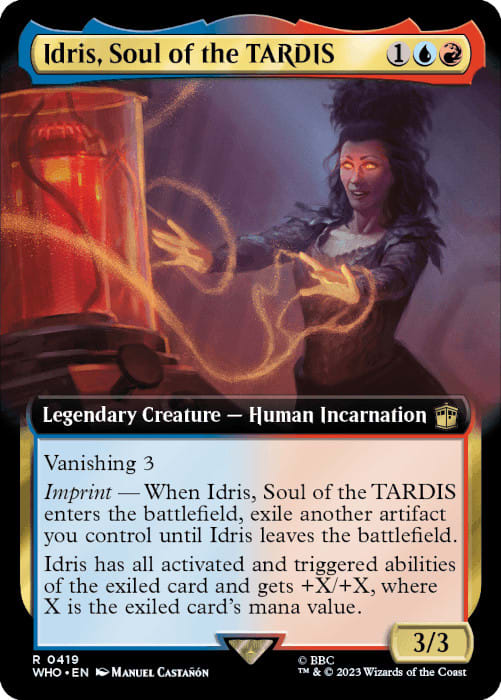 |  |
While only cameo appearances, it's fun to see Wizards of the Coast experiment with Imprint in different ways, such as on non-colorless permanents like Idris, Soul of the TARDIS. The casting costs and card types may vary, but the play pattern with Imprint remains constant. These permanents can exile something (either upon entering or as an activated ability), and then give you an effect based on what was exiled. In Idris, Soul of the TARDIS' case, the creature gains activated and triggered abilities of the exiled card and gets a power and toughness boost based on the exiled card's mana value. In the case of Dino DNA, you can pay six mana to create a token that's a copy of the exiled creature card (except it's 6/6, is a Green Dinosaur, and has trample).
Wrapping It Up
With something as versatile as Imprint, the possibilities are endless! While originally created with artifacts in mind, the concept of "imprinting" something onto a card and then having the card's effect vary based on what was imprinted is a flavorful one that can span many use cases. The effect can also be flavorful, bringing to life a concept in an intuitive, natural way (such as copying a creature after you harness its DNA, like in Dino DNA).
The keyword ability Imprint may be obsolete, but the play pattern and effect is alive and well. In fact, as recently as April 2024, Mark Rosewater has stated that we are likely to see Imprint again in a Standard set. Rosewater gives Imprint a five on the Storm Scale, suggesting there's a "right place" for Imprint, but he's optimistic we'll see it again.
Honestly, I am too! While I don't expect to see Imprint cards quite as powerful and combo-centric as Chrome Mox and Isochron Scepter again, balanced Imprint cards can be fun and dynamic to play with. They add another layer of possibilities to a card's utility, making Imprint cards both fun and rewarding to utilize strategically.
When you exile another card to imprint an ability onto your permanent, the possibilities of what that card can do are virtually limitless simply because there are so many unique cards in Magic. This dynamic effect leads to more interesting gameplay. More interesting, that is, as long as you're not copying Armageddon or Shahrazad every turn!