


 Locations



Magic cards have used artwork from hundreds of artists over its 30+ year history. Some artists are prolific across the game, with dozens or more unique pieces on various cards. Others, on the other hand, have literally illustrated the picture for a single card in the game's entire history.
Today, I want to create an artist spotlight for a member of the art community whose work can be found everywhere in early Magic, but has since become inactive. This artist is one of the original 25 artists for Magic: The Gathering, with artwork for cards from Alpha through Alliances (which happens to also be an Old School format). According to Scryfall, her work has touched 63 cards with unique art in that timeframe.
I'm referring to none other than Amy Weber!
Most Iconic Cards
I thoroughly enjoy Weber's classic, da Vancian style. Her work tends to focus on the subject at hand, leaving out the excessive, distracting details that other artists tend to incorporate. When you're looking at a card illustrated by Amy, you tend to know exactly what the object in question is about.
For example, one of Weber's most iconic pieces is Alpha's Fork.
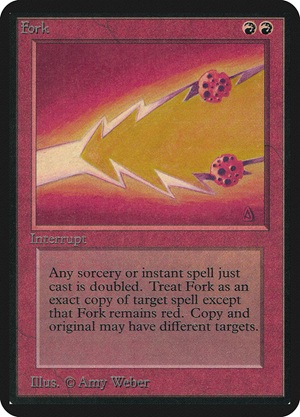
See what I mean about the focus on the card? I love how Weber brings the concept of copying a spell to life with a simple, bright illustration. The picture suggests what a Lightning Bolt would look like should it be duplicated. A modern-day version of this card would likely depict some wizard waving his arms to copy a spell, and then having that effect duplicated in some way to impact two separate victims. I'm sure such an approach would be of high quality, but there's something about Fork's simplicity that resonates. Any new player who sees Fork would immediately know this is an old card because we don't see art like this nowadays.
Two other classic examples of the same vein are Copper Tablet and Ankh of Mishra.
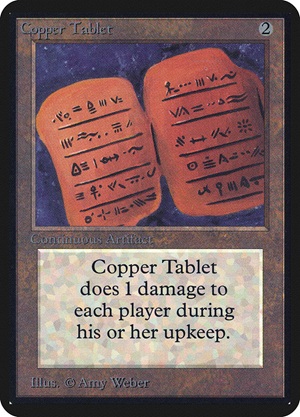 | 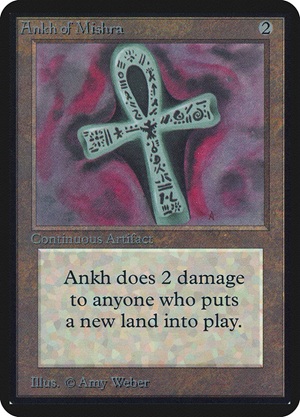 |
Weber has a way with artifacts that I've come to appreciate. Copper Tablet's art depicts what appears to be an ancient tablet, covered in indecipherable, cryptic runes only the most sophisticated of scholars may be able to interpret. Speaking of cryptic runes, Ankh of Mishra's art literally depicts an ankh, also covered in some spinoff of hieroglyphics. In both cases, the artifact in question is the central focus of the art, with only a simple background to highlight these objects. This approach is a go-to approach to Weber's earliest Magic illustrations, and you'll find the same style used on artifacts like Celestial Prism, Crystal Rod, and Conservator.
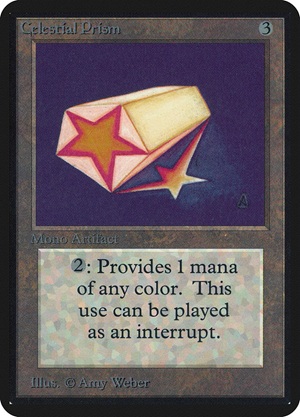 | 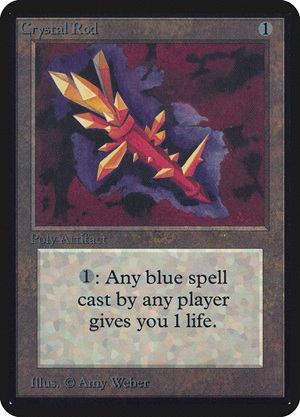 | 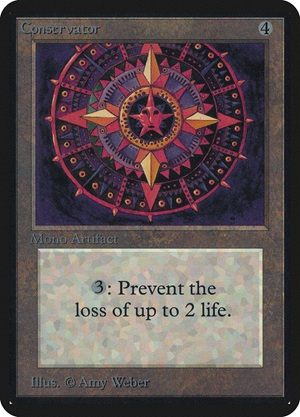 |
Notice how the same color palette is also implemented for each of these three cards. They look similar, but because the illustrations so literally capture each respective artifact, it's easy to determine which is which.
Other Amy Weber pieces I love for their literal designs include Warp Artifact, Ebony Rhino, Pyramids, and Mystic Compass.
A Little Bit of Memento Mori
One frequent theme you'll find across a handful of Amy Weber's art is this concept of Memento Mori, an artistic symbol acting as a reminder of the inevitability of death. It sounds dark in nature, but Weber manages to incorporate such elements without gratuitous use of violence and gore. Most notably, she includes a skeleton or skull in the art to evoke this trope.
For example, the most valuable card illustrated by Amy Weber features not one, but three skeletons with an ominous landscape: Time Walk.
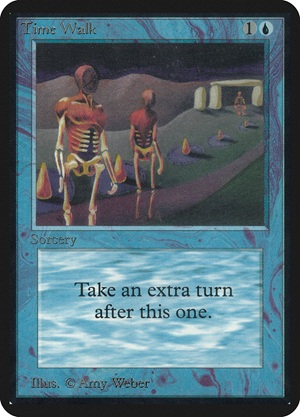
Of the Power Nine, my vote for most evocative and intriguing would be Time Walk (though Timetwister would be close). I love the combination of shapes, dark sky, ominous landscape, and of course the clock-faced skeletons of the foreground. It kind of reminds me of something Salvador Dali would paint.
As far as skeleton inclusions go, Weber didn't stop at Time Walk. There are numerous Magic art pieces she illustrated with the use of this motif. Three more examples include Knowledge Vault, Time Bomb, and Life Matrix.
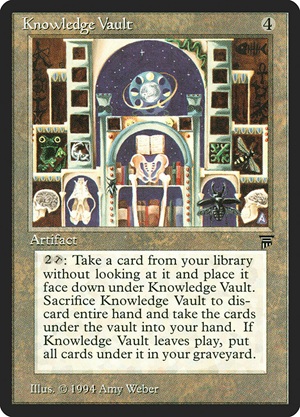 | 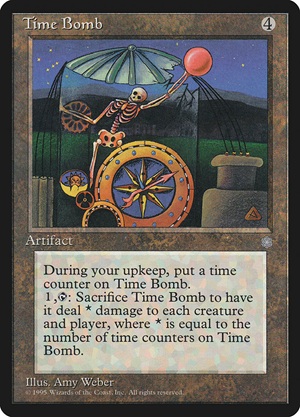 | 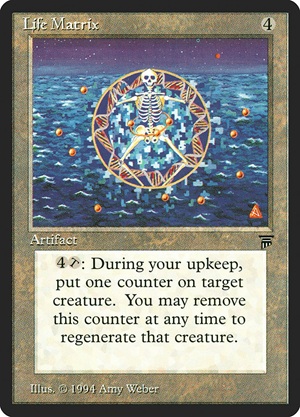 |
These three cards have much in common: they're each artifacts, they cost four generic mana, and they have an activated ability. Most notable is their inclusion of skeleton bones in the foreground of their art. In Time Bomb and Life Matrix, you have the entire skeleton on display reminding you of death and mortality. In the case of Knowledge Vault, only the pelvic bones and femurs are pictured for something a bit more abstract. In each case, the human bones add to the darkness and despair of each of these pieces of art.
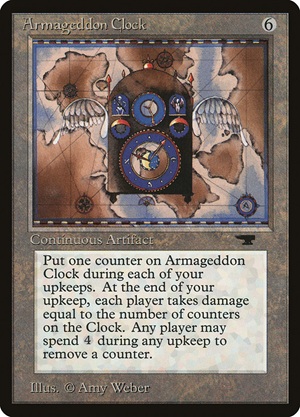
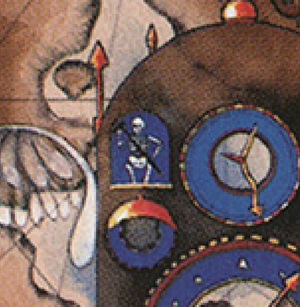
Other skeleton-related artworks by Amy Weber include Skeleton Ship, Urza's Avenger, Armageddon Clock, and Mishra's War Machine. The skeletons on some of these cards don't always make it to the foreground - Weber is loyal to her idea of bringing the primary object of the card to the foreground and central focus of her art. But even if the art is for something else, such as an Armageddon Clock, Weber finds a way to weave in a tiny skeleton to remind us of death.
 |  |
Then there are the Weber illustrations that depict a human skull. This is the prototypical memento mori feature - you'll find it on Argivian Archaeologist and my personal favorite, Illusionary Mask.
Machines - Leonardo Da Vinci Style
In addition to being a brilliant artist, Leonardo da Vinci also conducted advanced scientific research in fields such as light, human anatomy (there are those skeletons again), botany, geology, and engineering. In fact, da Vinci created numerous designs for machines for milling, tunnel excavation, levers and hoists, pumps, etc. He even created a flying machine based on the structure of bat wings. Sound familiar?
Amy Weber brought da Vinci's idea to life in her art for Ornithopter!
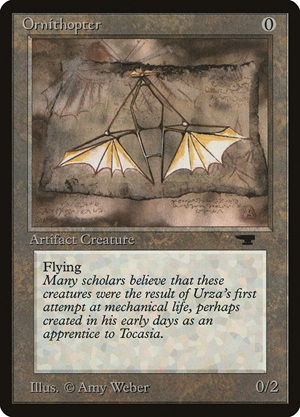
Leonardo da Vinci's influence on Weber's work is strongest on Ornithopter's artwork. Not only does the structure appear to be designed based on bat wings, but it also showcases writing and parchment in the background, reminiscent of da Vinci's sketches. The similarities are too strong to be coincidental - da Vinci's research on a flying machine must have influenced Weber's artwork.
The influence didn't stop there. If you look at some of Weber's other noteworthy machine illustrations for Magic, you can find similarities to da Vinci's sketches and inventive ideas. Another clear example is the big brother to Ornithopter, Roterothopter.
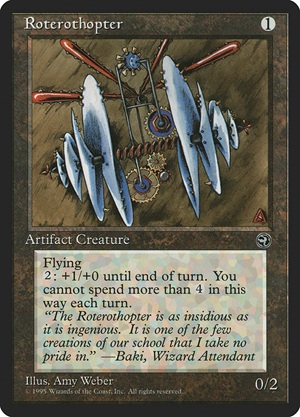
The illustration from Homelands looks a bit more sophisticated than the original, but you can appreciate use of simple tools such as gears and springs to lift the flying contraption off the ground. Personally, those round blade-like objects are enough to deter me from engaging in combat with Roterothopter.
Weber also used a similar style for cards that depicted other useful tools and devices, including Stone Calendar, Astrolabe, and Barbed Sextant. However, these don't share the same degree of da Vincian influence as Soldevi Digger, from Alliances.
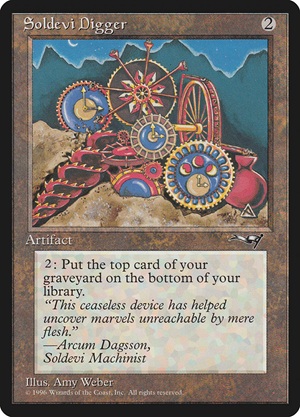
According to Vasari in The Lives, Leonardo "...used to make models and plans showing how to excavate and tunnel through mountains without difficulty, so as to pass from one level to another..." I'm sure the image Weber created for Soldevi Digger isn't exactly what da Vinci had in mind, but the connection can't be a coincidence. This is yet another piece of Weber's art that was likely influenced by da Vinci.
Wrapping It Up
This is just a smattering of some of Weber's most recognizable and iconic pieces of art. In reality, there are a handful of early Magic art by Amy Weber that I also thoroughly enjoy, but didn't have time to cover here. Before concluding, I'll shout out a few honorable mentions:
- Steal Artifact (I love the statues in the background and the lighting)
- Spiritual Sanctuary (I don't know why the water is green, but otherwise it looks like a place for peaceful respite)
- Shatter (an Alpha classic)
- Concordant Crossroads (another paradise)
- Time Elemental (the concrete illustration of an abstract concept)
Each of these, and more, truly showcase Weber's talent and close association with Magic. Older players like me view early Magic and Amy Weber as inseparable. If you were to remove Weber's artwork from the game, you'd be left with a gaping void. She brough us iconic, famous cards we've come to readily recognize as Fork and Time Walk. Amy has the distinction of being one of the five artists to have illustrated the original Power Nine (alongside Christopher Rush, Dan Frazier, Mark Tedin, and Mark Poole.
I'm forever grateful for what Amy Weber brought to Magic with her unique style, combining elements of death via skeletons, da Vinci via machines, and a style that truly emphasized the object of the artwork. It's too bad that Weber is no longer involved with this beloved game. Her website declares, "Magic: The Gathering fans: I no longer respond to mtg related requests or conversations."
Therefore, those interested in purchasing Magic items relating to Weber's art will have to shop her eBay store or the secondary market. Fortunately, there are over 100 Magic related items to browse at her eBay store, so there is plenty of opportunity to own a Magic icon while also supporting one of the game's first artists!