 Locations



In the early years of Magic, Wizards of the Coast created various abilities and effects without directly naming them. The "mechanics" of Mercadian Masques block were all deployed without keywords, including the Spellshaper ability and Rebels/Mercenaries.
Before Mercadian Masques' release, all the way back in Tempest block, there was another creature-based mechanic that went unnamed. Despite being anonymous, this "mechanic" would go on to influence popular modern-day abilities: Modular and Graft. Those familiar with these two mechanics will correctly conclude the ability involves +1/+1 counters.
That being said, I'd be curious to know how many players can readily identify the creature type and the ability I'm describing. Give up?
It All Started with a Drone
In 1997, Wizards of the Coast teased a new creature type by printing a common by the name of Spike Drone in Tempest: a slug-like creature with pods down its back and pincers on its head.
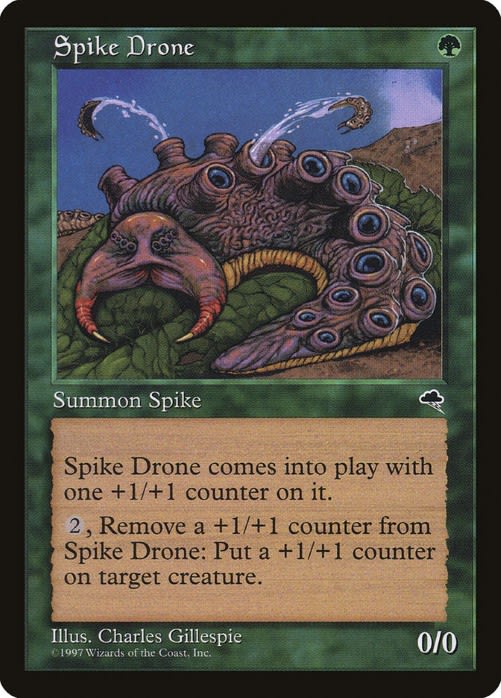
At the time, I don't think players readily understood the purpose of this creature. Even 1997, we had already seen a suite of one mana 1/1 creatures, so Spike Drone didn't possess a power level of note. What's more, you had to pay two generic mana in order to move around its sole counter--when you did, Spike Drone would simply die.
It was unclear of Spike Drone's purpose. Having a movable +1/+1 counter was a neat ability, and augmenting a better creature with that counter could serve a purpose. Was this worth putting Spike Drone in your deck, however? The picture was incomplete and left players scratching their heads.
Spike Family Reunion
What was the purpose of having a single Spike Drone in Tempest? Was there a purpose to the creature and its new, creative design? According to Mark Rosewater's Blogatog, "I originally designed Spikes in Tempest design, but we pushed them back to Stronghold, save the one teaser, to separate them from the Licids."
This all became clear with the release of Stronghold, the second set in Tempest block. In this set, we saw the release of five new Spikes, and each one had the same two mana ability that could move a +1/+1 counter off them and onto another creatures. The first two were commons with no additional abilities:
 |  |
These creatures were akin to Spike Drone both in appearance and effect. The key difference is that they came into play with more than one +1/+1 counter on them, meaning you could move a counter or more off them without losing the creatures themselves. That certainly made them more interesting.
The other three Spikes from Stronghold were where the new creature type got interesting. They had the same two mana ability to move counters around, and an additional ability that could utilize these +1/+1 counters to some effect.
Spike Soldier could receive a temporary +2/+2 buff by removing a +1/+1 counter (netting a +1/+1 for the turn). Spike Feeder allowed you to remove a +1/+1 counter to gain two life. Spike Breeder created 1/1 Spike creature tokens when you removed a +1/+1 counter, although this effect uniquely costed two generic mana.
Suddenly, a typal theme was born, driven by this +1/+1 counter unnamed mechanic. One could cast a Spike Feeder and Spike Colony, pay some mana to move +1/+1 counters from the Spike Colony to the Spike Feeder, and proceed to gain a handful of life at instant speed. Or, if a big attack was warranted, those counters could be moved over to Spike Soldier instead to buff the creature. Or, if 1/1 tokens were needed for some sort of go-wide strategy, Spike Breeder was there to help.
With six Spikes, a [n admittedly unimpressive] strategy could form. Yet, something was still missing from the Spike family. That's where Exodus comes in.
Exodus Completes the Family
Exodus brought four new Spikes to the fold, bringing the total number of Spike creatures to ten. The first three looked akin to the previous six: Green creatures with movable +1/+1 counters and some additional effect fueled by said counters.
 |  |  |
Spike Rogue was the lone uncommon--the creature allowed you to move its +1/+1 counters to other creatures for two generic mana. Uniquely, Spike Rogue also allowed you to move a +1/+1 counter off another creature and onto Spike Rogue!
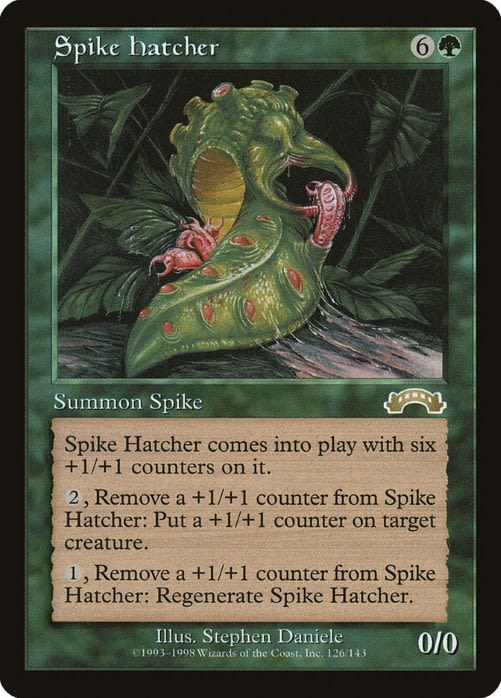
Spike Weaver and Spike Hatcher were the two rare Spike cards in Exodus. Spike Weaver allowed you to cash in your +1/+1 counters for a Fog effect (preventing combat damage for a turn). Spike Hatcher could regenerate with removal of a counter. Spike Hatcher also has the distinction of being the largest Spike, with six +1/+1 counters to start!
While all slightly different, the nine Spikes pictured above look and feel similar in nature. They congeal nicely to form a unifying typal theme.
This is not the case with the tenth: Spike Cannibal.
Spike Cannibal's art depicts an ugly, off-colored slug-like creature eating one of its own kind (hence "cannibal."). The creature's ability is highly flavorful in nature: like all the other Spikes, this one is also a 0/0 creature that enters with a +1/+1 counter. That's where the overlap ends, however. When Spike Cannibal enters, you move all +1/+ counters from all creatures (not just Spikes) onto Spike Cannibal. That's right. All +1/+1 counters. These are all interchangeable, so all your and your opponents' +1/+1 counters would move onto the Spike Cannibal.
Tardy to the Party and a Late Bloomer
At the end of 1998, ten Spikes were printed in total: nine Green creatures and one Black creature. Was that the end of the beloved Spike creature type? Technically, Spikes are a 7 on the Beeble Scale. In other words, it's unlikely to see Spikes return to a Standard-legal set, but it's possible if the right environment comes along.
We did, in fact, see Spikes return to Standard one time since Tempest block. In Time Spiral, eight years after Exodus, we saw the printing of Spike Tiller and the reprinting of Spike Feeder.
 |  |
Spike Tiller took the same form as the previous Green Spike creatures. It entered with three +1/+1 counters, you could move a counter to another creature by paying two generic mana, and you could pay two generic mana and remove a counter to make a land into a 2/2 creature with a +1/+1 counter on it. While the card didn't see much constructed play, it was exciting to see a new Spike printed after their eight-year hiatus.
The biggest splash was yet to come, however. Wizards of the Coast introduced a new card in Magic 2014 called Archangel of Thune, which had a highly synergistic ability.

She herself had Lifelink, and whenever you gained life, you placed a +1/+1 counter on each creature you control. With Archangel of Thune out, if you could find a way to convert +1/+1 counters into life, you'd have an infinite combo. It turns out, Spike Feeder did just that! In fact, the combination of Archangel of Thune and Spike Feeder was powerful enough to make its way into Modern.
This is quite possibly the most noteworthy appearance of the Spike creature type in the game's history. While never really recognized for their unique, groundbreaking ability, Spikes at least made it onto the Constructed scene thanks to this infinite life-gaining combination.
Wrapping It Up
It's unlikely we see Spikes return to Standard anytime soon (though never say never). Newer players won't have the appreciation of discovering the fun interactions that these creatures can have with each other.
I distinctly remember building a Spike Deck when I was a young and eager Magic player. It featured every Spike I owned alongside one copy of Spike Cannibal. I even remember the one time I managed to cast Spike Cannibal, and I moved all the fishtank beads from all my other Spikes onto the one card in one sweeping, overdramatic motion. Oh, to experience that feeling from a game of Magic again...
Alas, I can at least take solace in the fact that Spikes had a significant impact on the game as we know it today. Since their release, we've seen the Modular and Graft mechanics both utilize movable +1/+1 counters. In Modular, when a creature dies its +1/+1 counters get moved onto another creature. With Graft, you have the option of moving a Graft creature's +1/+1 counters to other creatures that enter the battlefield. While these are both mechanically different from the two-mana activated ability of Spikes, you can see how the Spike creatures were precursors to both mechanics.
In this way, the legacy of the Spike creature type lives on. I never found these slug-like creatures aesthetically attractive. Despite this, their interactions with each other and other +1+/+1 counters make for a fun and novel gameplay experience that all players should get to enjoy at least once.