 Locations


The Legendary Rule ("legend rule") prevents you from having more than one copy of the same Legendary card on the Battlefield by putting all additional copies into the Graveyard. It only applies to you, and only to cards with the exact same name that are also Legendary.
So, if you have a copy of Donatello, Mutant Mechanic on your Battlefield and you play out another one, one of those copies is going straight to the 'yard.

The card is neither destroyed nor sacrificed; it is placed in the Graveyard as a state-based effect. However, it does trigger any effects you get from sending something to the Graveyard.
How the Legendary Rule Works
If you control more than one of any Legendary permanent with the same name as another you control, the next time the game checks state-based effects, you have to choose one (or more - the point is you are left with only one) and put the rest of them into the Graveyard. They aren't sacrificed or destroyed, so you can't get around it with Indestructible or not being able to sacrifice things. You just go down to one, and you choose which one stays.
It does not check anyone else's Battlefield. You and I can both control a copy of Donatello, Mutant Mechanic without any trouble.
It wasn't always this way, and if you're just returning to the game after some time away, you might remember it differently.
It Started as Legend
Back when Magic: the Gathering first started, Creature cards were "Summon" cards, and each Creature was labeled "Summon X", where X was the Creature type. Certain Creatures were considered unique and specific; because of that, it was decided there couldn't be more than one of them on the Battlefield at any given time.
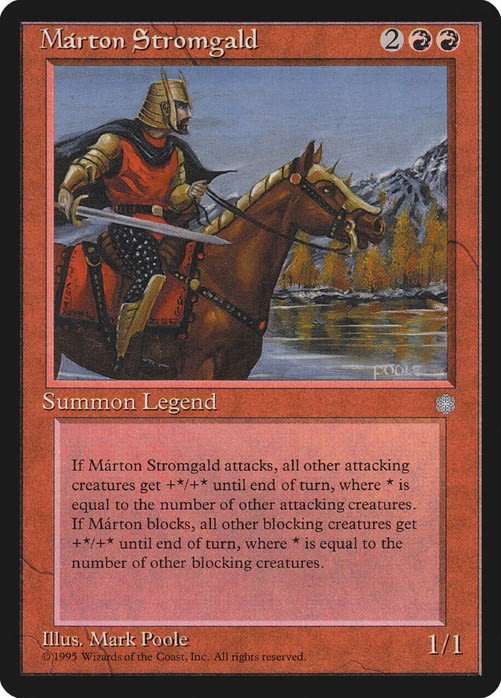
There's only one Marton Stromgald, right? So more than one can't exist.
At that time, those cards were limited to one-per-Battlefield, so if you had Marton Stromgald out and I had one in my Hand, I simply wasn't allowed to play it. In fact, before Ice Age, you were only allowed to have a single copy of any given Legendary Creature in your deck in any format!
Types Matter
Time marched on. Two big things happened:
- Each card got a type (Creature, Instant, Sorcery, Enchantment, etc.). This allows for subtypes (like Goblin, Warrior, or Squirrel) and supertypes, which are limited to just four: Basic (applies only to Lands), Legendary (can be lots of things), Snow (same), and World (which only exists on Enchantments and was retired in 1997).
- Kamigawa block introduced a whole bunch of new Legendary Creatures to the game, including for limited play.
We'd long since moved away from "Summon" cards, so instead of "Summon Legend," the Legends of old were errated with subtypes and started to look like this:
Legendary Creature -- Human Knight
Marton got two subtypes - Human and Knight - and the Supertype "Legendary." That Supertype replaced the Creature Type "Legend" starting in the Kamigawa block.
The rule also changed at this time. You were able to play a Legendary Creature if it already existed on the Battlefield. However, as soon as that spell resolved, the state-based effect immediately removed all instances of the Legendary card in question.
So, let's say you had a strong start with your Draft deck and led with Isamaru, Hound of Konda.

Three turns later, though, and six life down, I drew and played my own. The next time the game checked state-based actions, both of our Isamarus were placed into the Graveyard. Can't have more than one, so all were removed.
Note this is different from the current rules because during this period - which lasted until Magic 2014 - the rule looked at the entire Battlefield and removed every single copy of the Legendary card with the same name. That's no longer true.
What can be Legendary?
Any permanent can be Legendary. Creatures, mostly, but Enchantments, Artifacts, Tokens, Lands, and Planeswalkers can all be Legendary. If they are, the Legend Rule applies to them.
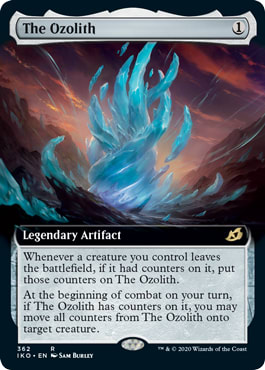
You can only control one copy of The Ozolith, for example.
Are there exceptions?
There are a few cards which let you get around the Legend Rule entirely, like Mirror Gallery and Sakashima of a Thousand Faces, both of which state the Legend Rule doesn't apply, though it's worth pointing out Mirror Gallery simply gets rid of it entirely and Sakashima only removes it for Permanents you control.
 |  |
Most of the Legendary items with the ability to create token copies of themselves also do something to prevent them from falling victim to the Legend Rule.

For example, Aeve, Progenitor Ooze can make copies of itself when it Enters, but it states it's not Legendary if it's a token, so the copies do not trigger the rule.
Final Answer
The Legend Rule means if you cast a Legendary spell and you already control a Permanent of that same name, you will need to choose one of them to keep and put the rest of them into the Graveyard.
The only way around it is with a very specific effect from something like Mirror Gallery. It only checks your Battlefield, and it doesn't destroy or force a sacrifice, it just places the card in the Graveyard.
References
- Comprehensive Rules - Magic: the Gathering from Wizards of the Coast
- State Based Actions: A Primer by L2 Judge Justin Turner