We’re back for another installment of Vorthos Wednesday, the best day of the week.
I’ve been reading up on art quite often recently. I’ve been hooked to artist blogs (they should write more) and the essential ArtOrder. I spend my light rail commutes home to wonderful South Minneapolis each day reading Vorthos posts as a cool-down session after working with legislators and NASA educators. There aren’t any politics and opinions in art, don’tcha know.
Wait . . . who am I kidding?! Art is steeped in controversy. Art is ever subjective, but has rules. Let’s make a comparison to sports.
Subjective Winner, With Rules
Kohei Uchimura of Japan competes in the rings during the men’s individual all-around artistic gymnastics final at the National Indoor Stadium during Day 6 of the Beijing 2008 Olympic Games on August 14, 2008, in Beijing, China. (Photo by Nick Laham/Getty Images AsiaPac)
Not a Subjective Winner, Also with Rules
Usain Bolt winning the 100 m in Beijing, China, Summer Olympics 2008 (photo by Doug Mills)
Why am I illustrating a point on subjectivity? Because I missed an art article written last Monday on Star City Games in the free section on art direction written by Bo King: A Johnny’s Vengeance – The Price Of Progress.
I feel compelled to illuminate some points.
The central tenet that Bo makes is that variety is good—as, I assume, he’s interested in more “traditional” art media. He definitely can have an opinion, but it’s subjective . . . like gymnastics. His view is not right or wrong, but the missing citations and the lack of research into commissioned art has me thinking that he was simply giving an unverified opinion.
Nature of Commissions/Illustration
What Bo omitted, knowingly or otherwise, is the market share of digital art. I don’t have the hard numbers, but they can be crunched from a variety of sources such as Spectrum, EXPOSÉ, and ImagineFX on the greater percentage of digital art and the number of book covers indicating a greater market share.
Spectrum 1–2 had zero Magic: The Gathering pieces of art.
Spectrum 7 had three.
Spectrum 15 had seventeen.
Spectrum 16 had fifteen.
Spectrum 17 had nine.
It ebbs and flows, but the art has improved since the game’s inception.
Fantasy art has changed. We live no longer in a world of Gygax’s design. Though timeless pieces of fantasy still exist in other brands with other aims, digital art has become the norm for Magic: The Gathering. Is this an art direction matter or a brand matter?
It’s really both.
Artists have more freedom than ever before from art directors.. There will always be an anecdotal Heartmender or Souls of the Faultless in the game.
">"/>">">"/>"/>
">"/>">">"/>"/>
Charms have incredible freedom, and the core sets aren’t tied to settings, allowing for a variety of styles and flavor.
">"/>">">"/>"/>
">"/>">">"/>"/>
Base sets are an area where “variety” can easily be integrated. Quotes from literature can be integrated into flavor texts to help identify more abstracted art. It would take a greater effort, but Diminish is a good start, with a Carroll quote.
">
"/>
">
">
"/>"/>
Commissions not only have to make sense from the art direction, but their digital aspect allows them to take direction faster. Any artist knows that red oil paint can take days, at the very least, to dry. Changing an entire piece is simply not possible.
If they allowed more freedom of expression, i.e., less art direction, it would create a greater divergence in art, but therein lies the issue. A variety of art means a higher risk of pieces not fitting the theme and diverging from the brand—or worse, a piece doesn’t fit and needs to be saved for a future usage, resulting in lost funds. A great example is Baneslayer Angel, which was submitted as a Serra Angel submission in Ninth Edition, but according to Jeremy Jarvis, Magic art director:
She had been sitting in the slush file, awaiting a good home. We don’t waste good art; sometimes it just takes a while to find a good fit for her. I regret that she was shown back with Ninth Edition as a “miss,” as that’s clearly not the case, nor do I believe it was the intent at the time. It’s a great painting, and I’m proud to have her on a Magic card.
They were lucky to use the piece, but “pick-up art” (art that is reused in a similar way due to hard deadlines, etc.), is rare, and art swaps happen when things don’t quite fit: here and here. Freedom is great, but artists don’t always hand in pieces on time, or completed, or with the art director’s changes, or a myriad of other issues.
The art direction urges artists to submit sketches and a great new artist who is known for this is Ryan Pancoast. He writes on his alternate submissions from time to time, but has some sourcing issues with images, as you’ll see here.
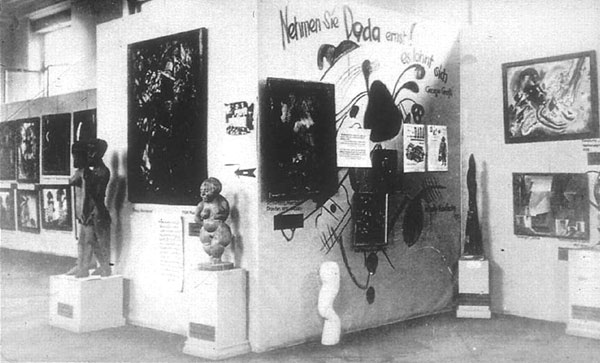
There is a notion of how diversity is good in art. The Degenerate Art exhibition in Munich in 1937 had a wide diversity of art. The Nazis believed that a disjointed show would illustrate inferior art, and result in a decrying of modern and postmodern art, helping their propaganda machine.
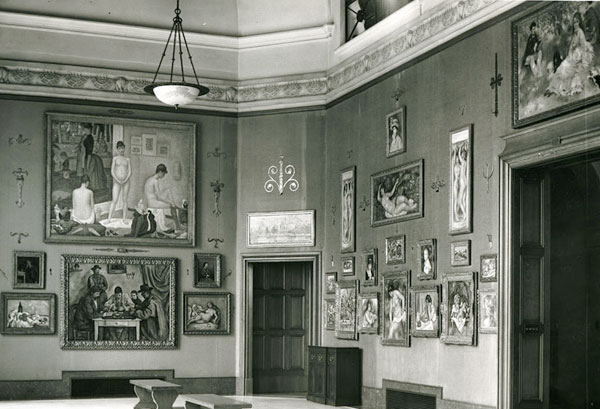
People loved it. Germans were able to see paintings like never before and liked the interactions next to each other. Disjointed art creates new conceptual meanings for the pieces. Keep in mind that simply which way a Georgia O’Keefe painting is hanged changes the meaning. The Barnes Foundation has a similar exhibition of art:
If you’re into art, you need to see the documentary Art of the Steal. Yes, it’s on Netflix.
These venues seem to agree with Bo King’s assertion that variety is a wise investment for quality art, but illustrations are not museum artworks. Few illustrations will be grouped together, making each individual piece a representation of the whole. If you see one card from the Scars of Mirrodin block, it has to inform a new player, a tournament player, and in drafts what the card is and what set it’s from—nearly instantly. By having a greater variety, it’s harder to tell. Can a new player differentiate Legends art from Unlimited art? Highly doubtful.
Variety is not the spice of life in a business. WotC’s purpose is to make money. It is not to push the medium forward; it’s not to keep players happy. It is to make money.
Art aids the selling of products, but must conform to how a depiction will resonate with players (brand) in campaigns (marketing) and analyze the results, only to repeat it all again. This may be cynical, and both artists and art directors strive for excellence (you see the Spectrum this year? #winning), but a large, diversified set is not only impractical, it’s almost impossible.
Self-Selection
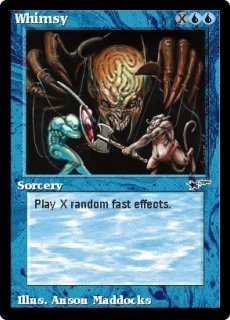
For artists to get noticed from art directors, they often create derivative depictions to prove that they can create in the style of the brand. (This is despite the piles of NC-17 art that can be submitted to art annuals or housed in a portfolio.) Art directors must choose artists that can fit into the aesthetics of the brand while moving the brand forward. Whimsy is largely omitted.
Successful brands must use artists who can conform to their style guides, to further their efforts in world-building through uniform depictions and flavor of art. Yes, Beebles are fun, and I love them too, but having an illustration that deviates too far from the purpose of the commission or a conveyance of the card’s mechanics is unprofessional. The artist will likely not receive a phone call or e-mail to return for more illustrations. The talent pool is so large at major companies that being selective is possible, and those who wish to play ball don’t sit on the bench.
Emotional Connection
Artworks are conversations, and artists act as facilitators that guide you to the message they are trying to convey with you. On occasion, things are straightforward or lack a deeper meaning, such as still lifes or school photography, but the arts largely have some deeper or significant meaning.
Bo is correct in questioning the emotional disconnect in commissioned work, but glosses over that illustrations have always had difficulties in approaching the transcendent.
Art is a conversation, and an illustration’s purpose is set—not up to the artist.
Constraints are a necessity, because not all artists know every Magic character, storyline, or even fantasy elements found in Dungeons & Dragons. This is where style guides come in to illuminate the artist and guide him or her to be successful in creating the depiction. Each artwork shouldn’t take two years, and be transformative and conceptually brilliant; art directors simply don’t have that sort of time. They would love to have pieces of quality that moving but are often on deadline more often than not.
Imagine a Magic card’s art label. What would it say? Is it to convey restlessness with life, or a comment on mortality using an anime setting, thereby summoning iconographic elements of Japanese artistic cultural capital?
Nope. It’s a depiction that illustrates the card, which creates cohesion and serves a role in promoting the product. When you see an art depiction and want zebras, there are physical constraints that will only get horses . . . with the occasional zebra or Icelandic horse.
Let’s use an example to illustrate how the game is moving forward with emotional resonance.
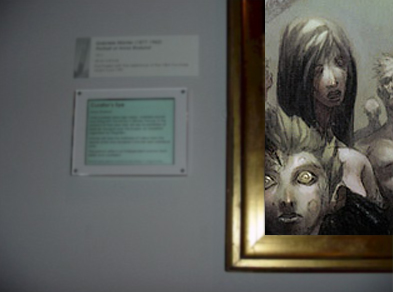
This product could not easily be sold in 2011. It lacks polish and professionalism demanded in the gaming field. Also, the art is more or less lifted from comics. Copyright issues must be avoided whenever possible.
">"/>">">"/>"/>
This depiction on a card could be sold today. It wouldn’t be on a booster pack, but it could work. The background should be integrated more as something important more than simply what forcefield is holding.
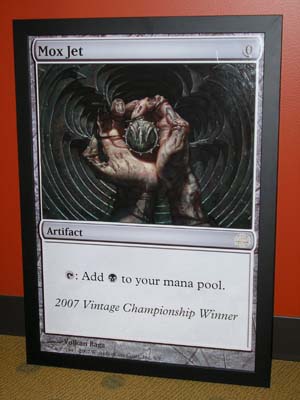
This piece could be on every promotional piece for the set, and it would work. The hands alone tell a story. It makes one think of Vecna almost, no? This transcends the card and the frame itself. Is it on the level of Matisse? I’m not sure yet.
Final Thoughts
What Bo King was asking without knowing is how artists can affect the customer experience. It’s actually a goal of Jon Schindehette, the senior art director on the D&D side. Classical art may be better or worse as an subjective opinion, but the brand needs to be consistent, and art directors need to be ever vigilant of consumers’ changing tastes over time.
It is the same for fantasy art as it is for fashion. There are vogues. In fashion, the most popular designers often make the vogues, but there also exist other influences.
It was a great jump-off point for a discussion, or simply the second-best troll depiction this year.



 Locations