


 Locations



Secrets of Strixhaven is finally here and it is looking extremely powerful. Not only are there obviously impactful cards across all rarities, but they range from small, core spells to major, bombastic pieces.
The Prepared mechanic is receiving the majority of the shine from the set. This should come as little surprise to many. Who wouldn't love getting to cast Ancestral Recall, Lightning Bolt, or Swords to Plowshares in Standard?
Personally, though, I'm far more interested in the unique one-off cycle of Mythic Rare cards from the set that all bear another all-new mechanic: Paradigm.
What Is Paradigm?

Paradigm is an all-new mechanic that appears on a cycle of five Mythic Rare spells. Every one is a Sorcery and is also a Lesson, acting as the only Lessons in the set. This way they represent a final presentation, project, etc. to showcase their mastery of what they learned during their time at Strixhaven.
Paradigm works as such, slightly adjusted from the reminder text on the cards:
What this means is that every turn for the rest of the game, you get to cast these mighty spells over and over again. The caveat is that if you have two copies of one spell in exile - let's use Improvisation Capstone as an example - you can only cast a copy of one of them each turn. Doubling up simply isn't allowed.
But wait, doesn't it feel like we've seen this somewhere before?
An Epic Misstep
If you've been playing for a long time, the Paradigm mechanic might seem a little bit familiar to you. I know it did for me, as someone who drafted quite a bit of Saviors of Kamigawa in high school.
The set was famous for a myriad of classic missteps, from the low powered designs to the questionable mechanics. All of which capped off an infamously weak and mechanically rough block.
Saviors made things far worse, though, with mechanics like Sweep and the "Wisdom" (hand size matters) debuting in the set. Just as notably awful, though, was the cycle of spells with the Epic mechanic on them.
 |  | 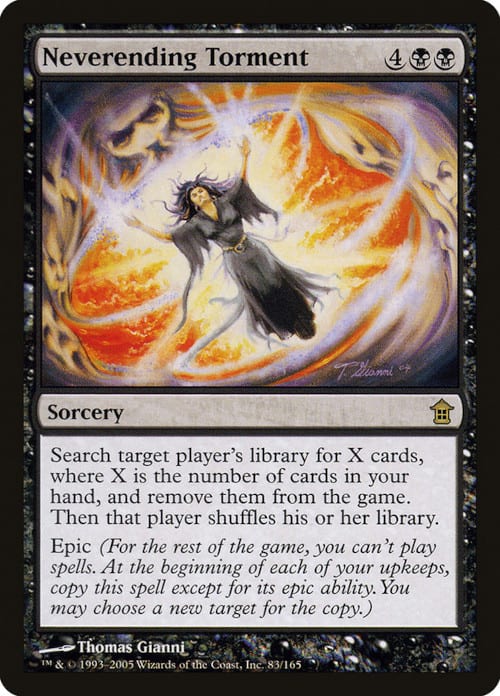 |  |  |
Each of these spells was meant to be bombastic, allowing you to cast a devastatingly powerful effect turn after turn. Once you cast the spell, it would create a copy of it at the beginning of your Upkeep every turn for the rest of the game. Pretty sweet, right?
Well, there was a catch: you would then be unable to cast spells for the remainder of the game. Yikes!
The drawback was so intense that it led to this cycle of cards going largely unplayed, with Epic being cited as one of Mark Rosewater's worst mechanics of all time. They weren't without their fans, though, as Enduring Ideal famously had a bit of a tournament resume by finding powerful Enchantments that could lock an opponent out of the game.
Enduring Ideal | Extended (2007) | Andre Mueller, 2nd Place Pro Tour Valencia
- Instants (8)
- 4 Orim's Chant
- 4 Seething Song
- Sorceries (7)
- 3 Enduring Ideal
- 4 Burning Wish
- Enchantments (10)
- 1 Honden of Seeing Winds
- 1 Pernicious Deed
- 2 Dovescape
- 3 Form of the Dragon
- 3 Solitary Confinement
- Artifacts (12)
- 4 Lotus Bloom
- 4 Pentad Prism
- 4 Sensei's Divining Top
- Lands (23)
- 1 Plains
- 1 Godless Shrine
- 1 Mikokoro, Center of the Sea
- 3 Flooded Strand
- 3 Sacred Foundry
- 3 Sulfur Vent
- 3 Windswept Heath
- 4 Ancient Spring
- 4 Tinder Farm
- Sideboard (15)
- 1 Cranial Extraction
- 1 Enduring Ideal
- 1 Morningtide
- 1 Pyroclasm
- 1 Vindicate
- 3 Boseiju, Who Shelters All
- 3 Tormod's Crypt
- 4 Leyline of the Void
Andre Mueller took the deck to a second place finish in the Extended Pro Tour at Valencia in 2007, losing to Remi Fortier's CounterTop Goyf list. The deck would see infrequent results across a handful of other major events into 2008, but would largely fade into obscurity as time went on.
Nowadays, only the most die-hard fans are willing to cast these spells. For your average player, however, it's just too much.
Instead, Paradigm is made to do what Epic set out to do but without the back breaking drawback the original mechanic featured.
The Five Paradigm Cards
Now that we've set up what Paradigm looks like as well as some of the history behind it, let's check out the individual cards.
Restoration Seminar
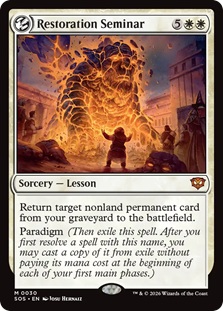 | 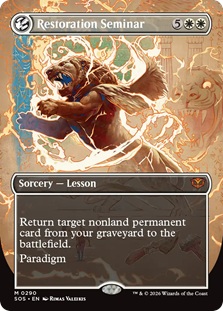 |
The first Paradigm card is Restoration Seminar.
This card represents the Lorehold and their uncanny ability to dig up the past and get stuff back from the Graveyard. Here, you're able to return a nonland permanent back to the battlefield every turn. That's extremely powerful, as it can allow you to cheat on mana and get something big turn after turn.
Your natural inclination will no doubt be to grab some big Creatures with this. Cards like Atraxa, Grand Unifier and Archon of Cruelty are the types that you'd love to put into the Graveyard and get back.
What about big Artifacts and Enchantments, though? Imagine pulling a Darksteel Forge out of your graveyard or a Primeval Bounty. Heck, I remember back during Mirrodin Standard when an opponent would use Bringer of the White Dawn to repeatedly buy back Mindslaver turn after turn to beat me. You can do just that with Restoration Seminar as well, should you feel so inclined to do so.
Amazingly, this also brings back Planeswalker cards as well. That might not seem like much as most Planeswalker cards aren't big enough to seem worthwhile to bring back. However, in games of Commander especially, Planeswalkers tend to be removed rather quickly. As such, this can provide you the means to repeatedly make use of them turn after turn.
Echocasting Symposium
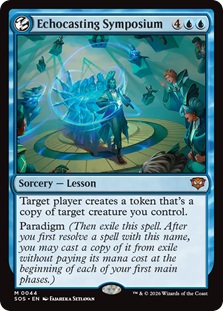 | 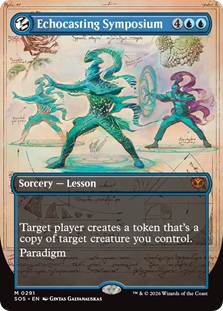 |
When I first saw Echocasting Symposium, I was reminded of two classic cards.
The first was Progenitor Mimic, a Creature that would enter as a copy of another Creature and create new copies turn after turn. The other was Followed Footsteps, an Aura which would do much the same by continually copying the Creature it was enchanting.
With each of those, you ultimately rely on your original Creature not dying, be it the Progenitor Mimic or the one enchanted by Followed Footsteps. Now, Echocasting Symposium offers you the chance to do it continually without relying on a single Creature. Instead, it copies itself every turn but lets you choose a different Creature each time.
In games of Commander, it can even act as an interesting political tool. This is because it requires you to target the player who makes the token copy of one of your Creatures. As such, if you want to form an alliance with someone at the table, you can give them something to stay alive and fight. Or perhaps you can do something cruel and give them a Creature which will instead actively harm them.
The choice is yours for how you wish to apply this card, so be sure to use it wisely.
Decorum Dissertation
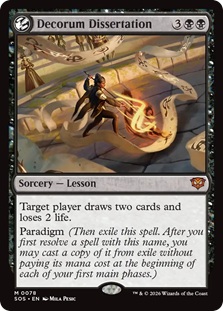 | 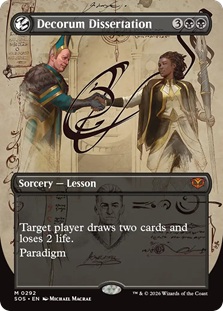 |
Decorum Dissertation is quite possibly the most elegantly powerful of the five Paradigm cards.
At first, it doesn't seem like much. Five mana is a lot for a Sign in Blood, but it's a bargain when it happens every single turn. Once you've drawn six, eight, and ten cards over time, you'll find that it's worth both every bit of mana and every point of life spent to fuel the spell.
The downside is that you naturally need to manage your life total. If you get too greedy with how many cards you draw, you can ultimately die from it, either from the life loss or from your opponent chipping away at your final life points. However, if you run Decorum Dissertation in a deck that's also packing life gain abilities in some form or fashion, then you can continually use it rather deep into the game.
Thanks to how Paradigm works, though, you can control just how far you want to go. You don't need to copy the spell every turn if you don't want to, so if your life goes too low, simply stop casting new copies until you can replenish your life.
Alternatively, you can also use the secret mode of the card if the game hits a point where it becomes relevant: targeting your opponents. Sometimes forcing your opponent to draw cards and/or losing life can be the action that seals your victory. Even if it may give them some options, who cares when you're ultimately the one coming out on top?
Improvisation Capstone
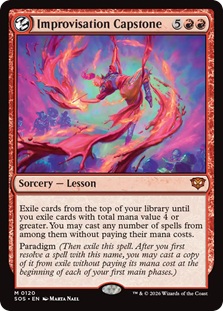 | 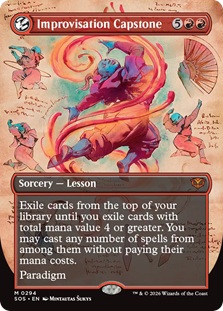 |
The first Paradigm card revealed, Improvisation Capstone, is quite possibly the most bombastic of the bunch. That's certainly fitting of a card clearly aimed at representing the Prismari school of artistic magic.
Casting Improvisation Capstone not only allows you to cast spells, but it can even provide a means of cheating on mana. For example, let's say you cast this in a game of Commander. You then - hypothetically - flip over a Sol Ring, an Arcane Signet, and an Ulamog, the Ceaseless Hunger. You get to cast all of them!
Just because you hit the four mana cap on the spell, that doesn't mean you're only limited to casting 4 mana's worth of spells. Instead, you can cast everything, including the huge threat that you pulled out in the process. Better still, you can do it turn after turn, drowning your opponents in major threats as you do.
There is one small catch to casting the spells you hit, though. You must cast them as part of the resolution of Improvisation Capstone. This isn't like many other effects which allow you to cast them until the end of your turn. You either cast them right then and there or you lose them for good.
Still, that shouldn't matter too much. Unless you find a Counterspell or a board wipe you don't want to use at the moment, you'll be hard pressed to find a spell that you're unwilling to cast.
Germination Practicum
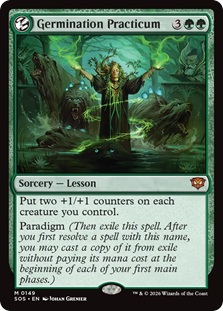 | 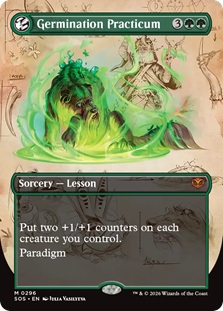 |
Germination Practicum is perhaps the most innocuous of the Paradigm spells.
Decorum Dissertation aside, the other spells each offer a big, flashy effect turn after turn. By comparison, Germination Practicum just distributes a bunch of +1/+1 counters. Thankfully, that can be plenty enough on its own.
A great example of this is Ouroboroid, a popular Green Creature card that was making a pretty big splash in Standard over the past year. It wouldn't be long before it also started showing up a bit in other formats as well, including Pioneer and Commander.
At its core, Ouroboroid is much the same thing. It distributes one counter on the first turn, two on the second, four on the fifth, and so on. Even just two turns on the battlefield can be enough to dominate any game it's played in, though, despite the exponential possibilities. It has one weakness, however: removal.
Germination Practicum lacks the exponential possibilities of Ouroboroid. Instead, it makes up for it by offering a spell that's hard to interact with turn after turn that can crush opponents in only a few turns, growing ever more intense the longer the game goes.
Conclusion
It's honestly unbelievable that Wizards was willing to take another stab at this type of mechanic.
Epic was a massive flop when it first came out with Saviors of Kamigawa. Despite the uniqueness of it, the drawback was far too intense. However, if you didn't have a drawback like that, couldn't these kind of cards be a bit too good?
As it happens, it looks like Studio X found the sweet spot with Paradigm. None of these cards seem too overpowered on their own. Both Decorum Dissertation and Germination Practicum are cheap enough that they'll get on some players' nerves, but they're modest enough to feel like things that we've already seen plenty in the past.
Each of the other three are too expensive to make work in your average game of Constructed. As such, they'll be at their best in games of Commander, but that's not saying much in a format already defined by huge, bombastic spells. That makes them all the more fun without feeling too terribly oppressive. Even if they do by the end game, though, then all that means is they're reaching Craterhoof Behemoth territory, which is perfectly fine.
All this is to say that Paradigm looks like an outstanding mechanic. We're still just coming off of the initial release of Secrets of Strixhaven, though, so time will tell if it's just fine or if it's somehow broken clean in half.
All I know is that I for one can't wait to cast these spells again and again.
Paige Smith
Bluesky: https://bsky.app/profile/themaverickgirl.bsky.social
Twitch: twitch.tv/themaverickgirl
YouTube: TheMaverickGal