

 Locations



Every now and then, Magic: The Gathering likes to get silly. This can bleed through on the normal cards, be it in the name, the art, or the flavor text.
Every now and then, though, it leans in all the way with the Un-sets. These are traditionally sets with a silver (or gray) border, though would eventually change to be represented with an acorn holo stamp instead.
All of these started with Unglued, the little set that could, all the way back in 1998. Many of the Un-sets have had rocky histories, with Unhinged and Unfinity being massive flops. The latter resulted in sweeping format bans and uncertainty about what the future holds for Un-sets.
Rather than looking to the future, though, I'd like to go back to 1998 and look at the first of these sets: Unglued.
How I Learned to Stop Worrying & Love Silver Borders
Regular readers will know that I love to talk about stories from my first years playing Magic. I've talked about how my cousin taught my sister and I to play, how my first packs were of Urza's Legacy and Starter 1999, and how my friend Zack introduced me to the might of the Elder Dragon Legends.
What I don't talk about nearly as much, though, is just how impactful Unglued was to me as a kid.
It was really a "right time, right place" sort of thing for me. As I was picking the game up in 1999, I played Magic super casually, only getting in the occasional game with my sister, my cousins, or the rare friend. As a preteen living on cartoons from television networks like Nickelodeon, Cartoon Network, Kids WB, and Fox Kids, I was the perfect audience for such a set.
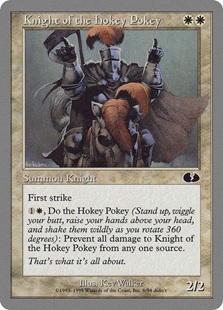 | 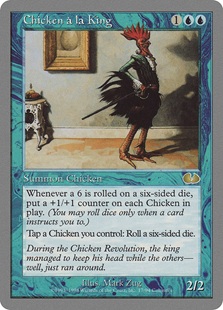 | 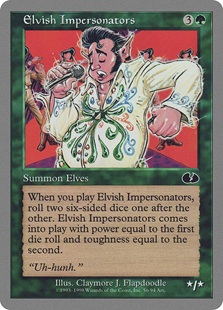 |
Lucky for me, the first card shop I went to frequently as a kid - a small store in a bowling alley called B&L Sports Cards - had plenty of Unglued. Not only did they have tons of packs, but they had a binder stuffed with singles that I'd frequently buy random singles out of as they caught my eye.
I can't tell you how much I loved trying to make Chicken a la King work, or how I'd use cards like Elvish Impersonators and Growth Spurt to get a big Creature. If I wanted to put a big Creature into play, like one of the aforementioned Elder Dragon Legends, I'd happily break out Timmy, Power Gamer.
And boy did I end many games with my sister when I'd slam an Incoming! onto the table.
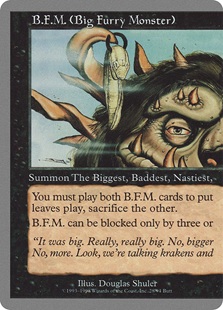 | 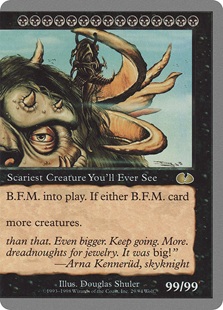 |
I'll never forget when Zack would go on to blow my mind once again when he showed me B.F.M. (Big Furry Monster). The card is simply unbelievable and has a serious wow factor the first time you see it in person, offering the experience of a massive card that requires two halves to play.
All of this is to say that I absolutely adore Unglued. It made the games I played in my earliest days a blast of silly goodness that mixed in perfectly alongside the more typical cards. As such, I'm stoked to jump in and take a look at what makes this set so awesome.
Unglued Essential Info
Before I start talking about the things that Unglued such a cool set, let's talk about a few core bits of information for it. This time around it's a little different as there are far fewer elements to talk about.
The set had only one designer and one developer: Mark Rosewater. He was plugged for the set by Bill Rose and Joel Mick to create a non-tournament legal set as an experiment. Not only was Mark known for being an "out-of-the-box" designer, as he put it, but he also comes from a background in comedy before his time with Magic.
The set came out on August 11, 1998 and featured 83 silver-bordered cards, five black-bordered full-art Basic Lands, and six tokens.
The silver borders were meant as a way to denote the fact that they weren't tournament legal. At one point previously in Magic's history, gray borders were attempted in place of white borders, so this technology likely evolved from that.
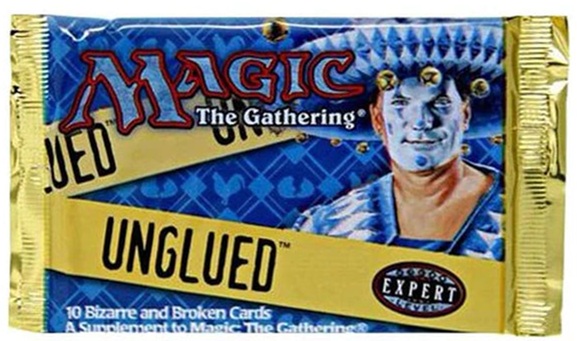
The set was released in 10-card Booster Packs that included six Commons, two Uncommons, one Rare, and one Basic Land. Tokens would sometimes appear in the Uncommon slot of select boosters, replacing an Uncommon card. Each of these packs featured the art of Jester's Sombrero.
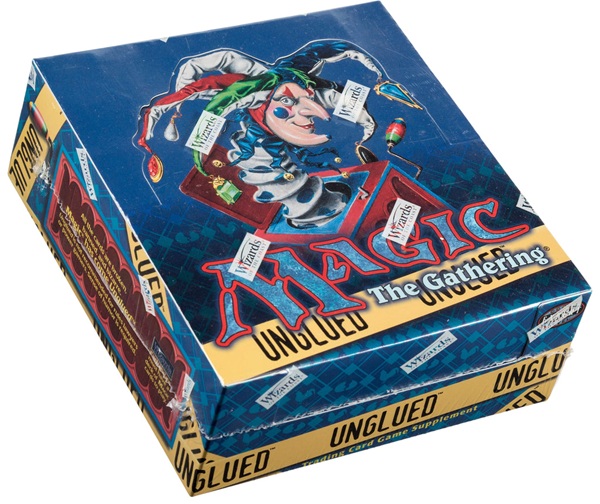
Booster Boxes were unusually designed, coming in tall square shaped boxes as opposed to the usual rectangular shape. They featured a large image of Jack-in-the-Mox to help the packaging stand out and contained 48 Booster Packs inside.
What Made Unglued So Unique?
Unglued took a lot of what made Magic cool and went extremely out of the box with it. Nowadays, we may take many of these things for granted, but at the time, they were quite novel.
Watermarks
A great example of this was the introduction of watermarks. We know these quite well nowadays, but they first showed up here in Unglued.
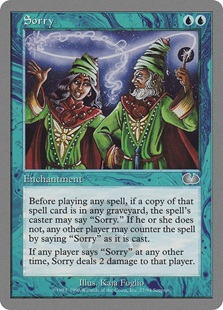 | 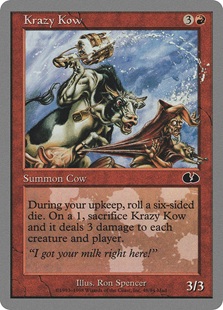 | 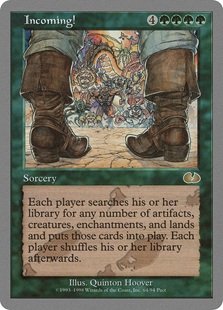 |
Some of these were more traditional examples we know today, like the frowning face in the textbox of Sorry. Others were more unique, with cards like Krazy Kow and Incoming! showing off a pattern taking up the majority of the text box.
Ever since Ravnica: City of Guilds and some promo releases from a few years prior, watermarks have become a mainstay of Magic releases. Settings like Tarkir and Strixhaven might not be anywhere near the same without this foundational element showing up here first.
Breaking the Card Frame
In addition to watermarks, many cards played around with the card frames themselves. While true for watermarks as well, playing with the card frame provided a unique challenge to see just what the printers could handle in the creation of cards.
 | 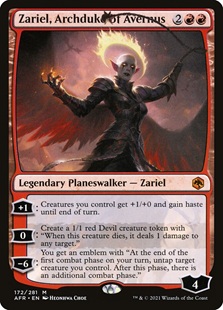 |
Several of these are fairly subtle in their application, having the art peek outside of the art box and into the card frame. We see this in just about every set these days, as this approach would be used for Planeswalkers following their introduction in Lorwyn. Almost every one of them slightly breaks the card frame, with only a handful that don't (Domri Rade, for example).
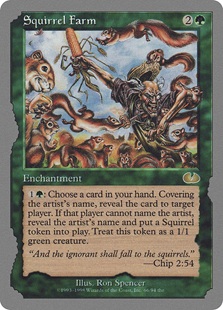 | 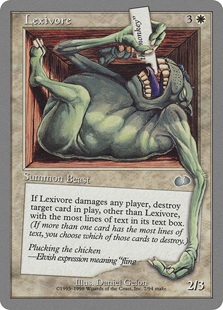 | 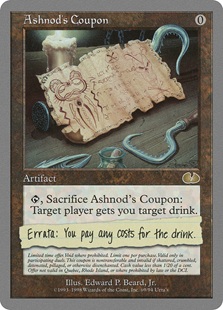 |
Other cards did way more with this concept. Squirrel Farm quite literally destroys the frame, taking out big chunks of it to indicate the Squirrels who are munching on it. Lexivore combines this with the art break, having the Creature's arm extend across the frame. Other cards like Cardboard Carapace, Ashnod's Coupon, and Once More with Feeling have big mocked up stickers on them.
An Inspirational Masterpiece
The most interesting thing about Unglued is the profound impact that it had on future card designs. Many concepts from this set would eventually make their way to black bordered sets, either in a roughly one-to-one capacity or else influencing future elements of the game.
Essential Game Pieces
Some of these are more obvious than others. After all, some of them are things that we see in quite literally every Magic release today.
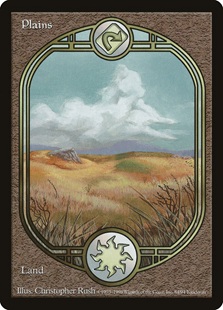 | 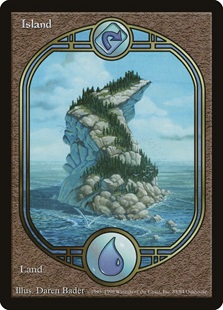 | 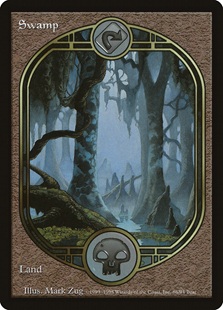 | 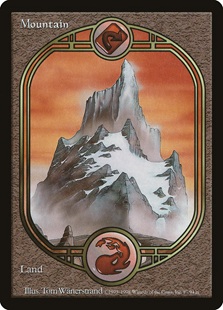 | 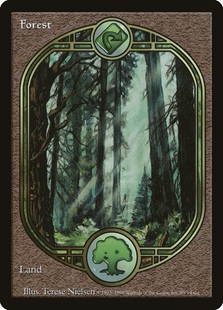 |
The biggest of these are the five full-art Basic Land cards. These were derived from a concept pushed by artist Christopher Rush and given the chance to shine here thanks to Mark Rosewater.
Full-Art Basics would continue to be a staple of every Un-set from here on, but eventually found their way into other sets as well. They appeared in Zendikar and the two Battle for Zendikar block sets, followed eventually by infrequent appearances in sets like Theros: Beyond Death and Kaldheim.
Ever since Innistrad: Midnight Hunt in 2021, we now see these in every major Standard release and many supplemental releases. The only sets to not feature full-art Basic Lands included ones with retro frames instead, usually in Remastered or Masters releases.
 |  |  |
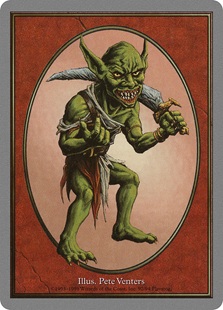 | 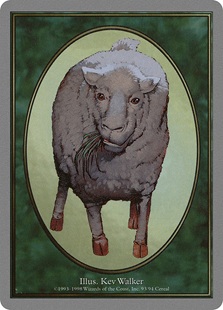 | 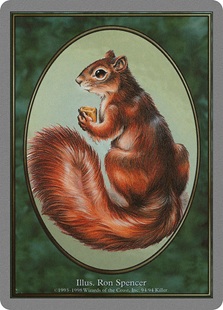 |
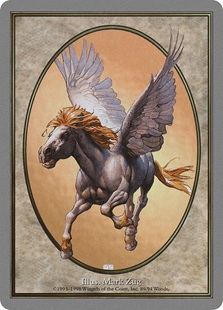
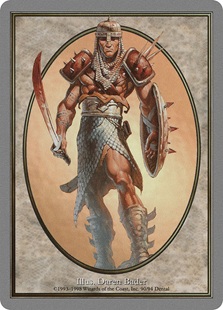
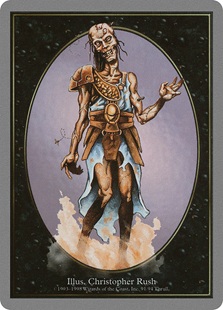
The set was also the first to feature tokens. Tokens were starting to become more common as the years went on and players didn't have a good way to represent them at the time. As such, they made their initial appearance here.
Each of these reflected a card that made these kinds of tokens that was somewhat popular at the time. Here are some examples for each:
- Pegasus Token: Sacred Mesa, Pegasus Refuge, and soon Pegasus Stampede
- Soldier Token: Kjeldoran Outpost
- Zombie Token: Feast or Famine, Sarcomancy
- Goblin Token: Goblin Warrens, Mogg Infestation
- Sheep Token: Ovinomancer, Flock of Rabid Sheep
- Squirrel Token: Liege of the Hollows, Squirrel Farm, and soon Deranged Hermit
Tokens would later be given out as Player Rewards promos as players would attend local events. Starting with Lorwyn, all Booster Packs would start to have tokens included in them, though initially they were infrequently replaced with ad cards and game helpers.
Today, every set has them, and they're frequently innovated on. Not only do we get tokens, but also checklist/blank cards and punch cards to provide game aids to players of all levels.
Direct Inspirations
Several cards from Unglued would also go on to serve as the basis for real cards that would make their way into black bordered sets.
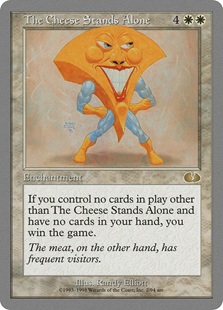 | 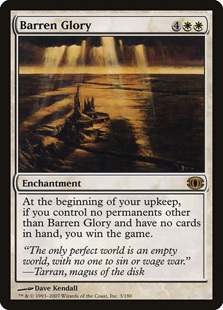 |
One of the most famous examples of this is The Cheese Stands Alone. This card was so close to being viable in black border that it was almost included in Eighth Edition - a set that featured one card from every set in Magic up to that point.
The team couldn't make it work and scrapped the idea, though they'd eventually succeed in making it work... sort of. Barren Glory was printed in Future Sight a few years after Eighth Edition. This card lacks the silliness of The Cheese Stands Alone but otherwise largely works the same way. The only mechanical difference between them is that Barren Glory checks on your upkeep as opposed to any time.
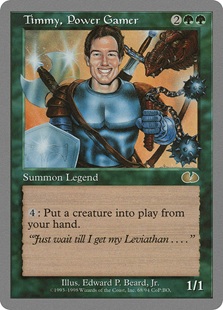
Another big one is Timmy, Power Gamer. This card allowed players to freely cheat big Creature cards into play with ease - something that we see quite often on Green cards nowadays. As of writing, cards like Sledge-Class Seedship, Smuggler's Surprise, and Michelangelo, Improviser all do exactly this.
Believe it or not, though, it would inspire several designs shortly after its release.
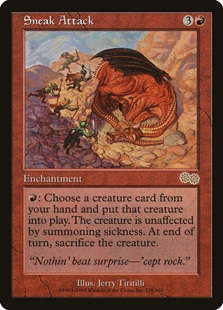 |  |  |
Just after Unglued released, the Urza block came out. Every one of these sets had ways to cheat Creatures into play mechanically. Sneak Attack - and its Sorcery sibling Show and Tell - made its first appearance here, allowing you to cheat multiple big Creatures into play for just one mana.
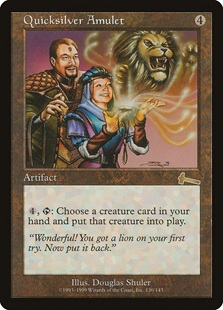
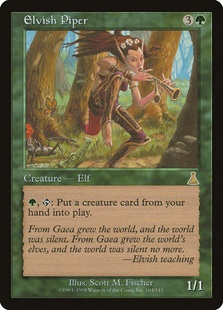
Much more in spirit of Timmy, Power Gamer were the cards that followed it, though. Quicksilver Amulet showed up in Urza's Legacy as an Artifact with the same activation cost, but gated with a tap activation. Elvish Piper would then show up in Urza's Destiny with an even cheaper cost, offset by the card's weak stats and tap ability.
Each of these would go on to become Casual darlings that would continue to inspire designs for years to come.
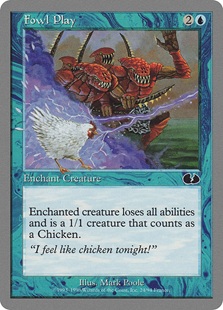 |
One other card I'd like to highlight is Fowl Play. This silly little card turned a Creature into a simple Chicken with no abilities.
I loved this card when I was a kid, though I couldn't tell you why. Perhaps it was the absurdity of it all, or maybe it was just the fact that it provided some solid removal Blue didn't often get in this era of play.
Eventually, though, it would become something that we'd see quite often.
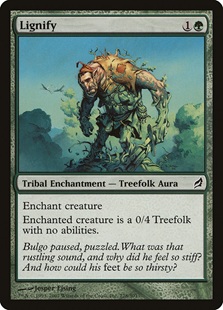 | 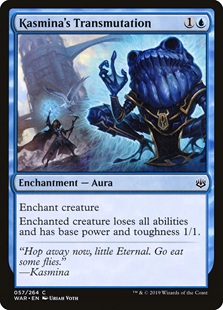 | 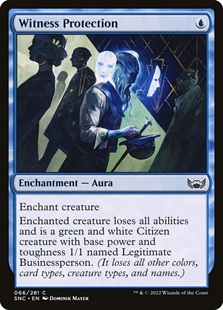 |
The card would inspire designs like Lignify and later Kasmina's Transmutation. Soon after the latter was printed in War of the Spark we'd see these all over the place with standouts including Frogify and Witness Protection.
Nowadays these are staple Limited effects that show up in just about every set. Spider-Man No More, Honest Work, Noggle the Mind, and Retro-Mutation are all great recent examples of this, showing how versatile it is to tweak from setting to setting.
A Mechanical Influence
In addition to direct riffs, some cards offered an influence in overall card mechanics.
Some of these are fairly obvious. For example, dice rolling was a silver-bordered only thing for years starting with Unglued. This would continue into every Un-set release afterward, with the exception of Unhinged.
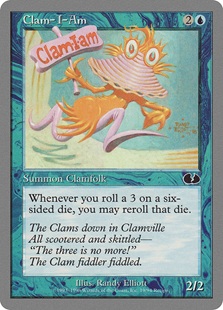 | 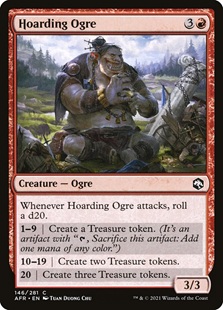 |
Eventually, this would come to black-bordered sets with Dungeons & Dragons: Adventures in the Forgotten Realms. After all, Dungeons & Dragons is well known for its dice rolling element, so it seems like a natural inclusion that, with proper balancing, could work great in black border.
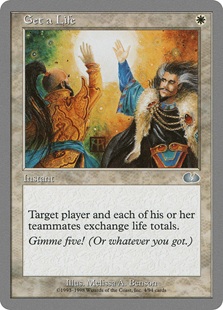 | 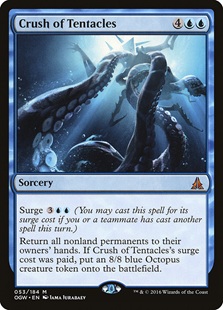 | 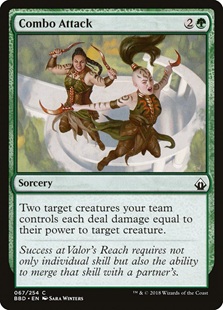 |
Unglued also boasted a cycle of cards that card about teammates for the first time in Magic. For many years, only one other card cared about teammates, with the term appearing on Imperial Mask in Future Sight.
This would go on later to appear as one of the cost reduction conditions for the Surge mechanic in Oath of the Gatewatch. Battlebond, a set dedicated to Two-Headed Giant, would also use the concept on several cards.
 |  |
Sometimes the mechanics wouldn't easily convert over whole cloth. Instead, they would be derived from individual Unglued designs that would turn the concept behind the cards and turn them into overarching mechanics.
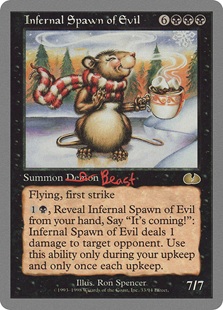
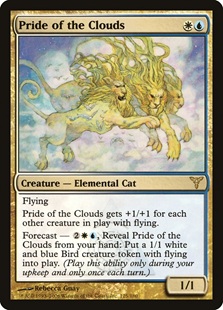
Take Infernal Spawn of Evil for example. This card would let you reveal it from your hand to do a small effect once per turn on your Upkeep. Later, in Dissension, this would inspire the Azorius mechanic Forecast. R&D weren't comfortable making the mechanic given the repetitive nature of it and would make them all quite weak, though a few managed to show up in tournament play.
| |
Perhaps most notable, though, was the influence of Big Furry Monster. The card was extremely popular, to the point that it was among the most highly rated cards in the set in customer surveys.
This led to Magic designer Ken Nagle to be inspired to try finding ways to make the card work in black-bordered Magic. Initially, he attempted to do something like it with a mechanic called "Link" in New Phyrexia. When that didn't work, they fell back onto Phyrexian Mana.
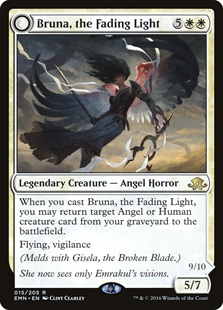 | 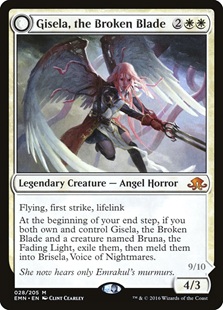 | 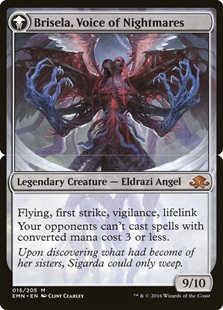 |
It wouldn't be until Eldritch Moon several years later where they would finally crack the code. With this set came Meld, a mechanic that allowed players to combine two cards and turn them into one card using Double-Faced Card technology. Only three Meld cards were made in the set, using six front-side cards.
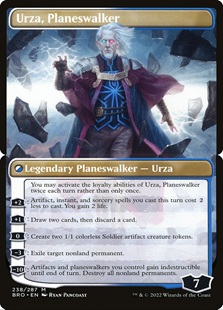 | 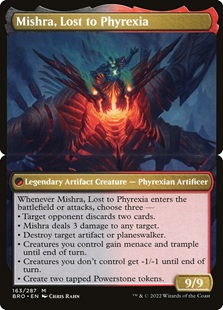 | 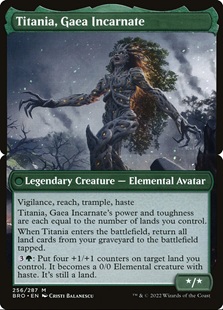 |
The mechanic would eventually make a brief return in The Brothers' War to show the final story moments of Urza, Mishra, and Titania. Perhaps most notably, this allowed Wizards to finally create an Urza Planeswalker card, and one that proved fittingly epic.
Weird Facts
It wouldn't be a fun retrospective piece without talking about some of the odd tidbits of a set. That's doubly true for a set like Unglued that's packed to the gills with silly elements.
The Hidden Message
Every card in Unglued - including the tokens and Basic Lands - have a single card randomly included at the bottom of the card beside the collector number. When lined up in order, they create a message. That message - adjusted for the purposes of visibility - reads as follows:
- Socks of Garfield
- Hot Monkey Love
- Colonel's Secret Recipe
- Squee's Play
- Banned in France
- Spoon
- Disrobing Scepter
- Bull Wolf
- Lotus Roach
- Sesame Efreet
- Needless Reminder Text
- Chicken Choker
- Clockwork Doppelganger
- Henway
- HELP I'M TRAPPED IN CARTA MUNDI
- Mad Cow
- Poke
- Lord of Wombats
- Gratuitous Babe Art
- Brothers' War Bonds
- Dwarven Kickboxer
- Mickey's Drunk
- Pact with the Wastes
- CoP:BO
- Urza's Chia Pet
- Thallid Shooter
- Shoelace
- When Chihuahuas Attack
- Wall of Cookies
- Kobold Ninja
- Mucusaur
- Kjeldoran Outhouse
- Bear in the Woods
- Dental Thrull
- Flavatog
- Cereal Killer
One of the cards mentioned in the above list - Mad Cow - was the original name for Krazy Kow. The name was changed due to the then-recent outbreak of the so-called "Mad Cow Disease."
Unglued 2: The Obligatory Sequel
While we would eventually see the release of other Un-sets like Unhinged, Unstable, and Unfinity, there was one which pre-dated them all.
Unglued 2: The Obligatory Sequel was originally slated to be the second Un-set soon after the release of Unglued. The set was so far along in development that it had numerous completed art pieces and concepts that we know about.
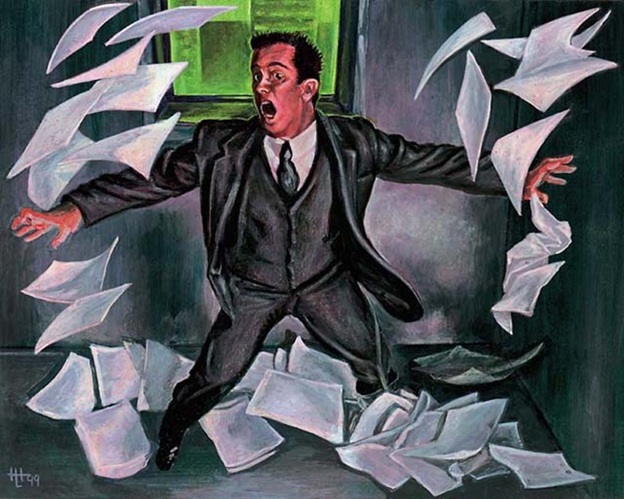
These included things like anthropomorphic vegetables that gave poison counters, scratch-off cards, and voting.
Mark has even shared numerous art pieces and card design ideas left on the cutting room floor from this set, like the above art from the famous Bob from Accounting commercial. Many of these would eventually be shared in an article titled "Un-Seen" in 2013.
 |
Several art pieces and concepts would go on to appear in other sets, both black-bordered and silver-bordered.
Atogatog is a great example of this, playing into the concept of a five-color Atog that ate other Atogs. This would show up in Odyssey thanks to the set also featuring a cycle of allied-color Atog cards.
Barrin's Unmaking and Artificial Evolution were noted as being examples of cards riffing off of ideas that were originally slated for Unglued 2.
And, of course, Split Cards were originally meant to appear here, continuing Unglued's experimentation with card frames. When the set was scrapped, they were utilized in Invasion block where they became a smash success.
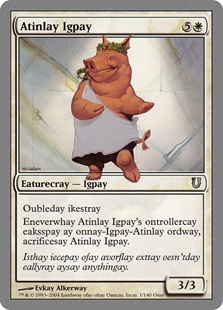 | 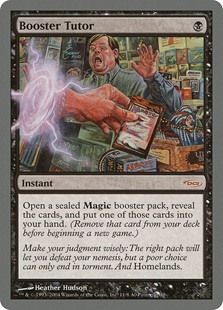 | 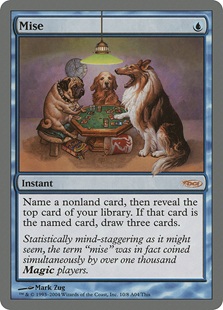 |
Many of these original arts and concepts would go on to influence elements primarily seen in Unhinged. Some cards lifted the art directly from Unglued 2. Others, like Booster Tutor, Granny's Payback, and Goblin Mime instead got new art, but the older Unglued 2 art was repurposed for a handful of Arena League promos. Mise, in particular, uses an art that was originally meant to be the box art for Unglued 2.
A Silly Costume
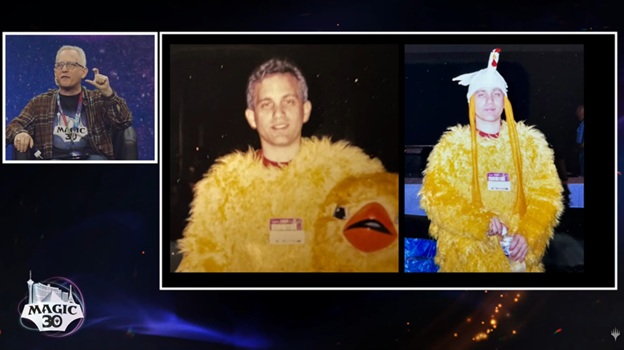
Mark Rosewater, the sole designer and developer of Unglued, head judged the Unglued prerelease at GenCon 1998 with a bit of a twist.
As you can probably tell in the image above, he did so in a chicken suit. This was done to play up the set's minor theme of Chickens being a Creature type focus while also playing into the humorous nature of Unglued.
Mark has also since revealed that he got sick due to the dusty nature of the suit, coming down with pneumonia. In spite of this, he would go on to make a tradition out of this, dressing as a donkey for Unhinged, a squirrel for the LoadingReadyRun Unstable Pre-Prerelease, and for the Unfinity reveal he dressed as an astronaut.
He would reprise the chicken suit once again at the Magic 30 convention in Las Vegas. The above image was taken from a talk he gave at that same event.
Conclusion
It's really difficult to overstate just how impactful Unglued was as a set. It's a release that tried to find new and inventive ways to push the boundaries of what Magic could do. In many ways, it would take the things learned about here and iterate on them in future black-bordered sets.
This would go on to be a common theme among many Un-sets in the future. Several cards and mechanics can trace their lineage back to elements of Unhinged and Unstable as well. For example, Mutate from Ikoria: Lair of Behemoths in many ways feels like a riff on the card S.N.O.T. or the Host/Augment mechanic in Unstable.
Without Unglued happening first, we might not have these innovations now. Better still, many of the cards were just oddly goofy fun to play if you let yourself opt in to the experience. Even with some particularly sour notes among the mix (the less said about Ghazban Ogress, the better), there is much joy to be had with this set.
I loved it when I was a kid, first discovering Magic. Even now, I pull out my old copy of Incoming! and think wistfully of the silliness it would create at the kitchen table all those years ago.
Even if these cards look a little too goofy, a bit too silly, give them a try. You never know what you might find you like in a Cube or a Rule Zero game of Commander.
Paige Smith
Bluesky: https://bsky.app/profile/themaverickgirl.bsky.social
Twitch: twitch.tv/themaverickgirl
YouTube: TheMaverickGal