


 Locations



When you're building a Commander deck, the first thing you have to consider is how many Lands you need. A lot players like to shirk this duty, running far too few for what their deck would like to do.
What is the perfect Commander deck Land ratio? Honestly, your curve might not matter as much as you think. Let's get into it.
The Basic, Uninfluenced Math
Rebell Lily has a lovely video going over the basics of the math for how many lands you should run. She focuses on Frank Karsten's booklet on how to consistently hit your land drops and Sam Black's video on Mana in Commander.
Karsten's booklet focuses on this gold ration in relation to 60-card formats. This ratio covers mulligan rules, hitting a Land drop each turn, and likelihood for mana flooding. Lily converted this information seamlessly into a ratio for Commander.
The number she came to, factoring the speed in which a player wins and typical mana curves, was 43 Lands. Yeah. That is a huge number, and that's just the safe number.
She mentioned that the number for the typical strategy of Commander shouldn't drop below 36 and not exceed 46. This number factors in the free mulligan in Commander and drawing on the play.
The Meta of Lands in Commander
One of the points that stuck with me from Lily's video was about the scale of acceleration and play style that is typical in Commander. She relegated ultra low mana curves to cEDH. She doesn't go into detail as to why that is, aside from that it's format that typically features more Aggro or Combo play styles.
I want to go into more detail about that particular point. You might think that running an ultra low curve is all that is necessary to run less Lands, but I don't think it's that simple. Being able to function and "take game actions" with that low a curve is one thing. It's another thing entirely for your deck to thrive and optimally pursue its gameplan at that curve. You want your deck to be able to perform and win consistently even with a small number of lands.
cEDH decks can win the game with one to two Lands over the course of a turn or two, and those decks are running 23 lands on the low end. cEDH TV had a video on how many Lands you should run in cEDH. He found that the deck with the highest win rate at the time, Kinnan, Bonder Prodigy, ran something around 26-27.
An efficient cEDH deck can get away with running something between 26-30 Lands and still win the game at a lightning pace. I have a hard time thinking that a Bracket 2-4 deck could manage that level of consistency even a few turns later and win with a ratio with 30-34 Lands.
The mana curve of your deck shouldn't be the only criteria we look at when deciding if our decks count as "Low curve," especially when we consider what our opponents are doing.
Higher curve decks are investing heavily in more mana and bigger, more engine-based strategies. Those avenues might outpace whatever your strategy is with only three to six Lands in play over the course of the game, depending on what Bracket you're in.
Consider what you might want to do over the course of eight turns to defeat three other players. Your card to value ratio is important. How much value can you usually get out of a non-cEDH mana curve that low?
The Commander Mulligan Climate
Another concern about mana curve is the community's prevailing sentiment about mulligans. How many mulligans should be allowed? The formal rules for a mulligan in Commander are often ignored or modified to make sure people have fun. In the past, I've written at length about this problem with mulligan rules in Commander.
I might have changed my opinion slightly. Previously, I didn't think mulligans affected the play pattern of your typical Commander game too much. However, when considering a deck that only needs two Lands to win but consistently doesn't get hands with Lands because of their Land count, mulligan rules matter a lot more.
Unlimited, punishment-free mulligans warp our perceptions about how consistent a deck is. That effect is significantly more pronounced the lower our curve is and the thinner our Land base is. Being able to mulligan for free can make players think running less Lands in their deck won't have any consequences. Even being socially limited to five punishment-free mulligans is going to significantly benefit decks with lower curves and fewer lands. It's why the punishment-free mulligan is so taboo in cEDH.
Most tables are friendly about mulligans, which I think is still fine in the grand scheme of things. Friendly, casual games of Commander are about the general enjoyment of everyone involved. So, does having consequence-free mulligans mean you should build your deck any differently? Does a deviation of two to three Lands make that much of a difference thanks to free mulligans?
The Commander Curve Climate
I admit, as an advocate for listening to general Land rules, I usually run about 37 Lands in all of my Commander decks. Even Wizards of the Coast doesn't usually put 43 Lands in the preconstructed decks they print to sell. I'm shirking my duty to promote building good mana bases, but so is everyone else. The current meta of Commander is playing less Lands, which means less consistently hitting your Land drops on your turn down the line.
Every other player in your average game is either getting flooded or mana screwed at a similar enough rate. Players are running somewhere between 33 (yeah, I know) and 38 Lands, averaging around 36 lands according to EDHREC. Reasonably, with strict mulligan rules, they should be in the red or yellow in terms of getting mana screwed. Shouldn't we be building according to that meta?
But you want to win, right? Every bit of the tuning that goes into your deck is about improving your odds or achieving victory. The ratio of Lands to game actions over the course of that game makes a difference in your chances of victory. The same is true with the value of a single card or how much it impacts the board state. Card draw, ramp, and card synergy are all hugely important.
Rebell Lily spoke about some of the ways to cheat the mana curve a little bit to avoid flooding with a lower curve than the perfect 43 Lands. She chose 40 as the number of Lands to work with. This is based on the common curve of cards in Commander decks being around three to four. She lists out the success to failure rate for getting four Lands by turn four.
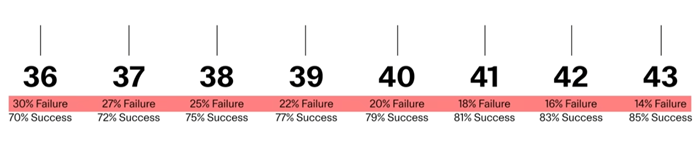
Lily talks about playing cards with Land Cycling, like Lorien Revealed, as replacements for the Lands you should be playing. She also mentions playing Modal Double-Faced Cards (MDFCs) like Disciple of Freyalise // Garden of Freyalise to reduce flooding. You can play the card as a Land early or a spell later when you don't need the Land. She also mentions Cycling Lands which are a land drop early or card draw later.
I worry about this strategy because I think Lands that come into play tapped might be worse for keeping tempo. Running any MDFC might be less synergistic if the card doesn't have good utility or a reasonable mana cost for what it does. You'd want to run something like Sink into Stupor // Soporific Springs, since a rate of three mana to bounce a non-Land permanent or spell is good, and an untapped Land for three life is also reasonable.
I tend to build decks as a filthy, sweaty Bracket 4 player, trying to win by turn five consistently. Tapped Lands just won't cut it trying to play at that speed, but for a more casual deck, Lily's suggestions are the best.
The speed of your deck, the turn by which you're trying to win, and the how much synergy between your cards matters is going to make a huge impact in how many Lands you want to play in your deck.
Conclusion
When considering how many Lands you run, it's clear that 43 is the optimal amount for what most players are trying to do. Lots of Magic experts have agreed upon this, but as a deck becomes more efficient, requiring less mana, the less Lands you'll need.
This change in efficiency must be drastic to deviate too much from the golden number of 43, though. If you've found that your low curve deck does consistently well, consider other factors. What bracket are you playing in? How free are your mulligans? That might be skewing your results. Your result might be influenced by something other than building a deck with a good curve and the appropriate number of Lands.
When building, I'm not suggesting you build toward a bad meta of low Land counts, but the curve and efficiency of your opponents' decks will affect the perception of performance of your deck as well.
Greedier decks might make your slightly less greedy deck seem better than it is. If you switch to pods that are more responsible and have stricter mulligan rules, you might find that you miss your Land drops and fall behind.
There are ways to cheat the number of Lands in your deck, according to Rebell Lily. With Landcycling and MDFCs and some supplemented acceleration in mana with ramp, it's possible to find your Lands more frequently without flooding.
Hopefully I've helped explain the necessity of running more Lands, the number of Lands you should be running, and how to supplement your Lands to avoid flooding.
Until next time, I'm @strixhavendropout on everything.