



 Locations


Welcome to the wonderful world of Duel Commander! If you enjoy cool deckbuilding puzzles featuring niche cards rarely seen in other formats, long grindy games flush with Creatures and interaction, or an underexplored and constantly shifting metagame with each new set release, this might be the format for you!

Whether you're a casual EDH player looking to scratch a more competitive itch while retaining some of the most fun aspects of singleton deckbuilding, a disenfranchised 60 card competitive player looking to try something new, or anything in between, I'm here to cover everything you need to know to get started in this fantastic and underappreciated (at least in America) format!
What Makes Duel Commander Different
At this point in Magic's lifespan, most people are already aware of how regular Commander, or EDH, works.
Duel Commander shares these deck construction rules, and the corresponding gameplay rules regarding casting your Commander and things like Commander tax and going back to the Command Zone. For this format, you still choose your Commander and build your 99-card singleton deck based on that color identity.
But, this is where the similarities stop. Duel Commander is not EDH. This is not a multiplayer format filled with casual play, politics, massive life totals, or multi-hour long best-of-one games. This is not a format to play your favorite unplayable eight-drop legend at the helm of your slow, zero-interaction ramp deck.
Rules, Structure, and Key Differences
At a gameplay level, Duel Commander is much closer to that of regular one-on-one formats: 20 life starting totals, a best of three format (albeit no sideboards), and competing in tournaments to win. Decks are finely tuned with some of the cheapest, most efficient interaction and threats throughout Magic's history.
The format has its own unique banlist, very closely curated by the DC Committee, an attentive group independent from Wizards of the Coast, determined to make the format as balanced and optimized for competitive play as possible, with a new banlist announcement every other month.
In addition to banlist curation, the committee also oversees rules management of the format, leading to some key differences in how the format functions compared to typical Commander.
Along with the obvious 1v1, 20 life, and best of three distinctions, Duel Commander also differs from its mother format in that "Commander damage" does not exist. Also, despite no sideboards, you're allowed to utilize a "Commander swap" between games in a match, meaning you can put your Commander into your deck and replace it with another Legendary with the same color identity to use as your new Commander for the next game.
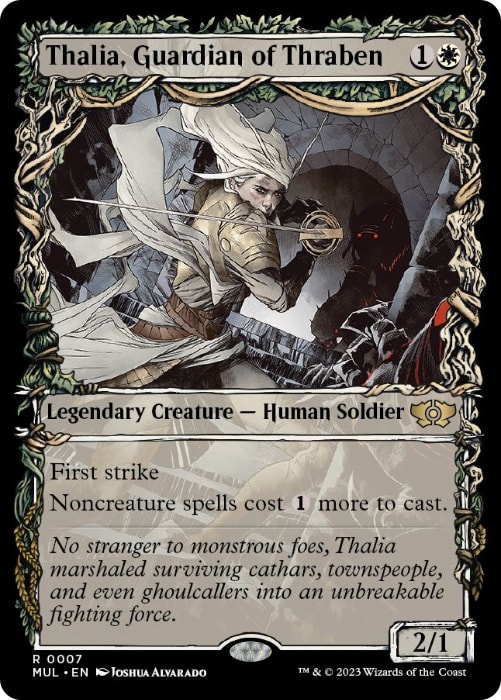 | 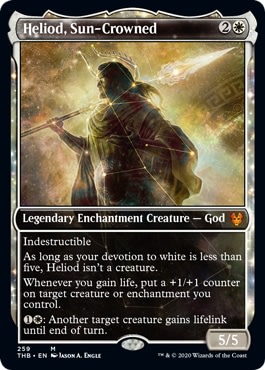 |
For example, Heliod, Sun-Crowned can replace Thalia, Guardian of Thraben, but Aragorn, King of Gondor can't be replaced with Phlage, Titan of Fire's Fury.
Lastly, there's a power level rules change to how the Partner mechanic (and related mechanics like Friends Forever, Background, etc) works. In each game, you are only allowed to cast one of your two Commanders.
This selection does not need to be made until the first time you cast your Commander each game, but after one has been selected, the other cannot be cast from the Command Zone at all for the remainder of that game.
Why Play Duel Commander
So we've covered the how to play Duel Commander, now let's dig into the why play Duel Commander. Unbeknownst to most of the U.S., Duel Commander is a massively popular format in Europe and Asia. There's an active tournament circuit, and one of them saw more than 900 players at Relic Fest in France just last year!
It's been around for a long time, I was even playing this format a decade ago in college at my LGS circuit, and my hope in writing this article is to put more eyes on the format here in the states and maybe get some awesome paper events of our own.
The format has a lot to offer, with a power level somewhere between Modern and Legacy. I lovingly refer to it as "Cube Constructed," relating to its singleton nature and emphasis on Creature combat surrounded with a mixture of some of the most powerful spells throughout Magic's history and a bunch of cards many players have never heard of.
The Deckbuilding Experience
Personally, I've always enjoyed the deckbuilding puzzles provided by Duel Commander compared to other competitive formats. Both the concept of a Commander as well as 99 card singleton decks offer a unique deckbuilding experience.
When you can only register one copy of the best removal spells like Swords to Plowshares, Lightning Bolt, or Fatal Push, you get to give a chance to try otherwise unplayable cards like Lay Down Arms, Fiery Impulse, or Defile.
 |  |  |
Cards like Wash Away, Drannith Magistrate, and Loyal Apprentice get to exist with entirely new levels of relevance. Some Commanders offer specific build arounds, giving life to extremely niche cards like Masterwork of Ingenuity, Reckless Charge, or The Sibsig Ceremony.
Additionally, with WotC's heavy emphasis on EDH in recent years, the format is always flush with new cards and decks, with even recent lower power sets like Spider-Man and TMNT offering multiple powerful new Commanders and maindeck staples to try.
This, combined with the Duel Commander Committee's vigilant banlist policy, keeps decks and the format itself everchanging and lacking the stagnation that other high power formats can sometimes suffer from.
Gameplay and Metagame Dynamics
As far as gameplay is concerned, the format is ripe with grindy games and Creatures ruling the format, both largely due to the nature of Commanders. Commanders acting as an eighth card in every "opening hand" that you get to cast multiple times a game generates a lot of card advantage for both sides of the table, and the average game of Duel Commander is generally a bit longer than other competitive formats.
Commanders are also face up before each game starts, giving a similar effect to open decklist events in that you're never deciding to keep or mulligan in the blind, eliminating a lot of game one nongames due to your hand lining up poorly against an unknown matchup.
The majority of Commanders being Creatures also influences games to revolve primarily around Creatures and counterplay to those Creatures, with almost every deck being flush with removal to keep pace with powerful threats.
Creature-light control decks exist to take advantage of that removal density, trading in the card advantage generated by multiple Commander casts for the virtual card advantage of blanking opposing removal spells. Combo decks are also plenty viable, often aided by using the Commander as a combo piece you always have access to.
The lack of sideboards lead to uninteractive combo decks being fairly curated via the banlist, so existing combo decks in Duel Commander are generally slower and offer multiple avenues of counterplay, rather than narrow explosive glass cannons like Legacy's Oops All Spells.
Decks of all flavors and archetypes exist and thrive in Duel Commander's ecosystem, but the power of Commanders generally keeps a Creature deck on top.
How to Build a Duel Commander Deck
Commander
The first step when constructing a Duel Commander deck is, obviously, Commander selection.
I cannot emphasize this enough: this is a competitive 1v1 format. That means, for better or worse, you can't just choose your favorite Legendary Creature and expect to do well in events.
This is a card you have access to in every single game you play, and will likely cast multiple times per game, so it's very important to choose a powerful card at the head of your deck. A brief scan of the current and historic metagame of Duel Commander shows that the format favors cheap Commanders (generally in the three to four mana range maximum) and often generate value or become a potent threat without too much additional support.
The quality of the average Legendary Creature has trouble competing with the efficiency of Yoshimaru, Ever Faithful or the card generation of Aragorn, King of Gondor, so be sure that when selecting a Commander you're utilizing a card at a sufficient power level for the format.

Another thing to keep in mind is how much of a build around your Commander is and how often you will untap with it. Rofellos, Llanowar Emissary is an exceptionally powerful card to untap with, having the potential to ramp you to six mana on turn three by itself. Despite this, the card made almost no impact on the format after its recent removal from the ban list.
Decks that need to untap with their Commander to function regularly are often not up to snuff in Duel Commander, due in large part to the removal density of the format. The best Commanders will provide immediate value or function as same turn combo pieces.
Now, all this may sound like scary and narrowing hurdles for a Commander to overcome, but looking at 2026 results alone, well over 100 different Commanders have published results in the format.
Practically every set adds at least one new competitive deck making a splash, with recent contenders like Spider-Man 2099, Aang, Swift Savior, Brigid, Clachan's Heart, and Raph & Mikey, Troublemakers.
This is all to say that the format is not at all restrictive to what you can choose as the Commander of your deck. The format is very open in my experience and is very underexplored. Powerful legends, both old and new, are getting dug up and molded into powerful competitors all the time.
The important thing to remember is simply to be mindful of the rules of engagement when stepping into Duel Commander.
Synergy Cards
Despite the previously mentioned issues in deckbuilding with a reliance on your Commander, it's pretty clear that there will be some level of building your deck with your Commander in mind.
The nature of a guaranteed eighth card you see in every game will influence some Commanders to run particular cards that would be otherwise unplayable, due to powerful inherent synergies.
This can extend to combo decks like Lumra, Bellow of the Woods or Lier, Disciple of the Drowned, largely constructed with their Commander as a part of their win condition. But for most fair decks of the format, this will typically be some powerful synergy pieces with your Commander.
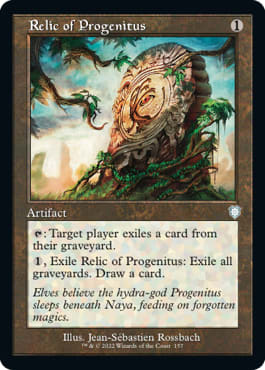 |  |
Combos can take many forms, like Relic of Progenitus and similarly shaped cards enabling Ketramose, the New Dawn or Magda, the Hoardmaster, or Wild Ride comboing with Spider-Man 2099 for a surprise hasty 15 damage swing, or be as simple as Overlord of the Mistmoors in Phelia, Exuberant Shepherd for a four mana Grave Titan.
While there are decks that are almost or entirely built as generic "good stuff" decks, like Aragorn, King of Gondor, the majority of decks in the format will find themselves playing some number of these core "synergy" cards enabled by or enabling their Commander.
The key here not to get lost in the weeds when adding these cards. Most decks can and should be able to function without their Commander, and it's important to not bog your deck down with too many situational pieces that are only good when your deck's main engine is operating at full capacity. You'll want to maintain balance with other, more generically good cards.
This is personally my favorite aspect of the format. Duel Commander makes a home for so many interesting cards that you would never see anywhere else and makes both deckbuilding and learning about other decks in the format a really fun and engaging experience.
Interaction
The next, and arguably more important, step in deckbuilding, is including interactive spells. This is something I can never encourage enough. Creatures are king in Duel Commander. The format is ruled by boardstates and Creature combat, and you need to be able to counter or remove things from that board.
There is a suite of cheap efficient interaction across all five colors that are basically autoincludes in decks of that color, with the exception of maybe mono-Green decks like Tifa Lockhart or Lumra, Bellow of the Woods, opting instead to lean on fast and powerful proactive gameplans, given the color's lack of quality interaction.
There's no concrete number of removal spells a deck should be playing, as it really depends on the colors and archetype of a given deck, but you definitely want to make sure you're playing a solid number. Typically, I err on the side of caution and include extra.
You'd always rather have too many rather than too few.
For convenience, I've taken the liberty of compiling a list of some of the more commonly played interactions. This list is by no means exhaustive but shows off a few options in (almost) every color (sorry, Green).
- White: Swords to Plowshares, Solitude, Parallax Wave, Skyclave Apparition, Swift Reconfiguration, On Thin Ice, Ossification, Oust, Portable Hole, Seam Rip
- Blue: Counterspell, Mental Misstep, Wash Away, Unable to Scream, Brazen Borrower, Force of Negation, Mana Leak, Stern Scolding, Daze
- Black: Fatal Push, Dismember, Toxic Deluge, Cut Down, Long Goodbye, Requiting Hex, Bloodchief's Thirst, Sheoldred's Edict, Orcish Bowmasters
- Red: Lightning Bolt, Fury, Pyrokinesis, Pyrogoyf, Galvanic Discharge, Chain Lightning, Ghostfire Slice, Flame Slash, Unholy Heat
- Green: Hm... Beast Within? Sometimes mono-Green plays Spatial Contortion or Kozilek's Command. Not all colors are created equally.
- Multicolor: Abrupt Decay, Drown in the Loch, Flame of Anor, No More Lies, Prismatic Ending, Leyline Binding, Supreme Verdict, Mawloc, Phlage, Titan of Fire's Fury
Another neat quirk of Duel Commander is the relevance of Oblivion Ring.
Generally low on the totem pole of removal spells in other competitive formats, the efficiency or utility of O-ring effects is often overshadowed by leaving yourself open to the opponent removing it and getting their card back.
In Duel Commander, however, O-ring effects have the ability to target Commanders, giving your opponent the option of either leaving their Commander under it until the O-ring is removed, a very risky play, or safely putting them back in the Command Zone.
 |  |
Suddenly this makes On Thin Ice a one mana unconditional Sorcery speed removal spell, even sometimes gaining an upside in a deck like Phelia, Exuberant Shepherd, where you can later flicker it for a second target down the line. Skyclave Apparition fully loses its downside when targeting an opposing Commander, unless your opponent wants to leave it stranded in exile for the rest of the game, in exchange for an illusion token.
One of the biggest glow ups is with cards like Swift Reconfiguration and Unable to Scream. Auras that incapacitate but don't remove a Commander from play can lock them out for the large portions of the game.
Removal spells are recontextualized within the context of Duel Commander, leading to cards that usually see no play suddenly being powerful staples of a given color.
Good Stuff
This is personally my least favorite part of deckbuilding in any format, and Duel Commander is no exception.
Sometimes cards are just too good not to play. Every Blue deck is still going to play Brainstorm, every Black deck gets Demonic Tutor, all the Creature decks are running Skullclamp.
Nothing particularly interesting to mention here, but the definition of "good card" does get stretched a bit since Duel Commander is a singleton format, so decks can't be padded out with 4 copies of the best cards in your colors.
Nonetheless, it is an important category of card, as these will oftentimes be the cards that make sure your deck functions under duress from your opponent.
If your opponent won't let your Phelia, Exuberant Shepherd attack, you don't want to be stranded with a bunch of irrelevant cards that are only good when you flicker them, you do need the ability to cast powerful threats like Ocelot Pride or Voice of Victory, even if they aren't as "interesting."
Mana Base
There isn't a lot exciting to mention here, as manabase building is generally pretty straightforward.
The most important thing to emphasize is to please put enough Lands in your deck. A good rule of thumb is starting at 40.
This is approximately equivalent to 24 Lands in a 60-card deck. For Duel Commader, you can't pull from the average EDH list with somewhere in the 33-35 range and expect success.
Games are grindy, and you'll want to hit a lot of Land drops along the way. Decks in this format are far worse off suffering from mana screw than flood, given the mana sinks that repeated Commander casts and the subsequent card advantage generated by them can provide.
Other than that, you'll generally see a regular smattering of fetches and dual Lands that make most decks function, with mono-color decks being afforded a little more leniency in playing more utility Lands, just like in other formats.
The Meta
Now that I've broken down some deckbuilding theory, let's go through some example lists and see how these ideas are applied to some of the top decks in the format.
Note: Before you get out your pitchforks and torches telling me I've miscategorized a deck, please understand that I'm just trying to explain the basics here.
We don't need to slog into the weeds on how many of the format's aggro or control decks can trend midrange due to the inherent card advantage and Creature density, or that some combo and aggro decks blur the line between the two.
This is just laying out basic decklists and deckbuilding and archetype ideas.
Aggro
Yoshimaru + Kraum
 | 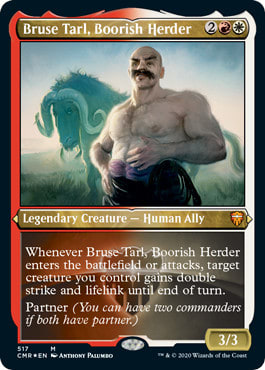 |  |
Yoshimaru is the premier aggro deck of the format, utilizing the strength of a consistent turn one snowballing aggro threat to put huge pressure on opponents.
Bruse was at one point the main partner to pair with Yoshimaru, as the 
 color pair sports some of the more efficient and aggressive threats in Magic, but recently players have started reaching for Kraum, Ludevic's Opus, with no actual manabase changes, simply playing a few technically Blue cards like Mental Misstep and Spider-Woman, Stunning Savior.
Yoshimaru is backed by a plentiful number of additional synergy legends to help keep the dog threatening, but many of those Creatures also function as powerful standalone threats like Headliner Scarlett and Adeline, Resplendent Cathar, to continue to beat down and accrue value even when the pup is removed.
This applies a lot of pressure to opponents not adequately equipped to answer multiple snowballing threats, and Yoshimaru's cheap cost means that even if answered, he can easily come back multiple times in a game to keep demanding more removal.
Tifa Lockhart

Toeing the line between aggro and combo, Tifa is the Duel Commander equivalent of an infect deck, utilizing the high burst damage potential of its Commander with a pile of landfall enablers, pump spells, and protection.
While this Tifa deck has a few backup beaters in other landfall synergy cards like Scythecat Cub, Bristly Bill, Spine Sower, and Sazh's Chocobo, the deck is otherwise highly reliant on its Commander, with practically every card in the deck dedicated to getting the opponent dead if you untap with her.
This is a perfect example of a very high synergy and low good stuff deck, and showcases that these types of decks do have the ability to exist in the format, in no small part leaning on Tifa's cheap mana cost and Green's redundancy in mana dorks aiding you in plowing through multiple casts per game when the need arises.
Midrange
Slimefoot and Squee

At this point, SnS is the Ol' Reliable of Duel Commander. Think 2016 Modern Jund (
 ). That's the vibe of this deck. Green provides a consistent base of manadorks to curve into the strong three drop Commander, who provides both ETB value and snowball potential.
Black and Red afford you some excellent removal options, in addition to Black's discard spells to provide additional disruption.
Slimefoot is a Creature dense deck, helping threaten additional value from his activated ability for those removing it with non exiling spells, and almost all the cards are more generally good ones than specific
Slimefoot synergy cards, outside of a handful of self-sacrifice synergies like Flare of Malice and Lazotep Quarry. This means there are minimal clunky do-nothing pieces, and instead the deck is a consistent midrange strategy, simply utilizing SnS as a strong threat in the Command Zone, the definition of a good stuff strategy that has proven itself as consistently one of the best decks in the format for years, but very rarely a standout power outlier.
Cloud, Midgar Mercenary

Followers of my content (and readers of my name) know I'm a huge fan of this Cloud, Midgar Mercenary deck, but I'll try to keep it brief and objective.
Current iterations of Cloud, Midgar Mercenary are good-stuff midrange decks utilizing a cheap and threatening tutor in the Command Zone to support whatever role you need to play based on the matchup.
Consistent access to powerful tools like Skullclamp, Umezawa's Jitte, and Pre-War Formalwear to draw cards, remove Creatures, or generate large boards in any situation you may need them, give Cloud the ability to fill out the rest of the deck with quality removal and hatebears like Sanctifier en-Vec and Aven Interruptor to disrupt the opponent, and pick up Equipment to beat down.
Along with a suite of generically good Creatures, however, are more than his fair share of synergy pieces. Tutoring consistency affords Cloud the ability to play situational Equipment bullets like Lion Sash for graveyard hate, Lavaspur Boots for some extra burst damage, and my personal favorite Masterwork of Ingenuity for more Pre-War Formalwear pop offs.
Along with these are a few Equipment synergy cards like Sigarda's Aid and Puresteel Paladin, but most Cloud lists try to play as few of these cards as possible, as most Equipment you tutor for are good enough by themselves.
Phelia, Exuberant Shepherd
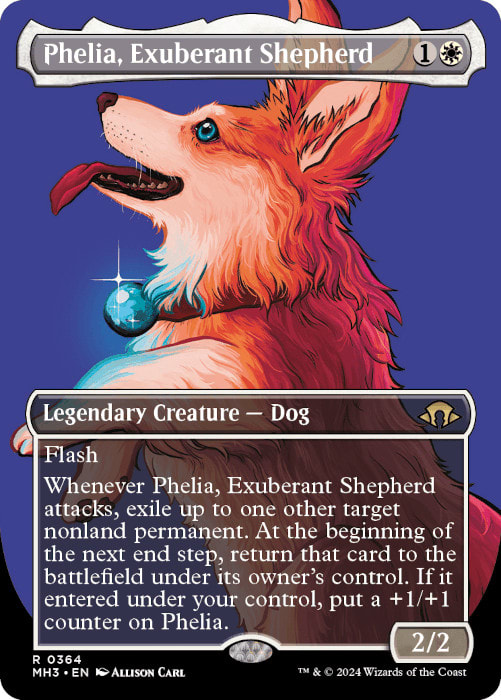
Trending towards the opposite side of the midrange archetype, this Phelia list showcases a midrange deck stretching synergies near their limit.
The low mana cost and Flash give you a lot of flexibility of when to deploy the pup, in addition to suite of protection cards like Mother of Runes afforded to it in White to help keep her alive.
Simply letting her untap once can spell quick defeat, with exceptionally powerful flicker synergy cards like Overlord of the Mistmoors, Steel Seraph, and Seasoned Dungeoneer, or make quick work of an opposing boardstate with all those Oblivion Ring synergies.
However, the deck can still operate like a strong mono-White midrange deck when needed. Rather than just packing the deck full of ETB Creatures that only pop off with a Phelia attack, the deck contains plenty of individually powerful White cards like Esper Sentinel or Anointed Peacekeeper.
Phelia even has the ability to utilize the Commander swap to bring Thalia, Guardian of Thraben in postboard games vs spell-based combo.
The deck also leans into some flash synergies with Phelia, being able to hold up Spectacular Spider-Man, Cathar Commando, Containment Priest or Reprieve in addition to the dog, keeping your opponent guessing.
Deadpool, Trading Card
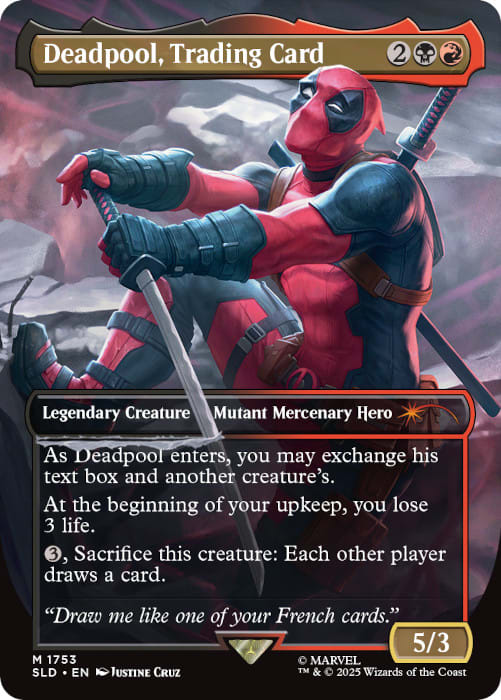
Rounding out the midrange lists is The Merc with a Mouth himself (a card many Magic players probably didn't even know existed!).
That aside, Deadpool, Trading Card is an extremely mechanically unique card, with the ability to fully steal a Creature's textbox. Mentioned earlier when discussing Swift Reconfiguration, being able to blank an opposing Commander without removing it is a very powerful option, doubly so when you get to steal some incredibly potent textboxes like Aragorn, King of Gondor or Phelia, Exuberant Shepherd.
After swapping with an opposing Commander, your opponent is forced to pay three and give you a card just to have the option of recasting it again, taxing them severely just to get their Commander back online.
And if your opponent doesn't have anything juicy to steal, Deadpool can even steal one of your own Creatures' textboxes, doubling up on a powerful ETB like Fury or stealing Haste off a previously deployed card like Screaming Nemesis for an extra five damage swing, or both in the case of Tersa Lightshatter.
Also, by design, these decks are almost purely good stuff lists. When your Commander is all about stealing the text of other Creatures, there's not a lot in the way of build-around synergies, outside of some previously mentioned nice ETBs to retrigger.
These decks largely consist of quality /removal and premium Creatures, with very minimal other standout cards outside of Deadpool himself.
Unfortunately, this card is not available and will likely never be available on MTGO, meaning the paper and online metagames are meaningfully distinct.
Tempo
Aragorn, King of Gondor
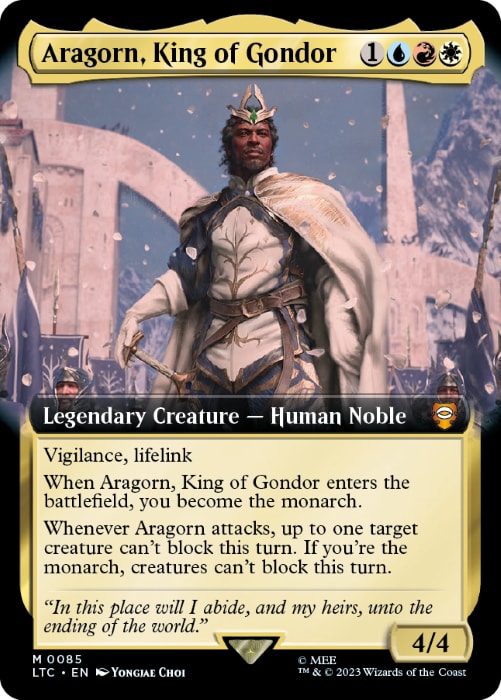
The king of Duel Commander since its printing, Aragorn is the premier good stuff tempo deck of the format. Not a single Commander synergy piece to be seen in the decklist, Aragorn is instead packed with the most efficient removal, counterspells, and cheap threats from throughout Magic's history.
Plenty of interaction at primarily one and two mana, and a suite of Creatures to help provide value and contest the board. Many of the Creatures also have Flash, with cards like Wan Shi Tong, Librarian and Faerie Mastermind giving the deck the ability to both hold up countermagic and continue to deploy threats when the opponent doesn't play into them.
The king himself is an incredibly potent threat and engine at the helm of the deck, offering an unrelenting card advantage engine if the opponent doesn't generate enough of a boardstate to pressure the monarchy, as well as a devastating mixture of keywords and attack trigger to play offense and defense.
This all combines into a deck with incredible strength, consistency, and resilience, and has cemented it as one of the best decks, and at many points in the format's history the best deck, for many years.
Spider-Man 2099

2099 is the new kid on the block, and it's no surprise he made a name for himself so quickly, rising the ranks to arguably the best deck in the format currently.
With an incredibly good statline and textbox for the manacost, 2099 decks don't mind waiting a few turns to deploy their Commander, playing an interactive tempo game upfront with plenty of burn and countermagic in turns one through three.
Once he unlocks on turn four, the deck becomes a multifacted wildcard. Depending on the matchup, he can easily pivot around, allowing for boardstate management with his self-enabled end step shock trigger and a Vigilance Double Strike body.
You can also take the approach of an aggro deck that can kill at the drop of a hat. 2099 has huge burst damage potential from Wild Ride, Reckless Charge, Clout of the Dominus, or Detective's Phoenix. Against non interactive decks, or anyone with their shields down, you can even Intuition for three of these enablers on their end step, untapping and killing from nothing.
Opposing decks must constantly keep their guard up, drawing a Splinter Twin-esque tension out of your opponents, making them play scared while you continue to pressure with your other plans.
If this deck speaks to you and you want to build it, just... don't get too attached. I'm not saying it can or even should get banned. But looking at the format, I think it's probably the most likely card to kick the bucket one of these days. Maybe I'm wrong.
Control
Tasigur, the Golden Fang

At one point deemed too powerful for Duel Commander, Tasigur was very recently freed from the banlist, to bolster the suffering control archetype. And it certainly worked.
This Tasigur brew is now the format's foremost control strategy, being very threat light and packed with an overabundance of removal and counters (and almost no Green cards), leaning on Tasigur's ability to cheat Commander tax via delve to provide the inevitability needed to close games.
Most, but not all, decks also include a very small Neoform into Hullbreaker Horror synergy package, and you'll also typically see a small backup wincon of Jace, Wielder of Mysteries, Tainted Pact, and sometimes Demonic Consultation (a package seen in a lot of Blue-Black decks) to open up backdoor kills while being reasonably useful cards by themselves.
If you want to sit back, play classic, long, drawn out, control games, maybe untap your Lands with a Wilderness Reclamation, look no further than this potent control strategy.
Atraxa, Grand Unifier
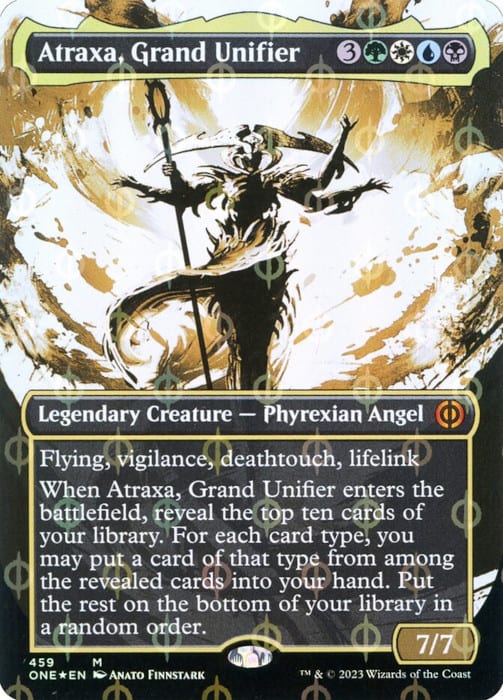
But if you're looking for a control deck that's a bit bigger and flashier, Atraxa is a solid alternative. Rather than casting a Tasigur over and over backed by interaction, this deck opts to clean up the end game with the massive swing of... just casting Atraxa a single time.
Turns out that a 7/7 with a million keywords that draws four or more cards when it enters the battlefield will clean up games pretty quickly afterwards.
To survive that long, the deck employs a similar "massive pile of removal and counters" strategy to Tasigur, gaining the versatility of adding White, with some needed unconditional removal for tougher to answer threats that Black removal spells can miss (like, ironically, Tasigur himself).
Atraxa also stands out in its handful of synergy pieces, primarily in ways to accelerate up to the powerful seven drop, like Temple of the False God, Sowing Mycospawn, and most importantly Dream Halls. Dream Halls not only powers out a fairly discounted Atraxa but also allows you to immediately deploy the cards drawn, which can dig you out of a lot of holes if you're a little too far behind normally.
The looming threat of a sudden fullstop game ender like Dream Halls being slammed at any moment past turn four puts a lot of pressure on opponents to close out games or get buried. (Just be careful, your opponent can utilize your Dream Halls too!)
Combo
Lumra, Bellow of the Woods
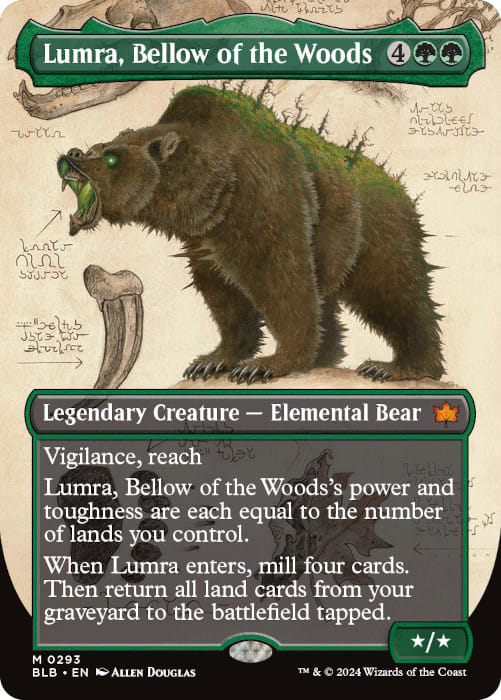
The world of combo decks is where Duel Commander decks get really unique. While we've covered a range of both good stuff and synergy driven decks, most combo decks of the format take that synergy to the next level.
Lumra is a very proactive combo deck, dedicated to assembling a Land untapper like Amulet of Vigor and a Land sacrificer like Zuran Orb, and casting Lumra. You then sacrifice all your Lands, mill some extra with Lumra, and return them all, untapping them to net mana.
Saccing all your Lands also conveniently kills Lumra, putting it back in the Command Zone to be cast again, continuing the cycle and churning through your entire deck. You eventually circumvent the increasing Commander tax by finding Command Beacon or Mirrorpool, looping the Land recursion infinitely and milling your entire deck before killing your opponent with Sunscorched Desert.
There are also more complicated lines that makes the desert not necessary as a wincon, but I'm no Lumra expert. If you're interested in learning the lines, there are some quality Lumra primers out there.
Suffice to say, Lumra is a deck with a very singular gameplan, so practically every card in the deck is either an untapper, sacrificer, or a card ramping you toward Lumra, and very little room for (or access to) interaction, outside of some stray Naturalizes and Beast Within.
This deck is basically Duel Commander Amulet Titan, so I'm sure that tickles the fancy of a few Amulet sickos out there. Which is great news because this is the best combo deck in the format right now, and probably one of the top three overall.
Again, sorry if I explained part of the combo wrong somewhere, I'm pretty unfamiliar with the deck's intricacies and even being in the same room as an Amulet of Vigor shuts off my brain something fierce. Apologies to the Amulet sickos out there. Feel free to yell at me and I'll edit the article later.
Acererak the Archlich
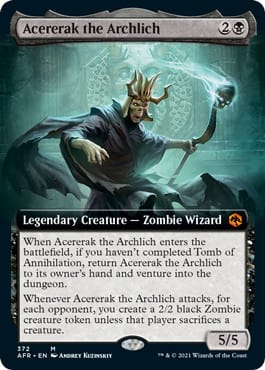
Acererak the Archlich, while much harder to pronounce, is a much simpler strategy. Collect your A + B combo of Heartless Summoning / The Sibsig Ceremony / Urza's Incubator + Relic of Legends / Carnival of Souls, then cast Acererak infinitely, going through Lost Mine of Phandelver infinitely to kill your opponent.
If you only have half of the combo, the cost reducers can still make Acererak very cheap, giving you the ability to churn a bunch of mana into powering through Dungeon of the Mad Mage, which gives a huge amount of card selection as you delve its depths.

The Sibsig Ceremony in particular works as an alternate one-card wincon, giving you the ability to repeatedly cast Acererak for , make a zombie, and descend into the dungeon, quickly amassing both an undead horde of attackers and plenty of dungeon value. With a very compact and consistent combo plan, as well as Black's access to tutors, the remainder of the deck is filled out with discard and removal to disrupt your opponent and keep yourself alive long enough to assemble the full combo.
Other Standout Decks
I really could go on and on about how many cool and unique decks exist in the format, but that would simply make this article way too long.
But here's a rapid-fire list of a bunch of other decks that exist in the format across basically any archetype or playstyle you can think of. This list is not even close to comprehensive, and if you're looking for a specific style of deck, odds are it exists or can exist somewhere.
- Raph & Mikey, Troublemakers: A Storm-esque deck utilizing a ton of fast mana to accelerate out its Commander, and cheat in one of a few Creatures that one shot your opponent from 20
- Toph, Greatest Earthbender: A landfall centric good stuff deck that can threaten big damage off its Commander, and even one shot with Inkmoth Nexus
- Terra, Magical Adept: a five-color reanimator deck with a built-in mill enabler
- Hidetsugu and Kairi:

 control with some self sacrifice enablers to set up and cast massive spells like Rise of the Eldrazi with your Commander
 - Light-Paws, Emperor's Voice: A mono-White bogles deck focused on snowballing out of control with Light-Paws and a ton of flash auras to tutor protection auras
- Aang, Swift Savior: A classic
 tempo deck
 - Elminster: An even more classic Control deck
- Grist, the Hunger Tide: A good stuff Creature centric midrange deck with a tough to answer Planeswalker at the helm to help accrue value and remove Creatures
- Hei Bai, Forest Guardian / Cosmic Spider-Man / Heroes in a Half Shell / Like 12 other five-color Commanders: Pure five-color good stuff piles with one of infinite different generic card advantage engines at the helm (Hei Bai plays some cool shrines though)
- Ketramose, the New Dawn: value with a cheap and tough to answer card advantage engine enabled by many different graveyard exiling trinkets
- Zurgo Bellstriker / Kellan, Planar Trailblazer: Pure Red deck wins, baby
- Glarb, Calamity's Augur:
 control with a Doomsday finish
 - Lier, Disciple of the Drowned: High Tide at its finest (a very amusing video of resident "really bad at combo decks" player [me] piloting it)

And many many more!
Format Entry Points
So, you read this far. The format sounds awesome, the decks are exciting, and you want in. What now? Well, you have a lot of options.
Decklist Resources
MTGTop8 and MTGDecks are some of the best places to find starting lists.
Unfortunately, MTGGoldfish does not source the many paper events happening across the pond, so these sites are usually the ones I go to when trying to find what certain decks look like or get inspired digging up cool tech I hadn't seen before.
Budget Decks
If you're on a budget, Duel Commander has plenty of options for starting players.
Light-Paws, Emperor's Voice and Zurgo Bellstriker are very cheap options, as well as being more simple aggressive linear decks to help get a feel for the format.
Other mono color options include decks like Tifa Lockhart, Magda, the Hoardmaster, or Acerak, the Archlich, as well as Phelia, Exuberant Shepherd and Cloud, Midgar Mercenary (if you omit the optimal but not strictly necessary City of Traitors).
Deck costs will obviously scale as you add more colors, due to the price of A/B/U/R Dual Lands, but in a singleton format you can sometimes get away with simply not running one if you're just starting out, slashing down the cost of many two-color decks like Spider-Man 2099 substantially.
MTGO
Magic Online has Duel Commander leagues and larger Trials available to anyone on the client.
With a rental service, MTGO becomes a very convenient and cheaper way to get a lot of reps in and even shop around on different decks, getting a lot of much needed format experience and reps on whatever deck you're thinking about playing.
I can't recommend MTGO enough to improve as a Duel Commander player, regardless of skill level. The sheer volume of matches you have convenient access to is unmatched.
Discord
The Official Duel Commander Discord is a great place for people who want to learn about the format and chat with likeminded folks. There are sections to talk about specific decks, and even regional forums both for advertising larger events or simply linking up with locals, in any area across the globe.
There is also the French Duel Commander Discord: Magic Bisquette, for French-speaking players.
Paper Duel Commander Hubs
While it's still running under the radar in the U.S., there are a few locations here that have started to support Duel Commander. I personally know of paper Duel Commander hubs in the Denver Metro area of Colorado, North Ohio/South Michigan, and Central Florida, but I'm hoping to see this list grow.
If you're interested in the format, chat with friends at your LGS. Maybe proxy up some decks and get a taste! It's the easiest way to enjoy any format in Magic, and maybe you'll spark the next format hub.
Popular online hubs:
Larger Paper Events
Unfortunately, Magic Cons have recently decided to stop supporting Duel Commander.
However, Cool Stuff Con currently plans to run a Duel Commander event on May 17th, which I will be at. Preregistration is here.

I also am hoping Card Titan hosts a Duel Commander event, but currently that remains to be seen. For now, here are some upcoming events:
CoolStuffCon on 5/17/26 in Dallas, Texas.
Northerners could also check out the MBG May 30th Duel Commander Dual Land Event on 5/30/26 in Howell, Michigan. This event is hosted by Moms Basement Games.
FAQ
Questions about the format? The official Duel Commander website and Discord have plenty of answers, and my DMs are always open on Discord or Bluesky. But I'll try to hit some common talking points I see brought up frequently here.
"Ew, I don't play Commander."
Not really a question, but it is a sentiment I get a lot, which I understand. There's quite the divide between people that enjoy Magic in a 1v1 competitive setting vs the social experience of casual games of EDH. But as I said up top, Duel Commander is not Commander. It shares the deckbuilding process, but is the same competitive 1v1 experience you would get in any other format.
I'm finding conflicting info on Duel Commander, what gives?
Sigh... I won't get in the weeds on this one, because the community is trying to move past it, but unfortunately search engine optimization is a tough battle to fight. Some months ago, the Technical Coordinator running the Duel Commander website basically took it over and kicked everyone out and invented his own format.
If you're curious about what transpired, you can read more about it, but for now, just ignore the other website. As time passes it is slowly fading away from relevance, but it is our format's annoying burden to bear for the time being. If you're not looking at the Official Duel Commander Site or Discord, you're in the wrong place for your info.
Why do some decklists totally break the rules?
This is more a Commander rules clarification than a Duel Commander specific one, but I thought it would be worth mentioning.
There are exceptions to every rule. Your Commander can be any Legendary Creature, some specific cards that have the text "This card can be your Commander," or any Legendary Vehicle or Spacecraft with printed power and toughness.
Commander decks are typically exactly 100 cards, with 99 maindeck and one Commander, but partner gives you an extra Commander, which eliminates one card in your maindeck, giving you a 98/2 split instead.
And companions function outside of deckbuilding completely, becoming a 101st card in the deck. Just be sure your Commander also abides by the companion stipulation.
Conclusion
So that's the format! I do really enjoy it, and hopefully this article can provide some easy to access resources for other people keen on learning more about it. I (selfishly) really want to see the format flourish stateside like it does overseas, so hopefully this article helps.
Share it around, get more people learning about Duel Commander, and play some games.
Reach out to me on Bluesky, in the Duel Commander Discord or my Discord DMs, or stop by my Twitch channel, where I stream Duel Commander every Tuesday at 6pm PST, if you have anything you want to chat about. I'm always happy to talk about Duel Commander.
Until next time,
xJCloud