 Locations



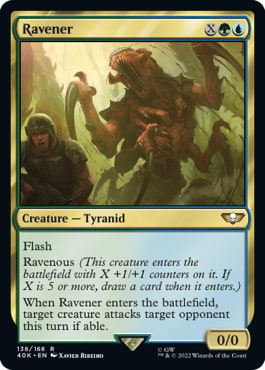
Magic players got their first real taste of bolters, biomass, and chittering alien nightmares back in 2022, when Wizards decided that "normal" Commander decks simply weren't unhinged enough. And with this notion came the Warhammer 40,000 Commander Decks, a full-on crossover that dropped Space Marines, Necrons, Chaos Cultists, and, perhaps most importantly, giant, Ravenous space bugs, straight into Magic's vast ecosystem.
Especially for the players who love turning mana into problems, the Tyranid Swarm precon felt like Christmas morning. Big creatures? Check. Scaling threats? You got it! A mechanic that actively rewards you for asking the table, "So... how much mana is too much mana?" Not a chance. The mechanic in question is known as Ravenous, and it wasted no time making its intentions clear: spend big, grow bigger, and if you really commit to the feast, you won't even run out of cards!
So, without further ado, grab a pile of dice, warm up your mana rocks, and try not to get eaten in today's Mechanics Overview Segment as we cover the Ravenous mechanic, one +1/+1 counter at a time.
What Is Ravenous?
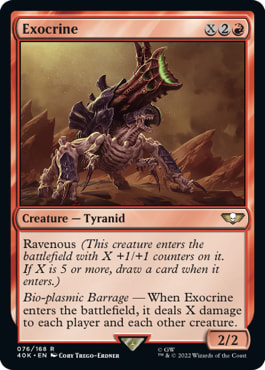
Ravenous is essentially a modified version of the oh-so-popular Hydra ability. When you cast a Ravenous creature, you choose a value for X as normal, then that creature enters the battlefield with X +1/+1 counters on it. But unlike the Hydra ability, if the value of X you paid is 5 or more, you draw a card!
So, Ravenous is actually two abilities stapled together:
- A Replacement Effect: Modifies how the creature enters the battlefield (it enters with counters).
- A Triggered Ability: Checks the value of X and draws a card if it is 5 or more.
This distinction actually matters quite a bit, but we'll come back to it a bit later!
The History of Ravenous
Ravenous is a surprisingly young mechanic by Magic standards, but it comes from a very specific moment in the game's history, one where Wizards was willing to get a little weird, a little experimental, and a lot crossover-happy.
As I mentioned earlier, the mechanic debuted in 2022 as part of the Warhammer 40,000 Commander Decks, Magic's first full Universes Beyond Commander release. These decks were built from the ground up to capture the feel of their respective Warhammer factions. That meant new creature types, bespoke mechanics, and designs that didn't necessarily have to answer to Magic's long internal history but only to flavor, resonance, and overall Commander playability.
And for the Tyranids, that meant one thing above all else: biomass scaling.
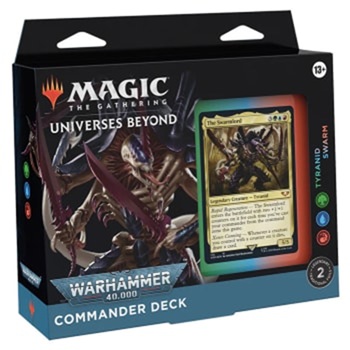
The Tyranid Swarm deck introduced Ravenous as a mechanical expression of the faction's identity. The Tyranids consume, adapt, and grow in response to available resources. Ravenous translates that fantasy cleanly into gameplay. The more mana you pour into a creature, the larger it becomes, and if you invest heavily enough, the hive mind even rewards you with extra cards. Mechanically, it encourages exactly the play pattern the deck wants: ramp aggressively, cast enormous threats, and keep the gas flowing.
At the time of release, Ravenous appeared exclusively in the Tyranid Swarm precon. There were exactly 11 Ravenous creatures, all in Temur colors, and all firmly rooted in the Tyranid creature lineup. And for a while, Ravenous felt like a mechanic that might never escape its Universes Beyond origin: cool, flavorful, but too tightly tied to alien space monsters to see broader adoption.
Then Bloomburrow (2024) came along.
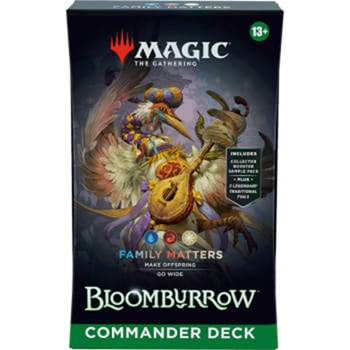
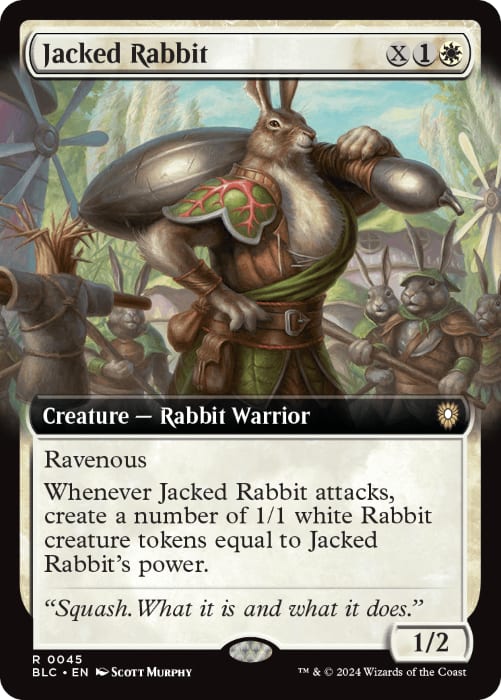
In the Bloomburrow Commander Deck: Family Matters, Ravenous made its first appearance outside Universes Beyond on Jacked Rabbit. This actually turned out to be a much bigger deal than it looked at first glance. Not only was Jacked Rabbit the first non-Warhammer Ravenous card, but it was also the first White card to ever use the keyword. That single printing quietly confirmed that Ravenous wasn't particularly locked to Tyranids, to Temur colors, or even to grimdark sci-fi.
This return of Ravenous essentially signaled that Wizards views Ravenous as more than a flavorful one-off. Much like how mechanics such as Cascade or Delve started life in very specific contexts before becoming evergreen-adjacent mechanics, Ravenous now sits in that interesting middle space. It's not ubiquitous, but it's no longer exclusive either.
Ravenous Rulings
Let's get to answering all the questions that will come up the moment someone casts a Ravenous creature for 7 mana and another player squints suspiciously.
Ravenous Creatures Enter With Counters
Understand:
This matters because of how Magic checks for triggered abilities. Any ability that looks for a creature entering the battlefield with a certain power or toughness will see the Ravenous creature fully grown.
For example:
This means:
- You cannot kill a Ravenous creature "in response" to it getting counters with something like a Cut Down.
- ETB triggers that care about creature size (yours or your opponents') will always see the +1/+1 counters already applied.
The Card Draw Trigger Checks the Value of X, Not the Counters
Here's another subtle but extremely important distinction:
Most of the time, those numbers will be the same. But Magic sure loves corner cases, don't it?
 | 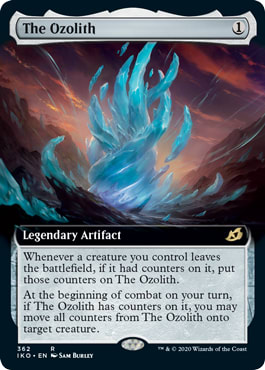 |
If replacement effects modify how many counters the creature enters with, say, something like a Doubling Season or The Ozolith, the Ravenous draw trigger doesn't care. It only asks one question:
If the answer is yes, you draw a card.
If the answer is no, you don't, even if the creature somehow enters with five or more counters anyway.
Copying Ravenous Permanents

If another permanent enters the battlefield as a copy of a Ravenous creature, here's what will happen:
- It does not enter with +1/+1 counters from Ravenous.
- You do not draw a card.
- X is treated as zero.
Why? Because Ravenous only functions on a spell that was cast with X in its mana cost. A Clone-style effect isn't casting a Ravenous spell; it's just carrying over copiable values.
Copying Ravenous Spells
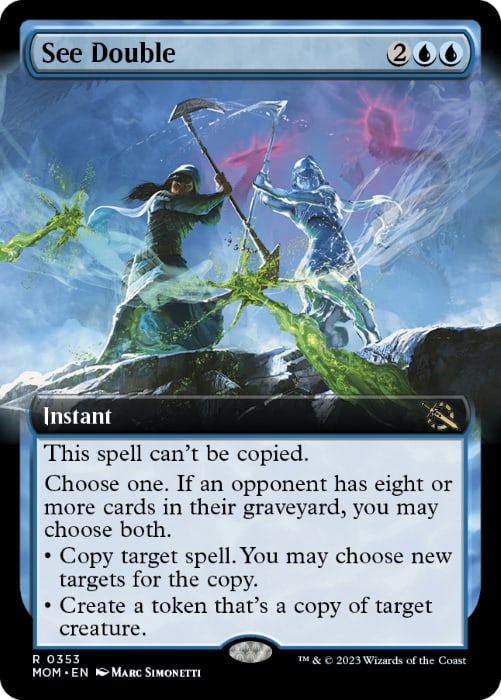
Now, copying Ravenous spells, on the other hand:
This means:
- The copy will enter the battlefield with X +1/+1 counters.
- The copy will check whether X was 5 or more.
- And if it was, the copy's Ravenous trigger will draw you a card.
In short: copying the spell preserves X; copying the permanent does not.
Stay Ravenous, Friends
By tying raw size to card advantage, Ravenous quietly encourages healthier gameplay patterns. You're incentivized to go big, but not recklessly. Five mana, for example, is the moment when your investment starts paying you back. That single card draw does a lot of heavy lifting, smoothing out variance, rewarding ramp, and making Ravenous creatures feel less like all-in gambles and more like scalable tools.
From a design perspective, Ravenous is also a quiet success story for Universes Beyond. It started life as a flavorful Tyranid-only mechanic and still managed to be clean and flexible enough to escape that context later. Its return in a non-Warhammer setting wasn't particularly loud or flashy, but it was certainly meaningful.
Now, will the mechanic ever become evergreen? Probably not. And honestly, that's fine. I feel Ravenous works best as a mechanic that shows up when Wizards wants to reward big mana strategies without essentially breaking the game wide open. Whether it eventually ends up on Hydras, Beasts, Plants, or something even stranger down the line, it's proven it can certainly stand on its own.
And with that, I think I've fed this segment more mana than even a Tyranid hive fleet could reasonably metabolize in one sitting. As always, happy brewing, may your X always be just high enough to draw the card, your Ravenous creatures enter exactly as large as you promised they would, and your opponents learn, far too late, that letting you untap with a pile of mana was a catastrophic error in judgment. Until next time!