



 Locations



Man, do Magic players love value.
We chase it. We hoard it. We build entire decks around squeezing every last drop of cardboard efficiency out of our poor, often unoptimized mana bases. So, when Wizards handed us a mechanic that literally says, "What if your spell... but twice?" you can bet a lot of us collectively leaned forward like goblins spotting unattended trinkets.
That's right! In today's Mechanics Overview Segment, I'm here to present to you Casualty, the signature mechanic of the Maestros crime family from Streets of New Capenna (2022), and easily one of the most inconspicuous ways to say, "Yeah, sure, this creature had a future. But my spell had other plans."
What Is Casualty?

When you cast a spell with Casualty N, you may sacrifice a creature with power N or greater as an additional cost.
If you do, then -
- The spell gets copied.
- The copy goes on the stack.
- You may choose new targets for the copy.
- Then the copy resolves before the original spell.
And voila!
One creature dies. Two spells happen.
The Maestros send their regards.
The History of Casualty

Casualty did not begin its life as the refined, sharply dressed mechanic we know today. As it turns out, during early development of Streets of New Capenna, the mechanic was known simply as "Splatter." And to be fair, this initial name was pretty accurate. Sacrificing a creature to duplicate a spell is inherently messy business after all, but it lacked the elegance and criminal sophistication that the Maestros family would eventually demand.
"Splatter" evokes an accident scene. "Casualty" evokes a line item in an assassin's expense report. As you can imagine, one of these fits a Grixis crime syndicate much more appropriately than the other.

Furthermore, it came to light that Casualty was actually conceived based on an earlier mechanic, Conspire. Introduced in Shadowmoor (2008), Conspire allowed players to tap two creatures of the same color to copy a spell. In theory, this was fairly clever and flavorful. In practice, however, it was awkward, board-state-dependent, color-restricted, and about as intuitive as explaining Banding to someone who had just learned what a land does.
When Wizards wanted to revisit the idea of creature-powered spell copying, they wanted something smoother, faster, and less likely to require a judge standing by at all times. And New Capenna provided the perfect setting to try again.
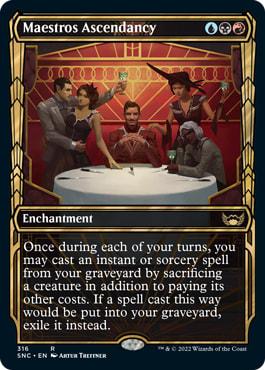
The Maestros were already themed around contract killing, disposable underlings, and turning death into profit, so converting creatures directly into spell copies was not just mechanically sound but narratively irresistible. Instead of tapping two creatures and checking colors, the new design simply asked for a single creature of sufficient power and a willingness to see it die for the cause. One sacrifice = One extra spell. Clean, brutal, efficient.
Casualty Rulings

The Basic Reality of Paying Casualty
Let's start with the more practical rulings.
- You may sacrifice only one creature per casualty ability. Remember, Casualty 2 does not mean two creatures. It means one creature with power 2 or greater.
- Paying casualty is optional. You can always cast the spell without paying its Casualty cost and keep your creature alive, if you're feeling particularly sentimental that day.
- If you choose to pay the Casualty cost, the creature is sacrificed while casting the spell, not later. By the time anyone can respond, the chosen creature is already swimming with the fishes.
Stack Order: What Resolves First?
This is one of the more common questions, and the answer is delightfully consistent with how most other Magic mechanics work.
The Casualty copy always resolves before the original spell.
The copy will be placed on the stack on top of the original, so it will resolve first.
Is the Casualty Copy "Cast"?
No. And this distinction often matters more than you'd think.
The copy is created directly on the stack. It is not cast. Which means -
- Abilities that trigger "when you cast a spell" do not trigger.
- Storm count does not increase.
- Magecraft still triggers, but only because it cares about spells being copied or cast.
Variable Casualty (Of Course, Ob Nixilis Gets Special Privileges)
Most Casualty cards use Casualty N, where N is a printed number.
However, Ob Nixilis, the Adversary, uses Casualty X.

So, when casting Ob Nixilis, the Adversary -
- You choose the value of X.
- Then you may sacrifice a creature with power equal to X.
- That chosen value is locked in for the spell.
- You then create an additional copy of Ob Nixilis, the Adversary that isn't legendary and has starting loyalty X.
What If the Original Spell Is Countered?
Good news for all you criminals everywhere: The copy still resolves.
Once the casualty cost is paid and the triggered ability creates the copy, the copy exists independently on the stack. Countering the original spell does not retroactively undo the murder you already committed.
But Can You Counter the Copy?
Absolutely.
The copy is a spell on the stack, so just like any other spell:
- It can be Counterspell'd.
- It can be Deflecting Swat'd.
- It can be Unsubstantiate'd.
Casualty, The Cost Of Doing Business
Casualty is the kind of mechanic that perfectly captures why Magic design continues to work even after three decades. It is simple on its surface, rich in its interactions, and dripping with enough flavor to stain our playmats.
From a design standpoint, Casualty is nothing short of a Christmas miracle. It worked in Limited without breaking formats. It scaled naturally into Commander without becoming oppressive. It rewarded thoughtful sequencing, proper threat assessment, and a willingness to part with your own pieces for greater gain. And not to mention, it gave aristocrats decks yet another reason to exist, spellslinger decks another reason to laugh in Storm, and Grixis players the world over another excuse to explain, again, that they are not degenerates, but merely efficient.
So, will Casualty return someday on another plane, in another crime syndicate, another cabal, another suspiciously well-dressed murder club? Maybe. Maybe not. If you've been keeping up with my segments, Magic is nothing if not unpredictable. But even if it never does, I feel Casualty has already earned its place in the long, strange lineage of mechanics that players point to and say, "Yeah. That one's pretty good."
And with that, I think I've sacrificed enough of your time to satisfy even the most demanding Maestros' contract. As always, happy brewing, may your sac fodder always be expendable, your spells and their copies resolve before your opponents find their 1-of Summary Dismissal, and your sacrifices be remembered not as losses, but as investments. Until next time, and always remember: if a spell is worth casting, it's worth casting twice.