



 Locations



Some mechanics in Magic wear their versatility and strength on their sleeves. For example, Storm, more times than not, will often announce to the table, "I'm going to end this game as soon as I cast these 20 spells first." Meanwhile, Overload screams, "Why stop at just one target when I can have them all at an absurd mana cost?" And then there's Replicate, the mechanic that looks as if these two mechanics had a love child, and that's what we're going to be exploring in today's Mechanics Overview Segment.
What Is Replicate?
Replicate [cost] (When you cast this spell, copy it for each time you paid its Replicate cost. You may choose new targets for the copies.)

Mechanically speaking, Replicate is a keyword ability that lets you pay a "Replicate cost" as an additional cost when you cast a spell. So, this means every time you pay that cost, you get a copy of the spell on the stack:
- Cast the spell.
- Decide how many times you want to pay the Replicate cost.
- Get that many copies of said spell.
As clarified by the reminder text, each copy can have its own targets if the spell targets something. So, this means that with enough mana, a single copy of Pyromatics can, in theory, shoot all 10 of your opponent's 1/1 Warrior Tokens and their face for 20 damage all for the low, low price of 60 mana! What a bargain!
The History of Replicate
Replicate first came onto the scene in Guildpact (2006), the second set of the original Ravnica block. And really, could it have gone to anyone but the Izzet League?

In its debut, the design was tight and symmetrical: Nine Replicate cards, all with Replicate costs equal to their mana costs, plus one enabler, Djinn Illuminatus, who gleefully handed Replicate out to any spell you cast.
After Guildpact, though, Replicate all but disappeared aside from being special guests in non-standard sets like Modern Horizons and Commander sets like New Capenna Commander (2022).

The Rules of Replicate (and Why Some People Get Confused)
Replicate really looks like a mechanic you can explain in a sentence: "Pay extra mana, make extra copies." And that's true, but, as you probably know by now, the devil always lives within the Comprehensive Rules. For example, according to the latest rules update, did you know that Replicate is actually two different abilities working in tandem? That's right; Replicate is both:
A static ability. This functions while the Replicate spell is on the stack, letting you pay the Replicate cost as many times as you want.
And
A triggered ability. When you cast the Replicate spell, the game checks how many times you paid that Replicate cost, then creates that many copies and puts them on the stack.
Is this confusing? Maybe a little bit. But that's why I'm here. Let's break down some of the most common misconceptions together.
"Replicate Copies Count As Casting."
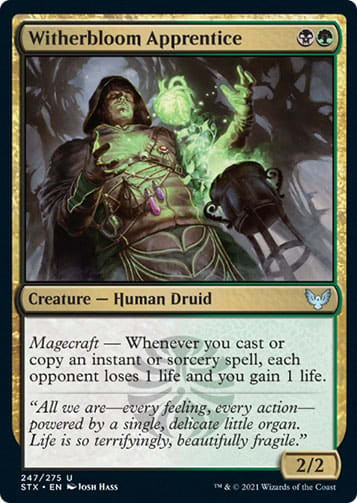
Nope. Only the original Replicate spell is cast. Copies are just copies. So, naturally, this means your Niv-Mizzet, Parun isn't drawing you twenty cards off a Replicate spell. Sorry. A Magecraft card like Witherbloom Apprentice, however...
"Replicate Copies Can Replicate Themselves."
They really can't. Yes, the words are technically printed on the copied spell, but since the copies are not cast, there's no window to pay the Replicate cost again.
"Replicate Is Just Storm/Rebound/Kicker With Extra Steps."
Yes, I know, I know. "Everything is Kicker, tee-hee-hee!" But let's think about it all like this: Storm counts spells cast during a turn, then makes additional free copies based on the amount. Rebound delays an additional free casting of the spell until your upkeep. And Kicker upgrades your spell, often by a significant margin, as it's cast if you decide to sink more mana into it. Replicate, on the other hand, is inherently less efficient than all of these other mechanics. You sink mana into a Replicate spell and get additional copies of an often less-than-optimal effect. There, do you see the difference now?!
Copy That, Replicate This

Unlike Storm, which has an undisputed reputation for degeneracy, or Rebound, which begs you to squeeze every ounce of value out of your delayed spells, Replicate is refreshingly honest. It doesn't give you anything for free, nor does it rarely provide you with a significant advantage when you do get to sink a lot of mana into it. Replicate simply asks of you, "How much mana do you got?" The more mana you throw in, the bigger and splashier the result. It's fair.
And that's really the takeaway of this article: Replicate is much less about "breaking the game" and more about breaking expectations. It's the kind of mechanic that makes you feel clever when you use it well, that rewards creativity, and that lets you tell great stories after the game. Because let's be honest. No one ever remembers your twentieth Lightning Bolt in a game. But everyone remembers the time you Replicated Shattering Spree five times against the Affinity player.
With all that said, I've probably already Replicated more words than most players have mana for, so I'll cut it off here before I start demanding a Storm count for your attention. As always, happy brewing, and may your mana pools be deep, your Replicate triggers never Stifled, and your playgroup never realize how deep the stack has gotten until it's far too late. Until next time, keep copying responsibly.