


 Locations



So you like graveyard shenanigans in your Magic, huh? Maybe you're the kind of player who gets just a little too excited when someone casts a board wipe. Or maybe you just want to watch your creature die, mummify it, and send it back into battle like it's the loyal protector of King Ahkmenrah from Night of the Museum (Did I age myself accordingly with this reference?). Whatever the reason, in today's Mechanics Overview Segment, let me introduce you to the elegant, mildly glorifying, and totally flavorful keyword from Amonkhet: Embalm.
What Is Embalm?
Embalm [cost] ([Cost], Exile this card from your graveyard: Create a token that's a copy of it, except it's a white Zombie ... with no mana cost. Embalm only as a sorcery.)
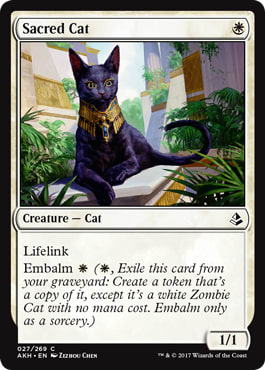
Embalm is a keyword ability that can only be activated, at sorcery speed, while the Embalm creature is in your graveyard. When you pay the Embalm cost, you exile the original card from your graveyard and, in return, create a token copy of it on the battlefield. But it is important to note that your creature doesn't exactly come back the same.
For the low, low price of exiling and Embalming your creature, your creature becomes:
- White color identity, no matter what color it was before.
- A Zombie, in addition to its other creature types.
- And, last but not least, a no mana cost creature, which can be super detrimental against cards like Fatal Push, which was, without a doubt, one of the best, if not the best, removal spells in Standard at the time.
The History of Embalm
Amonkhet, thematically, is a plane obsessed with the afterlife, but not in the "peaceful rest" sense. More in the "train your whole life so you can die gloriously, pass the Five Trials, and achieve a super-exclusive VIP afterlife club membership" sense. And as part of that culture, the people of Amonkhet treat the preparation of bodies with reverence.
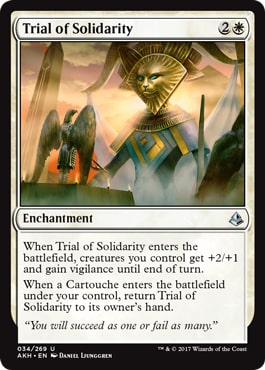
Mechanically speaking, Embalm captured this idea beautifully. Your creatures lived, fought, and (inevitably) died, but their purpose wasn't over. You could still call upon them, reborn as regal, bandage-wrapped servants with a sacred glow and an overgrowing sense of duty about them.
Across Amonkhet (2017), there was a modest amount, 15 to be precise, of Embalm cards, mostly in White and Blue, the colors most aligned with order, ritual, and devotion. And as you saw with Sacred Cat earlier, each one came with its own pre-printed mummy token, reinforcing that Wizards wanted this mechanic to feel not only mechanically novel, but visually special.
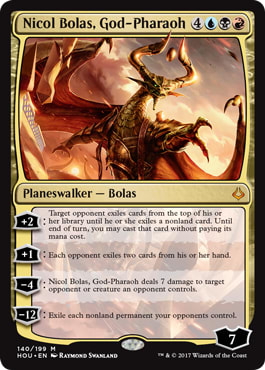
But then, without warning, Hour of Devastation (2017) happened, and the vibes weren't so good or respectful anymore. Nicol Bolas showed up and flipped the entire cosmology of Amonkhet on its head. Suddenly, the rituals of rebirth weren't sacred; they were weaponized. The afterlife was no longer a reward but rather an assembly line for his undead army. And from that narrative twist came Embalm's meaner, darker counterpart: Eternalize.
While Embalm was elegant and bespoke, Eternalize was industrial. Embalm created token copies with the same stats. Eternalize standardized everything to a 4/4 black Zombie. Narratively, one could say Embalm represented the people's belief system, while Eternalize represented Bolas shattering that system and repurposing it for war.

Embalm Vs. Other Reanimation Mechanics
As you probably know by now, Magic has no shortage of mechanics that let your creatures claw their way back into the world of the living. But each of these mechanics has its respective personalities, and Embalm fits into this ecosystem like the quiet nerd at the undead party who thought it'd be a good idea to bring detailed resurrection instructions. Let's break down the competition.
| Mechanic | How It Returns a Creature | What Makes It Different From Embalm |
| Unearth | Returns the creature for one turn with Haste, then exiles it. | Temporary return; no long-term board presence; maintains original color and type; emphasizes aggression instead of recursion value. |
| Disturb | Returns as the card's back face. | Card is recast from the graveyard; creature can change abilities, type, and sometimes, even P/T; no token creation; more transformative than Embalm. |
| Eternalize | Exile the creature from the grave to create a 4/4 black Zombie token copy that keeps its abilities. | Returns as a fixed-size 4/4; always black; overwrites original stats; more uniform and aggressive than Embalm. |
| Escape | Casts the creature from your graveyard by exiling other cards. Permanent return. | Still requires casting; demands multiple cards exiled as fuel; no token or aesthetic changes; often harsher resource cost. |
| Basic Recursion (Reanimate, Return Effects) | Returns the original card to the battlefield. | No token; no modifications; typically cheaper or more flexible; lacks the utterly flavorful cosmetic and mechanical alterations of Embalm. |
Let's Wrap It Up (Teehee)
Embalm doesn't combo off at lightning speed, it doesn't produce infinite loops, and it certainly won't ever make cEDH tables tremble unless someone is genuinely terrified of a 1/1 Sacred cat coming back from the graveyard. But what Embalm does do, and does brilliantly, is deliver an intoxicating blend of flavor, functionality, and thematic resonance that few mechanics can match.
It gives you value, but not so much that it warps the game. It offers recursion, but not so efficiently that it breaks formats in half. Instead, Embalm encourages a slower, more thoughtful style of play, the kind where you don't just throw your creatures onto the battlefield like cannon fodder, but actually consider how their second life might shape the next part of the game.
Will we ever see Embalm again? That's a big ol' maybe for now, I'd say. Wizards have made it abundantly clear that tightly flavored mechanics often stay married to their home plane, but the future is full of possibilities. And before you say anything, for the record, I don't consider Aetherdrift (2025) to be a proper return to Amonkhet, but that might just be a me thing.

I see a mummy, but I see no traces of my beloved AKH/HOU mechanics!
Anyways, I've probably Embalmed more words into this than even the most dedicated vizier could wrap in linen, so it's probably time to lay this discussion to rest...for now. As always, happy brewing, and may your opponents never forget the exact moment they learned why you're running every embalm card ever printed, proudly laying out your Embalm tokens, and casually self-milling a suspiciously well-prepared Vizier of Many Faces. Until next time.