 Locations


Ever wished your lazy creatures could help you cast your spells, but for some reason you don't want to play Elves? Whatever, that's your business, but Convoke is here to answer your cries. Its reminder text says this: "Your creatures can help cast this spell. Each creature you tap while casting this spell pays for {1} or one mana of that creature's color."
What all of that means, effectively, is that you can tap any creature for one mana towards a spell with convoke. Now all your creatures are elves! It's extremely versatile, and has a strong resume as both a tournament-winning mechanic and a casual table staple. Everybody loves cost reduction mechanics, and here is one where the additional cost is real.
This isn't Phyrexian mana. This is tapping real creatures that could be attacking or blocking.
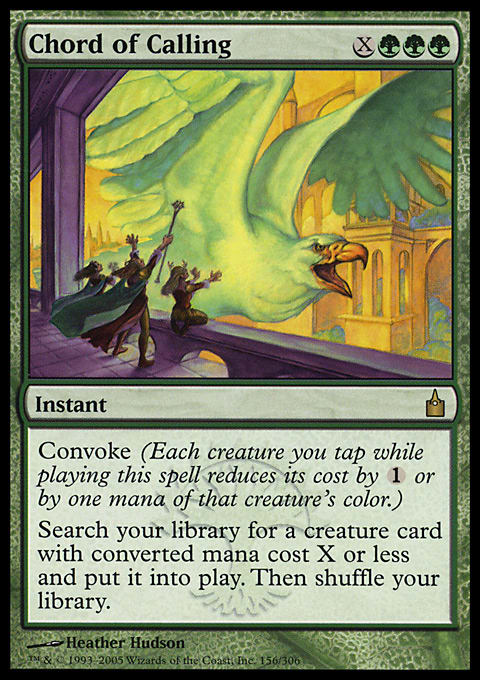
And yet, the flexibility of Convoke has always meant there are ways to make this cost more palatable. The most obvious is the fact that the marquee card for Convoke - the one that has seen play in just about every format imaginable - fetches you a creature at instant speed. I'm talking about Chord of Calling. It feels a lot less awkward to tap your creatures if it means you're putting a big blocker into play. But do you know what feels even better? Putting your final combo piece into play on your opponent's end step.
Yeah, Chord of Calling does it all; from extremely fair to Yawgmoth, Thran Physician (or even Melira in my day). But a mechanic can't be judged only on its best cards.
At time of writing, here are 99 cards with Convoke in the text box, according to Scryfall, and a big chunk of those have seen serious play. Many others have been decent limited cards. Almost none of them have been unplayable. Even a generic combat trick like Aerial Boost gets a... boost... from being free to cast, in the right circumstances.
That flexibility really goes a long way to making otherwise ordinary cards pretty good. The most obvious application is something like Autochton Wurm from the mechanic's debut set, Ravnica: City of Guilds. It's a great way to turn your little tokens and Elves into a huge game-ending monster. But even in terms of game-ending reach, there are other ways to apply Convoke that don't require getting into combat. Stoke The Flames is an excellent way to end a game when your little red creatures are struggling to attack through blockers.
What if you're not interested in ending the game quickly, though? Conclave Tribunal can help you out no matter what your game plan. It can be used to remove a big blocker but it can also be used to remove a big attacker and help to keep you alive. There are multiple removal spells with Convoke, and while most of them have been limited to, er, limited, a few - like Conclave Tribunal - have seen constructed play as well.
And then we get to the really out-there Convoke cards, and the cards that care about Convoke. Everything Comes to Dust is one of the weirder sweepers out there, but the chance to be a White Plague Wind is nothing to be sniffed at. Similarly, Lethal Scheme is an excellent way to add some value to your removal suite in Commander. Zephyr Singer is a really nice payoff for playing some creatures in your Blue deck.
There are several cards that give other cards Convoke, too. Invasion of Segovia is a fun one, but Wand of the Worldsoul might be the most interesting. Is it worth playing a tapped Manalith that only taps for one color if it means your future spells can be made way cheaper? Over 22,000 decks on EDHREC seem to think so, but either way, it's an interesting puzzle.
Finally, we can't talk about Convoke without discussing Sprout Swarm. Convoke is a great mechanic for asking players to solve a puzzle. How do you make Overwhelm good while also making it cheap? Can I afford to skip a combat step in order to pump my team with Venerated Loxodon? Meanwhile, Sprout Swarm asks a very different question: what were the designers thinking?
Sprout Swarm can quite literally win games by itself. At common. In Limited, it was so good that they chose to leave the card out of Time Spiral Remastered altogether. It was one of the earliest cuts from my own common/uncommon cube, back when it was just a pile of good cards. Its stale gameplay of turning Convoke into Epic without the downside was a cautionary tale. Nowadays, we don't really get repeatable Convoke spells, and this card is why.
Still, it goes to show just how many applications Convoke has. You can combine it with a swathe of other key words and it will probably do something interesting. Sprout Swarm just stands as a reminder that designers do need to be careful exactly what they combine Convoke with, because that malleability can go too far.