


 Locations



The Magic community is much abuzz about Secrets of Strixhaven. Content creators are racing to post videos of SOS Drafts as well as Standard decks that utilize the set's most powerful cards. The prepared mechanic is especially making waves, enabling players to jam some of Magic's most iconic Alpha cards in their matches.
One new card has made a much quieter, though not completely overlooked splash. That card is Diary of Dreams, a two-mana Uncommon Artifact that plays well in Prismari-based spell decks.
 |
Note That Type Line: Artifact - Book
You may be wondering what makes Diary of Dreams, an unassuming uncommon, stand out from a large set of 305 cards. It all boils down to the card's type line: Artifact - Book.
How is this different from other Artifact type lines? On many Artifact cards throughout the game's history, there has been no subtype. A card is simply printed with the type line: Artifact.
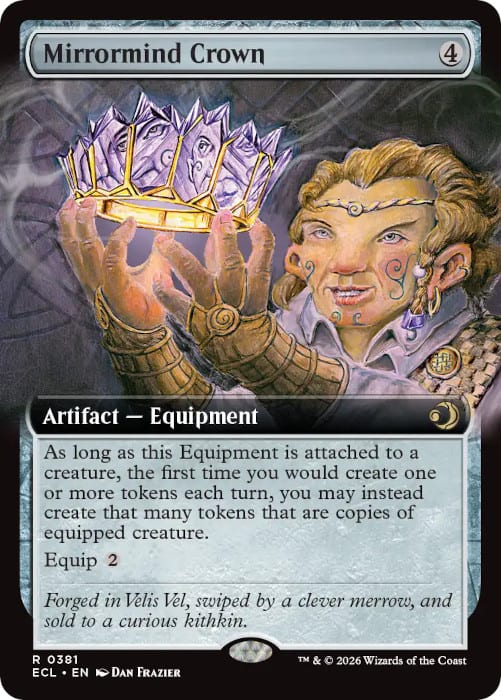
There are exceptions, of course. Equipment is an Artifact subtype. Vehicle is another. These subtype names help define a card's function in a game of Magic. When you see Artifact - Equipment on a card, you know the Artifact will have an equip cost and be attachable to a Creature. Likewise, an Artifact - Vehicle printed on a card tells us immediately the Artifact can become a Creature through some sort of crew activation.
 |  |
Additionally, there are Artifact tokens with subtypes that provide a well-understood, consistent activated ability. These tokens include Treasure, Map, Blood, Clue, Mutagen, and Food. If you've been playing Magic for at least a few years, you can probably readily describe what each of these Artifacts do. What's more, when a new card is printed with the Food subtype, we know that it'll include the two-mana activated ability to sacrifice and gain three life.
 |
What does the subtype "Book" imply in a game of Magic? There's no obvious answer to this question. Seeing as this was the first card ever to be printed with the Book subtype, one could speculate that every future Book card will share an effect in common with Diary of Dreams. For example, every future Book card could collect counters when you play Instants or Sorceries or have an activated ability to draw cards that diminishes in cost for each page counter.
There's one problem with these assumptions. Wizards of the Coast retroactively updated over 40 cards to include the Book subtype, meaning Diary of Dreams is not technically the first book Artifact card to be printed. It's more like the 45th.
Noteworthy Books
The new book subtype had rippling effects in the official Magic rules, updating dozens of past cards to contain this new book subtype. These changes go all the way back to the very first set, Alpha, and Jayemdae Tome.
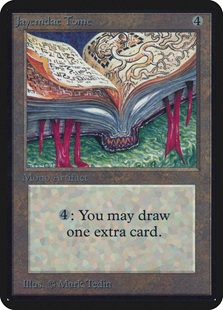 |
The original book was a simple, powerful (for its time), four-mana Artifact that could be activated for four more mana to draw a card. Note the old formatting - Jayemdae Tome is printed in Alpha as a Mono Artifact, simply meaning it requires tapping to activate.
Suffice it to say, Jayemdae Tome and Diary of Dreams both have something in common: they have an activated ability to draw a card. The reality is, many Book cards share this ability.
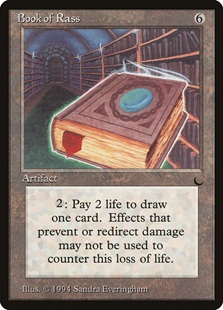 | 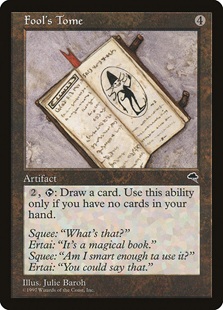 |  |
Book of Rass (one of my favorite arts from The Dark), Fool's Tome, and Illuminated Folio are all examples of Book Artifacts that draw cards upon activation. In Book of Rass, you can activate the effect repeatedly, but the cost is  mana and two life. In Fool's Tome the activation cost is half price - only mana - but requires you to be Hellbent (no cards in hand) to use. Illuminated Folio costs just
  mana to activate, but requires you reveal two cards from your hand that share a color in order to draw the card. The possibilities are endless.
Based on these examples alone, you may jump to the conclusion that all books draw you cards. It's true that most of them do. Unfortunately, there are a few counterexamples that discredit this hypothesis. Consider, as two examples, Sarpadian Empires, Vol. VII and The Book of Exalted Deeds.
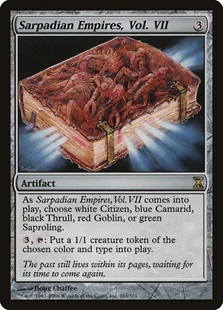 | 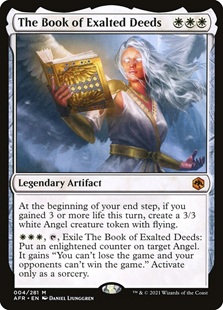 |
Here we have two examples, fifteen years apart in age, with abilities completely unrelated to drawing cards. In the former, you have a Artifact - Book with an activated ability that creates 1/1 Creature tokens of a specified type. In the latter, you have a Legendary Artifact - Book with a static ability that creates 3/3 Angel tokens and an activated ability that turns an angel into a Platinum Angel of sorts (you can't lose the game and your opponents can't win the game).
What do these two Book cards have to do with drawing cards? Absolutely nothing, which flies in the face of the "all Book Artifacts draw cards" theory.
Perhaps Wizards intends to take it one step broader, and imply that an Artifact - Book, by definition, contains an activated ability. Every example I've touched upon so far would fall into this category, after all.
I see two problems with this theory. First, many non-book Artifacts have activated abilities, meaning that the addition of the book subtype wouldn't add any unique identifier. If Books and non-Books can have activated abilities, then clearly this delineation is superfluous at best. Second, there are once again exceptions even to this generalization about books.
 | 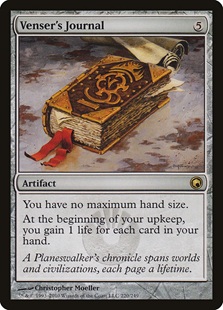 |
Spellbook, originally from Exodus, and Scars of Mirrodin's Venser's Journal are both clearly Book Artifacts. You can't argue with that fact, and both received the updated book subtype. Yet neither of these cards draw you cards nor do they have activated abilities. Both contain a static ability (no maximum hand size) and Venser's Journal has a triggered ability during upkeep. Both cards break the consistency of books containing activated abilities. We must search elsewhere.
Then there are the truly incongruous Book cards, which at face value could have been any other object with magical abilities. I'm talking about cards like River Song's Diary and Summoner's Grimoire.
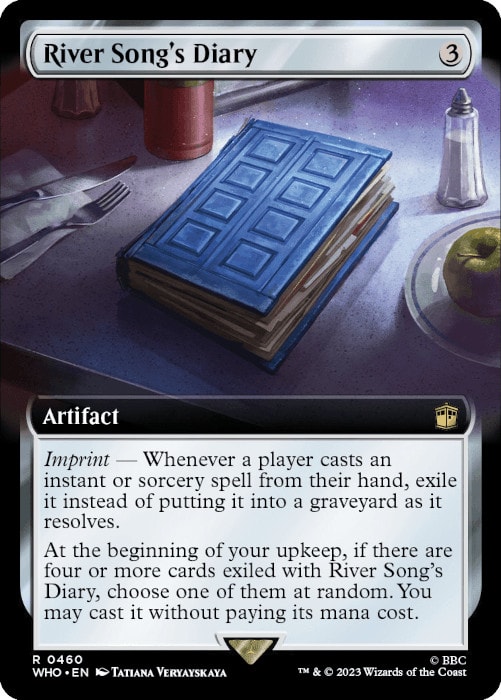 |  |
These appear to be top-down card designs. Wizards of the Coast wanted to include books from Dr. Who and Final Fantasy IP, and fit them into the game rules however it made sense to them. These books have no consistency with other historical book cards in Magic.
Forward Looking Hypotheses
A review of previous Book Artifacts indicates no clear rules-based commonality associated with this subtype. Perhaps the formalization of the Book subtype implies something to come. This is certainly a possibility, worth exploring.
While a card with the Book subtype won't automatically contain a common ability (e.g., drawing cards), it's possible that future cards will refer to the Book subtype. For example, cards could be printed that check for number of Books you have in play. Perhaps a librarian Creature will be printed with an ability that activates whenever a Book comes into play. In other words, other cards could be printed with "Books matter" themes, much akin to Creature type synergies we see today.

Taking it one step further, the creation of the Book subtype could be the beginning of a broader plan to apply subtypes to all Artifacts. All Creatures have subtypes (well, besides Nameless Race), so maybe all Artifacts will eventually have subtypes as well. This wouldn't imply immediate plans to harmonize rule sets. Rather, adding subtypes to Artifacts is a way of expanding creative space in an otherwise underexplored aspect of the game. Perhaps we'll see other subtypes emerge going forward, such as flower (Black Lotus, Lotus Bloom, etc.), Jewel (Moxes, Jeweled Amulet, etc.), and orb (Winter Orb, Zuran Orb, Chaos Orb, etc.).
With explicit Artifact subtypes, the design space Wizards of the Coast visits repeatedly associated with typal themes could be reapplied to Artifacts. This is my favorite theory thus far; credit to vibranttoucan for sharing this idea on the r/magicTCG subreddit.
The other reason Wizards of the Coast created the Book subtype could be for strictly flavor reasons. If the Artifact looks like a book and feels like a book, why not call it a "Book" in the official rules? Other than having to retroactively update dozens of previous cards - something done with some keystrokes in digital form - are there any downsides to creating the Book subtype? Perhaps the motivation to create the subtype is strictly flavor-driven, with unclear plans on how this could be activated via rules in the future.
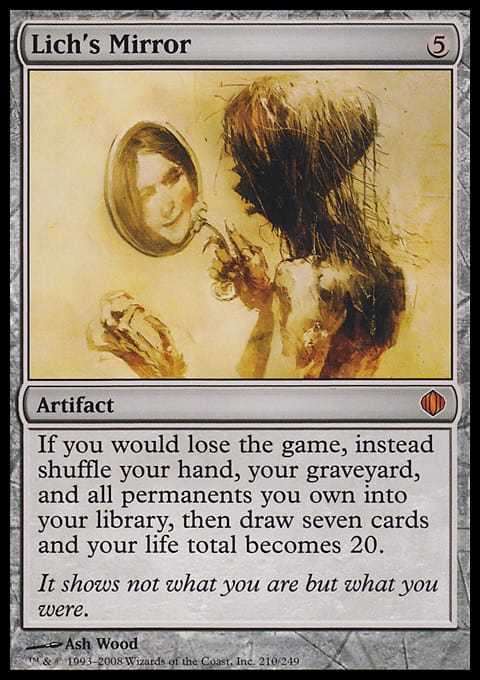
If the future state is that Panoptic Mirror, Mirror Universe, and Lich's Mirror are all "Artifact - Mirror" cards, what's the harm in that?
 |  |  |
Most likely, Wizards of the Coast will slowly introduce other Artifact subtypes for flavor reasons, leaving the door open for Artifact typal exploration in a future set.
Wrapping It Up
Artifact subtypes are nothing new in Magic. They've been around for years, ever since the advent of Equipment in 2003. Since then, we've seen a wide array of subtypes emerge: Fortification (2007), Gold (2008), Vehicle (2016), Clue (2016), Contraption (2017), Treasure (2017), Food (2019), Key (2019), Blood (2021), Attraction (2022), Powerstone (2022), Incubator (2023), Map (2023), Bobblehead (2024), Hat (2024), Junk (2024), Scrap (2024), Scythe (2024), and Spacecraft (2025).
Many of these subtypes are associated with "Acorn sets" that are not tournament legal. I lost count of how many times silver-bordered concepts made it into tournament-legal Magic. The advent of flavorful Artifact subtypes could be the latest instance of this. From a flavor standpoint, the idea makes sense and is a slam-dunk concept worth exploring further.
From a rules standpoint, it's a little unclear yet how Wizards of the Coast could utilize proliferous Artifact subtypes. For now, they sprinkle a bit of flavor onto a card. In the future, entire mechanics could center around various Artifact subtypes. Set designers have tapped into Creature typal themes multiple times over the years for their inspiration - an Artifact typal set seems like a natural evolution once the groundwork is set.
Thus, my boldest prediction is this: by 2030, we'll see a set that contains heavy focus on Artifact subtypes. Such a set would brilliantly combine the flavor of Artifact subtypes, such as Books, and typal themes and mechanics, a popular theme Wizards of the Coast has used for multiple set designs. Perhaps a return to Artifact-centric Avishkar, formerly Kaladesh, will explore this design space.